
Hotel Security Management

Effective hotel security management is a risk-based, property-specific program that combines written threat and vulnerability assessments, trained personnel, integrated technology, and tested emergency plans. The verdict is straightforward: hire a vetted professional provider to design, staff, and govern the program from day one. Attempting to patch together coverage reactively creates costly gaps and leaves your property, guests, and staff exposed.
Your program must include, at minimum:
- A written risk assessment completed within the first 30 days
- Documented emergency plans covering active shooter, fire, medical emergencies, bomb threats, and human trafficking indicators
- Licensed, insured, and bonded guard staff with hospitality-specific training
- Integrated access control and CCTV tied directly into guard operations
- Quarterly program reviews with measurable KPIs
Pro Tip: Require a written threat-and-vulnerability intake within the first 30 days of contract execution, with a signed SLA specifying corrective action timelines for every finding.
Table of Contents
- What should a hotel security program actually cover?
- How a property-specific risk assessment is performed
- What staffing model does your property actually need?

- How should technology and human vigilance work together?
- What scenarios must your emergency plan cover?
- What should your security contract include?
- What does a realistic onboarding timeline look like?
- What compliance and licensing checks must you complete?
- Key Takeaways
- What sets a partnership-driven approach apart
- Ready to build a security program your property can rely on?
- Authoritative sources used in this guide
What should a hotel security program actually cover?
The scope of a well-built program goes well beyond guards at the front entrance. A complete program addresses property-wide risk assessment, physical and cyber asset protection (including your Property Management System), staffing models for every coverage zone, event and guest-area security, parking and perimeter control, access control, CCTV and video analytics, master-key management, and post-incident investigations.

Deliverables your provider must hand you in writing include: a risk assessment report with a prioritized remediation plan and cost estimates, a formal emergency response plan with standard operating procedures, a training curriculum and drill schedule, an incident reporting format, and a KPI dashboard you can review monthly.
Decide up front what falls outside the vendor’s scope. Housekeeping-led watch duties, brand-standard disclosure restrictions, and camera-location confidentiality are common exclusions that must be documented before the contract is signed.
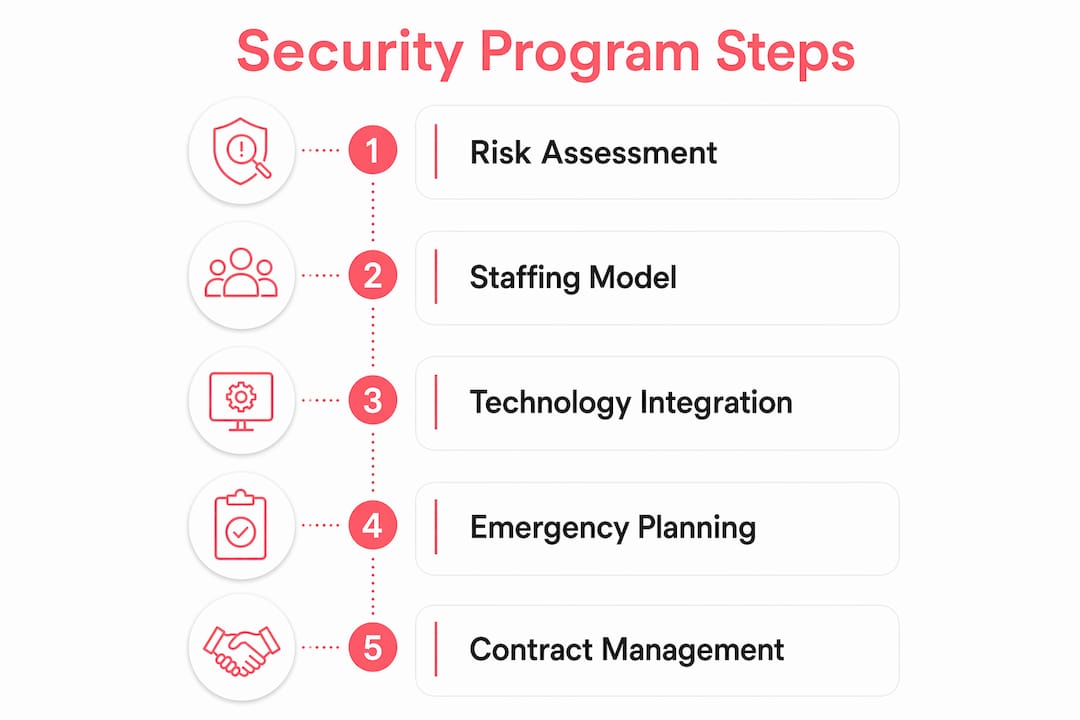
How a property-specific risk assessment is performed
Assessments are customized studies, not pass/fail audits. AHLA and OSAC are explicit: there are no universal audit standards for U.S. hotel security, which means every assessment must reflect the property’s specific threat profile, vulnerabilities, and operational context.
A credible assessment follows this sequence:
- Stakeholder interviews with department heads, front desk, housekeeping, and engineering
- Site walk with cross-department participation to map every access point and coverage gap
- Perimeter and access audit covering all entry/exit points, parking, and service corridors
- PMS and network review for role-based access and segmentation risks
- Key control inventory to identify unsecured master keys and unauthorized access patterns
- Personnel and contractor vetting review
- Event-space threat modeling for recurring or high-profile gatherings
Common findings include CCTV blind spots, unsecured master keys, PMS access risks, staffing gaps during peak arrivals, and high-risk event scenarios that lack dedicated coverage plans.
In one anonymized engagement, a mid-size hotel’s assessment revealed that master keys were stored in an unlocked drawer accessible to non-security staff, and that two CCTV cameras covering the service entrance had been offline for months. Prioritizing key-control upgrades and guard repositioning closed the highest-risk gaps within 45 days.
What staffing model does your property actually need?
Staffing decisions should be driven by risk level, occupancy patterns, special events, and state licensing requirements, not a flat headcount. A 200-room urban property hosting weekend events has a fundamentally different risk profile than a 60-room suburban extended-stay.
Hotel Security Management
| Role | Primary Function | Typical Coverage Pattern |
|---|---|---|
| Concierge liaison officer | Guest-facing deterrence and access control | Lobby, peak check-in/out hours |
| Roving patrol officer | Perimeter, parking, and floor sweeps | mobile |
| Static post officer | Fixed-point access control | Entry points, restricted areas |
| Supervisor/shift lead | Oversight, escalation, incident command | Each shift |
| Investigations liaison | Post-incident documentation and follow-up | On-call or contracted |
| Executive protection officer | Close protection for VIP guests | Event-driven or ongoing |
| Event-detail officer | Crowd management, access screening | Event-specific surge |
To estimate required guard-hours, multiply your average nightly occupied rooms by an appropriate threat-level multiplier to estimate guard-hours, then add event-surge hours from your calendar. That calculation gives you a baseline for your RFP.
Pro Tip: Require all contracted personnel to carry proof of state security licensing, current insurance certificates, and completed background checks before their first shift. Hospitality-focused customer service training and incident-reporting proficiency are non-negotiable additions to any staffing spec.
How should technology and human vigilance work together?
Technology reduces risk and enables your staff. It does not replace them. The most effective hospitality security programs integrate CCTV, access control, analytics, duress alerts, and a hardened PMS into daily SOPs, with trained personnel acting on what the technology surfaces.
Critical technology priorities for U.S. hotels:
- PMS security: Role-based access control, network segmentation, and privileged-access management are the highest-priority cyber controls for hospitality environments.
- CCTV coverage mapping: Eliminate blind spots in service corridors, parking structures, and elevator lobbies. Verify camera health on a scheduled basis.
- Tamper-resistant key control systems: Key cabinets with access logging reduce hand-offs and improve auditability for master keys and portable assets.
- Duress alert systems: Install in guest rooms, behind the front desk, and in back-of-house areas.
What scenarios must your emergency plan cover Hotel Security Management?
The emergency plan must address active shooter, bomb threats and suspicious packages, natural disasters, fire, medical emergencies, human trafficking indicators, and mass-casualty coordination. The DHS Protective Measures Guide for the U.S. Lodging Industry also recommends routine coordination with local first responders and regular exercises.
Exercise cadence your contract must specify:
- Tabletop exercises with department heads, at minimum twice per year
- Functional drills testing specific SOPs (evacuation, lockdown, medical response), at least annually
- Full-scale multiagency exercises with local law enforcement and fire, at least once per program cycle
- Annual plan review with updates reflecting any property changes, staffing shifts, or new threat intelligence
After every drill or real incident, require a written after-action report (AAR) that includes a timeline of events, identified gaps, assigned corrective actions with responsible owners, and a verification date for each fix. Plans should be stored in protected but accessible locations for authorized staff and first responders, per AHLA/OSAC guidance.
What should your security contract include?
Pricing is driven by labor (hourly rates for unarmed vs. armed officers), supervision ratios, specialized skills such as executive protection, background-screening depth, and insurance and indemnity requirements. For a detailed breakdown of what moves the number, see security guard pricing factors.
Contract must-haves:
- Detailed scope of work with coverage zones and hours
- SLAs for response time and incident closure
- Staffing matrix with role definitions and licensing requirements
- Training requirements and completion-rate minimums
- Insurance limits and indemnification language
- Confidentiality clauses covering camera locations and SOPs
- Background-check standards (state, federal, and sex-offender registry at minimum)
- Termination rights with notice periods
KPIs to demand in writing:
- Average guard response time to reported incidents
- Incident rate per 1,000 occupied room-nights
- Training completion rate (target full completion before deployment)
- Corrective-action closure time from AAR findings
- Client satisfaction score from monthly check-ins
Watch for hidden fees: mobilization charges, overtime premiums during events, specialized equipment rental, and additional background-check fees for replacements. Require full-cost transparency in the proposal.
What does a realistic onboarding timeline look like?
Basic operational readiness typically runs 30–90 days from contract signing. Full program maturity, including completed drills and a functioning KPI dashboard, generally takes several months.
| Milestone | Owner | Verification Artifact |
|---|---|---|
| Intake and contract signing | Client + provider | Signed contract, scope of work |
| On-site assessment | Provider | Written assessment report |
| Remediation plan approval | Client | Approved budget and priority list |
| Equipment procurement and integration | Provider + client IT | Installation records, system test logs |
| Staff hiring, licensing verification, training | Provider | Training logs, license copies |
| SOP publishing | Provider | Signed SOP acknowledgments |
| First tabletop drill | Both | After-action report |
| KPI dashboard go-live | Provider | First monthly report |
For properties that require backup power for security operations centers, emergency power planning should be addressed during equipment procurement, not after go-live.
What compliance and licensing checks must you complete?
Compliance is jurisdictional. Every U.S. state has its own security guard licensing requirements, and armed officer licensing is more stringent still. Require proof of active state licensure, current insurance certificates, and bonding documentation before deployment of any officer.
Practical compliance checklist:
- Verify active state security guard licenses for every officer assigned to your property
- Confirm armed officer licensing separately, including firearms qualification records
- Request certificates of insurance showing general liability, workers’ compensation, and professional liability minimums
- Confirm vendor controls over any subcontractors (subcontractors must meet the same licensing and background-check standards)

- Include confidentiality clauses covering camera locations, access control configurations, and SOP details
- Align SOPs with your brand standards and any franchisor security requirements
The NFPA 730 Guide for Premises Security covers administrative controls, perimeter security, and security systems for lodging properties and is a useful baseline reference for your internal compliance review.
Key Takeaways
A well-run hotel security program requires a written risk assessment, documented emergency plans, licensed personnel, integrated technology, and quarterly reviews, all governed by a contract with measurable KPIs.
| Point | Details |
|---|---|
| Start with a written assessment | Require a property-specific threat and vulnerability report within 30 days of contract signing. |
| Emergency plans must be tested | Schedule a tabletop drill within 60 days of go-live and a full-scale exercise within the first program year. |
| Contracts need measurable KPIs | Demand response time, incident rate per 1,000 room-nights, and corrective-action closure time in writing. |
| Compliance is state-specific | Verify active guard licenses, insurance certificates, and bonding before any officer is deployed. |
| Hubsecurityandinvestigativegroup delivers property-specific assessments, licensed guard staffing, executive protection, and program governance for U.S. hotels. |
What sets a partnership-driven approach apart
Most hotel security programs fail not because of bad technology or insufficient headcount, but because the provider treats the engagement as a staffing transaction rather than a risk management partnership. The difference shows up in the first 30 days: a transactional vendor sends bodies; a genuine partner sends an assessor.
At Hubsecurityandinvestigativegroup, we bring over 75 years of combined law enforcement and loss prevention expertise to every hotel engagement. Our approach starts with a documented assessment of your specific threat profile, not a generic checklist. We align our staffing models and SOPs to your brand standards, your occupancy patterns, and your event calendar. The outcome is a program you can measure, not just a presence you can see.
In one recent engagement with a full-service property, repositioning patrol coverage based on assessment findings and tightening key-control protocols produced a measurable reduction in reported access incidents within the first quarter. That kind of outcome comes from treating the assessment as the foundation, not a formality.
For property managers and owners who want to review our hotel and apartment security approach before scheduling a call, that resource walks through how we tailor strategies to individual properties.
Ready to build a security program your property can rely on?
Hubsecurityandinvestigativegroup delivers the full range of services a U.S. hotel needs: property-specific security assessments, contract guard staffing (armed and unarmed), executive protection for VIP guests, post-incident investigations, event security details, and ongoing program governance. We are not a staffing agency that fills shifts. We are a security partner that builds programs.
On your first call, request a scope-of-work sample, a recent assessment executive summary, sample SOPs, licensing and insurance documentation, and two client references from comparable hotel engagements. Those five items tell you everything about whether a provider is ready to protect your property or just ready to invoice you.
Contact Hubsecurityandinvestigativegroup to schedule your initial intake call and 30-day assessment kickoff. Your guests and your ownership group deserve a program built on evidence, not assumptions.
This article provides general guidance on hotel security program design and is not a substitute for legal, regulatory, or professional security advice specific to your property and jurisdiction. Confirm current state licensing requirements and applicable regulations with the relevant authorities before contracting.
Authoritative sources used in this guide
- AHLA and OSAC Hotel Security and Safety Assessment Form: The primary U.S. framework for property-specific hotel security assessments; covers all major threat categories and confirms that no universal audit standard exists.
- DHS Protective Measures Guide for the U.S. Lodging Industry: Federal guidance on threat and vulnerability assessments, emergency planning, and coordination with local first responders for lodging properties.
- NIST SP 1800-27: Securing Hospitality Systems: Covers PMS cybersecurity controls including role-based access, network segmentation, and privileged-account management.
- DNI/NCTC Hospitality Industry Suspicious-Activity Awareness: Federal guidance on staff training for suspicious-behavior recognition; supports training cadence and role definitions.
- NFPA 730, Guide for Premises Security (2018): Covers administrative controls, perimeter security, CPTED, and security systems for lodging properties; useful for internal compliance benchmarking.
- Morse Watchmans Hotel Security Whitepaper: Industry guidance on proactive security strategy, key control, and incident reporting as program maturity indicators.
- AHLA Safe Stay Initiative: AHLA’s industry-wide safety and security framework, including links to CISA active-shooter planning templates, human trafficking training, and employee safety device programs.
Why You Should Hire Hub Security & Investigative Group for Hotel Security Management
When it comes to protecting your business, property, or event, choosing the right security partner matters. For nearly two decades, Hub  Security & Investigative Group has been the trusted name in security management across Greater Boston, offering armed and unarmed guards, executive protection, private investigations, and customized loss-prevention solutions. Founded in 2004 by former law enforcement professionals, Hub has built its reputation on discipline, discretion, and results — and that reputation now extends well beyond the city limits of Boston. From corporate offices to residential communities, and especially in the hospitality sector, Hub’s approach to Hotel Security Management has made it a go-to partner for properties that can’t afford to compromise on safety.
A Local Firm With Deep Regional Reach Hotel Security Management
Unlike national chains that sub out their staffing to unknown contractors, Hub Security is a Massachusetts-licensed private detective firm that hires, trains, and supervises its own personnel. That means every officer assigned to your property has been vetted directly by Hub’s senior staff, many of whom bring seventy-five-plus combined years of law enforcement and loss-prevention experience to the table. Whether you need mobile patrols, building security, or a coordinated investigative response, Hub Security brings big-agency capability with small-agency accountability. This is especially true for Hotel Security Management, where discretion, guest experience, and rapid incident response all have to work together seamlessly — a balance Hub has honed through years of experience protecting high-profile properties and events across the region.
Ten Cities Around Boston That Can Benefit From Hub Security
Hub’s footprint stretches across the entire Greater Boston metro area, and each community has its own unique security needs:
1. Cambridge Security — With its dense mix of universities, biotech labs, and high-rise apartments, Cambridge security demands officers who understand both academic campus protocols and corporate asset protection.
2. Somerville Security — As one of the most densely populated cities in New England, Somerville security calls for vigilant foot patrols and rapid incident response in tight urban corridors.
3. Quincy Security — With its growing waterfront development, Quincy security requires construction site protection and coordinated patrols for new residential communities.
4. Newton Security — An affluent suburb with high-value homes and businesses, Newton security benefits from Hub’s executive protection and residential patrol services.
5. Waltham Security — Home to major tech and biotech campuses, Waltham security needs access control and after-hours building patrols to protect valuable intellectual property.
6. Brookline Security — With upscale retail corridors and dense residential streets, Brookline security is well served by Hub’s uniformed foot and mobile patrol teams.
7. Medford Security — A rapidly developing city near Tufts University, Medford security benefits from event coverage and campus-adjacent patrol support.
8. Framingham Security — As a retail and commercial hub along the MetroWest corridor, Framingham security calls for loss-prevention expertise and asset-recovery investigations.
9. Lynn Security — With its busy port-adjacent commercial districts, Lynn security requires experienced officers trained to deter theft and manage high-traffic environments.
10. Woburn Security — Home to numerous corporate offices and warehouses along Route 128, Woburn security depends on reliable patrol coverage and fraud investigation support.
Hotel Security Management You Can Trust
Few environments demand more from a security team than a busy hotel. Guests, staff, VIPs, and the general public all move through the same lobbies and corridors, which is why Hotel Security Management requires a different level of training and judgment than a standard guard post. Hub’s officers have coordinated security for high-profile guests, dignitaries, and large-scale events at some of Boston’s best-known hotels and venues, blending a visible, professional presence with the discretion that hospitality clients expect. From access control and VIP arrivals to overnight patrols and emergency response, Hub’s Hotel Security Management services help properties protect guests and reputation alike.
Why Hub Stands Apart Hotel Security Management
Every one of these communities faces different challenges, but the common thread is clear: effective security management requires local knowledge, licensed professionals, and a firm that treats every client relationship as a partnership rather than a transaction. Hub Security & Investigative Group delivers exactly that — combining armed and unarmed guard services, executive protection, event security, background checks, and full investigative capabilities under one Massachusetts-licensed roof.
Get Started Today
If your business, property, or event anywhere in Greater Boston needs a security partner who understands the region and answers the phone 24/7, Hub Security & Investigative Group is ready to help. Reach out today for a no-obligation consultation and see why so many Massachusetts businesses trust Hub to protect what matters most.
Recommended for Hotel Security Management
- 1.Apartment and Hotel Security: Protecting Residents, Guests, and Property in a Dangerous World – Hub Security & Investigative Group
- Top 10 Security Mistakes Property Owners Must Avoid in 2025 – Hub Security & Investigative Group
- 1.Why Apartments Need Security: Protecting Residents, Property, and Peace of Mind – Hub Security & Investigative Group
- How Professional Security Guards Prevent Crime on Commercial Properties – Hub Security & Investigative Group