Physical Security Risk Assessment

A physical security risk assessment is a structured, site-specific evaluation that identifies threats, vulnerabilities, and consequences across your facility so you can protect people, assets, and operations before an incident forces your hand. Your immediate next steps:
- Run it in-house using the nine-step workflow and zone-by-zone checklist in this guide if your team has a trained security professional and direct access to all facility areas.
- Commission an external assessment if your facility handles critical assets, has complex access control infrastructure, or if internal staff lack the objectivity or technical depth to test their own controls.
- Schedule targeted testing (system function tests, tabletop exercises, or a limited red-team check) if you have an existing program but have not validated controls in the past 12 months.
When to go external: facilities with high-consequence assets, multi-tenant buildings, or sites that have experienced a recent incident benefit most from a qualified outside assessor who brings no institutional blind spots.
Table of Contents
- What does a physical security risk assessment actually cover?
- Why regular security assessments reduce incidents and justify budgets
- How often should you conduct a physical security risk assessment?
- How to conduct a physical security risk assessment: 9-step workflow
- What physical threats does an assessment look for?
- On-site inspection checklist by zone and system
- How do you test and validate what the assessment found?
- How to score findings and build a remediation plan
- What U.S. government and industry standards should you reference?
- What does a complete assessment report look like?
- What does the evidence say about assessment effectiveness?
- Key Takeaways
- The part most assessment guides get wrong
- Hubsecurityandinvestigativegroup offers professional security assessments for Boston-area facilities
- Authoritative resources and templates to download
What does a physical security risk assessment actually cover?
At its core, a physical security risk assessment is an operational evaluation of how well your facility’s people, processes, and technology work together to protect against physical threats. It goes beyond checking whether a lock is installed. It asks whether the lock is the right type, whether staff actually use it, and whether a determined adversary could defeat it in under 60 seconds.
The CISA Venue Guide organizes this evaluation around the 5 D’s framework:
- Deter: Does the facility’s appearance, signage, lighting, and guard presence discourage opportunistic threats before they act?
- Detect: Do surveillance systems, alarms, and staff observation catch a threat early enough to allow response?
- Deny: Do access controls, barriers, and locked areas prevent unauthorized entry to critical spaces?
- Delay: Do layered physical controls (fencing, mantrap vestibules, reinforced doors) slow an adversary long enough for response forces to arrive?
- Defend/Assess: Are response protocols, emergency communications, and trained personnel in place to manage an incident once it occurs?
Every assessment maps findings to one or more of these layers. A gap in “Detect” that feeds a gap in “Delay” compounds risk in ways that a single-layer review will miss entirely. Site-specific factors change the weight of each layer: a data center prioritizes Deny and Delay, while a public venue may weight Deter and Detect more heavily given open-access operations.

Why regular security assessments reduce incidents and justify budgets
Structured, recurring assessments give security decision-makers something rare: documented evidence that a specific control gap exists, what it costs to close it, and what it costs to ignore it. That evidence is what converts a budget request from a wish list into a defensible proposal.
Industry research documents reductions in security incidents of up to 63% for organizations using regular, structured assessment programs.
Direct benefits security teams consistently report include:
- Reduced incidents: Identified vulnerabilities get closed before they are exploited.
- Clearer resource priorities: Asset criticality ranking directs limited budgets to highest-consequence areas first.
- Regulatory alignment: Documented assessments satisfy requirements under OSHA, HIPAA, and sector-specific standards.
- Faster insurance and compliance reviews: A current assessment report shortens due-diligence cycles with insurers and auditors.
- Executive buy-in: A scored findings report with cost bands gives leadership the context to make informed risk-acceptance decisions.
Both DHS and CISA treat site-specific assessments as standard practice, not optional enhancements. CISA’s Protective Security Advisor (PSA) program offers no-cost assessments to qualifying facilities, which means the baseline for “what a professional assessment looks like” is publicly documented and available to any U.S. organization.
How often should you conduct a physical security risk assessment?
The ISC Risk Management Process ties assessment frequency to a facility’s security level (FSL), which is determined by factors like mission criticality, population, and consequence of loss. As a practical baseline for U.S. commercial facilities:
- High-criticality sites (data centers, financial operations, critical infrastructure): annual full assessment, semi-annual system audits.
- Medium-criticality sites (corporate offices, healthcare facilities, multi-tenant commercial buildings): full assessment every 18–24 months, annual system checks.
- Lower-criticality sites (general retail, light industrial): full assessment every 2–3 years, with annual walkthroughs.
Beyond the calendar, certain operational events require an ad-hoc reassessment regardless of schedule:
- A security incident, near-miss, or credible threat report
- Major renovation, construction, or change to building layout
- Significant staffing changes, particularly in security or facilities roles
- New tenants, vendors, or contractors with regular site access
- Changes in ownership, lease, or facility management
- A shift in the local threat environment (new intelligence, nearby incidents)
- Deployment of new access control, surveillance, or alarm technology
The ISC standard frames assessment as a continuous cycle, not a one-time event. Facilities that treat it as a checkbox exercise typically discover during their next incident that their last “passing” assessment was already 18 months out of date.

How to conduct a physical security risk assessment: 9-step workflow
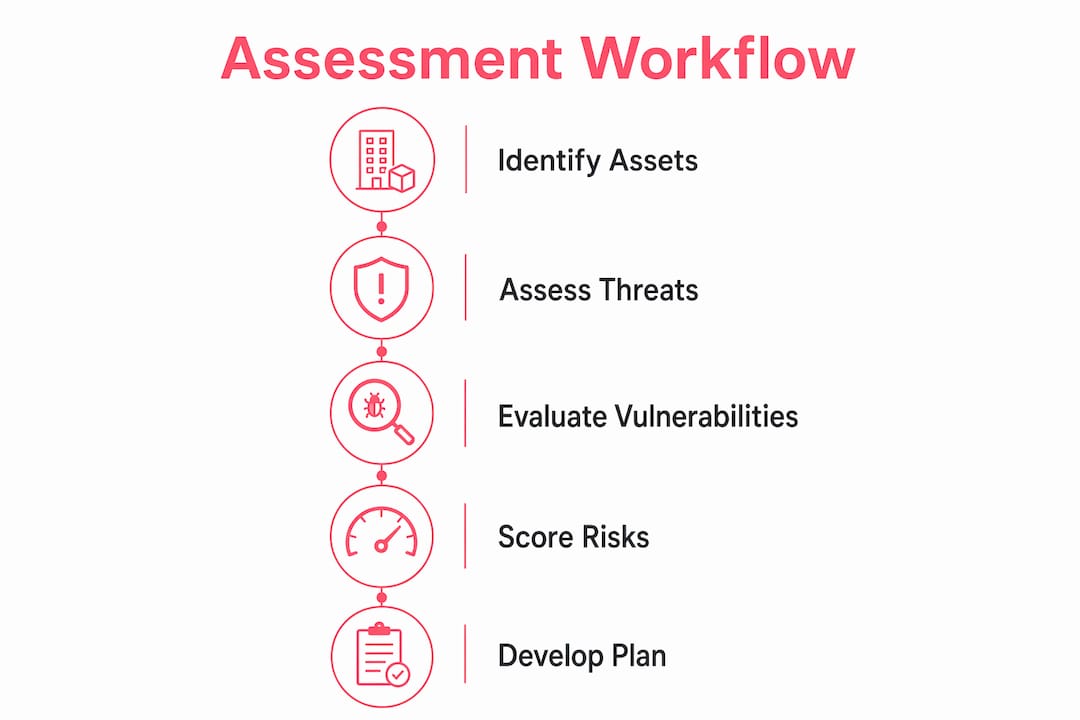
This workflow follows the structure recommended by the DOE Physical Security Systems Assessment Guide and aligns with CISA and ISC practitioner guidance. Each step names who to involve and what artifact it produces.
 Define scope and objectives. Identify which buildings, zones, systems, and asset categories are in scope. Document what “success” looks like (e.g., full perimeter coverage, access control audit for all credentialed doors). Involve: Security director, facility manager, legal/compliance. Artifact: Scope statement and assessment charter.
- Stakeholder kickoff. Brief department heads, HR, IT, and operations on the assessment timeline, access requirements, and confidentiality expectations. Establish a single point of contact for scheduling. Involve: All department heads, IT, HR. Artifact: Kickoff meeting notes, contact list, NDA if external assessor.
- Asset criticality ranking. List all assets (people, data, equipment, operations) and rank them by consequence of loss. This step determines where findings get prioritized later. Involve: Security, operations, IT, finance. Artifact: Asset criticality register.
- Threat analysis. Identify credible threats specific to your location, sector, and operations. Reference DHS threat bulletins, local law enforcement intelligence, and sector-specific advisories. Involve: Security team, local law enforcement liaison, CISA PSA if available. Artifact: Threat profile document.
- Vulnerability survey and site inspection. Walk the facility from outer perimeter inward, using the zone-by-zone checklist in the next section. Photograph deficiencies, map blind spots, and note behavioral observations (tailgating, propped doors, unescorted visitors). Involve: Lead assessor, facilities staff. Artifact: Completed inspection checklist with photos and annotated site map.
- Systems audit. Review access control software (credential lists, door schedules, alarm zones), CCTV coverage maps, alarm logs, and maintenance records. Check for orphan cardholder records and expired credentials. Involve: IT/security systems administrator, physical security team. Artifact: Systems audit report with gap list.
- Testing and validation. Run function tests on cameras, alarms, and access control failover. Conduct a tabletop exercise with security and facilities staff. Consider a limited red-team check for high-priority access points. Involve: Security team, IT, select department staff. Artifact: Test logs, tabletop after-action report.
- Risk scoring and prioritization. Score each finding using the formula: Risk = Threat × Vulnerability × Consequence. Assign a numeric weight to each factor (1–5 scale) and calculate a composite score. Group findings into priority buckets. Involve: Lead assessor,

Parking security watching over the parking area. The security guard is protecting property from illegal parking and theft. security director. Artifact: Scored findings register.
- Remediation planning and executive summary. Build a prioritized remediation plan with task owners, timelines, and rough cost bands. Write an executive summary that frames findings in business terms. Involve: Security director, facilities, finance, executive sponsor. Artifact: Remediation plan, executive summary report.
Governance note: Maintain chain of custody for all photos, test logs, and access control exports. Assessment reports may be subject to FOIA requests at public facilities; consult legal counsel on appropriate handling and distribution controls before the report is finalized.
What physical threats does an assessment look for?
Assessors look for the intersection of a credible threat and an exploitable vulnerability. The threat alone does not create risk; neither does the vulnerability in isolation. It is the combination, weighted by consequence, that drives prioritization.
Common physical security risks include:
- Unauthorized access and tailgating: The most frequently observed vulnerability in commercial buildings, often enabled by high-traffic entry points and insufficient access control enforcement.
- Theft (internal and external): Ranges from opportunistic retail theft to targeted removal of equipment or data assets.
- Vandalism and property damage: Particularly relevant for facilities with high public visibility or contentious operations.
- Active assailant: A low-frequency, high-consequence threat that requires specific detection, delay, and response planning.
- Insider risk: Employees or contractors with legitimate access who misuse it, often the hardest threat to detect through hardware controls alone.
- Hostile vehicle threat: Relevant for facilities with public-facing storefronts, event venues, or government-adjacent operations.
- Environmental and natural hazards: Flooding, fire, and severe weather that disable security systems or create forced-entry opportunities.
Scenario 1: A mid-size corporate office installs card readers on all exterior doors but never audits the credential database. A former contractor’s badge, never deactivated, is used to access the server room at 2:00 AM. The vulnerability was not the hardware; it was the orphan credential.
Scenario 2: A warehouse facility relies on a single CCTV system with no redundant recording. A targeted theft occurs during a network

outage. The camera was present; the footage was not.
Callout: Cyber-physical coupling. Access control panels, IP cameras, and alarm systems all run on network infrastructure. A vulnerability in the IT environment can disable physical controls entirely. Assessments that treat physical and cyber security as separate programs will miss this class of risk. Your security assessment process should include a review of how physical systems connect to the network and what happens to access control when the network goes down.
On-site inspection checklist by zone and system
Walk the facility from the outside in. Practitioner guidance consistently shows that behavioral and process-driven vulnerabilities (propped doors, blind camera angles, unescorted visitors) are missed when assessors rely on drawings rather than fieldwork.
Zone-by-zone checklist structure:
| Zone / System | What to Observe | Pass / Fail | Photo Required |
|---|---|---|---|
| Outer perimeter (fencing, gates, vehicle barriers) | Fence integrity, gate latching, vehicle standoff distance, signage | P / F | Yes if deficient |
| Parking and landscaping | Lighting coverage, sight-line obstructions, camera coverage of lot | P / F | Yes |
| Building envelope (walls, roof access, utility entries) | Unsecured roof hatches, utility penetrations, window locking hardware | P / F | Yes if deficient |
| Main entry / reception | Visitor management process, reception staffing, mantrap or airlock presence | P / F | Yes |
| Secondary and emergency exits | Door hardware condition, alarm on emergency exits, exterior lighting | P / F | Yes |
| Interior critical areas (server rooms, cash handling, storage) | Access control type, camera coverage, dual-person rule where applicable | P / F | Yes |
| Common areas (lobbies, break rooms, mail rooms) | Unescorted visitor presence, unsecured sensitive materials, camera blind spots | P / F | Yes if deficient |
| Emergency egress routes | Clear path, signage, emergency lighting function | P / F | Yes if deficient |
| Access control system | Credential list currency, door schedule accuracy, alarm zone mapping | P / F | No |
| CCTV / surveillance | Coverage gaps, recording retention, camera condition and angle | P / F | Yes |
| Lighting (interior and exterior) | Foot-candle levels at entry points, parking, and perimeter | P / F | Yes if deficient |
| Locks and door hardware | Grade rating, condition, key control policy | P / F | Yes if deficient |
| Alarms and intrusion detection | Panel condition, zone testing date, monitoring contract status | P / F | No |
| Signage and communications | Emergency contact postings, evacuation maps, duress alarm locations | P / F | No |
Export and print guidance: Export the completed checklist as a PDF immediately after the walkthrough. Attach geo-tagged photos to each deficient item. Transfer all files to a secure, access-controlled folder before leaving the site.
Pro Tip: Bring a lux meter to measure lighting levels at entry points and parking areas. Many facilities that “pass” a visual lighting check fall below the 1–2 foot-candle minimum at perimeter doors when measured directly.
How do you test and validate what the assessment found?
Testing converts a list of suspected vulnerabilities into confirmed findings. Without it, you are presenting an opinion; with it, you are presenting evidence.
Test types and when to use them:
- System function tests: Verify that cameras record and retain footage, that access control panels fail to the correct state during a power or network outage, and that alarms trigger and notify monitoring within the required response window. Run these for every
 system in scope.
 - Procedural tests: Have a staff member attempt to tailgate through a secured door during normal business hours and observe whether anyone challenges them. Test whether the front desk follows visitor management protocol with an unannounced visitor.
- Tabletop exercises: Walk security and facilities staff through a scenario (active assailant, fire alarm during peak occupancy, after-hours intrusion) and document gaps in response protocols. These require no physical disruption and are appropriate for any facility.
- Limited red-team / penetration tests: A controlled attempt by a trained assessor to defeat specific access controls. Appropriate for high-criticality facilities or when a specific control is suspected to be ineffective.
Rules of Engagement (ROE) for red-team activity:
- Written authorization signed by the facility owner or authorized executive before any test begins.
- Defined scope: which doors, systems, and time windows are in bounds.
- Named “get-out-of-jail” contact available by phone throughout the test.
- No force, no damage, no deception of emergency services.
- Immediate stop-work protocol if a real incident occurs during testing.
- All test activity logged in real time (time, actor, observation, outcome).
Sample evidence log fields: Date/time, tester name, location/zone, test type, observation, system response, pass/fail, remediation note, photo reference.
After testing, update each finding’s vulnerability score in the risk register. A suspected vulnerability that is confirmed through testing moves to a higher priority bucket regardless of its initial score.
Pro Tip: Never run a red-team test without notifying at least one senior security or facilities contact in advance, even if the test is designed to be covert to staff. An unannounced test that triggers a real 911 call creates liability and destroys trust with local law enforcement.
How to score findings and build a remediation plan
Risk scoring gives leadership a defensible basis for prioritizing spending. The formula is straightforward: Risk = Threat × Vulnerability × Consequence. Score each factor on a 1–5 scale, multiply, and you get a composite score between 1 and 125.
The General Security Risk Assessment methodology includes cost/benefit analysis as a required step, not an optional one. A finding that scores 75 but costs $200 to fix should be addressed before a finding that scores 50 but requires a $50,000 infrastructure project.
Sample scoring rubric:
| Factor | 1 (Low) | 3 (Medium) | 5 (High) |
|---|---|---|---|
| Threat | Unlikely, no history | Possible, regional incidents | Credible, local history |
| Vulnerability | Control is effective | Partial gap, workaround exists | Control absent or defeated |
| Consequence | Minor disruption | Significant loss or injury | Catastrophic, life-safety |
Priority buckets and example fixes:
- Immediate (0–30 days, $ cost): Deactivate orphan credentials, repair broken door hardware, replace burned-out perimeter lighting, post missing emergency signage.
- Short-term (31–90 days, $$ cost): Implement a visitor management system, adjust CCTV angles to close coverage gaps, update emergency action plan, train staff on tailgating prevention.
- Medium-term (91–180 days, $$–$$$ cost): Install additional access control readers at secondary entries, upgrade alarm panel, add vehicle barriers at main entrance.
- Long-term (6–12 months, $$$ cost): Replace end-of-life CCTV infrastructure, redesign lobby for controlled access, implement a formal security awareness training program.
An executive-ready remediation plan includes a task owner for every line item, a due date, a cost band, and a completion evidence requirement (photo, system log, or sign-off). Without owners and due dates, remediation plans become documents that nobody acts on.
What U.S. government and industry standards should you reference?
Citing authoritative standards in your assessment report does two things: it demonstrates that your methodology meets a recognized baseline, and it gives leadership an external reference point that is harder to dismiss than internal recommendations alone.
Key U.S. authorities and their relevance:
- DHS / CISA Venue Guide for Security Enhancements: Maps security measures to the 5 D’s framework and provides a menu of options by venue type and budget. Use it to justify control selections and to structure your findings report.
- ISC Risk Management Process (2024 Edition): The federal standard for facility security assessments. Sets FSL-based frequency guidance and defines the continuous assessment cycle. Cite it when recommending assessment cadence to leadership.
- CISA Protective Security Advisor (PSA) Program: Free, no-cost assessments available to qualifying U.S. facilities. Reference this when a client asks whether an external assessment is worth the cost.
- DOE Physical Security Systems Assessment Guide: Detailed technical guidance on systems evaluation and asset criticality
 methodology. Useful for facilities with significant physical security infrastructure.
 - NERC guidance for non-critical bulk power system facilities: Frames physical security assessments as the basis for prioritization and risk-based decision-making across an organization-wide program. Relevant for energy sector clients.
- OSHA Safety Management Hazard Identification guidance: Applicable when physical security findings intersect with workplace safety obligations.
- HIPAA Security Rule (HHS): For healthcare facilities, physical safeguards are a required implementation specification. Assessment findings that touch on PHI access must be documented and remediated under HIPAA timelines.
- ISO/IEC 27001: For organizations pursuing information security certification, physical and environmental security controls (Annex A) must be assessed and documented.
For financial institutions, federal banking regulators (OCC, FDIC, Federal Reserve) expect documented physical security programs as part of operational risk management. Citing ISC and CISA standards in your report signals alignment with federal expectations even when your facility is not federally owned.
What does a complete assessment report look like?
A well-structured report does more than list findings. It gives the responsible authority everything needed to accept, mitigate, or transfer risk without asking follow-up questions.
Recommended report outline:
- Executive summary (1–2 pages): overall risk rating, top three findings, recommended immediate actions, and total estimated remediation cost band.
- Methodology: scope, assessment dates, team credentials, standards referenced, and limitations.
- Facility overview: maps, photos, and a brief description of operations and population.
- Findings with scoring: each finding listed with its risk score, supporting evidence (photo reference, test log), and recommended control.
- Remediation plan: prioritized task list with owners, due dates, cost bands, and completion evidence requirements.
- Appendices: completed inspection checklists, test logs, credential audit results, and tabletop after-action report.
Recommended KPIs and metrics to track post-assessment:
- Number of open high-priority findings and days since identification
- Average time-to-remediate by priority bucket
- System test pass rate (percentage of tested controls that passed on first test)
- CCTV coverage percentage (percentage of critical zones with active, recording coverage)

- Percentage of credentialed doors with current, audited access lists
Sample remediation task card:
- Finding: Orphan cardholder credentials in access control system
- Owner: IT/Security Systems Administrator
- Due date: 30 days from report issue
- Priority: Immediate
- Cost band: $ (staff time only)
- Completion evidence: Screenshot of updated credential list with deactivated records, signed off by security director
What does the evidence say about assessment effectiveness?
The case for structured, recurring assessments is not theoretical. Industry research documents reductions in security incidents of up to 63% for organizations using regular, structured assessment programs rather than reactive, incident-driven reviews.
CISA’s guidance reinforces this with a specific recommendation: every facility’s assessment must be site-specific because layout, operations, and local threat intelligence produce findings that a generic checklist will never surface. A CISA site-specific assessment accounts for the unique combination of your building’s geometry, your staff’s behaviors, and the threat environment in your immediate area.
For building a business case, frame assessment findings in cost-avoidance terms:
- The average cost of a commercial burglary in the U.S. includes property loss, business disruption, and insurance premium increases, all of which a documented assessment and remediation program can demonstrably reduce.
- Regulatory fines for inadequate physical safeguards under HIPAA or sector-specific standards can exceed the full cost of a professional assessment many times over.
- Insurance carriers increasingly require documented security assessments for coverage of high-value assets or facilities. A current report can directly affect premium rates.
The ISC Risk Management Process frames assessment as a continuous cycle precisely because threat environments and facility operations change. A program that treats assessment as a one-time deliverable will always be behind the current risk picture.
Key Takeaways
A physical security risk assessment is only as useful as the remediation plan it produces: findings without owners, timelines, and cost context do not reduce risk.
| Point | Details |
|---|---|
| Start with asset criticality | Rank assets by consequence of loss before scoring threats so limited budgets go to the highest-impact areas first. |
| Use the 5 D’s as your framework | Map every finding to Deter, Detect, Deny, Delay, or Defend to ensure no layer of protection is overlooked. |
| Validate with testing | Confirmed vulnerabilities from system tests and tabletop exercises carry more weight with leadership than inspection observations alone. |
| Structured assessments reduce incidents | Industry research documents reductions in security incidents of up to 63% for organizations using regular, structured assessments. |
| Hubsecurityandinvestigativegroup delivers end-to-end assessments | From on-site inspection and testing through executive-ready remediation planning, Hub’s team brings over 75 years of combined law enforcement expertise to every engagement. |
Why Every Physical Security Assessment Must Include a Comprehensive Risk Assessment
A professional Risk Assessment is the foundation of every successful physical security program because it identifies the threats, vulnerabilities, and potential consequences that could affect an organization’s people, property, and operations. Without a structured Risk Assessment, security decisions are often based on assumptions rather than measurable risk, leading organizations to invest in solutions that  may not address their most significant vulnerabilities.
An effective Risk Assessment evaluates far more than physical security equipment. It examines employee procedures, visitor management, emergency preparedness, access control policies, cybersecurity integration, contractor oversight, and the organization’s ability to respond to both intentional and accidental incidents. By reviewing every layer of security, a Risk Assessment provides decision-makers with the information they need to prioritize improvements based on actual business risk instead of perceived threats.
Another benefit of a comprehensive Risk Assessment is that it creates a documented roadmap for continuous improvement. Rather than reacting to incidents after they occur, organizations can proactively reduce vulnerabilities before they result in financial loss, operational disruption, liability, or reputational damage. This proactive approach helps maximize security investments while supporting regulatory compliance and industry best practices.
Security threats continue to evolve, making it essential for organizations to perform a Risk Assessment on a regular basis instead of treating it as a one-time project. Business operations change, employees come and go, facilities expand, and new technologies are introduced. Each of these changes can create new vulnerabilities that should be evaluated through an updated Risk Assessment to ensure existing security controls remain effective.
Organizations that make Risk Assessment a routine part of their overall security strategy are significantly better positioned to identify emerging threats, allocate budgets wisely, and protect their most valuable assets. Whether protecting a corporate headquarters, manufacturing facility, healthcare organization, educational campus, or critical infrastructure, a professional Risk Assessment provides the data needed to make informed security decisions.
Ultimately, every recommendation made during a physical security assessment should be supported by a documented Risk Assessment. This ensures that corrective actions are based on objective analysis rather than opinion, resulting in stronger security, better resource allocation, improved resilience, and a safer environment for employees, visitors, customers, and stakeholders.
Hubsecurityandinvestigativegroup offers professional security assessments for Boston-area facilities
When your facility needs more than a checklist, Hubsecurityandinvestigativegroup brings over 75 years of combined law enforcement and loss prevention expertise directly to your site. Our assessment engagements cover the full scope: on-site inspection from outer perimeter to interior critical areas, systems audit, controlled testing (including tabletop exercises and limited red-team checks), and a complete executive-ready report with a prioritized remediation plan and task cards your operations team can act on immediately.
A typical engagement runs two to four weeks from kickoff through final report delivery, depending on facility size and complexity. Every deliverable is written for two audiences: the security team that will execute the remediation, and the executive sponsor who needs to approve the budget. We work with corporate offices, commercial buildings, financial institutions, and event venues across the Boston area and beyond.
If your last assessment is more than 18 months old, or if you have never had a formal one, the gap between your current security posture and your actual risk profile is wider than you think. Contact Hubsecurityandinvestigativegroup to schedule a consultation, or visit our building security services page to learn more about what a professional engagement includes.
Authoritative resources and templates to download
These government and industry resources are free, publicly available, and directly applicable to U.S. facility security assessments. Each one is worth bookmarking before you begin.
- CISA Venue Guide for Security Enhancements: Maps the 5 D’s framework to specific security measures by venue type and budget. Use it to structure your findings and justify control selections to leadership.
- ISC Risk Management Process, 2024 Edition: The federal standard for facility security assessments. Sets FSL-based frequency guidance and defines the continuous five-step assessment cycle. Cite it in your methodology section.
- DOE Physical Security Systems Assessment Guide: Detailed technical guidance on systems evaluation and asset criticality methodology. Particularly useful for facilities with significant physical security infrastructure.
- CISA/ISC Planning and Managing Physical Security Resources: Practical guidance on building executive-ready remediation plans with task ownership and life-cycle cost estimates. Use it as a template reference for your report’s remediation section.
- NERC Risk Assessments and Best Practices for Non-Critical BPS Facilities: Frames assessments as the foundation for organization-
 wide risk prioritization. Relevant for energy sector facilities and any organization integrating physical security into an enterprise risk program.
 - General Security Risk Assessment Guidelines: A seven-step methodology covering asset identification, vulnerability analysis, probability, impact, mitigation options, feasibility, and cost/benefit analysis. A practical companion to the ISC standard for non-federal facilities.
- CISA Protecting Places of Worship: Six-step security guide applicable beyond faith communities to any facility with open-access operations. Includes a self-assessment tool and references to DHS threat bulletins.
- CISA Houses of Worship Security Resources: Includes a paper-based self-assessment, an interactive digital tool, and the Protective Measures Awareness course. Adaptable for any small-to-medium facility conducting an initial baseline assessment.
Why You Should Hire Hub Security and Investigative Group to Conduct a Risk Assessment
Protecting your business requires more than installing cameras or hiring a security guard. Every organization has unique vulnerabilities that can expose employees, customers, property, and sensitive information to unnecessary risk. The first step toward building an effective security program is a professional Risk Assessment performed by experienced security professionals who understand how to identify threats before they become costly incidents.
Hub Security and Investigative Group provides comprehensive security consulting and physical security evaluations for businesses, schools, healthcare facilities, warehouses, construction sites, retail centers, apartment communities, and corporate offices throughout Massachusetts. With decades of combined industry experience, our team evaluates every aspect of your facility to identify weaknesses and recommend practical, cost-effective improvements.
A professional Risk Assessment goes far beyond checking whether cameras are working or doors lock properly. Our security specialists examine access control procedures, visitor management, employee policies, lighting, fencing, surveillance coverage, emergency planning, parking lots, delivery areas, key control, alarm systems, and internal security procedures. We also evaluate operational practices because many of today’s largest security failures occur due to process weaknesses rather than equipment failures.
Businesses often assume they are adequately protected until an incident occurs. Theft, workplace violence, vandalism, unauthorized access, fraud, and liability claims can have devastating financial consequences. A detailed Risk Assessment identifies these vulnerabilities before they become expensive problems, allowing organizations to strengthen their security posture while protecting their reputation and operations.
Why Businesses Choose Hub Security and Investigative Group for Risk Assessment.
Hub Security and Investigative Group believes that every client deserves a customized security solution rather than a generic checklist. Every property is different, every business has different operational needs, and every facility faces unique threats. Our assessments are designed around your specific environment, helping management prioritize improvements based on actual risk instead of assumptions.
After completing your Risk Assessment, we provide a comprehensive report detailing identified vulnerabilities, the likelihood of exploitation, the potential impact on your organization, and recommended corrective actions. This practical roadmap helps business owners and facility managers make informed decisions about future security investments.
Our recommendations are realistic, scalable, and designed to improve security without disrupting normal business operations. Whether your organization requires enhanced access control, improved lighting, updated emergency procedures, additional patrol coverage, or employee security awareness training, our team develops recommendations that fit your budget and operational goals.
Security Solutions Throughout Eastern Massachusetts
Hire Security in Boston
Boston businesses face unique security challenges, including heavy pedestrian traffic, commercial crime, special events, and high-value commercial properties. Organizations should Hire Security in Boston to conduct a professional Risk Assessment that identifies vulnerabilities before criminals have the opportunity to exploit them.
Hire Security in Cambridge
Cambridge is home to universities, technology companies, research facilities, and corporate headquarters. Organizations should Hire Security in Cambridge because protecting intellectual property, employees, and sensitive research requires proactive planning and professional security evaluations.
Hire Security in Waltham
From office parks to manufacturing facilities, businesses should Hire Security in Waltham to evaluate access control systems, parking areas, warehouse security, and emergency response procedures. A professional assessment helps reduce operational risks while protecting valuable assets.
Hire Security in Lowell
Industrial facilities, distribution centers, healthcare providers, and retail businesses should Hire Security in Lowell to identify vulnerabilities associated with employee access, inventory protection, and facility security. Preventing theft is always less expensive than recovering from it.
Hire Security in Burlington
Corporate campuses and medical facilities benefit from professional Risk Assessment security planning. Businesses should Hire Security in Burlington to ensure that physical security measures, emergency procedures, and visitor management programs work together effectively.
Hire Security in Lexington
Professional offices, schools, and residential communities continue to expand throughout Lexington. Organizations should Hire Security in Lexington to proactively evaluate security Risk Assessment procedures and reduce exposure to unnecessary threats before they impact business operations. Hub can provide Risk Assessment for all residents of Lexington
Hire Security in Framingham
Retail centers, logistics companies, and commercial facilities should Hire Security in Framingham to review current security measures, identify operational weaknesses, and improve overall preparedness against theft, vandalism, and unauthorized access. They can assist with conducting Risk Assessment for all organizations.
Hire Security in Watertown
Growing commercial development brings new security challenges. Organizations should Hire Security in Watertown to evaluate existing security infrastructure, improve emergency preparedness, and strengthen policies that protect employees, customers, and visitors. Risk Assessment in Watertown lead to safety.
Experience You Can Trust
Risk Assessment with Hub Security and Investigative Group combines experienced security professionals, investigative expertise, and practical operational knowledge to deliver comprehensive security solutions that produce measurable results. Our team understands that effective security is built on preparation, planning, and continuous improvement—not simply reacting after an incident occurs. With 40 years of conducting Risk Assessment experience.
Every recommendation we make is supported by industry best practices and real-world experience. Rather than selling unnecessary equipment, we focus on identifying the security measures that will provide the greatest reduction in organizational risk while maximizing your existing investments.
A comprehensive Risk Assessment also demonstrates due diligence. Many insurance providers, corporate clients, and regulatory agencies increasingly expect organizations to identify and manage security risks through documented evaluations. Having an independent assessment performed by qualified professionals shows your commitment to protecting people, property, and business continuity.
Protect Your Organization Before an Incident Occurs
Waiting until after a theft, workplace violence incident, data breach, or act of vandalism is always more expensive than preventing it. Investing in a professional Risk Assessment gives your organization the information needed to make smarter security decisions, prioritize future improvements, and reduce liability.
If you want to strengthen your organization’s physical security, improve emergency preparedness, and identify vulnerabilities before they become costly incidents, contact Hub Security and Investigative Group today. Our experienced professionals will perform a thorough Risk Assessment, develop practical recommendations tailored to your facility, and help you build a safer, more secure environment for your employees, customers, and visitors.
Recommended
- Workplace Threat Assessment: A 2026 Guide for HR and Security Pros – Hub Security & Investigative Group
- The Ultimate Guide to Business Security: Protecting Your Assets, Employees, and Future – Hub Security & Investigative Group
- 1.The Importance of Security in Today’s World: Protecting People, Property, and Peace of Mind – Hub Security & Investigative Group
- (3) Instagram