
A working warehouse security checklist covers six areas: perimeter and yard control, access control and badging, CCTV and alarm coverage, inventory and process controls, personnel policies, and a testing schedule that keeps every system honest. If you only fix one thing this week, reconcile your last cycle count variance and lock down who still has active badge access. That single move closes the two gaps that create most opportunistic theft.
Here is the fast version to walk the floor with today:
- Confirm perimeter fencing and gates are intact, with no gaps near dock areas.
- Verify all exterior lighting covers entrances, yards, and blind corners.
- Check that badge or PIN access logs match your current employee roster.
- Confirm CCTV cameras cover every dock door and high-value storage aisle.
- Test alarm zones and confirm monitoring service response times.
- Reconcile your most recent cycle count against your WMS records.
- Inspect trailer seals and confirm the 7-point inspection is being logged.
- Verify visitor and contractor sign-in procedures are actually being followed.
- Confirm a written security plan exists and names an accountable owner.
- Check that terminated employees’ access has been revoked within 24 hours.
Pro Tip: Start with the cycle-count reconciliation and access log audit together. Variance plus stale badge access is the combination that precedes most internal shrink cases we see referenced in loss-prevention casework.
Key Takeaways
A warehouse security checklist works when perimeter controls, access management, surveillance, inventory reconciliation, and staff training are tested on a fixed schedule rather than reviewed once and forgotten.
| Point | Details |
|---|---|
| Start at the perimeter | Walk the yard, docks, and storage aisles first since these zones account for most reported incidents. |
| Layer physical and technical controls | Combine fencing, badge access, and CCTV so each system compensates for the others’ blind spots. |
| Reconcile inventory on a schedule | Run cycle counts against WMS records with variance thresholds that trigger automatic review. |
| Train staff on real findings | Build toolbox talks around your last audit’s actual gaps, not generic security modules. |
| Get a professional walkthrough | Hubsecurityandinvestigativegroup’s on-site assessments turn checklist gaps into a prioritized remediation plan. |
Table of Contents
- Warehouse Security Checklist Priorities: Vulnerable Areas To Check First
- Physical And Technical Controls That Actually Work Together
- Inventory And Process Controls That Catch Shrink Early
- People, Policies, And Training That Close The Human Gap
- Emergency Planning And System Maintenance Cadence
- Copy This 40-Point Warehouse Security Checklist Template
- Aligning Your Checklist With TAPA, CBP, And OSHA Standards
- Cybersecurity Gaps In Your Warehouse Management System
- What Auditors Actually Catch During A Walkthrough
- Turn Your Checklist Into A Verified Security Plan
- Frequently Asked Questions
- Sources
Warehouse Security Checklist Priorities: Vulnerable Areas To Check First
Not every square foot of a distribution center carries the same risk. Walk these zones first, because they account for most incidents: the external yard and trailer parking area, dock doors and receiving bays, storage aisles with high-value SKUs, mezzanine levels, and office or visitor entry points.
- Yard and perimeter: unmonitored trailer staging invites drop-and-hook theft and unauthorized entry.
- Dock doors: blind spots between trailers and low camera angles let cargo walk out unnoticed.
- Storage aisles: dense racking creates sightline gaps, especially near high-value or easily resold inventory.
- Mezzanines and offices: often excluded from badge zoning even though they hold sensitive records or overflow inventory.
- Visitor and contractor areas: loosely enforced sign-in creates an easy cover story for unauthorized access.
Cargo theft cost businesses $114 million in a single year according to industry reporting, and dock and yard areas remain the most exploited entry points. That number alone justifies starting your walkthrough at the fence line, not the front office.
Physical And Technical Controls That Actually Work Together
A fence without lighting is decoration. A camera without a monitored alarm is a recording of a crime already committed. Physical and technical layers only function as a layered security approach when each piece compensates for the blind spot of the one before it.
Start with the perimeter: anti-ram gates, fencing rated for your risk level, and yard management procedures that track every trailer in and out. Access control comes next. Badge readers, PIN pads, and vehicle checks should segregate driver, employee, and visitor traffic into distinct, logged paths, not one shared entry everyone uses out of convenience.
CCTV coverage needs to prioritize entrances, dock doors, and high-value storage zones rather than chasing a camera count for its own sake. Retention periods matter as much as placement. Tamper protection and adequate night lighting turn a camera from a formality into usable evidence.
Alarm systems round out the technical layer. Motion and vibration sensors (intrusion detection basics) should feed a monitored response, whether that’s a third-party monitoring center or onsite security patrols who can physically verify an alert. A physical security risk assessment is the fastest way to identify where these systems currently fail to overlap.
Pro Tip: Map your camera coverage to inventory value, not floor space. A 10,000-square-foot aisle of low-value pallets needs less scrutiny than a 500-square-foot cage holding electronics or pharmaceuticals.
For access control equipment specifics, small business access control guidance covers practical badge and visitor management options worth reviewing before you shop for hardware.
Inventory And Process Controls That Catch Shrink Early
Physical controls stop people from walking in. Process controls catch what happens once they’re already inside. Your WMS reconciliation should run against physical cycle counts on a fixed schedule, with variance thresholds that automatically trigger a review rather than getting buried in a monthly report nobody reads.
Shipping and receiving deserve their own procedure, not an improvised routine. A 7-point trailer and container inspection at receiving, recommended under global facility security standards, catches tampering before cargo enters your building. Driver identification, staging area assignment, and manifest reconciliation before release close the loop on the outbound side.
- Reconcile manifests against physical load counts before any trailer leaves the yard.
- Run scheduled cycle counts with documented variance thresholds, not ad hoc spot checks.
- Use RFID tagging for high-turnover, high-value SKUs; barcode scanning is usually sufficient elsewhere.
- Require a signed handover at every stage: receiving, staging, and final release.
That sequence, verify on arrival, stage, inspect again before loading, sign off on release, is the single biggest process lever most warehouses underuse.
People, Policies, And Training That Close The Human Gap
Technology stops working the moment someone with legitimate access decides to abuse it. That’s why personnel controls matter as much as any camera. Background checks before hire, tiered clearances for high-value storage areas, and a real visitor sign-in process with temporary badges are baseline expectations, not extras.
Training should cover more than orientation-day basics. Forklift certification, shipping and receiving procedures, and threat awareness (what suspicious behavior looks like and how to report it) deserve recurring sessions, not a single onboarding video. Retail loss prevention strategies built for executives translate directly into warehouse floor practice.
- Run background checks and tiered access clearances before granting high-value area access.
- Issue temporary, logged badges for every visitor and contractor, no exceptions.
- Hold short toolbox talks tied to specific checklist failures you found during your walkthrough.
- Define a clear incident reporting chain with progressive discipline for policy violations.
Pro Tip: Pull one item from your last audit and build a five-minute toolbox talk around it. A threat-awareness program built on real findings sticks better than a generic annual training module.
Emergency Planning And System Maintenance Cadence
A checklist only holds up if the systems behind it get tested, not just installed once and forgotten. Evacuation routes, an updated emergency contacts list, and a documented relationship with local law enforcement or a monitored response partner all belong in your annual review, not a drawer.
Maintenance is where most facilities quietly slip. Monitored alarms need service contracts. Motion and vibration sensors need tamper checks. Spare parts for critical hardware should be on hand, not on backorder when a camera fails.
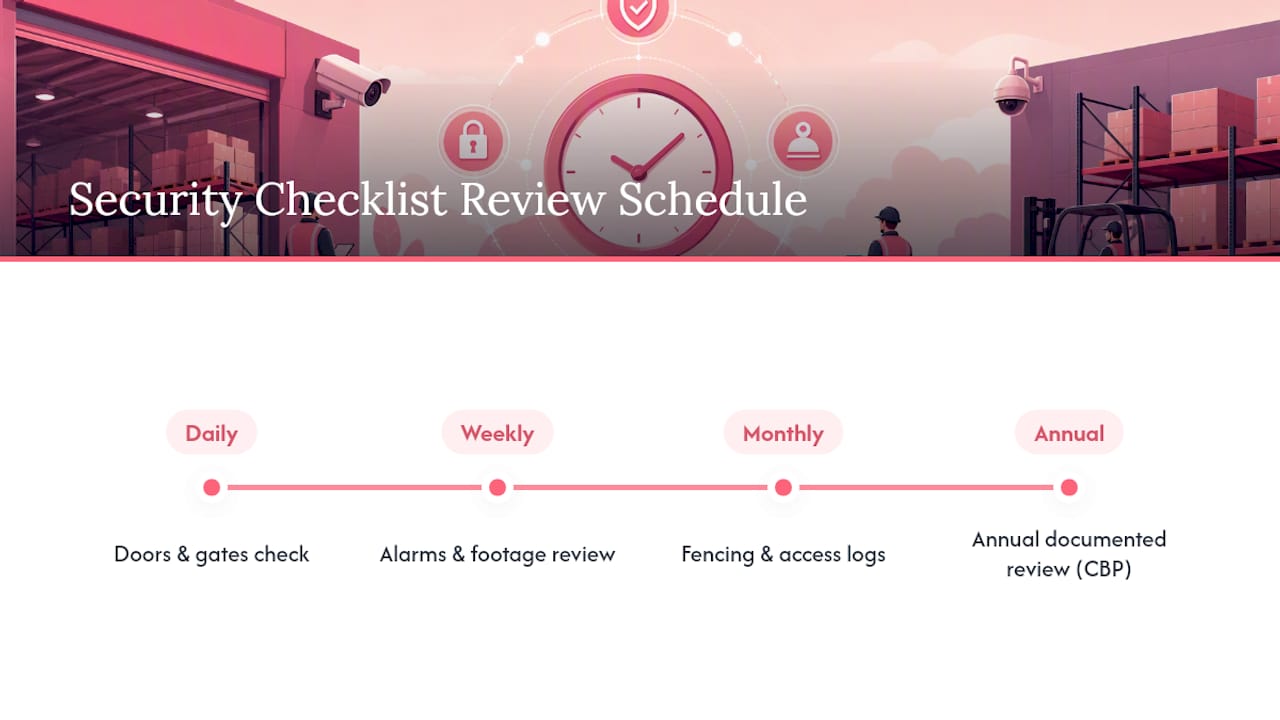
| Frequency | Task |
|---|---|
| Daily | Confirm gates and dock doors are secured after hours |
| Weekly | Test alarm zones and review CCTV footage for gaps |
| Monthly | Inspect fencing, lighting, and access logs against staff roster |
| Annual | Review the full security plan and emergency contact list |
Copy This 40-Point Warehouse Security Checklist Template
This is the version you print, laminate, or paste into a task app. It’s grouped by zone so you can hand a section to a specific supervisor and hold them accountable for it.
| Zone | Sample checklist items |
|---|---|
| Perimeter/Yard | Fencing intact; gates locked and logged; yard lighting functional; trailer staging monitored |
| Docks/Receiving | Dock doors sealed after hours; 7-point trailer inspection logged; driver ID verified |
| Storage/Racking | High-value cages locked and badge-restricted; aisle cameras unobstructed; mezzanine access logged |
| Office/Visitor | Visitor sign-in enforced; temporary badges issued and collected; reception area monitored |
| Systems/Monitoring | CCTV retention meets policy; alarm zones tested; tamper alerts confirmed active |
| Inventory Procedures | Cycle counts reconciled against WMS; variance thresholds documented; manifests matched pre-release |
| People/Training | Background checks completed; forklift certifications current; threat-awareness training logged |
| Emergency/Documentation | Evacuation routes posted; emergency contacts updated; security plan reviewed and signed |
Fix what you can this week (badge revocations, dock door seals). Schedule the next month for camera and lighting gaps. Push fencing repairs, sensor upgrades, and full policy rewrites into the next quarter. Assign a named owner to every row, because a checklist with no owner just becomes a document nobody revisits.
Aligning Your Checklist With TAPA, CBP, And OSHA Standards
You don’t need to build your security plan from scratch. The TAPA FSR 2026 standard sets a global certification baseline covering CCTV, access control, and intrusion detection, and it gets revised periodically to keep pace with new threats.
If your facility handles bonded cargo, CBP Appendix D requires a written, signed security plan, perimeter barriers, and annual procedure reviews, with named accountability for who owns compliance.
- OSHA has no single warehouse rulebook, but general industry rules on hazard communication and fire prevention still apply.
- The 6S framework, 5S plus Safety, folds hazard identification directly into routine housekeeping inspections.
- Overlapping safety and security training sessions save time and reinforce both goals at once.
Cybersecurity Gaps In Your Warehouse Management System
Your WMS is now as much a security asset as your fence line. If someone gains remote access to inventory records, they can falsify manifests, mask shrink, or reroute shipments without ever setting foot on your property.
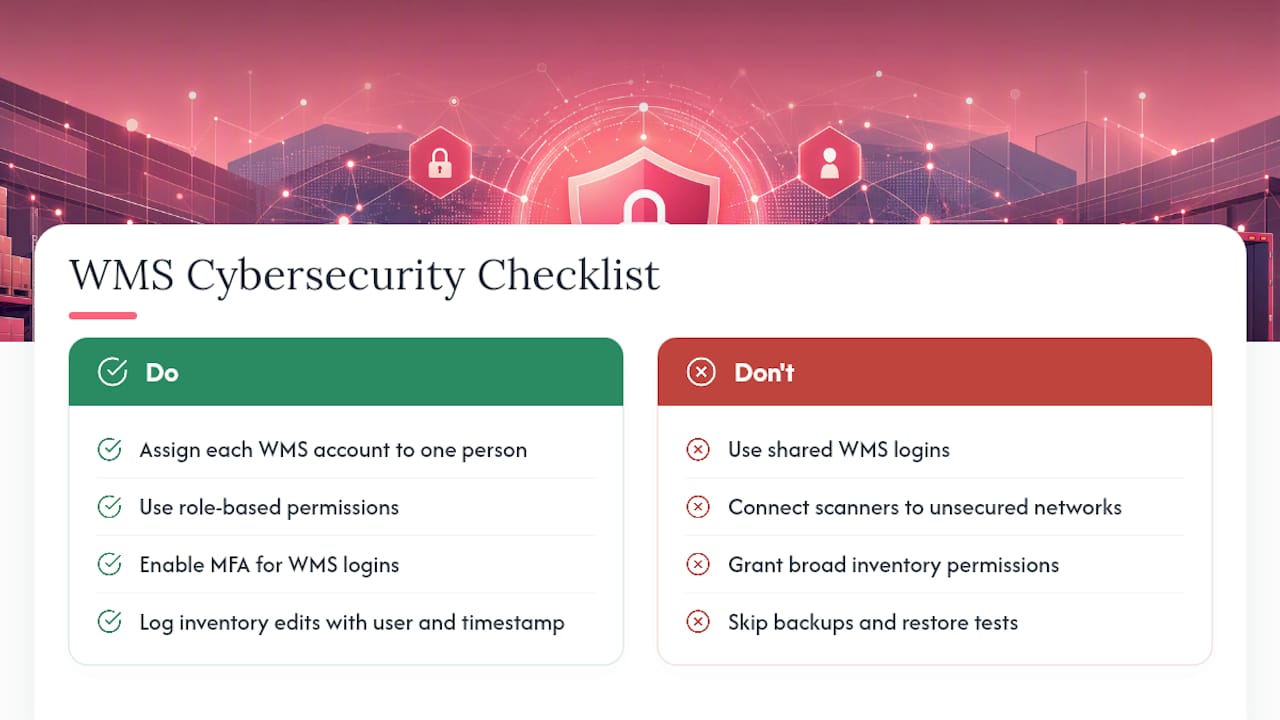
Start with access hygiene inside the software itself. Every WMS user account should map to one person, with role-based permissions that limit warehouse staff to the functions their job actually requires. A receiving clerk doesn’t need permission to adjust inventory counts across the entire facility.
Multi-factor authentication on WMS logins closes the most common entry point for credential theft. Pair that with an audit trail that logs every inventory adjustment, manifest edit, and access change, timestamped and tied to a specific user, not a shared login everyone uses.
RFID and barcode scanners that sync to your WMS create another exposure point if they connect over unsecured networks. Segment your warehouse floor network from your corporate network where possible, and keep firmware on scanners and access control panels current.
Backup your WMS data on a schedule that matches your risk tolerance, and test the restore process at least once a year. A ransomware incident that locks your inventory records is functionally identical to a physical break-in: you can’t ship, receive, or verify what’s actually on your shelves. Treat your software access controls with the same rigor as your badge system, because increasingly, that’s exactly what they are.
What Auditors Actually Catch During A Walkthrough
The most common failures aren’t exotic. Inconsistent badge issuance, contractor access nobody tracks, and yard lighting that’s been “on the list” for two years show up in nearly every walkthrough. Fix badge issuance and yard lighting first. Those two corrections close the widest, most exploited gaps immediately.
Turn Your Checklist Into A Verified Security Plan
A checklist tells you what’s wrong. It doesn’t fix loading dock blind spots, rewrite your access control policy, or negotiate a monitoring contract. That’s where a professional walkthrough earns its cost back fast, because a trained assessor turns your 40 items into a prioritized gap list with a realistic remediation timeline instead of a to-do list that stalls at item twelve.

Hubsecurityandinvestigativegroup has spent over two decades combining law enforcement and loss-prevention backgrounds into practical, on-site assessments for facilities across the Boston area. Rather than handing you another generic template, our team walks your specific yard, docks, and storage areas and tells you exactly which gaps create the most risk for your operation. If your last audit turned up more questions than answers, our comprehensive building security services start with a walkthrough scheduled around your operating hours, not ours. Reach out this week to get a assessment date on the calendar before your next scheduled inventory count.
Frequently Asked Questions
What should be on a basic warehouse security checklist?
A basic checklist covers perimeter fencing and lighting, access control and badge management, CCTV coverage of docks and high-value storage, alarm testing, inventory reconciliation against your WMS, and documented visitor and contractor procedures.
How often should a warehouse security checklist be reviewed?
Daily checks cover doors and gates, weekly checks cover alarms and footage review, monthly checks cover fencing and access logs, and the full plan should get a documented annual review under standards like CBP Appendix D.
What is the biggest vulnerability in most distribution center security setups?
Dock doors and yard areas create the most blind spots because trailers block camera sightlines and staging areas are often loosely monitored compared to interior storage.
Do small warehouses need the same security measures as large ones?
The scale differs, but the categories don’t. Even a small facility needs perimeter control, access logging, basic CCTV, and inventory reconciliation to prevent shrink and unauthorized entry.
How does a warehouse management system factor into physical security?
Your WMS records access changes, inventory adjustments, and manifest edits that reveal internal theft patterns invisible to cameras alone, which is why role-based permissions and audit trails matter as much as badge readers.
Sources
- TAPA FSR 2026 Global Standard – Facility Security Requirements (2026 Revision)
- Lean & Environment Toolkit: Chapter 5 | US EPA
Recommended
- Hotel Security Management: What Every Property Must Require
- Corporate Security Policy: A Great Guide for Managers In 5 Min read – Hub Security & Investigative Group
- Corporate Security Policy: A Complete Guide for Managers
- Security Guard Post Orders: A Supervisor’s Complete Guide – Hub Security & Investigative Group