
For most closed commercial properties, a documented mobile patrol combined with monitored cameras delivers the strongest overnight security for businesses per dollar spent. Continuous static coverage still wins when your property has active late-night access points, like a loading dock running third shift or a lobby that never fully locks down. The right call comes down to deterrence, verification, and cost efficiency working together, not any single guard standing in a doorway.
Your immediate next step is simple:
- Commission a site-specific risk assessment before you call a single vendor.
- Ask any provider to return a written scope of coverage tied to your actual exposure hours, not a generic package.
- Compare at least two coverage models (patrol versus static) against the same risk profile before signing anything.
Key Takeaways
Effective overnight security for businesses depends on matching the coverage model to documented risk exposure, then verifying every pass and post order in writing.
| Point | Details |
|---|---|
| Match model to exposure | Static guards suit continuous access points; mobile patrols suit locked perimeters and concentrated risk windows. |
| Verify before you hire | Confirm licensing, pull the COI directly from the insurer, and request written post orders and training records. |
| Demand digital proof | GTMS with GPS or NFC checkpoint scanning and photo-documented reports replace unverifiable “trust me” patrols. |
| Run a verified first pass | A documented pass within an hour of closing catches unlatched doors before anyone else finds them. |
| Budget with line items | Request guard pay, bill rate, and technology fees broken out separately to spot underpriced, high-risk bids. |
| Hub Investigative Group | Provides site risk assessments, written post orders, COI documentation, and GPS-verified patrol reporting for Boston-area properties. |
Table of Contents
- Static Guards, Mobile Patrols, or Remote Monitoring: Which Fits Your Property?
- How Do You Vet an Overnight Security Provider?
- What Drives the Cost of Overnight Security?
- Onboarding a New Overnight Security Program: The First-Night Checklist
- How Hub Investigative Group Delivers on This Checklist
- The Gap Between Good Advice and What Actually Gets Built
- Get Overnight Coverage Built Around Your Property, Not a Template
- Sources
Static Guards, Mobile Patrols, or Remote Monitoring: Which Fits Your Property?
The choice isn’t guards versus technology. It’s matching coverage to how your property actually behaves after hours.
Static guards make sense when exposure is continuous. Think open lobbies, active loading docks, or any site where someone needs to check credentials or manage access control in real time. A guard standing post can de-escalate a situation the moment it starts, which a camera simply cannot do. That immediacy costs more per hour than any other model, and it’s the right tradeoff for access control points that see foot traffic around the clock.
Mobile patrols work best when your exposure is concentrated rather than continuous. A warehouse with a locked perimeter, a strip mall with multiple tenants, or a construction site with expensive equipment on-site overnight doesn’t need someone stationed at the gate for eight hours. It needs randomized, GPS-verified passes that make the property an unpredictable target. Randomized intervals matter more than most owners realize: predictable patrol schedules create exploitable patterns, while irregular timing removes the window a would-be intruder is counting on.
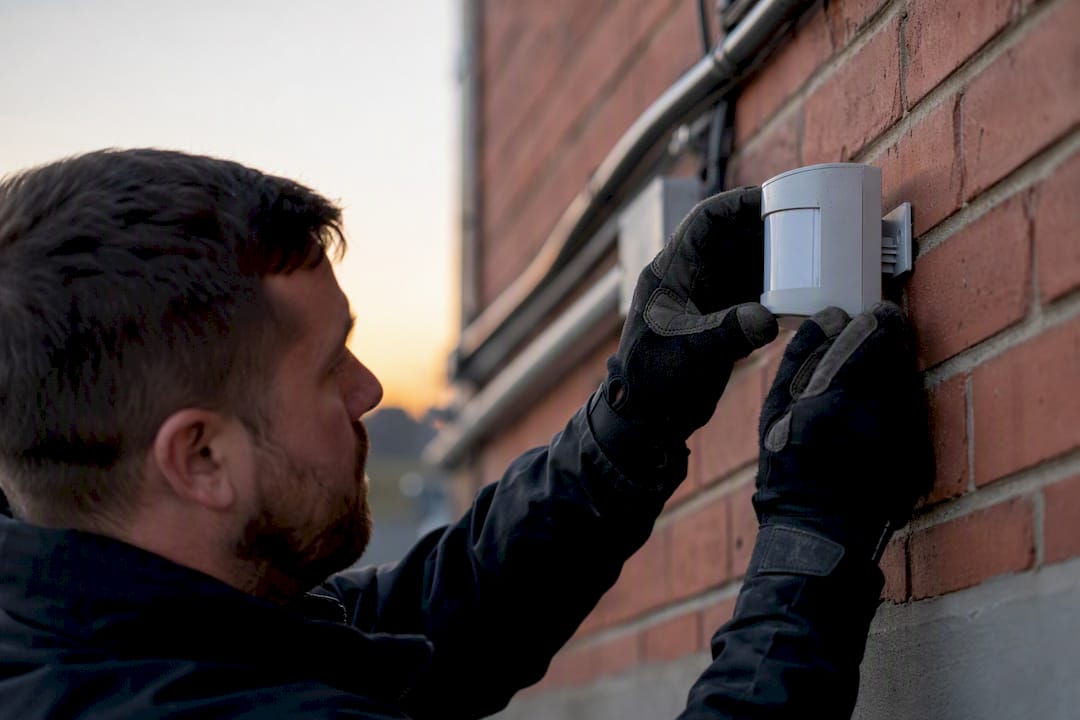
Remote monitoring paired with a verified human response chain reduces staffing costs, but it has a real limit. Monitored camera systems still depend on someone answering the alarm, and that response has to be fast and documented. Cameras alone don’t stop anything; they just tell you what happened after the fact.
Hybrid models often deliver the best balance. A short evening post that manages closing-time foot traffic, transitioning into randomized overnight patrol passes, fits retail and hospitality properties especially well, since most of their risk sits in the first hour or two after close, not at 3 a.m.
Pro Tip: Pull your incident history and map it against time of day before you choose a model. Most properties discover their real exposure sits in a two or three hour window, not across the whole night, which changes the entire coverage math.
How Do You Vet an Overnight Security Provider?
A cheap bid is the single riskiest decision you can make in commercial security. Vetting isn’t complicated, but skipping steps is how businesses end up with undertrained guards, gaps in coverage, and liability they didn’t know they were carrying.
-
Commission a site-specific risk assessment first. Insist any vendor return a written scope of work built around your actual property, not a boilerplate proposal. Comparing at least three bids on identical scope is standard practice for a reason: it’s the only way to know if a low number reflects efficiency or corners being cut.
-
Verify licensing and pull the certificate of insurance directly from the insurer. Confirm workers’ comp and general liability limits match your risk exposure. If the post is armed, general liability policies typically exclude firearms and assault-and-battery exposure, so you need a specific endorsement, not just a standard GL certificate. Name your business as additional insured on the policy itself.
-
Request written post orders, not verbal assurances. Ask about supervisor visit frequency, guard turnover rates, and documented training records. A vendor who can’t produce training documentation on request is a vendor who probably isn’t tracking it.
-
Require digital verification as a baseline, not an upgrade. GTMS systems using GPS or NFC checkpoint scanning replace the old “trust me” model with actual proof a checkpoint was inspected. Photo-documented patrol reports and 24/7 dispatch access should be part of the standard package, not an add-on.
Pro Tip: Ask to see a sample post order and a sample patrol report before you sign. If the vendor hesitates or has to “put something together,” that tells you how organized their operation actually is.
What Drives the Cost of Overnight Security?
Overnight coverage pricing breaks down into a handful of variables: hourly coverage versus per-pass patrol billing, armed versus unarmed staffing, supervisor oversight frequency, technology fees for GPS or camera systems, response travel time, and total pass counts per night.
The temptation to go with the lowest bid is understandable, especially for facility managers managing tight budgets across multiple properties. But the cheapest quote often omits payroll burden, insurance costs, and supervision that a legitimate provider has to build into their rate. When a bid comes in dramatically lower than competitors on identical scope, that gap usually shows up later as undertrained personnel or a guard who doesn’t show up.
Ask for line-item billing that separates guard pay, the company’s bill rate, and any technology fees. This does two things: it lets you compare apples to apples across vendors, and it flags red flags early, like a bill rate so close to minimum wage that the company can’t possibly be covering training and insurance.
- Request pricing broken down by coverage type (static hours vs. patrol passes).
- Ask whether technology fees (GTMS licensing, camera monitoring) are itemized separately.
- Consider a trial period before committing to a full-term contract.
- Compare hybrid post-plus-patrol pricing against a full static contract for the same property.
A short trial term with defined performance metrics, like fill rate and response time, lets you validate a vendor’s claims before locking into a longer agreement.
Onboarding a New Overnight Security Program: The First-Night Checklist
The first night of a new overnight program tells you more about a vendor than any sales call. Here’s the sequence that catches problems before they become incidents.
- Have the vendor run a verified first pass within an hour of closing. This single step catches unlatched doors and other immediate vulnerabilities before anyone with bad intentions has a chance to find them first.
- Set randomized patrol windows and a minimum nightly pass count tied to your property’s actual risk hours, not an arbitrary round number.
- Define your alarm response protocol in writing: verification steps, on-scene inspection, when police get called, and how the morning report reaches you.
- Schedule supervisor audits and periodic site walks with documented findings, not just a phone check-in.
- Confirm dispatch contact information is current and tested before night one.
- Verify the morning report includes photo documentation, not just a checkmark.
Pro Tip: Ask your provider to loop in a facilities contact for power and connectivity redundancy. If your cameras or alarm system rely on backup power, coordinate that plan with a resource like Futuregen’s guidance on emergency power for commercial spaces so a blackout doesn’t blind your monitoring system exactly when you need it most.
How Hub Investigative Group Delivers on This Checklist
Hub Investigative Group has operated in Boston since 2004, built on more than 75 years of combined law enforcement and loss prevention experience. That background shapes how we run overnight programs: mobile patrol with GTMS-enabled reporting, static posts where continuous coverage is warranted, and risk assessments that determine which model actually fits your property before we recommend anything.
When you onboard with us, you get:
- A site-specific risk assessment completed before coverage begins.
- Written post orders and a documented scope of work.
- A COI naming your business as additional insured, plus proof of training records.
- GPS-verified patrol reporting with photo documentation on every pass.
The Gap Between Good Advice and What Actually Gets Built
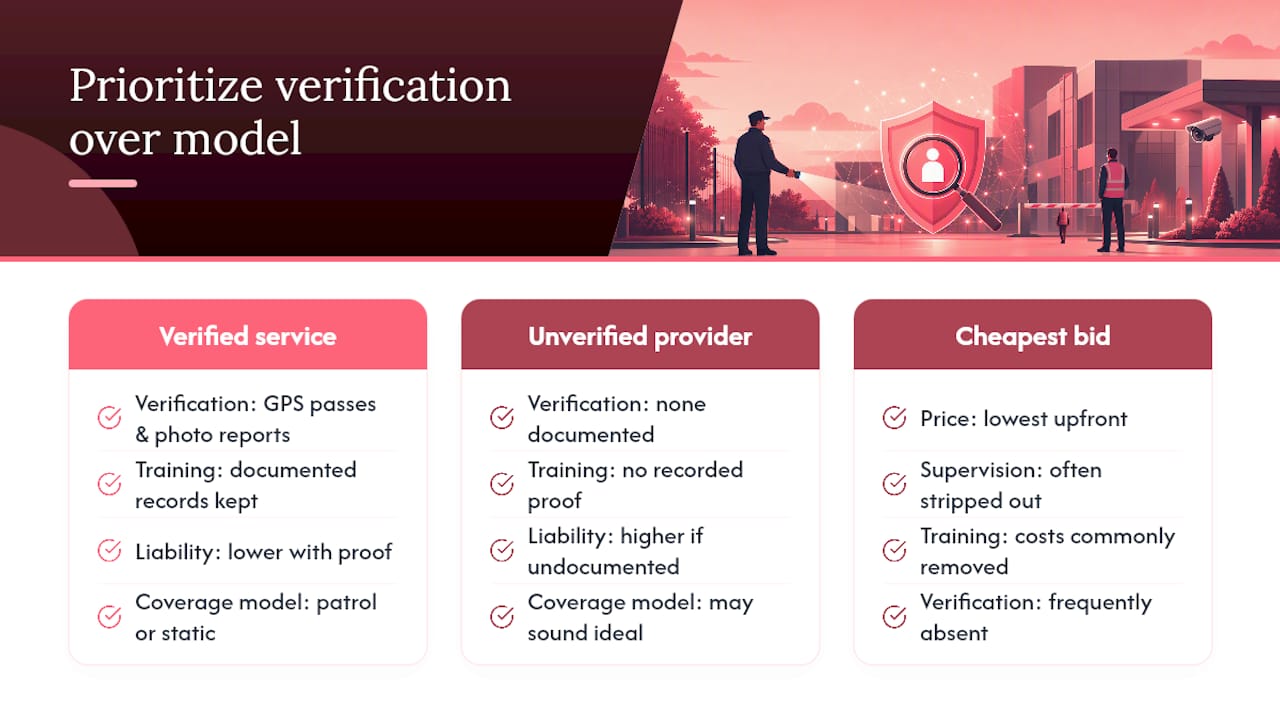
Most overnight security advice stops at “get a guard” or “install cameras,” as if the model matters more than the verification behind it. It doesn’t. A static guard with no documented training record is a bigger liability than a well-run patrol service with GPS-verified passes and photo reports. The conventional wisdom treats coverage type as the decision; the real decision is whether the provider can prove what happened overnight, not just claim it.
Here’s what I’d push back on: facility managers often chase the cheapest bid because security feels like a commodity line item. It isn’t. The cheapest bids routinely strip out supervision and training costs, and that gap surfaces exactly when you need coverage to work, during an actual incident, not during a sales pitch.
Prioritize verification systems first, coverage model second. A mediocre model with airtight documentation beats a perfect-sounding model with none.
Get Overnight Coverage Built Around Your Property, Not a Template
Hubsecurityandinvestigativegroup builds overnight coverage around what your property actually needs, not a one-size package sold to every commercial client in Boston. If the checklist above sounds like more diligence than most vendors want to provide, that’s the point: it’s the diligence that keeps a cheap bid from becoming an expensive mistake six months in.
Our team brings risk assessments that map your actual exposure hours before recommending static coverage, mobile patrol, or a hybrid post-plus-patrol model, so you’re never paying for continuous staffing your property doesn’t need. For properties with higher-profile risk, from executives to sensitive retail operations during layoffs, our executive protection services in Boston extend the same documentation standard: written post orders, verified patrol reporting, and a COI that names you as additional insured.
Start with a short site risk assessment. It’s the fastest way to find out whether your property needs a guard standing post or a well-documented patrol running randomized passes overnight, and it costs far less to find out now than after an incident.
Sources
- Hiresecuritynow
- Mobile Patrol vs. Dedicated On-Site Guards: Which Cost Structure Fits Your Property? – Safety Host Unit
- Mobile Patrol vs. Static Guards: Choosing the Right Mix for Your Property | AGS Protect Security Insights
Recommended
- Hotel Security Management: What Every Property Must Require
- The Ultimate Guide to Business Security: Protecting Your Assets, Employees, and Future – Hub Security & Investigative Group
- How Professional Security Guards Prevent Crime on Commercial Properties – Hub Security & Investigative Group
- Professional Security Guards Prevent Crime on Properties