
Skip tracing is the lawful, methodical process of locating someone who has moved away from their known contact information, when the search is done for a permissible purpose and relies on legally obtained data. It’s a discipline built for finding people who owe money, need to be served with legal papers, or have simply lost touch with family. Skip tracing basics start with one non-negotiable rule: you need a legitimate reason to search, and you need to source your information legally.
Common lawful uses include:
- Serving legal process on a defendant who has changed addresses
- Locating a debtor for collection purposes
- Reconnecting missing persons with family or reuniting heirs with an estate
- Verifying an address before a real estate transaction or eviction filing
Skipping the legal groundwork isn’t a shortcut. It’s the difference between a defensible investigation and a lawsuit waiting to happen.
Key Takeaways
Lawful skip tracing depends on establishing permissible purpose first, then verifying every lead across independent sources before making contact.
| Point | Details |
|---|---|
| Permissible purpose comes first | Never search without a legitimate legal, financial, or personal reason tied to a lawful use case. |
| Follow the four-stage workflow | Gather identifiers, search outward from confirmed facts, verify results, then make contact. |
| Recency beats volume | A recent utility record or employment filing outweighs several older public records. |
| Pretexting is a hard stop | Any provider offering bank balances “on demand” is describing a federal crime, not a service. |
| Hire Hub Investigative Group for complex cases | Licensed investigators document permissible purpose and chain of custody for cases involving fraud, evasive subjects, or court proceedings. |
Table of Contents
- What Is Skip Tracing and Where Is It Used?
- How to Skip Trace: A Step-by-Step Workflow
- Skip Tracing Techniques and Sources Worth Knowing
- What Are the Legal Limits on Skip Tracing?
- Tools, Costs, and When to Bring in a Professional
- Why Licensed Investigators Handle the Harder Cases
- A Verification Checklist for Every Skip Trace
- Hub Investigative Group’s Approach to Lawful Skip Tracing
- Sources
What Is Skip Tracing and Where Is It Used?
Skip tracing gets its name from the old phrase “skipping town,” referring to someone who leaves without a forwarding address. At its core, understanding skip tracing means recognizing it as a records-based hunt for a current, verified location, built from fragments of public and licensed data rather than guesswork.
The practice shows up across a surprising number of professions:
- Debt collectors use it to locate borrowers who stopped responding after a loan default.
- Process servers rely on it to find defendants who need to be personally served with a summons.
- Private investigators use skip tracing as one tool among many, often layering it with surveillance or interviews.
- Real estate professionals trace heirs or absentee owners before a probate sale or tax lien purchase.
- Families and volunteer groups use basic techniques to reconnect with missing relatives.
One distinction trips up almost every beginner: a skip trace is not the same thing as a Fair Credit Reporting Act (FCRA) consumer report. A skip trace answers “where is this person right now?” A consumer report, by contrast, is a regulated product used for decisions about credit, employment, insurance, or housing. If your goal is a hiring decision or a loan approval, you need an FCRA-compliant report from a Consumer Reporting Agency, not a locate service. Blending the two is one of the fastest ways an amateur skip tracer creates legal exposure for themselves or their client.
How to Skip Trace: A Step-by-Step Workflow
Professional skip tracing follows a fairly consistent sequence: gather identifiers, mine sources, verify results, then make contact. That order matters because each stage narrows your search and reduces the odds of chasing the wrong person entirely, according to Thomson Reuters’ overview of the process.
- Collect your starting identifiers. At minimum, gather the subject’s full legal name, date of birth, last known address, and any known aliases, relatives, or employers. The more identifiers you start with, the fewer false matches you’ll chase later.
- Search from confirmed facts outward. Begin with what you know is true (an old address, a former employer) and expand into new territory: neighbors, associates, and linked addresses. Resist the urge to jump straight to a paid database before exhausting free, confirmed leads.
- Verify and corroborate every lead. A single database hit isn’t proof of a current address. Cross-reference at least two independent sources before treating a location as reliable.
- Read recency indicators carefully. A record’s age matters as much as its content. A utility hookup from three weeks ago outweighs a five-year-old voter registration.
- Make right-party contact carefully. Confirm identity before disclosing sensitive information, and follow any applicable debt collection or process-serving rules for that jurisdiction.
Pro Tip: Keep a running log of every source you check, including the date and what it showed, even the dead ends. If the case ever escalates to a court affidavit of diligent search, that log becomes your evidence that you searched thoroughly and in good faith.
Skip Tracing Techniques and Sources Worth Knowing
Effective skip tracing methods rely on layering different types of sources, since no single database tells the whole story. Public records remain the backbone of any search. Property deeds, court dockets, and voter rolls are typically free, and they create a durable paper trail because they rarely disappear once filed. Their weakness is timing: a deed recorded two years ago tells you nothing about where someone lives today.
Paid databases fill that gap. They aggregate scattered public data and add recency signals, like recent utility connections or employment filings, that indicate whether an address is still live. LegalClarity’s overview of skip tracing notes that these recency indicators are often what separates a stale lead from a workable one.
Databases that flag recency are widely understood to improve the odds of reaching the right person on the first attempt, rather than burning contact attempts on outdated addresses.
Social media and open-source intelligence (OSINT) add a different kind of signal entirely:
- Check tagged locations, employer listings, and mutual connections on public profiles.
- Watch for check-ins, event RSVPs, or marketplace listings that hint at a current city.
- Cross-reference usernames across platforms to spot aliases.
Human sources close the remaining gaps. A quick, polite call to a former neighbor or employer can confirm what three databases only suggested. Private investigator training resources consistently list associate interviews alongside database work as a core technique, precisely because people often know things no record will ever show. Field verification, physically confirming a vehicle or mail at an address, remains the gold standard when the stakes are high enough to justify it. For a deeper look at combining digital sources with fieldwork, our OSINT primer breaks down search tactics in more detail.
What Are the Legal Limits on Skip Tracing?
Permissible purpose is the single concept every skip tracer, amateur or professional, must understand before running a search. It means you have a specific, legally recognized reason to seek someone’s information: serving legal papers, collecting a legitimate debt, or reuniting a missing person with family all qualify. Curiosity does not.
The FCRA draws a hard line around consumer reports. If the information you gather will factor into a credit, employment, insurance, or housing decision, you’re legally required to obtain it through an FCRA-compliant consumer report, not a standard skip trace. Treating a locate service as a substitute is a common and costly mistake.
The Gramm-Leach-Bliley Act (GLBA) protects nonpublic financial information and criminalizes pretexting, the act of lying to obtain someone’s financial data. This is the bright line that separates legitimate research from a federal crime.
Any provider advertising “bank balances on demand” or offering to call a bank while impersonating the account holder is describing pretexting outright, not a service worth trusting.
The Driver’s Privacy Protection Act (DPPA) restricts access to DMV records to a narrow list of permitted uses, and most states require a private investigator license to perform locates for hire. ProofServe’s guidance for attorneys points out that hiring an unlicensed vendor can turn a routine locate into a regulatory problem, even when the underlying search itself was legal. Watch for these red flags:
- Any vendor promising instant access to bank or brokerage account details
- Search firms that won’t disclose their state licensing status
- “Guaranteed” results on hard-to-find subjects, which usually signals corner-cutting
Tools, Costs, and When to Bring in a Professional
Free public records handle a large share of basic cases: locating someone with a common name in a small town, or confirming an address tied to a property deed. When those sources dry up, the next tier is paid people-search platforms, which typically run from a few dollars per lookup to monthly subscriptions in the tens of dollars, depending on the depth of data and how many recency indicators they include, per LegalClarity’s cost breakdown.
Licensed private investigators price their work differently, usually by hourly rate or flat fee per case, with costs scaling based on how difficult the subject is to find and how much fieldwork the case requires. Several factors point toward hiring a pro rather than continuing solo:
- The subject is actively evading contact or has a history of fraud
- The case may end up in court, requiring an affidavit of diligent search
- You lack a clear permissible purpose and need a compliance check before proceeding
- The search requires accessing licensed-only data sources
For straightforward name-and-address confirmations, private investigator ethics and DIY diligence often suffice. For anything with legal stakes attached, the cost of a licensed investigator is cheap insurance against a much larger problem.
Why Licensed Investigators Handle the Harder Cases
Hub Investigative Group has spent over two decades applying more than seventy-five years of combined law enforcement and loss prevention experience to cases that go beyond a simple database search. Licensed investigators document permissible purpose in writing before a search begins, maintain a time-stamped chain of custody for every source checked, and corroborate findings across multiple independent records before reporting a location as confirmed.
Certain cases call for that level of rigor by default:
- Subjects with a documented history of evading service or collection
- Asset searches connected to a fraud or civil litigation matter
- Cases requiring surveillance or field verification, not just database work
- Situations where an affidavit of diligent search will be needed for a court
A defensible locate isn’t just about finding the right address. It’s about being able to prove, months later, exactly how and why you found it.
The gap between an amateur search and a licensed one usually shows up when a case gets challenged. Documentation is what holds up.
A Verification Checklist for Every Skip Trace
Before you consider a locate finished, run through a short checklist:
- Confirm minimum identifiers. Name, date of birth, last known address, and at least one alias or relative should all be on record.
- Cross-check across two or more independent sources. A single hit is a lead, not a confirmation.
- Weigh recency over volume. One recent utility record outranks ten old voter files.
- Log your search trail. Time-stamp every source, including dead ends, for audit purposes.
- Stop and consult counsel if pretexting, DPPA-restricted data, or unlicensed vendors enter the picture. These are hard stops, not judgment calls.
Pro Tip: Treat your search log the way an accountant treats receipts. You may never need it, but the one time you do, it’s the difference between a defensible case and an expensive mistake.
A Note on Cutting Corners
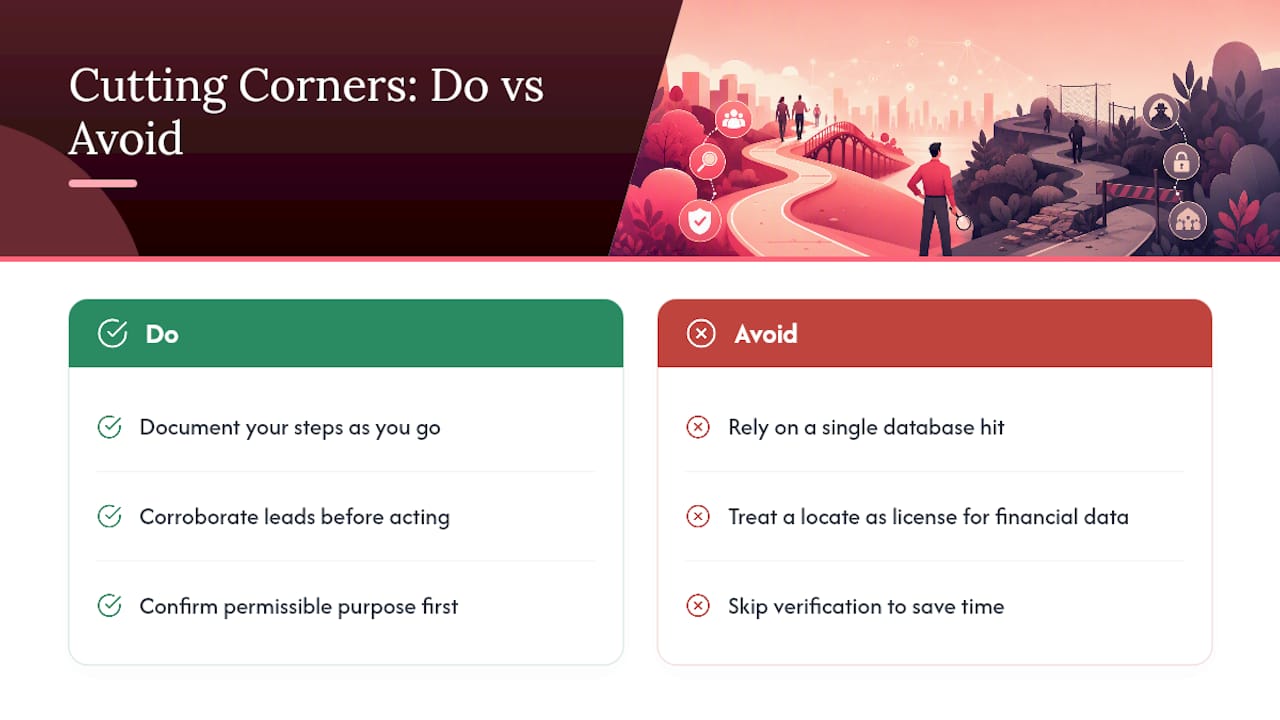
Skip tracing rewards patience far more than it rewards clever workarounds. The cases that go sideways almost always trace back to someone skipping verification because a single database hit felt convincing enough, or someone treating a locate as license to gather financial details they had no legal right to touch. Neither shortcut saves real time once you account for the cleanup.
The lesson that sticks with anyone who does this work seriously is simple: document as you go, corroborate before you act, and treat permissible purpose as the first question, not an afterthought. That discipline is what separates a repeatable, defensible process from a lucky guess.
— Derek
Hub Investigative Group’s Approach to Lawful Skip Tracing
When a case moves past what a public-records search can handle, Hub Investigative Group’s private investigation services bring licensed, documented rigor to the search rather than a database subscription and a guess. Every engagement starts with a clear statement of permissible purpose and follows a chain of custody that holds up if the case ends up in court.

Our investigators combine public-record searches, licensed database access, and field verification when a subject is actively difficult to locate, backed by decades of combined law enforcement and loss-prevention experience. That mix matters most in asset searches, fraud investigations, and cases requiring surveillance, situations where a wrong guess or a compliance misstep carries real consequences. If you’re weighing whether a case needs a licensed investigator, our private investigation services page outlines what a consultation covers and what to expect from the first call. Reach out to start that conversation before a deadline forces a rushed decision.
Sources
- Fair Credit Reporting Act (FCRA) — FTC transcription (March 2026)
- What is skip tracing? An overview — Thomson Reuters Legal
- What is Skip Tracing? Techniques and Tools for PIs — Investigative Academy (NITA)
- The legal limits of skip tracing for attorneys — ProofServe
This article is general information, not a substitute for advice from a qualified lawyer. Consult a qualified legal professional about your own circumstances before acting on anything here.
Recommended
- Police vs Private Investigators Who Better: Understanding the 7 Key Differences – Hub Security & Investigative Group
- Amazing PI’s Organization Guide’s: 5 Critical Reasons Why Structure Matters in Private Investigation – Hub Security & Investigative Group
- What Amazing Things Private Investigator Actually Do? The Ultimate Guide – Hub Security & Investigative Group
- How Katz v. United States Shapes Modern Private Investigation – Hub Security & Investigative Group