Armed vs Unarmed Security: 2026 Decision Guide

The right choice between armed and unarmed security guards comes down to three factors: your risk profile, your budget, and the environment you need to protect. There is no universal answer, but there is almost always a clear answer once you map those three factors honestly.
Here is the core comparison at a glance:
- Armed guards carry firearms and are authorized to use lethal force when legally justified. They provide strong deterrence, active threat response, and are suited to high-risk environments. They also carry significantly higher costs, stricter licensing requirements, and elevated liability exposure.
- Unarmed guards rely on presence, observation, de-escalation, and reporting. They are cost-effective, less intimidating to the public, and appropriate for moderate to low-risk settings.
- Training requirements differ sharply: unarmed guard training varies from 0 to 40+ hours by state, while armed guards must complete firearms qualification and ongoing requalification in every U.S. state.
- Insurance premiums for armed security are substantially higher than for unarmed coverage due to use-of-force liability.
- Licensing for armed guards requires a security-specific firearms endorsement. A personal concealed-carry permit does not qualify.
Table of Contents for Armed vs Unarmed
- What armed vs unarmed security guards actually means
- How unarmed security guards are trained and deployed
- What armed security guards are trained to do
- Key differences between armed and unarmed guards
- When unarmed security guards are the right choice
- When armed security guards are justified
- How to decide between armed and unarmed security guards
- Licensing, insurance, and liability: what you need to know in 2026
- Key Takeaways
- Hubsecurityandinvestigativegroup: matched protection for your risk level
What armed vs unarmed security guards actually means
Both armed and unarmed security guards are licensed, state-regulated professionals. The distinction is not simply about who looks more intimidating. It reflects a fundamental difference in legal authority, training depth, and the scope of force each guard is permitted to use.
An unarmed security guard is a licensed professional whose primary tools are visibility, communication, and situational awareness. They observe, deter, report, and coordinate with law enforcement. They do not carry firearms, though some may carry non-lethal tools like pepper spray depending on state law and employer policy.
An armed security guard holds an additional firearms endorsement on top of their base security license. They are authorized by their employer to carry a firearm at a specific post and are trained to operate within a use-of-force continuum that extends to lethal force when legally justified. That authorization is post-specific and employer-granted. It is not a blanket permission that travels with the guard.
How unarmed security guards are trained and deployed – Armed vs Unarmed
Unarmed guards form the backbone of most commercial security operations in the United States. Their role centers on deterrence and documentation rather than physical intervention.
Core duties typically include:
- Access control and visitor screening
- Foot and vehicle patrols
- Incident observation and detailed reporting
- Customer service and public interaction
- Emergency response coordination with law enforcement
- Basic first aid and evacuation support
Training requirements for unarmed guards vary more than most people realize. State licensing requirements range from zero mandatory training hours in some states to 40 or more hours in others, covering topics like report writing, legal authority, emergency procedures, and conflict de-escalation. Most states require a background check and some form of licensing exam.
Unarmed guards are well-suited to retail environments, office buildings, residential communities, hospitals, schools, and public events where the primary goal is deterrence and a visible, approachable presence. That said, unarmed status does not eliminate legal risk. Negligence claims involving wrongful detention, failure to prevent an incident, or rough handling remain real exposure for unarmed operations, making professional liability insurance non-negotiable regardless of armed status.

What armed security guards are trained to do Armed vs Unarmed
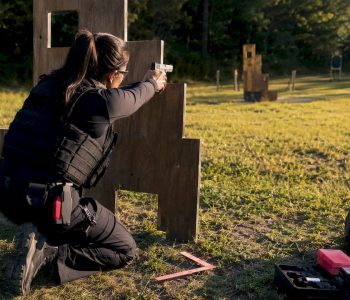
Armed guards operate under a more demanding regulatory and operational framework. Every U.S. state requires a firearms endorsement on top of the base security license, and that endorsement is tied to specific employer authorization for a specific post. A civilian concealed-carry permit does not substitute for this credential.
Armed guard licensing and training typically includes:
- State-issued armed guard card or firearms endorsement
- Live-fire qualification testing
- Annual or biannual requalification
- Legal standards for deadly force and use-of-force continuum
- De-escalation and scenario-based judgment training
- FBI background check and, in some states, psychological evaluation
Armed guards must maintain current firearms qualification through regular live-fire t
 raining and legal update courses, requirements that far exceed what unarmed guards face. In states like New York, armed training runs 47 hours; Texas requires Level III certification at 45+ hours; Florida mandates 28 hours with annual requalification.
Deadly force is legally justified only when a guard reasonably believes it is necessary to prevent death or serious bodily injury. Property protection alone does not meet that threshold. Every armed deployment must include a clear scope of work that defines exactly when and how force may be introduced.
Environments where armed guards are typically deployed:
- Banks, credit unions, and financial institutions
- Jewelry stores and high-value retail
- Government and critical infrastructure facilities
- Executive protection details
- Cash-in-transit operations
- Locations with documented histories of violent incidents
Key differences between armed and unarmed guards
The table below captures the dimensions that matter most to decision-makers evaluating armed vs unarmed guards.
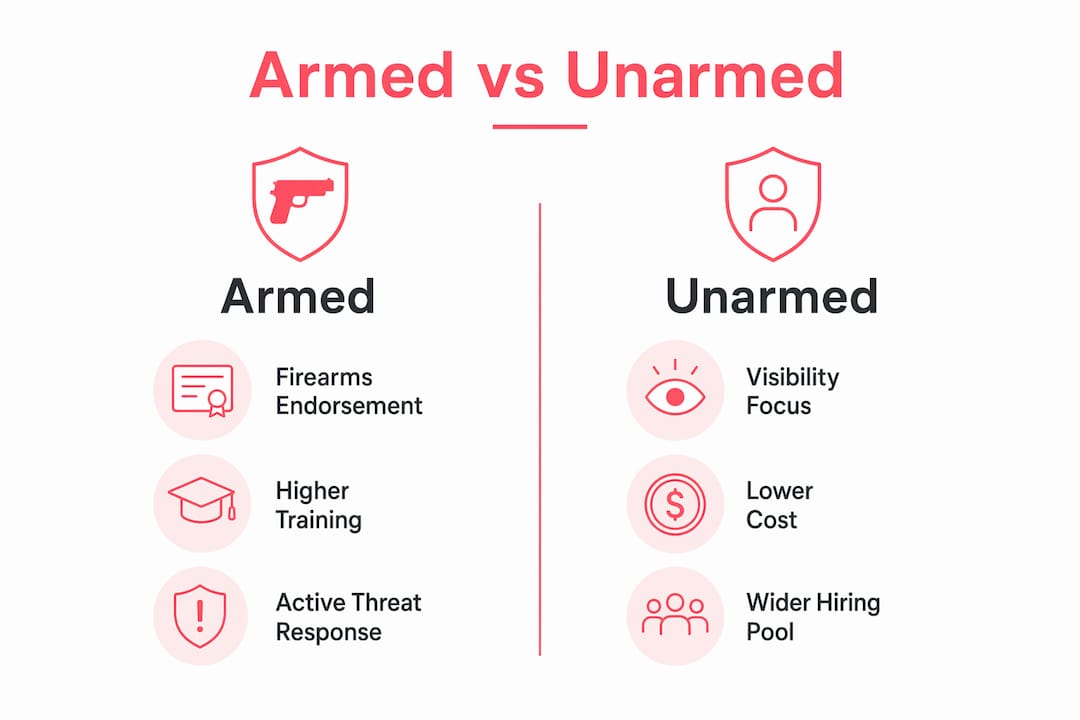
| Dimension | Unarmed Guards | Armed Guards |
|---|---|---|
| Training requirements | 0–40+ hours by state; focus on observation, reporting, de-escalation | Firearms qualification + base license; annual/biannual requalification mandatory |
| Response capabilities | Deterrence, observation, reporting, non-lethal intervention | Full use-of-force continuum including lethal force |
| Cost | Lower payroll, standard insurance premiums | Higher payroll, significantly higher premiums often several times unarmed rates |
| Liability exposure | Negligence, wrongful detention, failure to prevent | All unarmed risks plus criminal charges, wrongful death, massive civil damages |
| Licensing complexity | Base security license; varies by state | Base license plus armed endorsement; employer authorization required per post |
| Public perception | Approachable, community-friendly | Authoritative deterrent; can feel intimidating in some settings |
Additional differences worth noting:
- Armed guards require employer-specific post authorization, not just a personal permit
- Insurance underwriting for armed operations involves psychological evaluation history and weapons handling records
- Armed presence can be counterproductive in high-public-interaction settings where de-escalation is the priority
- Operational complexity increases with armed deployments: scope-of-work documentation, use-of-force policies, and incident reporting protocols all require greater rigor
When unarmed security guards are the right choice
For most commercial and community environments, unarmed security delivers strong results at a manageable cost and liability level. The key is matching the guard type to the actual threat profile, not the perceived one.
Unarmed guards are the right fit when:
- The primary risk is theft, trespassing, or unauthorized access rather than violent confrontation
- High public interaction is central to the operation (retail, hospitality, healthcare)
- Budget constraints make armed premiums and payroll unsustainable
- The environment benefits from an approachable, service-oriented presence
- Licensing simplicity is a priority, particularly for multi-state operations
- The goal is deterrence, documentation, and rapid escalation to law enforcement
The unarmed security advantages here are real. Lower insurance costs, a broader hiring pool, simpler regulatory compliance, and better community relations all contribute to a more sustainable security program. For commercial property security, unarmed guards covering access control, patrols, and incident reporting often provide exactly the layered protection a business needs without the operational burden of an armed program.
The limitation is clear: in a genuine active-threat scenario, an unarmed guard can delay, report, and coordinate, but cannot neutralize the threat. That limitation is acceptable in most environments. It becomes unacceptable when the risk profile genuinely warrants armed response capability.
When armed security guards are justified
Armed security is not a status upgrade. It is a specific operational decision that should be driven by documented risk, not perception or preference. The liability for armed guard incidents is exponentially higher than for unarmed incidents, and misuse of lethal force can result in criminal charges and severe civil damages for both the guard and the hiring entity.
Armed security is justified when:
- The location handles high-value assets with documented theft or robbery risk (banks, jewelry stores, cash-in-transit)
- Credible threat intelligence or a history of violent incidents exists at the site
- The environment requires active deterrence against armed adversaries
- Executive protection or VIP security demands a higher tier of response capability
- Regulatory or contractual requirements mandate armed coverage
- Law enforcement response times in the area are insufficient for the risk level
The decision should follow a formal risk assessment, not intuition. When the threat profile clearly shows that an unarmed guard’s response ceiling is insufficient, armed coverage is the responsible choice.
How to decide between armed and unarmed security guards
A structured decision process protects you from both under-protecting a high-risk site and over-deploying armed resources where they create more liability than safety.
Work through these decision factors in order:
- Threat assessment: What is the documented history of incidents at this location? What does local crime data show? Has a formal security assessment been conducted?
- Asset value: What are you protecting, and what is the financial and reputational cost of a breach?
- Public interaction level: Will guards interact frequently with customers, residents, or visitors? High interaction favors unarmed.
- Budget: Can you sustain the higher payroll, insurance premiums, and compliance costs of armed coverage long-term?
- Regulatory requirements: Does your industry, contract, or jurisdiction mandate armed coverage?
- Insurance implications: Have you consulted your insurer about how armed versus unarmed deployment affects your policy limits and premiums?
Understanding security guard pricing factors before you commit to a contract helps you build a realistic budget that accounts for all cost drivers, not just the hourly rate.
Pro Tip: Before signing any security contract, request the vendor’s current insurance certificates and training records. If an armed security company cannot produce up-to-date firearms qualification records for every guard assigned to your post, your liability exposure increases because you failed to vet your vendor properly. This is one of the most overlooked risks in security procurement.
Licensing, insurance, and liability: what you need to know in 2026
The U.S. security industry operates under a state-by-state licensing framework with no single federal standard. That variation creates real compliance complexity, especially for organizations operating across multiple states.
Key licensing facts for 2026:
- All U.S. states require a firearms endorsement for armed guards, layered on top of the base unarmed license
- Armed endorsements require live-fire qualification and regular requalification, typically annually or biannually
- Employer authorization is mandatory for a guard to carry on duty; this shifts real liability to the hiring entity beyond the guard’s personal permits
- Some states now require psychological evaluations as part of armed licensing
- Working armed without a valid license is a criminal offense in most states
On the insurance side, the gap between armed and unarmed coverage costs is substantial. Insurance premiums for armed security are often several times higher than for unarmed coverage, driven by the use-of-force risk that insurers must underwrite. Armed policies require higher minimum liability limits, more rigorous vetting of guard history, and explicit firearms liability coverage.
Insurance reality check: Unarmed security is not low-risk by default. Professional liability coverage remains critical for unarmed operations because negligence claims, wrongful detention suits, and failure-to-prevent incidents generate real financial exposure. The difference is scale: an unarmed incident might produce a manageable lawsuit; an armed incident can produce criminal charges and seven-figure civil damages.
For organizations managing security across multiple sites, dispatch and scheduling software helps maintain compliance documentation, track guard certifications, and ensure the right credential level is deployed to each post.
Key Takeaways
The right guard type is determined by documented risk, not assumption. Armed guards offer greater response capability but carry costs and liability that only high-risk environments can justify.
| Point | Details |
|---|---|
| Risk profile drives the decision | Low to moderate risk environments are almost always better served by unarmed guards. |
| Armed licensing is layered | Every state requires a firearms endorsement plus employer post authorization; a concealed-carry permit is not sufficient. |
| Insurance costs differ significantly | Armed security premiums are often several times higher than unarmed rates due to use-of-force liability. |
| Unarmed guards still carry liability | Negligence and failure-to-prevent claims apply to unarmed operations; professional liability insurance is required regardless. |
| Hubsecurityandinvestigativegroup offers both | With over 75 years of combined law enforcement expertise, Hubsecurityandinvestigativegroup deploys armed and unarmed personnel matched to your specific risk profile. |
Hubsecurityandinvestigativegroup: matched protection for your risk level

When the decision between armed and unarmed protection has real consequences for your business, your people, or your assets, you need a security partner who has already done this analysis hundreds of times. Hubsecurityandinvestigativegroup, established in 2004 and built on over 75 years of combined law enforcement and loss prevention expertise, deploys both armed and unarmed personnel based on a formal assessment of your environment, not a default package.
We work with corporate clients, property managers, event organizers, and executives across the Boston area and beyond, providing professional security services that are calibrated to your actual risk profile. Whether your situation calls for an approachable unarmed presence at a community event or a fully credentialed armed detail for executive protection, we match the right personnel, training, and documentation to your specific post. Every engagement includes clear scope-of-work protocols and verified licensing.
Contact Hubsecurityandinvestigativegroup today to schedule a security assessment and get a protection plan built around your actual needs. We offer unarmed as well as armed security.
Recommended
- Combating Modern U.S. Security Threats: How Professional Security Guards Make a Difference – Hub Security & Investigative Group
- 24-Hour Security Guard Coverage vs. Alarm Systems: Which One Protects Your Property Better? – Hub Security & Investigative Group
- 24-Hour Security Guard Coverage vs. Alarm Systems: Which One Protects Your Property Better? – Hub Security & Investigative Group