
Most routine employment background checks typically return results within a few business days, though simple electronic database checks can finish the same day. The range widens considerably once a search spans multiple counties, requires a manual court pull, or includes FBI fingerprint processing, which can stretch to several weeks. The single biggest factor is scope: how many jurisdictions are searched and whether records come from an electronic repository or a courthouse clerk who must pull them by hand.
TL;DR:
- Electronic database and credit checks can return the same day, while single county searches take one to three business days with electronic court access.
- Criminal searches across several counties or states usually take three to ten business days, but broad searches and manual courthouse requests can stretch into weeks.
- Employment, education, and license verifications often take two to seven business days, and delays depend on how quickly past employers, schools, or boards respond.
- Applicants can reduce avoidable delays by submitting complete legal names, address histories, identity documents, and consent forms promptly, then requesting status from HR.
- A flagged record does not automatically disqualify an applicant; employers should assess the offense, time elapsed, and job relevance before deciding.
Table of Contents
- Typical turnaround times by background check type
- Factors that affect turnaround time
- Common delays, how to spot them, and what they mean
- How applicants and employers can speed up checks or check status
- Hub Security and Investigative Group: how professionals scope and manage turnaround expectations
- Balancing speed and fairness in background screening
- Reliable background checks through Hub Security and Investigative Group
- FAQ
- Sources
Typical turnaround times by background check type
Each type of screening draws on a different data source, and that source dictates the pace. Here is what to expect for the checks that come up most often in hiring and personal vetting.
- Database and identity checks: often minutes to the same day, since these pull from existing electronic records rather than live institutions.
- Single-county criminal searches: commonly 1 to 3 business days where the county offers electronic access; manual clerk lookups can take several days to a week.
- Multi-county or multi-state criminal searches: typically 3 to 10 business days, and searches covering many counties or states can extend to multiple weeks.
- Employment and education verifications: 2 to 7 business days on average, longer if a school registrar or a private employer’s HR department is slow to respond.
- Credit checks: usually same day to 1 business day for consumer-credit-report-based screens.
- Motor vehicle records (MVR): often same day to a few business days, depending on how quickly the state repository processes requests.
- FBI fingerprint-based and international checks: often several weeks, since FBI processing times vary and international checks depend on foreign government repositories that can take considerably longer.
A CFPB market snapshot of the screening industry confirms this spread: turnaround times can range from minutes to several weeks depending on what is being searched, with many standard criminal checks completing within a few business days. The same reporting notes that verification calls, meaning contacting a past employer, a school, or a licensing board, are frequently the slowest link in the chain, since the request depends on a third party’s response time rather than the screening firm’s own speed.
If you are an applicant staring down a multi-week wait, the delay usually has nothing to do with you personally. It reflects which counties are being searched and whether those counties still require someone to physically request a record.
Factors that affect turnaround time
Several operational and legal variables determine whether a check finishes in a day or a month. Understanding them helps you tell the difference between normal processing and something that needs attention.
- Court access model: states and counties with electronic repositories return results fast; others still require a clerk to manually pull paper files, which adds days.
- Scope of search: the more counties, states, or aliases included, and whether sealed or expunged records require special handling, the longer the process takes.
- Verification steps: confirming employment, education, or professional licenses means waiting on a third party, which can add days or weeks depending on how responsive they are.
- Identity issues: a mismatched name, an incomplete address history, or a Social Security number discrepancy forces an extra round of manual verification.
- Seasonality and volume: hiring surges, holidays, and high-volume stretches at clerk offices or screening firms can slow every request in the queue.
- Legal and procedural steps: FCRA notification requirements and the individualized assessment the EEOC recommends before taking adverse action both add time, by design, before a final decision is made.
On that last point, the EEOC’s enforcement guidance directs employers to weigh what are often called the Green factors, meaning the nature of the offense, how much time has passed, and the nature of the job, and to give an individualized assessment to any applicant who gets flagged by a criminal-history screen. That step is not a delay to route around. It is a safeguard that protects both the employer and the applicant from a decision made too quickly on incomplete information.
Pro Tip: Ask your screening provider upfront which counties in your search still require manual clerk pulls. That single question often predicts your actual turnaround better than any general estimate.
Common delays, how to spot them, and what they mean
Not every slow check is a red flag. Knowing the difference saves you from unnecessary worry or, on the employer side, from a candidate who disappears out of frustration.
- Normal delays include multi-jurisdiction searches still in progress, a pending response from a court clerk, or a verifier (a former employer or school) that has not yet replied.
- Problem indicators include long stretches of silence with no status update, a sudden request for additional identity documents with no explanation, or an adverse-action notice that arrives without any prior chance to respond.
- Dispute timelines matter here too. Screening companies generally have 30 days, with possible extensions in some cases, to investigate a dispute and must notify the consumer once the investigation closes, according to CFPB consumer guidance. That window can pause a hiring decision entirely while the dispute works through.
- When to escalate, ask for the screening company’s name directly, request a status update from HR, or file a formal dispute with the reporting agency, and keep a written record of every exchange along the way.
How applicants and employers can speed up checks or check status
A few concrete habits shave real time off most checks, and they cost nothing but a little upfront attention.
- Applicants: provide full legal names and complete past-address history, submit identity documents early, sign consent forms promptly, and ask for the screening company’s name and a copy of your report.
- Employers: scope the search to the role’s actual level of authority, collect complete candidate information upfront, name the screening vendor on the consent form, and set a realistic timeline expectation at the start.
- If an error surfaces, dispute it immediately and attach documentation; the FTC’s guidance for employer background checks confirms you are entitled to a copy of the report and a Summary of Rights before any adverse action is finalized.
A short message like “Your background check typically takes 3 to 7 business days; we will follow up either way” does more to reduce candidate anxiety and repeat check-in calls than any amount of silence.
Pro Tip: If a court record comes back with an error, requesting the official disposition directly from the clerk and submitting it to the screening firm is usually faster than waiting for the dispute process to run its full course.
Hub Security and Investigative Group: how professionals scope and manage turnaround expectations
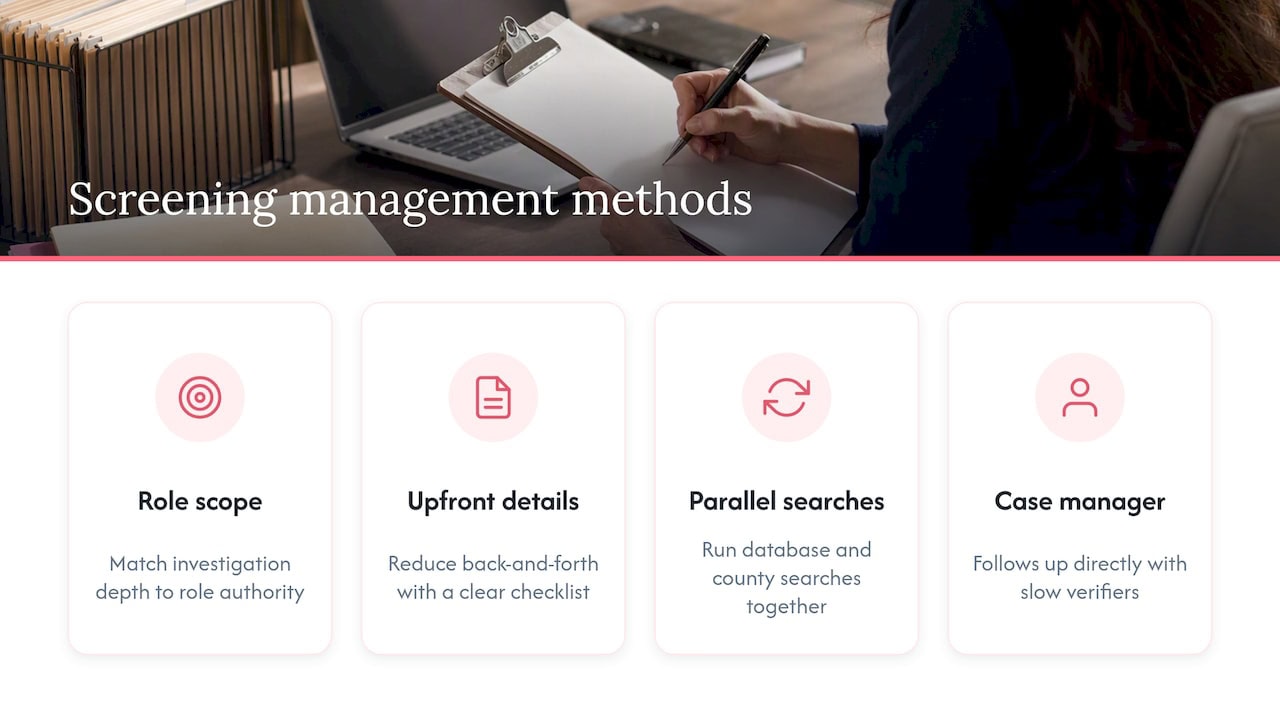
We approach every screening the way our executive background check scoping guidance outlines: match the depth of the investigation to the actual authority of the role, rather than running the same blanket search for every position. Our due diligence checklist gives HR teams and event organizers a clear list of what to hand us upfront, which cuts down on the back-and-forth that slows most checks. In practice, that means running database and county searches in parallel instead of in sequence, prioritizing the jurisdictions that matter most to a hiring decision, and assigning a dedicated case manager who follows up with slow verifiers directly. For executive vetting or event security screening, where the stakes of an incomplete picture are higher, that kind of hands-on management is what keeps a thorough check from turning into an open-ended wait.
Balancing speed and fairness in background screening
Employers understandably want a fast answer, but a check that moves too quickly often skips the individualized review the EEOC calls for, and that creates real legal exposure. My view is that a reasonable buffer, often a few extra business days built into the hiring timeline, costs far less than a rushed decision that gets challenged later. Candidates should not sit in silence either: if a check stalls past the expected window, requesting your own copy of the report is a reasonable and fair step, not an aggressive one.
— Derek
Reliable background checks through Hub Security and Investigative Group
Background checks are scoped to what the role actually requires, with case managers assigned from day one and jurisdictions prioritized to avoid delays from slower courts. For employers who need both speed and a defensible, FCRA-aware process, including help handling a dispute without derailing a hiring timeline, our background check services team can walk through your specific scope and give you a realistic estimate before you commit.

Reach out for a timeline estimate tailored to the roles or events you are screening for, and we will tell you upfront what to expect rather than leaving you guessing.
FAQ
How long does it usually take to hear back from a background check?
Most routine employment checks return results within 1 to 5 business days, though simple database checks can come back the same day. Checks involving multiple counties, manual court pulls, or FBI fingerprint processing often take considerably longer, sometimes several weeks.
Can a background check come back in 2 days?
Yes, a straightforward single-county criminal check or a database-based screen can often return in 1 to 3 business days when the jurisdiction offers electronic record access. Checks that require a manual clerk pull or verification from a third party typically take longer than two days.
Can you fail a background check and still get hired?
It depends on the employer’s policy and the nature of what the check found. The EEOC recommends an individualized assessment that weighs the offense, how much time has passed, and its relevance to the job before any exclusion decision is finalized, so a flagged result does not automatically end the process.
How can I tell if I passed my background check?
The clearest sign is simply receiving a job offer or confirmation to proceed, since most employers only notify candidates directly if there is a concern. If an employer plans to take adverse action based on the report, the FTC requires that you receive a copy of the report and a Summary of Rights before a final decision is made, giving you a chance to review and respond.
Sources
- Enforcement guidance on the consideration of arrest and conviction records in employment decisions (EEOC)
- Market Snapshot: Background screening (CFPB)
- Employer background checks and your rights (FTC)