
Good cash handling security comes down to five habits: keep less cash on site, limit who can touch it, split the duties so no one person controls a dollar from sale to bank, move deposits on a schedule with a sealed bag and a second person, and reconcile every day. This guide turns those habits into written procedures you can adopt, shows when a deposit escort or armored pickup makes sense, and explains the federal reporting rules that confuse most owners.
TL;DR
- Store cash in a locked, fireproof safe, give access to the fewest people possible, and change combinations when someone leaves.
- Never let one person collect, deposit and reconcile the same cash. Use two-person counts and sealed deposit bags.
- Deposit on a fixed schedule, and use an armored carrier or a trained escort when the amount or the route raises your risk.
- A $3,000 deposit is not suspicious by itself. The $10,000 federal threshold is about reporting, not about guilt.
- If a robbery happens, protect people first. Hand over the money, do not resist, and call 911 once the robber is gone.
Table of Contents
- Why written cash procedures matter
- Secure storage and access control
- Separate the duties
- Counting, documenting and reconciling
- Deposits: timing, sealed bags and escorts
- Federal cash reporting rules, and the $3,000 question
- If a robbery happens
- Perspective: what we see on the ground
- Where a security partner fits
- A one-page cash handling checklist
- FAQ
- Sources
Why written cash procedures matter
Cash losses rarely come from a dramatic event. They come from small gaps: a drawer shared by two cashiers, a safe combination nobody changed after a resignation, a deposit bag left on a desk overnight. A written procedure closes those gaps because everyone knows what to do and a missed step is visible.
The second reason is safety. Cash on hand is what makes a location a target, and the people carrying it to the bank are the most exposed. The OSHA-hosted workplace violence prevention checklist treats cash handling as part of protecting employees: limit the cash in registers, use drop safes or lockboxes, and test locks, cameras, lighting and alarms regularly. If you want the wider picture, our workplace violence prevention guide covers the human side.
Secure storage and access control
Start with where cash sits between the sale and the bank.
- Locked, fireproof storage. The West Virginia State Treasurer’s Cash Receipts Handbook says cash should go immediately into a locked fireproof drawer, safe or other secure place, with access limited to the minimum number of authorized employees.
- Out of public view. Count and store cash where customers cannot see it. A visible cash office invites a robbery.
- Combinations and keys. Combinations and custody keys stay on the person responsible, never in a desk drawer. The University of Colorado’s cash control procedure calls for a named custodian at each cash location, periodic combination changes, a change whenever staff turn over, and limited keys.
- Lost keys. The OSHA-hosted checklist says to issue as few keys as possible and change locks when keys are lost or not returned.
- Drop safes. A drop safe lets a cashier move excess cash out of the drawer without being able to retrieve it. It is the single cheapest way to lower the amount a robber can get.
A practical rule for a small business: one named custodian, one backup, and a written list of who holds a combination. When someone on that list leaves, the combination changes that day.
Keep the technology side secure too
Cash procedures depend on the register and point-of-sale system telling the truth. If the POS drops offline mid-shift, cashiers improvise and totals stop matching. A shift manager who knows how to handle fixing POS network issues quickly keeps manual workarounds, and the errors that come with them, to a minimum.
Separate the duties
Segregation of duties is the control that catches both theft and honest mistakes. The idea is simple: the person who takes the money is not the person who records it, deposits it or reconciles it.
Here is how universities, which handle large volumes of cash and publish their rules, apply it:
- The University of San Diego requires deposits to be prepared by someone who did not collect the cash or open the mail, and requires daily balancing against register, receipt and mail-payment totals.
- Colorado State University’s cash handling policy says to separate handling from recording, and to use supervisor review when duties must be combined. It also requires a monthly change-fund count with results kept for audit.
Small businesses often cannot split every task across different people. When that is true, use a compensating control: the owner or a manager reviews the deposit slip against the register report, initials it, and sometimes does so without warning. The University of Colorado procedure uses the same logic of compensating controls where one-person access cannot be avoided.
A simple duty split for a five-person shop
| Task | Who does it | Who checks it |
|---|---|---|
| Ring sales and take payment | Cashier | Register report |
| Count the drawer at close | Cashier plus shift lead | Both initial the count sheet |
| Prepare deposit and seal bag | Shift lead | Manager signs the log |
| Carry or hand off deposit | Escort or armored carrier | Bank receipt |
| Reconcile bank receipt to register | Owner or bookkeeper | Monthly spot review |
Counting, documenting and reconciling
A count nobody can verify is worth very little. Build the paper trail into the routine:
- Issue a receipt for every sale and record the amount, date and payment type.
- Use blind counts. Cashiers count their drawer without seeing the expected total, which removes the temptation to adjust. Retail guidance such as this list of cash handling practices is common, but the principle is the same everywhere: assign each employee a specific drawer and audit regularly.
- Count with two people for larger amounts, out of public view. The Louisville Metro Police Department’s procedure for non-evidentiary currency requires two members to be present when depositing or withdrawing from a safe, with the reason, date, time and both signatures or code numbers in a safe log. A business can copy that safe log as is.
- Record reasons for every void, refund or adjustment, and have a supervisor sign off.
- Reconcile daily. Compare the count to the register total, investigate any difference the same day, and keep the notes. Colorado State requires retaining results for audit, and the University of Colorado requires reconciliation to the financial system no less than monthly.
Decide in advance what size of overage or shortage triggers a manager review. A shortage of a few dollars once is a training issue. The same shortage on the same shift every week is a pattern, and patterns deserve a closer look. Our guide to a defensible employee theft investigation explains how to handle that situation without creating legal exposure.
Deposits: timing, sealed bags and escorts
The longer cash sits, the more it is exposed. The West Virginia handbook calls for sealing deposit bags, depositing within one business day, and dual signatures on bank transfers. The University of Washington’s cash handling procedures recommend depositing when cash reaches $500 or at least weekly. Those are public-sector benchmarks, so set your own limit around what your insurance policy covers and what you can afford to lose.
When to use an armored carrier or escort
A bank deposit escort policy is simply a written answer to three questions: how much cash triggers extra protection, who goes with it, and what the route looks like.
A reasonable framework:
- Low amounts. One sealed bag, two employees sign it out, the trip happens at a varying time. Never use the same route and hour every day.
- Moderate amounts. Two people, or one employee plus a trained escort, in a vehicle rather than on foot.
- Large amounts. Armored carrier pickup. Colorado State’s policy recommends scheduling a one-time armored-carrier pickup for deposits of $5,000 or more.
Two habits matter on every trip. Avoid fixed patterns, and look for anyone who seems to be watching your departures. Our article on surveillance detection explains what to do if you think someone is following you.
For employees who carry money, OSHA’s guidance for lone workers in cash-heavy jobs is to cut the amount on hand. In its taxi driver robbery prevention sheet, NIOSH recommends making deposits during the shift and using cashless systems where feasible. The same logic fits a small retailer: more frequent small deposits mean less to steal on any one trip.
Federal cash reporting rules, and the $3,000 question
Owners often ask whether depositing $3,000 in cash is suspicious. By itself, no. Ordinary businesses deposit cash all the time, and there is no federal rule that flags a deposit at that level. Two separate rules cause the confusion.
Form 8300. A business that receives more than $10,000 in cash in one transaction, or related transactions, must report it. The IRS form is titled Report of Cash Payments Over $10,000 Received in a Trade or Business. According to the IRS guidance on Form 8300, it generally must be filed within 15 days of the transaction, and a written statement goes to each named payer by January 31 of the following year. The IRS reference guide adds that a business may voluntarily file for a suspicious transaction at or below $10,000.
Structuring. Splitting deposits to stay under $10,000 is itself a problem. FinCEN’s ruling on structuring describes depositing currency on multiple days in amounts just under $10,000 to avoid a currency transaction report as structuring. So do not break up a legitimate large deposit to keep it small. Make it in one piece and let the bank file what it must.
The practical takeaway: deposit what you took in, when you took it in, and keep clean records. Questions about a specific transaction belong with your accountant or attorney.

If a robbery happens
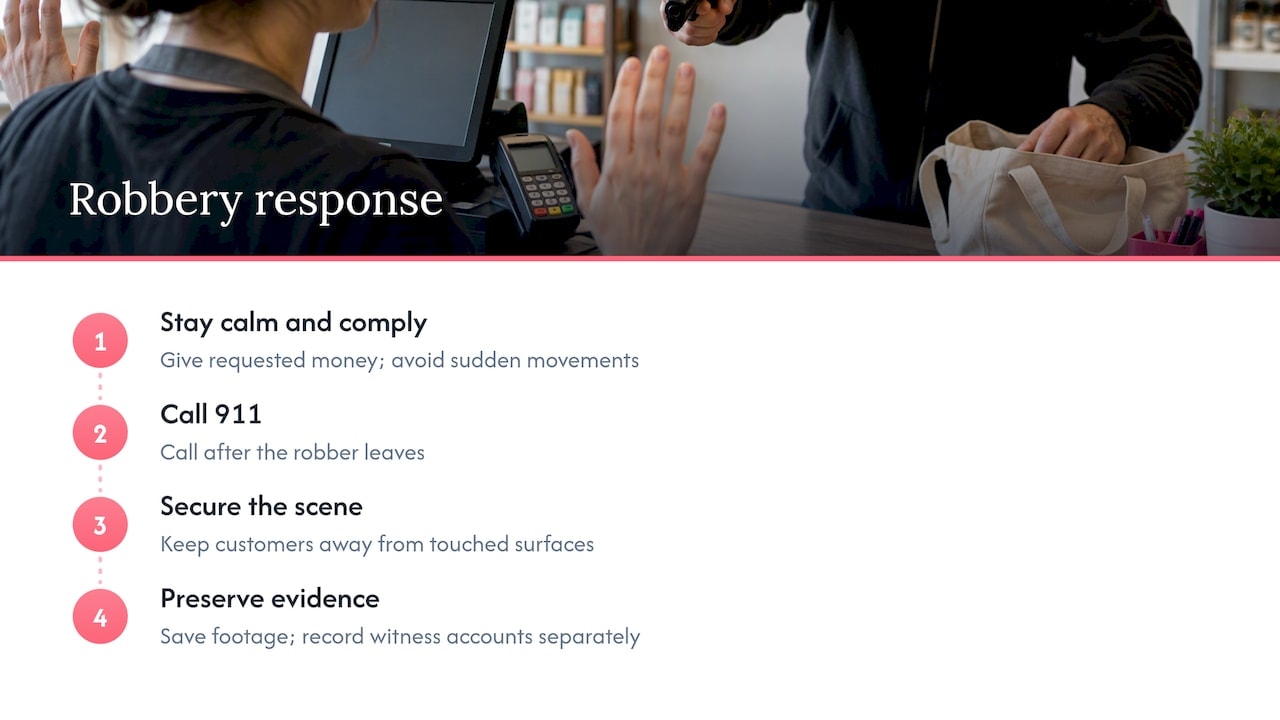
Put the procedure in writing and rehearse it, because no one decides well under stress. The OSHA-hosted checklist tells employees to stay calm, give the robber the money requested, avoid resisting or making sudden movements, note identifying details only if it creates no danger, and call 911 immediately after the robber leaves. NIOSH’s guidance says the same: let the robber take the money.
For tense situations that are not yet violent, CISA’s De-escalation Action Guide says imminent violence calls for immediate 911 contact. Otherwise staff should use your internal reporting channel and give factual details without guessing.
After the incident, secure the scene, keep customers away from touched surfaces, preserve camera footage, and write down what each witness saw before they compare stories.
Perspective: what we see on the ground
In our experience guarding Massachusetts retail, bank and commercial locations, the written policy is rarely the weak point. The weak point is the routine: the same employee, the same bank, the same time, every Friday. A written procedure that nobody varies is a schedule for someone watching.
We think about cash the way we think about every site, as a layered security approach. Lock and access control is the first layer, duty separation is the second, a visible guard or patrol is the third, and the escort or armored pickup is the last. No single layer is perfect, but together they push a would-be thief toward an easier target. Because we have worked on loss prevention since 2004, we start with prevention, not response, and we staff our own guards and dispatch rather than subcontracting, so the person on your site is someone we have trained and know.
We also tell clients not to let a guard turn a poor process into a risky one. An escort who carries a bag you never counted protects very little. Fix the count, the log and the schedule first, then add people.
— Derek
Where a security partner fits
Most small businesses can handle storage, counts and logs on their own. A trained guard becomes worth the cost at three points: opening and closing when cash is out, deposit runs above your comfort level, and sites with a history of theft or threats.
We provide armed and unarmed security guards for retail, bank, healthcare and commercial locations across Massachusetts, with GPS patrol tracking and 24/7 dispatch staffed by our own employees. New clients are matched with a guard within 24 to 48 hours of an approved quote. If cash shortages point to an inside problem, our investigators can help, and you can see the full range on our services page. For retail owners, our loss prevention strategies piece goes further on shrink.
A one-page cash handling checklist
- Named custodian and backup for every safe and drawer
- Combination and key list reviewed, changed when staff leave
- Drop safe in use, with a limit on drawer cash
- Two-person count above a set dollar amount
- Count sheet and safe log signed every time
- Sealed deposit bag, varied route and time
- Armored pickup above your own set threshold
- Daily reconciliation, with differences investigated the same day
- Monthly review by someone outside the cash process
- Written robbery response, rehearsed by every employee
FAQ
What are some examples of cash handling procedures?
Common ones include issuing a receipt for every sale, counting out of public view, storing cash in a locked safe, separating collection from deposit and reconciliation, sealing deposit bags, depositing within one business day, and reconciling daily. The West Virginia handbook lists all of these. Adapt the thresholds to your own risk and insurance.
Is depositing $3,000 in cash suspicious?
Not on its own. The $10,000 figure applies to Form 8300 reporting of qualifying business receipts. Suspicion comes from patterns, such as repeatedly depositing just under $10,000 to avoid a report, which FinCEN describes as structuring.
When should a business use an armored carrier or deposit escort?
When the amount, the route or your history of incidents makes a solo trip risky. Colorado State recommends armored-car pickup for deposits of $5,000 or more. For smaller amounts, two employees, a varied route and a trained escort can lower the risk.
How often should we audit cash handling?
Count and reconcile daily, and have someone outside the process review at least monthly. Colorado State requires change-fund counts at least monthly and permits announced or unannounced audits. Surprise checks catch more than scheduled ones.
Sources
- West Virginia State Treasurer, Cash Receipts Handbook
- OSHA-hosted workplace violence prevention checklist
- University of Colorado cash control procedure
- University of San Diego cash handling procedures
- Colorado State University cash handling policy
- Louisville Metro PD SOP 8.55
- University of Washington cash handling procedures
- NIOSH taxi driver robbery prevention sheet
- IRS Form 8300
- IRS guidance on Form 8300
- IRS Form 8300 reference guide
- FinCEN ruling on structuring
- CISA De-escalation Action Guide