
Counter-surveillance for executives is the work of finding out whether someone is watching you, your family, your home or your routes, and then acting before that attention turns into harm. It combines trained observation, route and routine planning, technical checks and a written risk assessment. This guide explains how the work is done, what you can do yourself, where your own efforts stop being enough, and how to decide on professional support.
TL;DR
- Counter-surveillance is about prevention: spotting and disrupting hostile observation early, not reacting once something has happened.
- It starts with a security risk assessment that reflects your visibility, your value to the organization and any history of threats.
- The most valuable skill is anomaly recognition: noticing what does not fit, not fearing every stranger.
- Technology helps, but advance work, predictable-routine control and trained people do most of the protecting.
- Scale the response to the assessed risk. A senior executive with a specific threat needs more than one with general public visibility.
Table of Contents
- What counter-surveillance actually means
- Why prevention is the point
- Start with the risk assessment
- How to detect surveillance: what trained people look for
- Where technology fits, and where it does not
- Surveillance versus undercover operations
- Matching the response to the risk
- Travel, events and the moments you are most exposed
- Our perspective
- Working with a Massachusetts team
- What you can do this week
- FAQ
- Sources
What counter-surveillance actually means
Surveillance is the observation of a person, place or activity. Hostile surveillance is observation done to prepare for something: a stalking campaign, a theft, a confrontation, a kidnapping attempt, or the collection of information to damage a company. Counter-surveillance is the set of measures that detect that observation and make it harder or pointless.
It is not paranoia. Being observed is normal in modern life: cameras, neighbors, delivery drivers, fellow commuters. The skill, as practitioners such as R. S. Suryavanshi describe it in a professional manual on surveillance and counter-surveillance tradecraft, lies in recognizing the anomaly: a change in the environment or in someone’s behavior that suggests intent rather than coincidence.
The goal is also not to confront anyone. The aim is to learn that interest exists, document it, and let a qualified team decide whether to adjust your routine, escalate to a threat assessment or involve law enforcement.
Why prevention is the point
Protective intelligence doctrine is clear on this. The U.S. Secret Service’s guidance for state and local officials describes threat assessment as gathering and assessing information about people who may have the interest, motive, intention and capability to mount an attack. Identifying those people early and managing the situation is far more effective than responding to an attack in progress.
For a corporate executive, the same logic holds on a smaller scale. A person photographing your home on three different days is a problem you can solve in week one. The same person is a much harder problem in week six. Our own approach to this is laid out in more detail in our piece on evidence-based protective intelligence for executives and security teams.
Start with the risk assessment
Before buying equipment or hiring a team, establish what you are protecting against. The ASIS International 2025 executive protection research reports that the foundation of an effective program is a comprehensive security risk assessment conducted before protective measures are put in place. The assessment weighs the executive’s visibility, their value to the organization and any historical threats, and from those it sets the scope and resources.
In practice, a useful assessment answers these questions:
- How public are you? Press coverage, conference speaking, social media, and corporate filings all place your name and often your address in front of strangers.
- What does your company do that could attract hostility? Layoffs, litigation, pricing disputes, a controversial product or a contested merger all raise your risk profile.
- Has anyone already shown interest? Unwanted letters, repeated contact, someone appearing at events, or online fixation all count.
- Where are you predictable? Fixed commute, the same gym at the same hour, the same restaurant on Fridays.
- Who else is exposed? Family members, assistants and drivers are often easier to watch than you are.
If you are in Massachusetts, we handle this through our security risk assessment service and through threat assessment services. If you are unsure which one you need, our guide to vulnerability versus risk assessment explains the difference.
How to detect surveillance: what trained people look for
Detection rests on a few principles that you can understand even if you leave the execution to professionals.
Establish your baseline
You cannot spot what is out of place until you know what normal looks like at each location. Who is usually on your street at 7:30 a.m.? Which vehicles are normally parked near the office garage? Trained teams walk and drive your routes in advance, often repeatedly, to learn the baseline. Anything that departs from it becomes a candidate for closer attention.
Look for repetition across time and place
One unfamiliar face is nothing. The same face at your home, at a restaurant and then at an airport is a pattern. The same applies to vehicles, which may change plates, colors or drivers while keeping a recognizable profile. Investigators we work with log observations precisely because a single sighting means little and three sightings in different settings mean a lot.
Watch behavior, not appearance
Hostile watchers rarely look suspicious. What gives them away is behavior: loitering without a clear purpose, a person who reacts to your movement a beat too quickly, someone who looks at their phone but never uses it, or a parked vehicle occupied for hours. Practitioners describe the discipline as controlling your attention. Even the best technology is of little use if you are staring at your phone instead of your surroundings, a point made in the tradecraft manual cited above.
Use surveillance detection routes
A surveillance detection route, or SDR, is a planned path with natural points where anyone following has to reveal themselves or break pattern: a choke point, a long straight street, a building with two exits. It is a professional technique. We do not suggest executives improvise one alone, particularly if a specific individual may be fixated on them, since the wrong reaction can escalate the situation.
Disrupt, do not just observe
Detection without disruption leaves you exposed. Varying departure times, rotating routes, changing vehicles, using a secure entrance, and limiting what is public about your calendar all reduce what a watcher can learn. Most of the value of a program comes from this unglamorous pattern disruption.
Where technology fits, and where it does not
Technical surveillance countermeasures (TSCM), usually called bug sweeping, check offices, homes and vehicles for hidden microphones, cameras and trackers. They matter if you discuss sensitive matters such as acquisitions, litigation strategy or personnel actions. But they are not the whole job. The 2025 ASIS research indicates that fewer than half of organizations use specialized cybersecurity tools or technical surveillance countermeasures in their executive protection programs, and effective security often depends on careful advance work and protective intelligence.
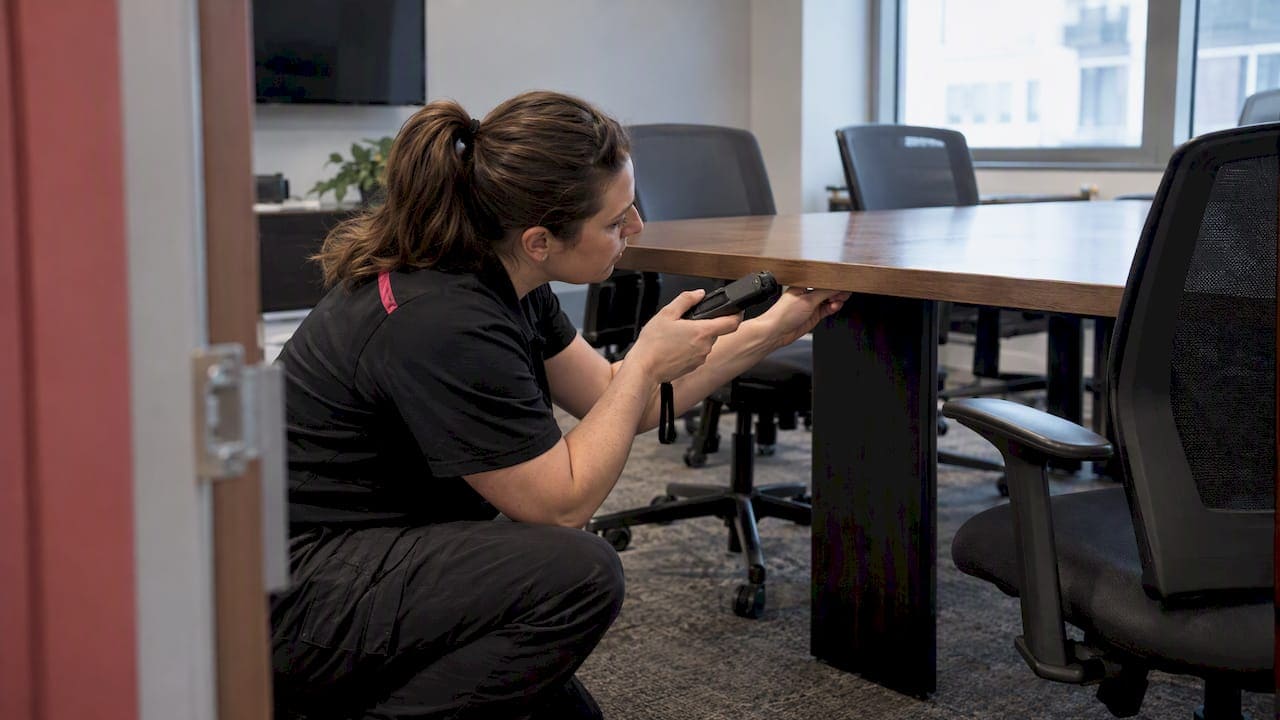
More data is not automatically better either. ASIS’s Security Management magazine has noted that high volumes of real-time alerts can create a fire-hose effect that distracts a team from its main duty of watching the person they protect. The point is targeted, high-value intelligence, not a wall of feeds.
The same research reports that open-source intelligence is the most common way organizations identify threats, used by more than half of surveyed security professionals, alongside social media monitoring, government crime reports and physical surveillance. For an executive, that means two things: someone should be looking at what the public can find about you, and someone should be watching for hostile attention aimed at you online as well as on the street.
Surveillance versus undercover operations
Readers often confuse these. Surveillance is observation: watching, photographing, documenting, usually from outside, without interacting with the subject. An undercover operation involves placing someone inside a setting under a role, such as an employee, to gather information through participation. Counter-surveillance concerns the first. It is defensive, looking for people who are watching you. Undercover work is an investigative tool, typically used for matters such as internal theft or workplace misconduct, and is a different engagement with different legal and operational considerations.
Investigators use many of the same surveillance techniques an adversary would: static observation points, mobile following with several vehicles, photographic documentation and pattern logs. That is exactly why people who have done this work are good at detecting it. They know what a surveillance team needs and what it leaves behind.
Matching the response to the risk
Not every executive needs a full-time team. Industry research shows how varied practice is: 38% of organizations provide 24/7 close protection for their most protected individuals, while 40% provide it at home and during travel only when a specific, identified threat exists. Protection scales with the assessed environment.
A practical way to think about tiers:
| Situation | Typical response |
|---|---|
| Visible executive, no known threat | Risk assessment, online exposure review, routine variation, awareness briefing for family and staff |
| Heightened profile (layoffs, litigation, controversy) | Added advance work on key venues, periodic counter-surveillance checks, secure transportation for sensitive dates |
| Specific, identified concern (stalking, direct threats) | Threat assessment, documented surveillance detection, close protection at home and in transit, coordination with law enforcement |
If stalking is the concern, our guidance for security leaders on opening a behavioral threat assessment intake when an executive faces stalking explains the steps and the paper trail that matter.
Travel, events and the moments you are most exposed
Surveillance is often easiest to conduct, and hardest to detect, when you are away from your normal environment. Hotels, airports, conferences and offsite meetings put you in unfamiliar surroundings with published schedules.
Sensible habits for travel include:
- Keep your itinerary limited to people who need it, and avoid posting plans in real time.
- Have your driver or team scout the hotel entrances and the route from the airport before you arrive.
- Request a room that is not publicly associated with your name or company.
- Carry only the documents you need, and keep copies of key travel documents separate from the originals so a loss or theft does not derail the trip.
- Vary routes between the hotel and meeting sites, particularly on multi-day visits.
For conferences, shareholder meetings and company events, advance work covers entry points, who is checking credentials and where you are exposed between the car and the door. Our event security planning playbook covers the venue side of this in detail.
Our perspective
At Hub Investigative Group, we draw on more than seventy-five years of combined law enforcement and loss prevention experience across our team, and that background shapes how we approach counter-surveillance. We have seen how often a problem that looked sudden had been visible for weeks to someone who knew what to look for.
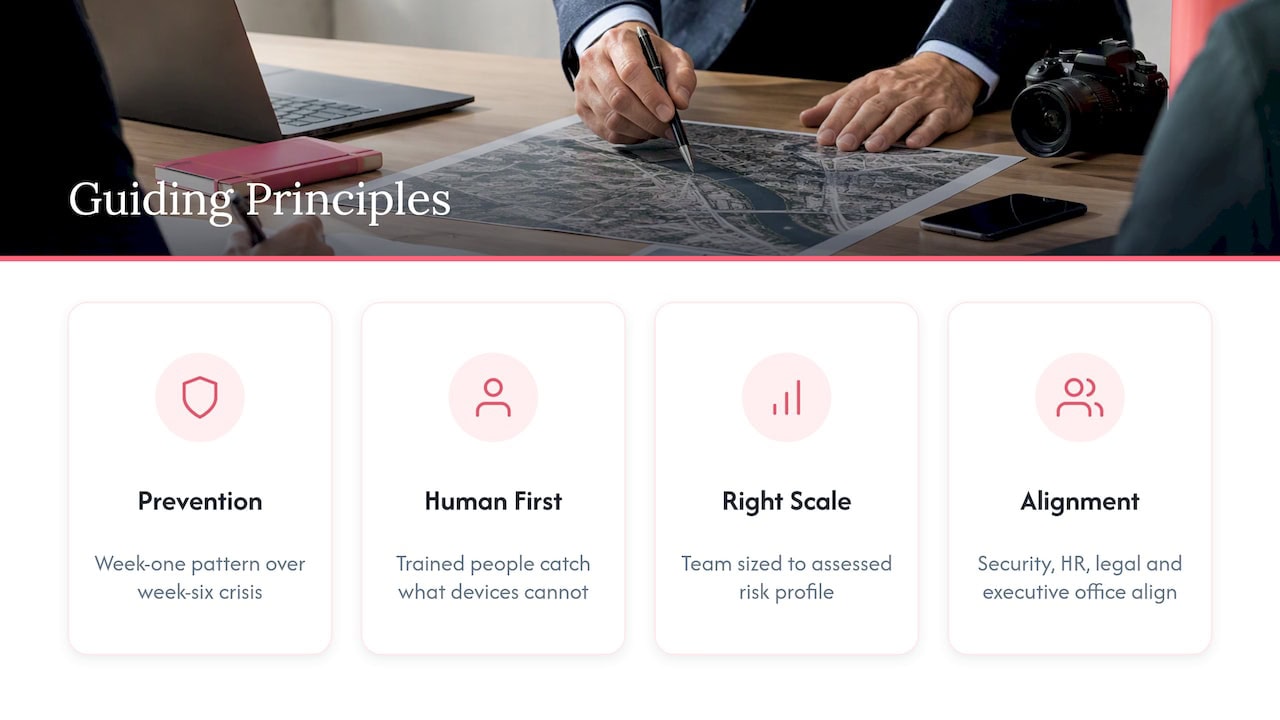
Three convictions guide our work. First, prevention beats response. We would rather have a quiet conversation about a pattern we noticed in week one than a crisis in week six. Second, the human element comes before the gadget. Equipment has a place, but a trained person who understands your routine and your risk profile catches what a device cannot. Third, scale matters. We do not believe every executive needs a visible detail, and we do not recommend one when the assessment does not support it. A lean management structure lets us build a team around your actual risk profile rather than around a rate card.
We also encourage clients to see protection as part of how the company manages risk overall. ASIS’s executive protection standard guidance frames executive protection as an integrated business capability tied to enterprise risk management, not just a bodyguard service. That is how we like to work: with security, HR, legal and the executive’s office aligned, so the person being protected is not left managing the program alone.
— Derek
Working with a Massachusetts team
If you need help in Boston or elsewhere in Massachusetts, we offer counter-surveillance services as part of a wider executive protection offering. Depending on your assessment, that can mean surveillance detection around your home and commute, advance work for events and travel, and coordination with executive protection planning or corporate executive protection if the risk warrants a closer detail.
We do not publish prices for these engagements because scope varies a great deal with your risk profile. For a sense of the factors that drive cost, see our guide on what to budget for executive protection. To discuss your situation confidentially, start from our services page or contact us through the Hub Investigative Group website.
What you can do this week
You do not need to wait for an engagement to improve your position. These steps cost little:
- Search for yourself the way a stranger would. Check what is public about your home address, your family and your schedule, and ask for removal where you can.
- Write down anything that felt off: date, place, a description, a plate if you caught it. Patterns only emerge from records.
- Brief your assistant, driver and family on what to report and to whom, without alarm.
- Change one routine element, such as departure time or parking spot, and see whether anything shifts.
- Do not confront anyone you suspect. Note it, move on safely, and call your security contact or law enforcement if you feel in danger.
If the notes start to show repetition, that is the moment to bring in professionals.
FAQ
What is the difference between surveillance and counter-surveillance?
Surveillance is watching a person, place or activity, usually to learn routines or gather information. Counter-surveillance is the defensive side: detecting that watching, documenting it and disrupting it. Professionals use the same techniques for both, which is why experienced investigators are effective at counter-surveillance.
How do I know if I am being followed or watched?
Look for repetition: the same person or vehicle appearing in unrelated places, or people whose behavior does not match their surroundings. One sighting is rarely meaningful, so keep notes and avoid confronting anyone. If you feel threatened, go to a public, staffed place and contact law enforcement.
Do all executives need counter-surveillance?
No. The right level depends on your assessed risk. Research shows organizations vary widely, with some providing round-the-clock close protection and others only acting when a specific threat is identified. A risk assessment tells you where you fall.
Is a bug sweep the same as counter-surveillance?
Not quite. A bug sweep, or technical surveillance countermeasures check, looks for hidden audio, video or tracking devices in a room or vehicle. Counter-surveillance is broader and includes physical detection of people watching you, route and routine planning, and online exposure review.
Sources
- ASIS International: The Executive Threat Environment, 2025 executive protection report
- U.S. Secret Service: Protective Intelligence and Threat Assessment Investigations
- ASIS Security Management: The Tech Advance, How Executive Protection Leverages Technology
- ASIS International: Introducing the ASIS Executive Protection Standard
- Surveillance and Counter-Surveillance Tradecraft, MIT Press Bookstore listing