
CPTED, short for crime prevention through environmental design, rests on four principles: natural surveillance, natural access control, territorial reinforcement, and maintenance. Some sources fold maintenance into territorial reinforcement or add activity support as a fifth, but the idea is the same. You shape a property so that legitimate people can see and be seen, offenders find fewer openings, and the site shows that someone is in charge. Below, we explain each principle with examples from the kinds of properties we protect in Massachusetts, and we show where design stops and people have to take over.
TL;DR
- CPTED has four widely used principles: natural surveillance, natural access control, territorial reinforcement, and maintenance.
- It is a problem-solving method for a specific place, not a product you buy or a checklist you finish once.
- Design is cheapest at the planning stage, but low-cost fixes such as lighting, trimmed landscaping, and clear signage work on existing sites too.
- Design alone is not enough. Studies and practitioners keep finding that active management and trained people determine whether a design works.
- Measure results against your own incident history so you know what is working.
Table of Contents
- What CPTED actually is
- The four CPTED principles, one by one
- A quick reference table
- Applying CPTED to different property types
- Why design alone is not enough
- Building a security culture around the design
- How to run a CPTED review of your own property
- Cost and timing
- Our perspective
- Where Hub can help
- FAQ
- Sources
What CPTED actually is
The core claim is simple: the built environment influences both the opportunity for crime and the fear of it. The City of Fontana’s guidelines describe CPTED as the idea that proper design and effective use of the built environment can reduce the fear and incidence of crime and improve quality of life. Researchers at the National Institute of Justice and the COPS Office go further and describe it as a problem-solving strategy rather than a fixed product. That means you start with the place: its crime patterns, its users, its layout. Then you design around what you find.
The question that drives the process, in the COPS Office guide, is “why here?” The same publication explains that opportunities for crime arise from conditions of the building, the site, its location, and how the place is used. A loading dock that is empty at night, a stairwell with no sightline, and a back gate that never latches are all answers to that question.
The four CPTED principles, one by one
Published lists vary. Some local handbooks name three elements, some name five, and one overview lists the four we use here. Treat them as lenses. You look at a site through each one in turn.
1. Natural surveillance
Natural surveillance means arranging physical features, activities, and people so that legitimate users can see what is happening and offenders feel watched. The Chandler, Arizona police department’s handbook describes it through low or see-through fencing, strategic landscaping, and lighting that minimizes shadows and concealment areas. The same handbook notes that lighting in parking facilities and other high-risk areas should meet recognized standards, such as those from the Illuminating Engineering Society.
What it looks like on a property:
- Windows and entrances that face parking areas and walkways instead of blank walls.
- Shrubs trimmed low and tree canopies lifted so sightlines stay open.
- Even lighting with few dark pockets, rather than one bright fixture and deep shadows beside it.
- Reception desks, offices, or patrol routes placed where staff can see doors and lots.
Lighting is the fix most owners can do quickly. We explain why it matters at homes in our piece on outdoor lighting for security, and the same logic applies to a retail plaza at 9 p.m. in January, when New England’s early darkness leaves lots empty and unobserved.
2. Natural access control
Access control guides people to the places they should be and makes it plain where they should not go. The COPS Office describes it as using physical and psychological barriers to indicate who belongs in a space and what they should be doing there. That can mean gates and locks, but also landscaping, walkway layout, and a single clearly marked main entrance.
On a real site, this principle usually comes down to a few decisions:
- Reduce the number of entry points you must monitor, then make the remaining ones obvious.
- Direct visitors past a reception point, a guard post, or a camera view before they reach tenants or inventory.
- Separate delivery, employee, and customer flows so an unfamiliar person stands out.
- Keep fences, doors, and gates working. A gate propped open for months teaches everyone that it does not matter.
How vehicles and pedestrians enter and exit a site is also a planning question, and planners write about it in detail. This guide to access management standards for planners and developers is a useful reference if you are involved in a new development or a site redesign and want to see how driveway and entry decisions get made.
3. Territorial reinforcement
Territorial reinforcement is the visible expression of ownership. People protect places they feel responsible for, and offenders read the signals. Clear boundaries between public and private space, such as a change in paving, a low wall, a planting bed, or a sign, tell visitors where they are entering. Tenants who personalize their entries and shared spaces tell outsiders that the place is watched.
Examples we see often in Massachusetts: apartment communities where shared courtyards are defined and furnished so residents use them, commercial parks where each building has a distinct entry and signage, and retail plazas where rules for loitering and parking are posted and enforced. The last part matters. A sign that nobody enforces is decoration.
4. Maintenance
Maintenance is sometimes left off the list, but it is the principle that keeps the other three working. Graffiti, burned-out lights, overflowing trash, and broken fencing all tell a would-be offender that nobody is paying attention. The City of Fontana’s materials describe visible deterioration as a signal that a place lacks active management or guardianship, which can invite further disorder.
For a property manager, this is the most practical principle because it is already part of your operating budget. A written inspection routine, fast repair of lights and locks, and same-day graffiti removal do more than most owners expect.
A quick reference table
| Principle | What it asks | Typical fix | Who keeps it working |
|---|---|---|---|
| Natural surveillance | Can legitimate users see the space, and can the space be seen? | Lighting, trimmed landscaping, open sightlines | Maintenance staff, patrol |
| Natural access control | Is it clear who belongs and where they go? | Fewer entries, gates, signage, reception points | Guards, property management |
| Territorial reinforcement | Does the site look owned and cared for? | Defined edges, signs, active shared spaces | Tenants, management |
| Maintenance | Does anything signal neglect? | Repair schedules, cleaning, graffiti removal | Facilities, management |
Applying CPTED to different property types
Parking lots and garages
Parking facilities deserve special attention. The National Institute of Justice notes that parking facilities are more likely settings for violent and property crimes than all other real estate except residences. CPTED here means bright, even lighting, clear sightlines to elevators and exits, limited entrances, and visible attendants or patrols. Our parking lot security guide for property owners walks through what to check.

Shopping plazas and retail
Plazas have many tenants, shared lots, and different closing times, which weakens territorial control. Aligning lighting schedules, defining the shared edge of the property, and placing a visible patrol presence help. See our shopping plaza security guide for seven ways to improve safety on that kind of site.
Apartment communities
Residential sites depend on who owns the common spaces. A recent NIJ-listed study of multi-unit apartments looked at the interplay of environmental design and management practices and found the association between design and safety is often shaped by how well a site is managed. If you operate residential buildings, our page on apartment security in Boston covers how guards support those layouts.
Construction sites
Construction sites are a special case, because the environment changes weekly. Temporary lighting, perimeter fencing, controlled gates, and after-hours monitoring become the working version of CPTED. Our construction site security page describes how we approach it.
Why design alone is not enough
This is the point most CPTED articles bury. Experts cited by the COPS Office describe CPTED as one component of a layered approach that works best with active patrols, community policing, and sound management policy. Relying only on physical changes tends to produce limited or temporary results.
The apartment study above points the same way: the effect of a design feature depends on whether the site is managed and maintained well. A well-lit lot with a broken camera and no one checking it is a design that has been left to decay.
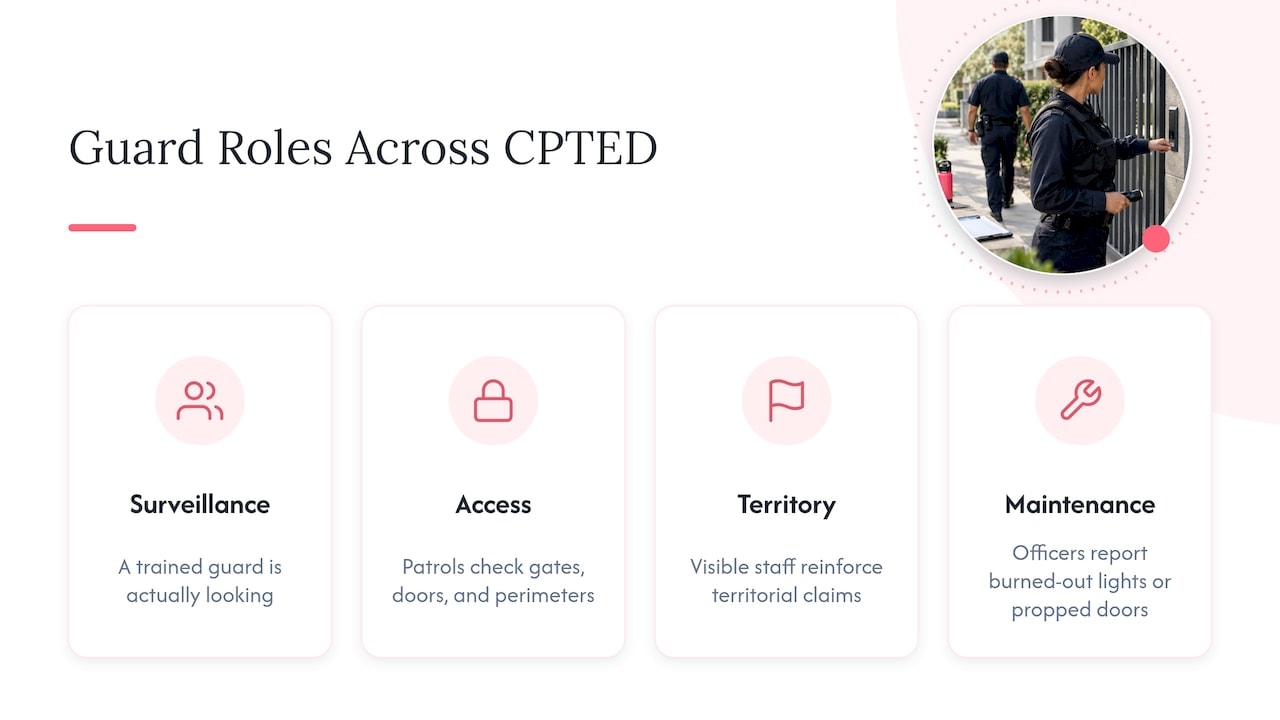
This is where people come in. A trained guard turns natural surveillance from a hope into a fact: someone is actually looking. A patrol route enforces access control, since gates, doors, and perimeters get checked and tested at irregular times. Visible staff reinforce territorial claims, and an observant officer notices the burned-out light or the propped door and reports it, which supports maintenance. For how guards deter crime on commercial sites, see our article on how professional security guards prevent crime on commercial properties.
Building a security culture around the design
A site’s culture decides whether the principles hold. Staff who challenge unfamiliar visitors politely, tenants who report broken lights, and managers who respond within a day all keep the environment doing what it was designed to do. A few habits make this real:
- Put a named person in charge of site conditions, with authority to order repairs.
- Give employees a simple way to report problems and show them that reports lead to action.
- Train front-line staff in conflict de-escalation so that challenging a stranger does not become a confrontation.
- Review incident reports monthly and look for patterns by time, door, and area.
How to run a CPTED review of your own property
You can start without a consultant. The steps below follow the problem-solving approach the NIJ and COPS Office describe.
- Collect your history. Pull incident reports, police calls for service, insurance claims, and tenant or employee complaints for the past one to two years.
- Walk the site twice. Once in daylight and once after dark. Note dark spots, hiding places, unlocked doors, and blocked sightlines.
- Walk it as an intruder. Where would you enter, hide, or leave unseen?
- Rank problems by risk. A dim stairwell with prior incidents comes before a cosmetic issue.
- Choose fixes in three tiers. Quick (lighting, trimming, signage), medium (fencing, access hardware, cameras), and long term (layout changes, which the COPS Office notes can be costly and may involve zoning or building code issues when retrofitting).
- Add the human layer. Decide who will patrol, who will inspect, and who will respond.
- Measure. Practitioners stress that evaluation should be purposive and empirical, checking results against specific security objectives such as fewer incidents and less fear of crime in that setting.
If you want an outside view, a formal assessment is a good starting point. Our physical security risk assessment guide explains what is reviewed.
Cost and timing
The COPS Office is clear that the most cost-effective moment to build CPTED in is design and construction, and that retrofitting existing structures can be very expensive. For owners of older Massachusetts buildings, the practical path is to focus on the low-cost items first, such as lighting, trimming, signage, and repair routines, and to fill remaining gaps with staffing. We do not publish a fixed price for guard services because the cost depends on the site, hours, and risk profile, and our page on what determines security guard pricing explains the factors.
Our perspective
We have worked on the human side of this for years, and our team brings more than seventy-five years of combined law enforcement and loss prevention experience. What that experience teaches is that owners often spend on hardware and forget the habits. We have seen a good fence beside a gate that stays open, and a bright lot with nobody watching it.
Our view is that CPTED is the first line of defense, but not the only one. We prefer a layered approach: sound design, active maintenance, and trained, licensed people who know the property. We stay lean, so the person you speak to at the start is close to the people doing the work, and we tailor the plan to your site rather than hand over a template. Our focus is prevention, stopping the incident before it escalates, and a CPTED review is where that starts.
— Derek
Where Hub can help
If you want the principles applied to a specific site, we offer security risk assessments and consulting, along with armed and unarmed guards, mobile patrol, and construction site security across Massachusetts. You can see everything on our services page, or reach us through our main site to talk through your property.
FAQ
What are the four principles of CPTED?
The four most commonly cited are natural surveillance, natural access control, territorial reinforcement, and maintenance. Some agencies list three or five, adding activity support or merging maintenance into other categories. The ideas overlap, so use the version your local police or planning department references.
Does CPTED work on existing buildings?
Yes, though it is easiest and cheapest at the design stage. On existing sites, lighting, landscaping, signage, access hardware, and repair routines are the usual starting points. Major layout changes can be costly and may need zoning or code approval.
Can CPTED replace security guards?
No. The COPS Office describes CPTED as part of a layered approach, and studies show that management practices shape whether design features help. Guards and patrols make surveillance and access control real, and they report the maintenance problems that weaken a design.
How do I know if CPTED is working at my property?
Compare incident reports, calls for service, and complaints before and after your changes. Practitioners recommend measuring against specific objectives for that site. Also ask tenants and staff whether they feel safer, since reducing fear of crime is part of the goal.
Sources
- Using Crime Prevention Through Environmental Design in Problem-Solving, COPS Office
- CPTED Handbook, Chandler Police Department
- CPTED Guidelines, City of Fontana
- City of Fontana
- Crime Prevention Through Environmental Design and Community Policing, National Institute of Justice
- CPTED in Parking Facilities, National Institute of Justice
- Environmental Design and Management Practices at Multi-Unit Apartments, National Institute of Justice
- Guide to Frugal Evaluation, National Institute of Justice
- Crime Prevention Through Environmental Design, EBSCO Research Starters