
Enterprise security risk management (ESRM) is a management cycle that ties every security decision, from a lobby guard to a cybersecurity control, to the assets your organization cannot afford to lose. It is not a product or a one-time survey. You identify what matters, rank the risks to it, choose proportionate protections, and review the results on a schedule. This guide explains the cycle, the public frameworks behind it, and how to carry it into the physical side of a business.
TL;DR
- ESRM starts with assets and risks, not with products. Guards, cameras and badge systems come after you know what you are protecting and from what.
- The ASIS ESRM Guideline describes a cycle: prioritize assets, prioritize risks, mitigate, then keep improving.
- NIST and GAO both say security belongs in enterprise governance, with named owners, measures and executive sponsorship.
- Physical and cyber risk overlap. A stolen badge or an exposed camera network can cause harm on both sides.
- A site assessment with interviews and an on-site walk-through is the practical first step. We can run one for Massachusetts organizations.
Table of Contents
- What enterprise security risk management means
- The ESRM cycle, step by step
- The frameworks leaders should know
- Governance: where most programs fail
- Physical and cyber risk do not stay in separate lanes
- Turning the cycle into a site assessment
- A worked example: a multi-tenant office building
- Our perspective
- When the assessment points to people on site
- Where to start this quarter
- FAQ
- Sources
What enterprise security risk management means
ASIS International, the professional body that formalized the approach, defines ESRM as a strategic approach that ties an organization’s security practice to its overall strategy using established risk management principles. In plain terms, security stops being a cost center that reacts to the last incident and becomes a function that answers to the same questions as finance or operations: what could hurt the mission, how likely is it, and what are we willing to accept?
That shift has a practical consequence. A security manager who works this way does not ask “how many guards do we need?” first. They ask which assets matter most, who or what could harm them, and what mix of measures reduces that risk to a level leadership has agreed to live with. Sometimes the answer is a guard. Sometimes it is a locked door, a visitor procedure, or a policy change that costs nothing.
ESRM is also not the same as enterprise risk management (ERM), which covers every kind of business risk, including financial and strategic. ESRM is the security-specific discipline inside that larger picture, and it works best when it reports into the same governance process.
The ESRM cycle, step by step
The ASIS guideline describes three components: context, the cycle, and the foundation. The cycle itself has four steps. The first three are laid out below as they apply to a business with physical locations. The fourth is continuous improvement, which we cover under governance.
1. Identify and prioritize assets
An asset is anything whose loss would hurt the organization’s ability to do its job: people, inventory, cash, data, intellectual property, equipment, reputation, and the buildings that house them. ASIS ties priority to how each asset affects the mission, and the output is a ranked list.
For a Massachusetts property manager, the top of that list may be resident safety and the building’s access system. For a jewelry retailer, it is inventory and staff at opening and closing. For a healthcare facility, it is patients, staff and controlled areas such as pharmacies. The same threat means different things to each.
2. Identify and prioritize risks
Next you list what could plausibly harm those assets and rank each by its effect on the mission. CISA and the Interagency Security Committee frame this as threat, vulnerability and consequence analysis, and they present it as a formal process rather than a universal formula for guard counts or camera counts.
The inputs should be real. CISA’s planning workbook describes a risk assessment built on interviews with personnel and stakeholders, on-site inspections, and review of public records such as local crime statistics. A checklist filled in from a desk will miss the propped fire door, the contractor who has a key nobody tracks, and the shift change when the lot is empty.
3. Mitigate the prioritized risks
Now you match measures to the ranked risks. The CISA and ISC standard describes a proportionate strategy built on deterrence, detection, assessment, response and restoration. The mix can include access control, patrols, visitor procedures, emergency coordination, surveillance, lighting, barriers, business-continuity measures, and trained unarmed or armed personnel where that is lawful and justified.
A simple matrix helps: assets down one side, ranked risks across the top, and in each cell the control that addresses it, its owner, and what it costs. Empty cells show gaps. Cells with three overlapping controls show where you may be overspending.
4. Review and improve
The cycle repeats. Incidents, new tenants, a changed floor plan, a layoff, a new executive with a higher profile: each one can move an asset or a risk up or down the list. We cover how to keep that rhythm in the governance section below.
The frameworks leaders should know
You do not need to adopt every standard. You do need to know what each one is for, so you can pick what fits.
| Source | What it gives you | Best used for |
|---|---|---|
| ASIS ESRM Guideline | The four-step security risk cycle and the idea of security as a business function | Setting up the security program’s logic |
| NIST CSF 2.0 | Six Functions: Govern, Identify, Protect, Detect, Respond, Recover | Cybersecurity outcomes and board-level language |
| GAO ERM good practices | Six essential ERM elements, from aligning risk with goals to communicating with stakeholders | Connecting security to enterprise governance |
| CISA and ISC Risk Management Process | Threat, vulnerability and consequence analysis for facilities | Physical site risk |
| CISA SAFE | A high-level facility assessment report, produced in under two hours | A fast physical baseline |
Two cautions apply. First, the ISC standard was written for federal facilities. Private organizations borrow its method, but nobody requires them to follow it. Second, NIST describes CSF 2.0 as outcome-based rather than a mandatory checklist, so your controls should reflect your mission, risk appetite, legal requirements and resources.
For the cyber side, the vCISO-oriented walkthrough NIST IT security: a practical guide for security leaders is a readable companion if you are mapping NIST functions onto your own program.
Governance: where most programs fail
The cycle is simple on paper. The hard part is ownership. NIST’s quick-start guide says the goal is to integrate cybersecurity risk information into the wider enterprise risk process so leaders can monitor, evaluate and adjust risk across business units. The practical test for an executive is not “do we have a control?” but four questions:
- Do we understand the risk this control addresses?
- Who has the authority and the budget to act on it?
- How do we measure whether it works?
- Can we explain why the remaining risk is acceptable?
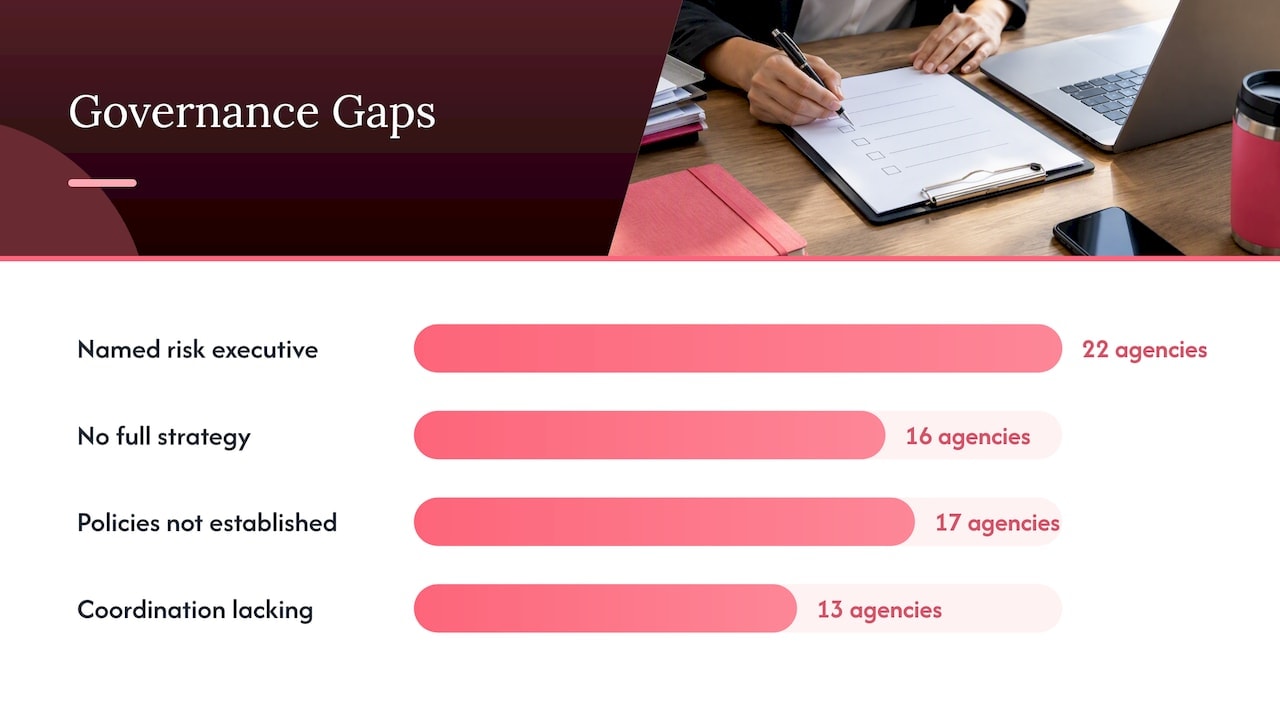
GAO’s federal work shows how often that breaks down. In a review of 23 agencies, 22 had named a cybersecurity risk executive, yet 16 had not fully established a risk strategy, 17 lacked fully established agency- and system-level risk policies, and 13 lacked full coordination between cybersecurity and enterprise risk management. Naming an owner is the start, not the finish. These are federal agencies, so treat the numbers as a warning about the pattern, not a statistic about private companies.
GAO’s good-practice guidance also stresses senior-leadership commitment, regular review cycles, performance indicators and stakeholder communication. In a small or mid-sized company, that can be as modest as a quarterly 45-minute review with the owner or COO, one page of incidents and near-misses, and a list of open actions with names and dates.
Physical and cyber risk do not stay in separate lanes
Most businesses assess physical security, cybersecurity, personnel security and vendor risk separately. Incidents ignore those boundaries. CISA’s paper on security convergence notes that physical and cyber risk are often managed through two parallel but separate processes.
Think through a few ordinary cases:
- A cloned or lost badge opens a door to the room where servers or records sit.
- An IP camera network with default passwords is a digital weakness in a physical-security tool.
- A departing employee keeps system access while HR and facilities believe the exit is finished.
- A cleaning or maintenance vendor has after-hours access to offices with unlocked screens.
The fix is organizational before it is technical: shared terms for risk, one escalation path, and a single report that leadership reads. If your IT lead and your facilities lead have never sat in the same risk meeting, start there.
Turning the cycle into a site assessment
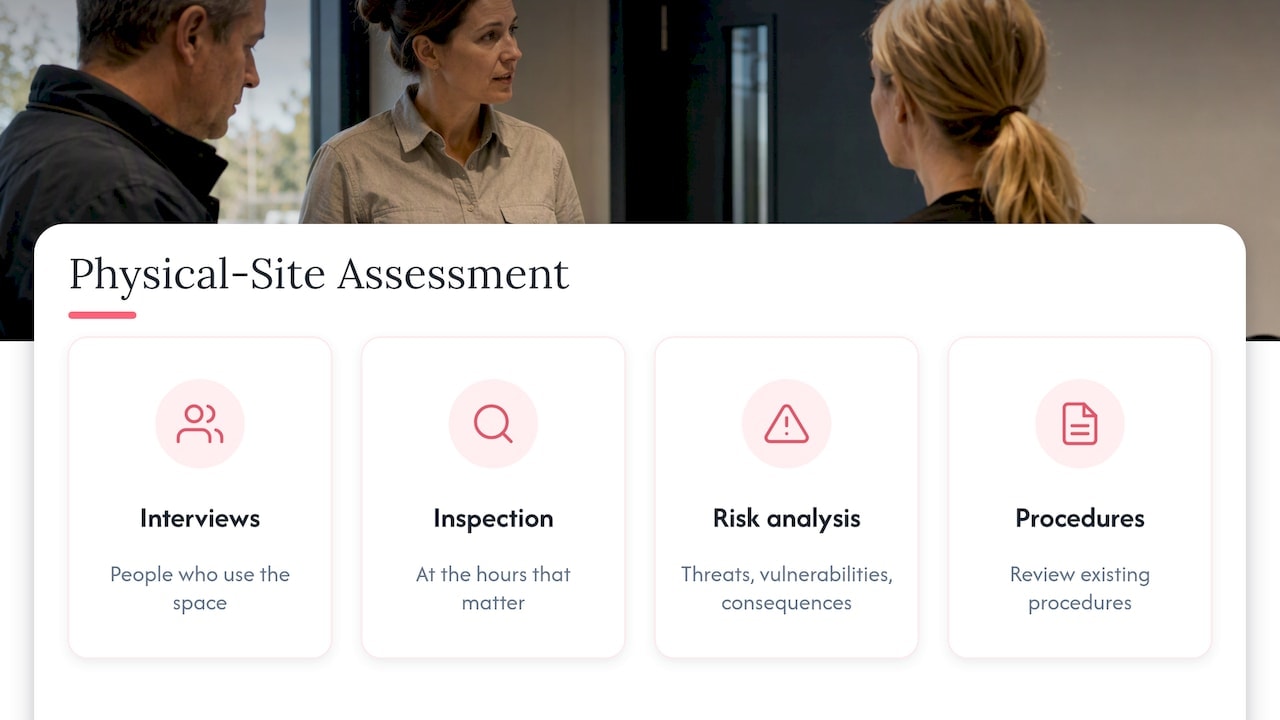
For physical locations, the assessment is where ESRM becomes concrete. A credible one has four parts: interviews with the people who use the space, an on-site inspection at the hours that matter, analysis of threats, vulnerabilities and consequences, and a review of your existing procedures. It ends with options ranked by impact and cost, not a generic list of products.
If you want a quick baseline, CISA’s SAFE assessment is designed to produce a report in under two hours, covering existing good practices, observed vulnerabilities and mitigation options. CISA says the options are voluntary and the facility decides what to implement. It is also a high-level tool, not a replacement for specialized engineering, regulatory or investigative review.
For cyber programs, GAO’s Cybersecurity Program Audit Guide points to six areas to examine: asset and risk management, configuration management, identity and access management, continuous monitoring and logging, incident response, and contingency planning and recovery. That list also works as a sanity check for the cyber half of a combined review.
On the physical side, our own pages go deeper on what a real security assessment checklist should cover, a two-page physical security risk assessment guide, and the office security layers to prioritize: badge, camera and visitor controls. When the concern is a specific person, our workplace threat assessment guide is written for HR and security teams working together.
A worked example: a multi-tenant office building
This is an illustration, not a client case. Say a property manager in the Boston area runs a five-story office building with a staffed lobby until 6 p.m. and a parking lot behind it.
Assets, ranked: tenant employees and visitors; tenant property and records; the building’s access control system; the lot and vehicles; the owner’s reputation with tenants.
Risks, ranked: after-hours tailgating through the rear door; vehicle break-ins in the lot; unauthorized visitors reaching upper floors; a disgruntled former employee of one tenant; a vendor with an uncontrolled key.
Mitigations matched to the ranking:
| Risk | Control | Owner | Review |
|---|---|---|---|
| Rear-door tailgating | Door alarm, camera view, repaired closer | Facilities | Monthly |
| Lot break-ins | Lighting check, randomized patrols | Security provider | Monthly incident log |
| Unauthorized upper-floor access | Visitor sign-in and badge issue | Lobby staff | Quarterly audit |
| Former employee threat | Notification protocol with tenant HR | Property manager | On event |
| Uncontrolled vendor keys | Key register, rekey schedule | Facilities | Twice a year |
Notice that only two of five controls involve a guard, and none of them was chosen before the risks were ranked. That is the point. When a guard is the right control, you hire for a defined purpose, with post orders that say what the guard watches, who they challenge, and when they escalate.
Our perspective
We have worked in Massachusetts since 2004, and the pattern we see most is spending that came before analysis. A site buys cameras after a break-in, adds a guard after a complaint, and never goes back to ask whether those measures match the risk that is still open. ESRM corrects that order.
Our approach is built on loss prevention and prevention-first planning. That means a guard’s presence is one layer, not the whole plan. We tell prospective clients when a policy change or a repaired door will do more than a post would, because a plan that fits the risk is the one that survives the next budget review.
Where guards are the right answer, how we staff matters. Our dispatch is staffed by our own employees, we never use subcontractors, and our patrols are tracked by GPS, so the person responsible for your site is someone we train and supervise. We keep management lean, which keeps the attention on your site rather than on overhead. Executives and property managers can then ask a simple question of any security vendor: who exactly is on my site tonight, and who answers when they call?
— Derek
When the assessment points to people on site
Once the risks are ranked, some will call for trained people: a lobby presence, mobile patrol across several properties, event coverage, construction-site protection, or executive protection for a high-profile leader. We provide armed and unarmed guards, mobile patrol and executive protection across Massachusetts, along with security risk assessments and consulting. New clients are matched with a guard within 24 to 48 hours of an approved quote.
The credentials to ask any provider for are the license, the insurance and the staffing model. Ours: Massachusetts Private Detective Firm License #LP0203L and $3 million in general liability insurance. If you want a risk-based review before you decide on staffing, start with our security risk assessment service or browse the full list of services. To see what shapes the cost of coverage, read our guide to security guard pricing.
Where to start this quarter
- Name an owner with real authority, and put security on the leadership agenda once a quarter.
- List your top ten assets and rank them by what the loss would do to operations.
- Walk each site at opening, closing and the quietest hour, with someone who does not work there.
- Rank the risks, then match each to a control, an owner and a review date.
- Bring physical, cyber, HR and vendor risk into one report so incidents are not split between departments.
- Repeat after every significant change and at least once a year.
FAQ
What is the difference between ESRM and ERM?
Enterprise risk management covers every category of business risk, such as financial, strategic and operational. ESRM applies the same risk principles to security: protecting people, property, information and operations. A healthy program feeds ESRM results into the broader ERM process so security tradeoffs reach leadership.
Do I need a framework like NIST CSF to do ESRM?
No. NIST CSF 2.0 focuses on cybersecurity outcomes and is designed for organizations of any size or sector, but it is not a mandatory checklist for private companies. Many organizations use it for the cyber side and a physical method such as the ISC process for their sites, and then report both together.
Who should own security risk in a company?
A named executive with authority over budget and priorities, supported by people from security, IT, HR, facilities and legal. GAO’s federal review found that naming a risk executive was not enough without strategy, policies and coordination behind the role.
How often should we reassess?
Treat it as a recurring cycle. Review at least annually and after any significant change, such as a move, a layoff, a new tenant, an incident or a higher-profile executive. Quarterly check-ins on open actions keep the plan from going stale.
Sources
- ASIS International: A Brief Guide to ESRM Implementation
- NIST SP 1303: CSF 2.0 Enterprise Risk Management Quick-Start Guide
- NIST Cybersecurity Framework 2.0
- GAO-17-63: Enterprise Risk Management good practices
- GAO-19-384: Cybersecurity risk management programs
- GAO-23-104705: Cybersecurity Program Audit Guide
- CISA: Security Assessment at First Entry
- CISA and ISC: The Risk Management Process, 2024 Edition
- CISA: Security Planning Workbook
- CISA: Security Convergence, Achieving Integrated Security