
The best defense against doxxing is to starve it of material. Remove your home address, phone numbers and family details from data broker and people search sites, lock down accounts, give out less of your real information, and put a response plan in place before anything is published. No single step is enough on its own, and none of them is permanent, so the work has to be repeated.
This guide is written for executives, founders and the security, HR and legal staff who support them. It covers where the data comes from, how to shrink it, what to do in the first hours of an incident, and when the problem has moved from privacy hygiene to physical safety.
TL;DR
- Doxxing starts with data that is already public: broker sites, social media, public records and breach dumps. Reducing that supply is the highest-return step.
- Opt-outs reappear over time, so treat removal as a recurring process, not a one-time task.
- Protect the whole household and inner circle. Family members and assistants are often the easiest route to an executive.
- If you are targeted, preserve evidence first, then secure accounts and report threats.
- Once a threat touches your home, travel or workplace, privacy work needs to be paired with physical protection and an investigation.
Table of Contents
- What doxxing is, and why executives are targeted
- Where the data comes from
- A prevention plan in five layers
- What to do in the first 24 hours of a doxxing incident
- When privacy hygiene is not enough
- Building doxxing resilience into an executive protection plan
- Perspective: why we pair privacy work with people on the ground
- How Hub can help
- FAQ
- Sources
What doxxing is, and why executives are targeted
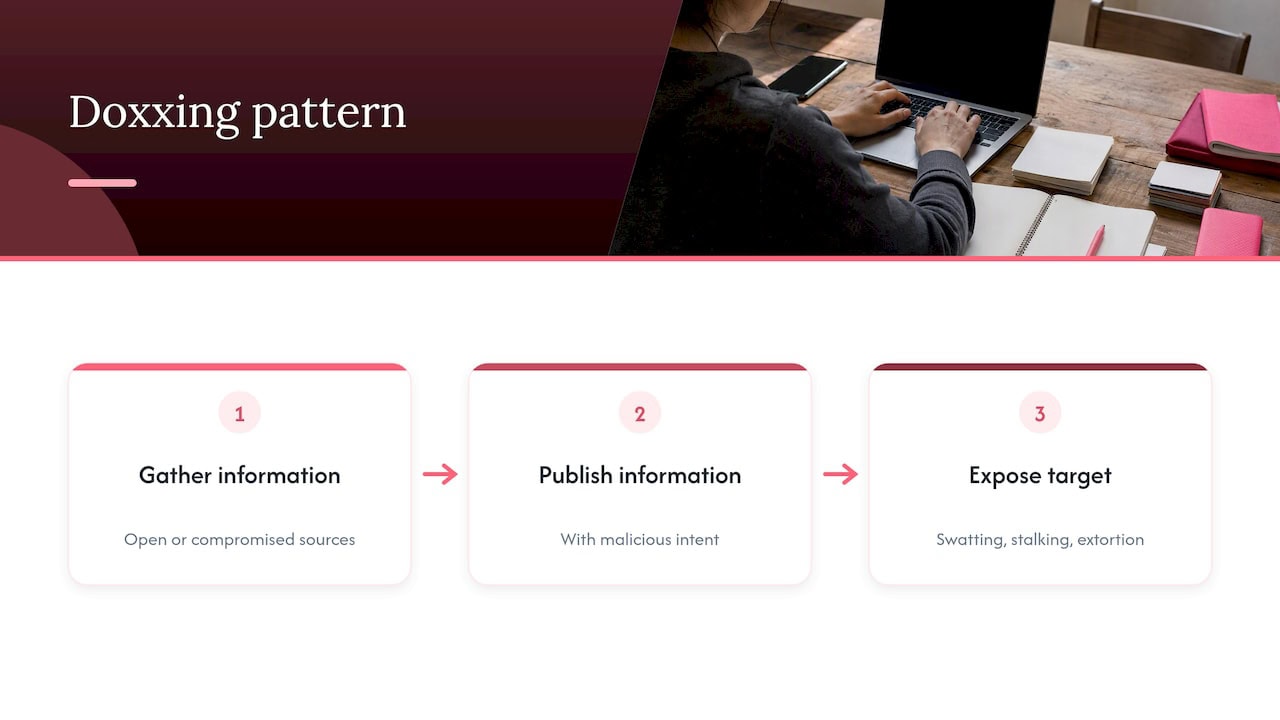
The Cybersecurity and Infrastructure Security Agency (CISA) describes doxxing as gathering personally identifiable information, or sensitive organizational information, from open sources or compromised materials and publishing it with malicious intent to harass, intimidate, steal from or embarrass the target. It can lead to swatting, stalking or extortion.
For executives, the motive is often broader than money. The same CISA guidance points out that leaders are targeted as part of reputation attacks meant to undermine confidence in the organization. A layoff, a plant closure, a controversial product decision or a public statement can turn a name on an org chart into a target within hours.
That is why we treat doxxing as a visibility problem and not only a privacy problem. The question is not “Is my data private?” but “How easily could a stranger with a grudge find where I sleep, where my children go to school and when I leave the office?”
Where the data comes from
An attacker rarely needs to hack anything. A profile is usually assembled from a handful of ordinary sources:
- People search and data broker sites. These compile addresses, phone numbers, relatives and past residences from public records and commercial data. The FTC explains that people search sites sell your information and that most offer a way to opt out.
- Public records. Property deeds, court filings, voter files and corporate registrations can all carry a home address.
- Social media. Tagged photos, check-ins, school logos in the background and a family member’s public profile can reveal more than your own accounts do.
- Breaches. The National Cyber Security Alliance notes that more than 1 billion sensitive data points were leaked in 2024, and that aggregators feed on this material.
- Everyday sign-ups. Retail accounts, loyalty programs and restaurant reservations all collect data that can later be sold or leaked.
A prevention plan in five layers
We like the phrase “layered security approach” because it matches how this works in practice. Each layer is imperfect. Together they raise the cost and effort for anyone trying to find you.
Layer 1: Take your information off broker and people search sites
This is the first thing to do, and the answer to the common question of how to opt out of data brokers. The steps are plain, if tedious:
- Search your own name, your spouse’s name, your home address and your phone numbers. Include variations and former addresses.
- For each site that lists you, find its opt-out or removal page and submit the request. The FTC’s guidance on getting people search sites to stop selling your information walks through the typical process.
- Keep a spreadsheet of site, date submitted, confirmation and next check date.
- Repeat for every adult in the household, and consider adult children and elderly parents who share your address history.
- Re-check on a schedule, at least quarterly.
The last step matters. CISA’s guidance warns that opting out is not a permanent fix: because public records databases keep updating, information often reappears, so you need a recurring, systematic removal and monitoring process. If you or your staff do this by hand, assign an owner and a calendar reminder. Otherwise it will quietly lapse.
A caution on Massachusetts specifics: a comprehensive state data privacy bill, H.4514, has been introduced in the legislature and includes opt-out rights over the sale of personal information. A bill is not a law, so do not count on it to do this work for you.
Layer 2: Secure the accounts that hold your life
If an attacker gets into your email, they can reset almost everything else and read what you have said about travel, family and security arrangements. The FTC recommends long passphrases and multi-factor authentication. Its guidance, and the CISA material we rely on, favors authenticator apps or physical security keys over text-message codes.
A practical baseline for an executive and household:
- A password manager, with unique passphrases of at least 15 characters on email, banking, cloud storage and social accounts.
- Authenticator apps or hardware keys on every account that offers them, starting with email and mobile carrier accounts.
- A PIN or passcode on the mobile carrier account, to make SIM-swap takeovers harder.
- A credit freeze, which the FTC describes as a way to keep others from opening credit in your name.
Layer 3: Give out less, and give out different
The NCSA’s advice is to move from a default of openness to controlled sharing. Treat each request for personal data with skepticism, even a dinner reservation or a store account, because these are common collection points.
The same source describes a technique sometimes called data poisoning: using unique email addresses, separate phone numbers, or slight variations in details when signing up for non-essential services. That breaks the links aggregators use to stitch a profile together. For executives, a few concrete habits follow:
- Use a business address or a mailbox service for deliveries, subscriptions and registrations that do not require your home address.
- Keep property in a trust or an LLC where your attorney advises it, so the deed does not show your name. Ask your own counsel whether this suits your situation.
- Use a separate email and phone number for retail, travel and loyalty accounts.
- Decline optional data fields. If a form does not need your date of birth, do not give it.
Layer 4: Clean up the social footprint, including your family’s
Audit your public profiles and those of your spouse, children and close associates. CISA stresses that digital hygiene has to cover the executive’s entire inner circle, since family and close associates often give attackers the easiest way in.
Start with these:
- Switch family accounts to private and remove location tags from past posts.
- Check photos for house numbers, street signs, license plates, school uniforms and recognizable local landmarks.
- Remove your home address and personal phone from conference bios, nonprofit board pages, press releases and professional directories.
- Brief assistants and household staff on what not to confirm to callers. A friendly voice asking about your schedule is a classic social-engineering move.
CISA’s Manage Your Online Presence page explains how threat actors use publicly available information for targeted intrusions, and is a useful checklist for family members.
Layer 5: Know what an investigator can find about you
The fastest way to learn what an attacker would see is to look the way an attacker would. A professional review of your exposure, covering broker listings, public records, social media and the connections between them, shows gaps that self-searching misses. Our social media investigation work, for example, maps what is publicly visible and how it links back to a person.
What to do in the first 24 hours of a doxxing incident
Speed matters, but order matters more. The sequence we recommend:
- Preserve evidence before you delete anything. Take screenshots, print messages, and capture sender details, dates and times. The FTC-linked guidance is to keep malicious messages open on the device rather than risk deleting them by accident. This record is what law enforcement and investigators will work from.
- Secure accounts. Change passwords, enable multi-factor authentication, and sign out of all sessions, starting with email and phone carrier.
- Assess the threat. The FBI’s threat intimidation guide defines a threat broadly: any statement or indication of intent to inflict pain, injury or damage. If the posts include your address, your children or a stated intention to act, treat it as a safety event and not an online nuisance.
- Report it. Contact local police for threats and harassment, and report to the platforms hosting the content. If there is an immediate danger, call 911.
- Notify your people. Tell family, the executive assistant, building management and your corporate security lead what happened and what to watch for.
- Remove what you can. Submit takedown requests to the platforms and broker sites that show the exposed data.
What Massachusetts law says
In Massachusetts, criminal harassment under M.G.L. c. 265, § 43A covers a willful and malicious pattern of conduct aimed at a specific person that seriously alarms them and would cause a reasonable person substantial emotional distress. It expressly reaches conduct by electronic communication devices, and a first offense carries up to 2.5 years in prison and a fine of up to $5,000. Doxxing that is part of a pattern of harassment can fall within it. Whether a particular incident does is a question for your attorney and the police.
When privacy hygiene is not enough
Some incidents outgrow what an opt-out spreadsheet can solve. Signs that it is time for a professional response:
- Your home address has been published alongside a threat.
- You notice unfamiliar vehicles, people or deliveries near your home or office.
- The harasser is anonymous and keeps returning under new accounts.
- A family member is being contacted or followed.
- The posts coincide with a layoff, litigation, an activist campaign or a public controversy involving your company.
The Department of Justice has observed that many victims assume harassment is a local matter, when digital threats often cross jurisdictions and need federal law enforcement and specialized investigative resources to trace sophisticated anonymous actors. Local police are essential for a report and a response, but an identified source and a documented case usually take dedicated investigative work.
In practice that means three things working together:
- Investigation. Identifying who is behind the harassment, documenting the pattern, and preparing evidence an attorney and law enforcement can use. See our stalking and harassment investigation service.
- Threat assessment. Judging whether the person is likely to escalate. Security leaders can read how we approach it in our guide on opening a behavioral threat assessment intake when an executive faces stalking.
- Physical protection. Adjusting routes, residence coverage, travel and event security to the new risk profile.
Building doxxing resilience into an executive protection plan
The most effective programs fold digital exposure into the same plan that covers travel, offices and public appearances. A sound executive protection plan starts with a risk profile: who the executive is, what the company is doing, who might be angry, and what is publicly knowable. Then it matches measures to the risk.
For a company, that means a few standing practices:
- A named owner for executive privacy, whether in security, legal or the chief of staff’s office.
- A quarterly exposure review for the C-suite and board, including family where they consent.
- A written escalation path: who calls whom, when a threat appears.
- Pre-agreed protocols for high-risk moments such as layoffs, earnings, shareholder meetings and public controversies.
- Training for assistants, reception and security staff on social engineering and what not to disclose.
When a threat is credible, privacy measures work alongside high-profile protection on the ground: advance work, controlled arrival points and people who recognize what is out of place.
Perspective: why we pair privacy work with people on the ground
We have worked in Massachusetts security and investigations since 2004, and the pattern we see is consistent. Companies spend heavily on cyber defenses and almost nothing on the executive’s personal exposure, until the day a home address appears in a post. By then the damage is a security problem, not a privacy one.
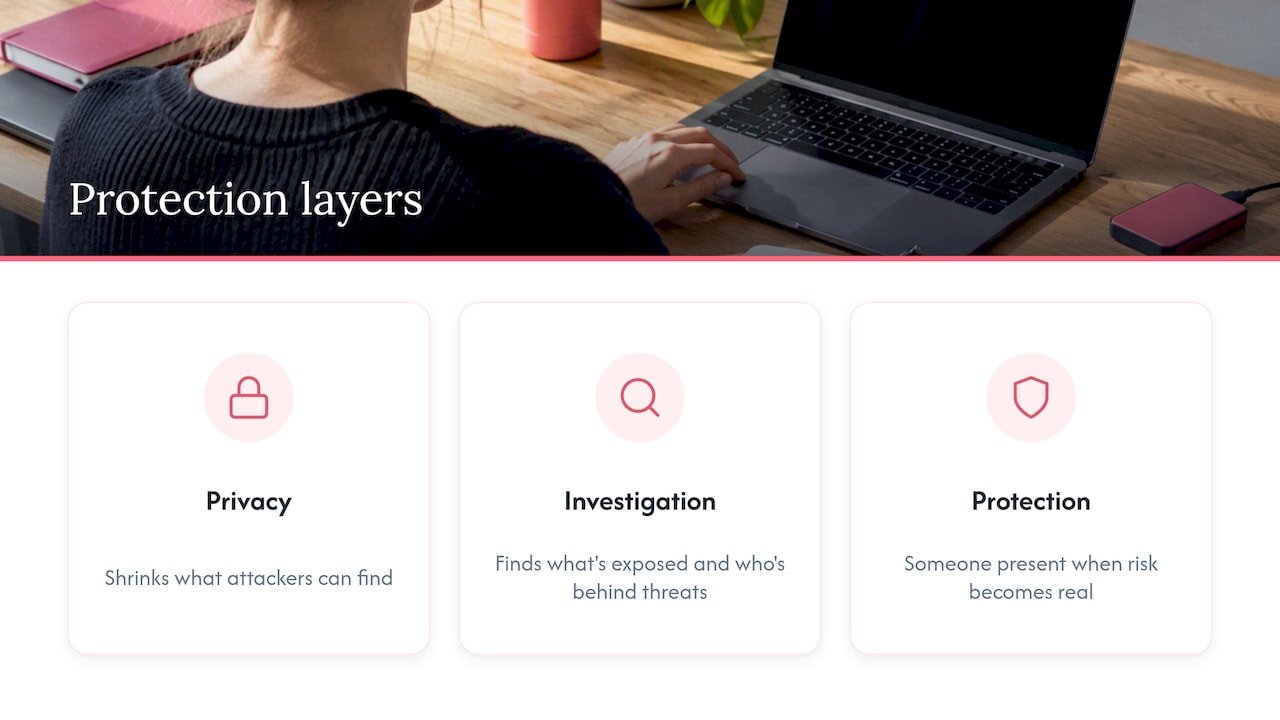
Our view is that prevention beats reaction every time, and that prevention has to be layered. Removing listings and tightening accounts shrinks what an attacker can find. An investigator can tell you what is still findable and who is behind a threat. Protection staff handle the part no software can: someone physically present when a risk becomes real.
We also hold that the household is part of the perimeter. In many cases we would rather spend an hour with an executive’s spouse and assistant than another hour on the executive’s settings. And we are candid that none of this is a one-time project. Data comes back, circumstances change, and the plan must be revisited.
That is why we keep investigations, patrol and protection under one roof, with our own employees and no subcontractors. When a situation moves from online to physical, the people who understood the threat are the same people who respond.
— Derek
How Hub can help
Hub Security and Investigative Group is a Massachusetts security and private investigation company, licensed as a Private Detective Firm (License #LP0203L) and carrying $3 million in general liability insurance. We provide executive protection, armed and unarmed guards, and investigations including stalking and harassment cases, with 24/7 dispatch staffed by our own employees. New clients are matched with a guard within 24 to 48 hours of an approved quote.
If you are an executive or security lead who wants an exposure review, a threat assessment or protection that fits your risk profile, see our full list of services or learn about executive protection in Massachusetts. Pricing is built around your situation, so we start with a conversation.
FAQ
How do I keep myself safe from doxxing?
Reduce what is findable and make accounts hard to take over. Remove your listings from people search sites, use passphrases with authenticator-based multi-factor authentication, and share less personal data when you register for services. Include family members, since their public profiles can expose your address and routines.
Is opting out of data brokers a one-time job?
No. Public records databases are constantly updated, so listings often return after removal. Keep a log of every request and re-check on a regular schedule, quarterly at minimum for high-profile people.
Is doxxing illegal in Massachusetts?
There is no single doxxing statute that we rely on. However, publishing someone’s information as part of a malicious pattern that seriously alarms them can amount to criminal harassment under M.G.L. c. 265, § 43A, which expressly covers electronic communications. Threats are a separate matter. Talk with an attorney about your specific facts.
When should an executive hire a private investigator or security team?
When your address has been posted with a threat, someone is watching or following you or your family, or an anonymous harasser keeps resurfacing. An investigator can document and identify the source, and protection staff can address physical risk while police handle the report.
Sources
- CISA: Protective Measures to Reduce Doxing
- FTC: What To Know About People Search Sites That Sell Your Information
- National Cyber Security Alliance: How to Stop the Flow of Personal Data
- Massachusetts Legislature: Bill H.4514
- FTC: Protect Your Personal Information From Hackers and Scammers
- FTC: What To Know About Identity Theft
- CISA: Manage Your Online Presence
- FBI: Threat Intimidation Guide
- Mass.gov: M.G.L. c. 265, § 43A
- U.S. Department of Justice: harassment and multi-jurisdictional threats