
A financial background check is a targeted investigation into a person’s financial history, assets, liabilities, and business interests, not the credit screening an employer runs during hiring. Done properly, it produces a verified asset and liability picture, often expressed as a net-equity estimate, that holds up because it rests on primary records rather than database guesses. Entities like the IRS and FinCEN set the rules investigators work within.
TL;DR:
- Confirm property ownership and liens at county offices; vehicle, vessel, and aircraft records sit in separate registries, while private bank balances remain inaccessible.
- A single county property search takes days, while searches spanning several states, business filings, vehicle registries, and court records can take weeks.
- Treat market values as estimates and recorded liens, mortgages, and judgments as documented deductions because collectible equity may fall well below headline asset value.
- Unexplained transfers to relatives, mixed personal and business accounts, cashier’s checks, or missing records warrant litigation support, forensic accounting, or subpoenas for inaccessible records.
- FinCEN beneficial ownership records are not open to ordinary investigators; they typically use state corporate filings and other public business records instead.
Table of Contents
- What investigators look for: assets, interests, and encumbrances
- When to order a check and how to scope it
- Reading the report and spotting red flags
- Hiring an investigator: what to provide and what to expect
- Where financial background checks fit in a broader risk strategy
- Beyond public records: surveillance and interviews
- How this plays out in corporate and executive contexts
- Why trained investigators outperform DIY searches
- How we help with financial background checks and asset searches
- FAQ
- Sources
What investigators look for: assets, interests, and encumbrances
Before anyone runs a financial background check, it helps to know what is actually searchable and what is not. Real property ownership gets verified through deeds, mortgage records, and property tax rolls held at the county recorder or courthouse, which remains the authoritative source even when a database shows something different. Personal property such as vehicles, vessels, and aircraft each has its own registry, and ownership history there is usually straightforward to confirm.
Business interests are trickier; understanding FinCEN BOI reporting clarifies beneficial ownership and reporting requirements. Beneficial ownership information filed with FinCEN can clarify who controls a company, but that database is non-public, and access is strictly limited to law enforcement with court authorization or financial institutions with a specific regulatory need. For most due diligence or litigation support work, investigators rely on state corporate filings and other public business records instead.
- Real property ownership and liens are verified at the county recorder or courthouse, not from a database printout alone.
- Vehicles, vessels, and aircraft are tracked through their respective state or federal registries.
- UCC filings and court judgments reveal liabilities that reduce a subject’s actual net equity.
- Private bank account contents are generally not available through a standard search.
When to order a check and how to scope it
Financial background checks get ordered for a handful of recurring reasons, and knowing which one applies to you shapes how the investigation should be scoped.
- Transaction due diligence: verifying a buyer, investor, or partner’s financial standing before you sign.
- Litigation support and asset tracing: locating assets a judgment debtor may be hiding before or after a ruling.
- Fraud investigation: tracing where diverted funds went and who benefited.
- Executive risk assessment: understanding the financial exposure of a candidate for a sensitive role.
- Missing-asset searches: locating property tied to an estate, a divorce, or a business dissolution.
Scope decisions, which jurisdictions to search, how far back to look, and which asset classes matter, drive both the cost and the timeline of the engagement. A single-county real estate search takes days; a multi-state search across business filings, vehicle registries, and court dockets takes weeks. Before you call an investigator, write down what you actually need answered, which jurisdictions the subject has lived or operated in, and how far back the relevant history goes.
Reading the report and spotting red flags
A net-equity summary is only useful if you understand what each line represents. Market value is an estimate, often based on comparable sales or assessed value, while recorded encumbrances are hard figures pulled from liens, mortgages, and judgments. The difference between the two is what is realistically collectible, which is frequently far less than the asset’s headline value.
Certain patterns in a report should prompt a closer look:
- Transfers to relatives or associates with no clear business purpose.
- Commingled personal and business accounts that obscure where money actually went.
- Heavy reliance on cashier’s checks or intercompany transfers instead of traceable wires.
- Missing originals, destroyed files, or gaps in record-keeping.
Bankruptcy case history offers concrete illustrations of how seriously courts treat these patterns. In a bankruptcy case, a bankruptcy court in Colorado found that a debtor’s failure to maintain adequate financial records and unexplained transfers supported denial of discharge, a reminder that concealment tactics carry real legal consequences once they surface in court.
When a report turns up findings like these, the right next step is usually escalation: litigation support, a forensic accountant, or a subpoena to compel records that a standard investigation cannot reach on its own.
Hiring an investigator: what to provide and what to expect
Getting accurate results starts with what you hand over at intake. The more specific your starting information, the less time an investigator spends on preliminary identification work.
- Provide full legal names, known aliases, and identifying details such as date of birth when available.
- Share any known asset details: addresses, vehicle descriptions, business names, or account references.
- Include prior filings, contracts, or correspondence relevant to the dispute or transaction.
- State your jurisdictional scope and lookback period up front.
Before signing a proposal, ask the investigator exactly which sources they intend to search, whether courthouse pulls are included or treated as an add-on, how they document chain of custody, and what their reporting format and confidentiality safeguards look like. A credible proposal should name these specifics rather than describe the work generically.
Expect a completed engagement to deliver an evidence-backed report, a list of every source consulted, a net-equity worksheet showing the deduction math, and certified copies or notarized extracts when the findings may end up in court. Jurisdiction breadth matters more than almost anything else for timeline and cost: a search confined to one county moves quickly, while a subject with property or business interests scattered across several states takes longer because each jurisdiction has its own recordation system and response time.
Pro Tip: Request a sample report format before you sign, so you know whether the deliverable will actually hold up if the matter ends up in litigation.
Where financial background checks fit in a broader risk strategy
A financial background check rarely stands alone. For organizations managing executive risk, vetting a new business partner, or protecting against insider fraud, it works best as one layer in a broader risk management approach rather than a one-time report that gets filed and forgotten.
Pairing a financial investigation with a security risk assessment gives a fuller picture: the financial side identifies exposure, undisclosed liabilities, or questionable asset transfers, while the risk assessment looks at physical vulnerabilities, access controls, and executive protection needs. For corporate clients, this often means financial due diligence feeds directly into decisions about executive protection planning, travel security, or workplace risk protocols, particularly when a financial investigation surfaces a credible threat tied to a disgruntled business partner or a contested transaction.
Timing matters too. Running a financial background check before a major transaction, a sensitive hire, or an executive’s public exposure increases gives decision-makers time to act on findings instead of reacting to a crisis. Treating the check as a recurring part of due diligence, rather than a single event triggered by suspicion, tends to catch problems earlier and with less disruption.
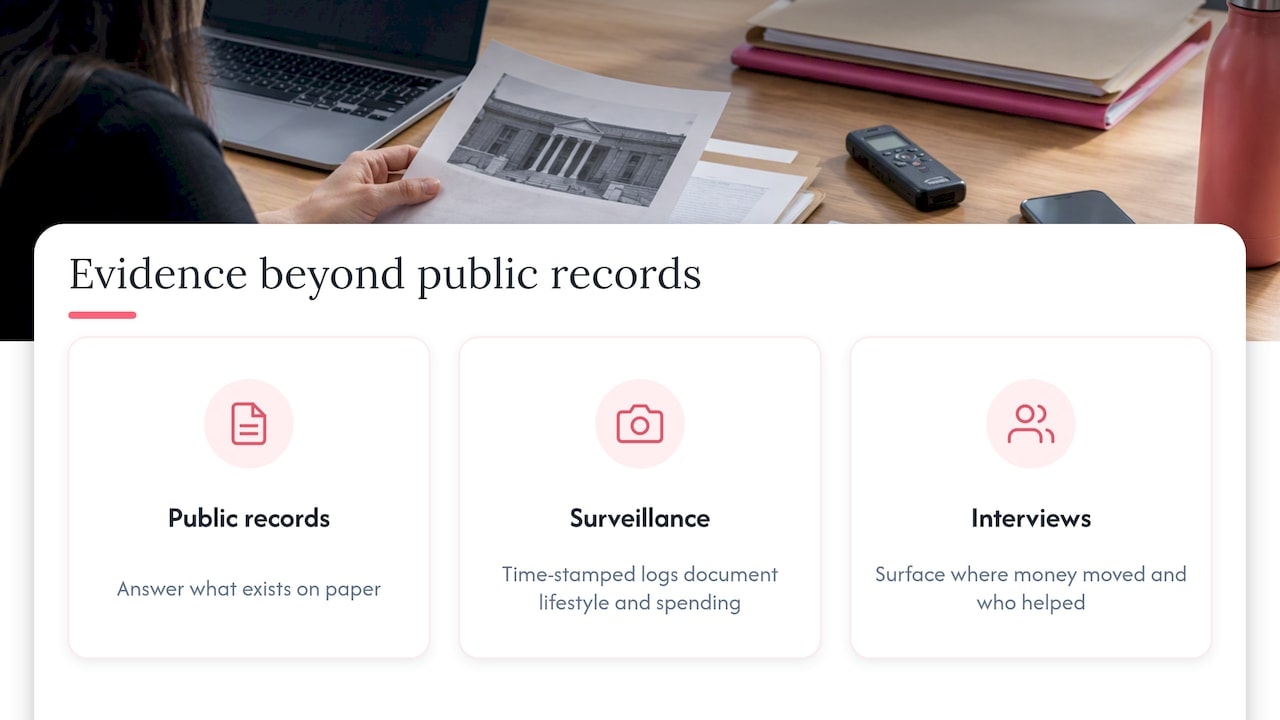
Beyond public records: surveillance and interviews
Public records and courthouse verification answer the question of what exists on paper, but they cannot always explain intent or current behavior. That is where surveillance and interview-based techniques come in, particularly in asset-concealment or fraud cases where the paper trail alone does not tell the full story.
Surveillance in a financial investigation typically focuses on observing a subject’s actual lifestyle and spending patterns against their declared financial position, documented through time-stamped logs and original media rather than summaries. When a subject claims limited means but is observed operating a business, driving an unregistered vehicle, or frequenting a property not listed in their disclosures, that observation becomes a lead worth chasing through public records.
Interviews, whether with former business partners, employees, or associates, can surface information no database or registry will ever contain: where money was moved, who helped structure a transaction, or why a transfer to a relative happened right before a judgment was entered. These interviews require care, since statements need to be documented accurately and in a way that holds up if the matter proceeds to litigation. Combined with the paper trail, surveillance and interviews often close the gap between what the records show and what actually happened.
How this plays out in corporate and executive contexts
Financial background checks show up most often in two corporate scenarios: due diligence ahead of a transaction and risk vetting around executive protection. In a due diligence context, a prospective investor or acquirer wants confirmation that a target company’s stated assets and liabilities match what is actually recorded, not just what appears on a balance sheet prepared for the deal.
In executive protection contexts, a financial background check often precedes a broader risk assessment when a company is evaluating a threat tied to a business dispute, a terminated employee, or a contested estate. Understanding a subject’s actual financial position, including hidden interests or recent asset transfers, helps a protective team gauge motive and capability before building a security plan around an executive’s travel, residence, or public appearances. In both scenarios, the financial investigation functions as groundwork that shapes decisions made well after the report is delivered.
Why trained investigators outperform DIY searches
Database searches feel thorough because they return a lot of results, but a printout is not proof. Courts and counterparties want ownership confirmed at the courthouse, liens verified at the recording office, and a documented chain of custody behind every claim. Reconstructed records or a snapshot from a people-search site rarely survives that scrutiny on its own. When a search turns up unexplained transfers or missing records, that is the point to bring in forensic accounting or litigation support rather than push a DIY search further.
— Derek
How we help with financial background checks and asset searches
We built our investigative practice on the same principle this guide follows: verify at the source, document everything, and deliver a report that holds up under scrutiny. Our background check services draw on combined law enforcement and loss prevention experience, and we apply that same rigor to asset search investigations and due diligence investigations for clients who need answers they can act on.

An engagement with us can start with a discussion of what you need answered, followed by an investigation plan outlining the records to pursue.
If you need a financial background check for a transaction, a dispute, or an executive risk question, request a consultation to discuss the details and scope of the work.
This article is general information, not a substitute for advice from a qualified financial advisor. Consult a qualified financial professional about your own circumstances before acting on anything here.
FAQ
What is a financial background check?
A financial background check is an investigation into a person’s financial history, assets, liabilities, and business interests, distinct from the credit screening employers use during hiring. It typically produces a verified asset and liability summary built from courthouse and public-record confirmation rather than database output alone.
How is net equity calculated in an asset investigation?
Net equity is calculated by estimating an asset’s fair market value and then subtracting valid liens, mortgages, and other recorded encumbrances. Department of Justice forfeiture guidance treats this deduction as a required step, since skipping it is the most common cause of an inflated valuation.
Can I access someone’s FinCEN beneficial ownership information myself?
No. FinCEN’s beneficial ownership database is non-public, and access is restricted to law enforcement with court authorization or financial institutions with a specific regulatory need. Private investigators typically work around this limit using state corporate filings and other public business records instead.
What red flags suggest someone is hiding assets?
Common red flags include unexplained transfers to relatives or associates, commingled personal and business accounts, heavy use of cashier’s checks instead of traceable wires, and missing or destroyed financial records. Bankruptcy court findings have repeatedly treated these patterns as evidence of concealment when records cannot explain where money went.
What should I provide an investigator before a financial background check?
Give the investigator full legal names, known aliases, identifying details, and any known asset information such as addresses, vehicle descriptions, or business names. Providing prior filings or correspondence up front, along with your jurisdictional scope and lookback period, speeds up the engagement and improves accuracy.
Sources
A financial background check often starts with intake: what question are you trying to answer, and what names, aliases, or related entities should the search include. From there, investigators typically begin with database and public-record searches, which are fast and useful for generating leads, but the IRS’s own guidance on locating taxpayers and their assets is blunt about their limits: digital tools and credit reports are starting points, not confirmation. Final verification happens at the courthouse or the relevant official registry, where recordation is legally authoritative.
Primary sources an investigator typically consults include:
- Fincen
- 5.1.18 Locating Taxpayers and their Assets | Internal Revenue Service
- Appeal from the United States Bankruptcy Court for the District of Colorado
FinCEN’s beneficial ownership database sits outside this list for most private investigations. FinCEN’s own FAQ material confirms the database exists to support law enforcement and regulated financial institutions, not general asset searches, so investigators work around it using the public filings above.
Once ownership is confirmed, the real work is calculating net equity: estimating fair market value, then subtracting every valid lien, mortgage, and encumbrance recorded against the property. The Department of Justice’s own forfeiture guidance treats this deduction step as mandatory, and skipping it is the single most common reason an asset valuation turns out wrong. Courts generally prefer original recorded documents over reconstructed records, and bankruptcy proceedings have repeatedly shown how reconstructed or incomplete records invite scrutiny.
Pro Tip: Ask any investigator you hire whether their report distinguishes between a database lead and a courthouse-confirmed fact; the two carry very different evidentiary weight.