
Choose the security guard company that can prove four things in writing: it is licensed and insured for the work, it screens and trains its own guards, it supervises them in the field, and it puts incident response and replacement coverage in the contract. Everything else, from uniforms to price, matters less than those four. Below is the checklist we would use if we were on your side of the table, with the questions to ask, the documents to request and the warning signs to watch for.
TL;DR
- Ask for the company’s current license and its certificate of insurance, and confirm both yourself before you sign.
- Find out who the guards are: how they are hired, screened, trained and supervised, and whether they are employees or subcontractors.
- Let a written risk assessment decide how many guards you need and whether they should be armed, not a sales call.
- Make sure the contract covers post orders, reporting, guard replacement, termination and indemnification.
- Excessive turnover, evasive answers about licensing and vague answers about subcontracting are the clearest warning signs.
Table of Contents
- Start with your risk, not the company
- Check licensing and insurance first
- Ask how guards are screened, trained and kept
- Look at supervision and technology
- Test how they handle a missed shift
- Decide between armed and unarmed guards
- Read the contract line by line
- Red flags that should end the conversation
- Why we built Hub the way we did
- See how we handle it
- FAQ
- Sources
Start with your risk, not the company
Before you compare providers, write down what you need protected and from what. A property manager worried about trespassing after hours needs something different from a retailer dealing with shoplifting, a hospital with agitated visitors, or an event planner managing a crowd. Companies will quote against whatever you tell them, so the clearer your description, the more comparable their proposals will be.
A useful risk review covers five things:
- Incident history. Police calls, break-ins, vandalism, theft and complaints over the last one to two years.
- Hours of exposure. Which hours, days or events carry the most risk. A site that is quiet at noon may be vulnerable at 2 a.m.
- Physical layout. Entrances, parking areas, blind spots, lighting, cameras and access control.
- People. Staff, tenants, patients, customers or guests, and any sensitive situations such as layoffs or evictions.
- Assets. Cash, inventory, equipment, records or high-profile individuals.
If you would rather have a professional do this, a security risk assessment is a standard first step. Guidance on managing private security says decisions about the type, number, responsibilities and arming of guards should flow from a risk assessment. A company that quotes before asking you any of these questions is selling hours, not protection.
Check licensing and insurance first
This is the filter that removes most weak candidates, so do it before you take a single meeting.
Licensing
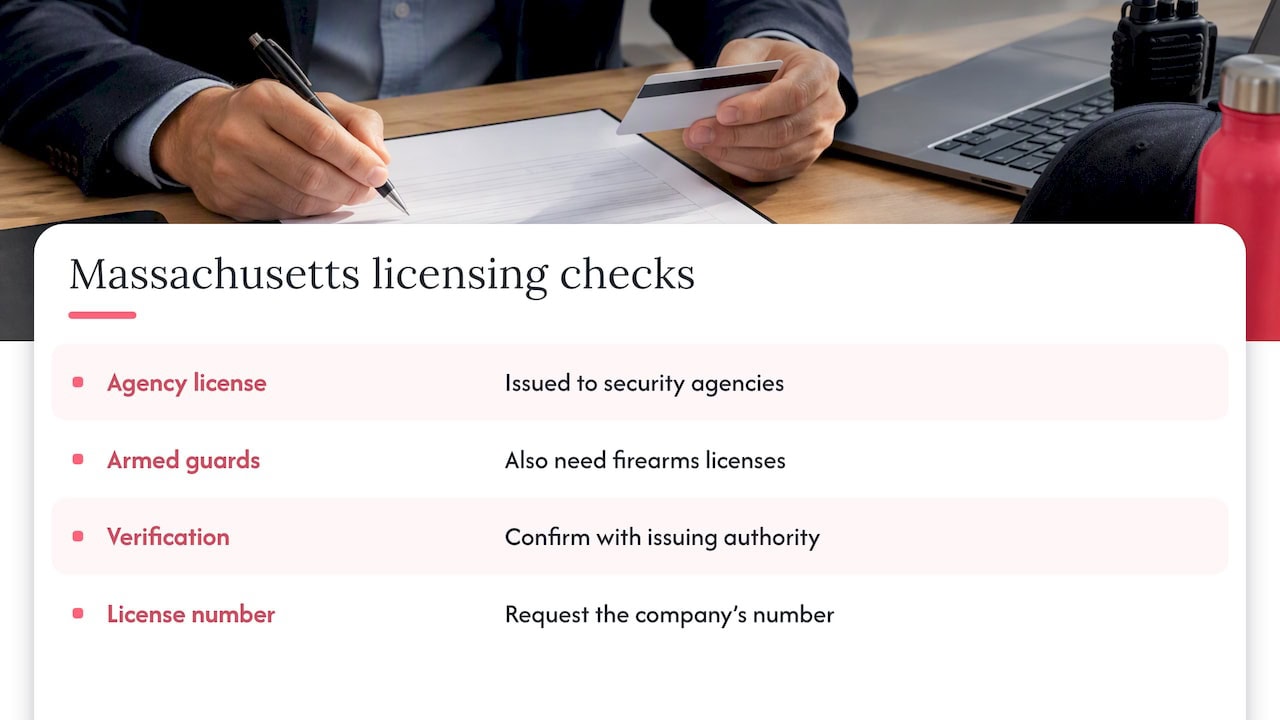
In Massachusetts, licenses are issued to security agencies rather than to individual guards, according to a summary of the state’s guard requirements. That makes the company’s own license the first document to request. Armed guards face a second layer: they must hold firearms licenses, not just a security license. Ask for the license number, confirm it with the issuing authority, and ask how the company confirms the firearms licensing of any armed officer it assigns to you.
The principle is the same everywhere. Hiring organizations should confirm that a security firm holds valid, current state licensure in the jurisdiction where the services take place. A company that is evasive about its license is telling you something.
For reference, we operate under Massachusetts Private Detective Firm License #LP0203L, and we have been in business since 2004. You should expect any provider to hand over equivalent details without hesitation.
Insurance
Ask for a certificate of insurance, not a verbal assurance, and ask for the name and phone number of the insurance agent. Check these items:
- General liability. We carry $3 million in general liability insurance. Compare any provider’s limits against the value of what they will be protecting.
- Workers’ compensation. If a guard is hurt on your property, you want that covered by the company, not by you.
- Additional insured status. Ask whether your organization can be named on the policy.
- Specialized coverage. Large institutional contracts sometimes ask for coverage such as abuse and molestation liability, which protects against negligent hiring or supervision. It is worth asking about if guards will be around children, patients or residents.
You can also ask for the contractor’s experience modification rate for the last three years. A lower rate indicates better safety performance, and a company that tracks it will know the number.
Ask how guards are screened, trained and kept
You are not hiring a company logo. You are hiring the individual who stands at your door, so the questions should be about people.
Screening and training
Ask how the company hires and trains officers, how it checks backgrounds, and whether it can show proof of those background checks. This is standard advice from building management guidance on hiring a guard service. Then ask what training covers beyond the legal minimum. A serious program touches site security, patrol methods, active-threat response, risk mitigation and CPR/AED, and it tests officers on post orders. One institutional bid requirement lists exactly those subjects, which makes a good benchmark for what to expect.
In our own experience, conflict de-escalation is the skill that separates a guard who prevents an incident from one who merely reports it. Ask how it is taught and practiced.
Turnover and references
Ask the company for its guard turnover rate, and ask its references about turnover and about how quickly trained replacements arrived. Building guidance suggests asking references about turnover and replacement quality. High turnover means the guard who learned your site this month will not be there next month, and it often points to pay or management problems.
Employees or subcontractors
Ask plainly: will the people on my site be your employees, or will you pass the work to another firm? Some companies quietly subcontract overflow shifts, and you may never know who is standing at your post. We never use subcontractors, and our dispatch is staffed by our own employees. Whatever the answer from a company, it should be given directly. Even then, the responsibility stays with you: guidance on private security notes that the hiring organization keeps oversight responsibility for vetting, training, equipping and monitoring, whether guards are employees or contractors.
Look at supervision and technology
A guard with no supervisor drifts. The best-written post orders mean little if nobody checks that they are followed. Contract language from a large municipal agreement shows what good looks like: it requires documented, regular site visits by contractor supervisors to confirm guards follow post orders and policies. Federal facility guidance goes further, stating that training is critical to performance and that the hiring agency should maintain a system to validate that all guards meet mandatory qualifications.
Put these questions to any candidate:
- How often does a supervisor visit my site, and how is each visit documented?
- Do patrols leave a verifiable record, such as GPS tracking, that I can review?
- Who answers the phone at 3 a.m. when a guard calls in, and is that person the company’s employee?
- Can I see a sample daily activity report and a sample incident report?
Written instructions are the backbone of all this. If you want to know what a good set looks like, our guide to security guard post orders walks through them, and our overview of what security guards do on the job helps you describe the duties you need.
Test how they handle a missed shift
Reliability is mostly about the day something goes wrong: a guard calls out sick, a car breaks down, or a storm hits. Ask what happens in the first hour. Who finds a replacement, how long does it take, and who tells you? A company with thin staffing will answer in generalities. A company with a real bench will describe the process. If you want to understand what dependable coverage looks like from the scheduling side, this piece on scheduling that survives call-outs explains the mechanics that keep shifts filled.
A solid proposal should also define the security tasks and coverage hours, a client contact, staffing arrangements, emergency procedures and reporting, as contractor hiring guidelines recommend. If any of those is missing from what you receive, ask for it in writing.
On our side, new clients are matched with a guard within 24 to 48 hours of an approved quote. Ask any company you are considering for its own timeline, and ask what it commits to when you need coverage sooner.
Decide between armed and unarmed guards
This decision should come from your risk assessment, not from a feeling about how a site looks. The guidance on private security says the choice of armed or unarmed protection should derive from a documented risk assessment of the specific site and its threats, and that arming a guard calls for a dedicated training program.
A practical way to think about it:
| Situation | Usually fits |
|---|---|
| Lobby greeting, access control, visitor check-in | Unarmed |
| Overnight patrol of a low-incident property | Unarmed or mobile patrol |
| Retail with repeated theft and confrontation risk | Unarmed, with a risk review |
| Cash handling, jewelry, bank locations | Often armed, after assessment |
| A specific, credible threat to people or assets | Armed, after assessment |
The table is a starting point, not a rule. Our armed vs. unarmed decision guide goes through the trade-offs, and if a threat has already been made, read when to hire armed guards. Remember that armed guards cost more because of licensing and training, which contractor guidelines identify as a cost factor. Our pages on armed security and unarmed security guards describe how each works in practice.
Read the contract line by line
The contract defines the rights and responsibilities between you and the contractor and is what ensures they meet your needs, in the words of hiring guidelines for security contractors. Those guidelines say it should address indemnification, termination and guard replacement. Add this checklist:
- Scope and post orders. Exactly which posts, hours and duties are covered.
- Rates. Billing rates by post type, overtime and holiday rates, and how and when increases happen. Costs generally reflect wages, wage increases, uniforms and equipment.
- Right to remove a guard. Institutional contracts commonly let the client require removal of an unsatisfactory employee. Ask for the same.
- Supervision and reviews. Frequency of site visits and management reviews.
- Reporting. What you receive, how fast, and in what format.
- Subcontracting. A clause that forbids it, or requires your consent.
- Termination. Notice periods and any penalty for leaving.
- Insurance and indemnification. Limits, additional insured status and who bears which risk.
Rates are best compared on a like-for-like basis. Ask each company to price the same posts, the same hours and the same reporting, then compare. A low hourly rate that excludes supervision or replacement coverage is not a lower price.
Red flags that should end the conversation
- Excessive turnover or poor relationships with employees. Hiring guidance lists both as warning signs.
- Evasiveness about licensing. If a company will not give you a license number, stop there.
- No clear insurance contact. You should be able to reach the agent who wrote the policy.
- Vague answers about subcontractors. Ask the question directly and expect a direct answer.
- A quote with no site visit. A fixed price for a place nobody has seen is a guess.
- No sample reports. If they cannot show you what you will receive, they may not produce it.
- Pressure to sign quickly. A reputable firm will let you check references first.
Why we built Hub the way we did
We started Hub in 2004 with a simple belief: security works best when it is built around prevention. That is why we begin with loss prevention and the specific risk profile of your site, not a standard package of hours.
Our guards, armed and unarmed, are our own people, and so is our 24/7 dispatch. We never use subcontractors, because when something happens at 2 a.m. you should know exactly who is responsible. GPS patrol tracking gives you a record of what was done, not just a promise.
We keep our management structure lean, which lets us give personal attention to each client without the overhead of a large firm. Our own claim is simple: ask us everything on this checklist, and hold us to the answers.
Derek
See how we handle it
We provide armed and unarmed security guards, mobile patrol, event security and executive protection for businesses, property managers, healthcare facilities, retail and bank locations in Massachusetts. Our private investigators also handle background checks and other investigative work. You can see everything we offer on our security and investigative services page.

If you are comparing providers, send us your site details and we will talk through a plan built around your risk. For help deciding what to ask, our guide to hiring a security company in Massachusetts covers the local side in more depth.
FAQ
How many security guard companies should I compare?
Three is a practical number. Give each the same site details and ask for proposals covering the same posts, hours and reporting. That lets you compare scope and service quality, not just hourly rates.
Should I choose the cheapest quote?
Not by default. Billing rates reflect wages, uniforms, equipment and supervision, so an unusually low rate often means something is missing. Ask what the rate includes, and compare turnover, supervision and replacement coverage next to the price.
Do I need armed guards?
Only if a documented risk assessment of your site points that way. Many locations are well served by unarmed guards or mobile patrol. Cash handling, jewelry and bank locations, or a credible threat, are the situations where armed protection is most often considered.
What documents should I ask a security company for?
Request the company’s license number, a certificate of insurance with the agent’s contact details, a sample post order, a sample incident report, references, and the contract draft. Confirm the license and insurance yourself before signing.
Sources
- Massachusetts Security Guard Requirements
- Guidelines for Hiring a Security Contractor
- Contracted Security Services RFP, Saint Peter’s University
- Hiring a Security Guard Service, Buildings
- Use of Security Forces: Assessing and Managing Risks
- Contract Summary Sheet, City of Los Angeles
- Armed Contract Security Officers in Federal Facilities, ISC Best Practice
- Employee scheduling that survives a call-out