
A no trespass letter in Massachusetts is a written notice from the person in lawful control of a property, telling a named individual not to enter or remain there. It is not a court order. What it does is put the person on documented notice, so that coming back can support a criminal trespass complaint under G.L. c. 266, § 120. The letter only works as well as its wording, its delivery and its paper trail, and this guide walks through all three.
TL;DR
- Anyone with lawful control of a property, such as an owner, tenant or manager, can forbid a person from entering. The notice can be direct, posted, or come from a court order.
- A strong letter names the person, forbids entry, describes the premises in detail, states your authority, cites the statute and says police are getting a copy.
- Send it with proof of delivery: registered or certified mail with return receipt, or service by a constable or police officer. Give the police a copy and the signed receipt.
- If the person returns after valid notice, call police. Do not confront them yourself. A trained guard on site can document and de-escalate.
- Landlord-tenant disputes follow eviction rules, not trespass letters. Talk to an attorney before sending one to a tenant.
Table of Contents
- What a no trespass letter does under Massachusetts law
- What to put in the letter
- How to deliver it and document it
- What happens if the person comes back
- Where hidden cameras, GPS and investigations fit in
- Beyond the letter: a layered approach to keeping people off your property
- Our perspective
- Work with a licensed Massachusetts security team
- FAQ
- Sources
What a no trespass letter does under Massachusetts law
Massachusetts treats trespass as a crime when someone enters or remains, without right, in a dwelling, building, boat, improved or enclosed land, wharf, pier or school bus after being forbidden by the person with lawful control. The statute is M.G.L. c. 266, § 120, and it names three ways to give that notice: directly, by posting, or through certain court orders.
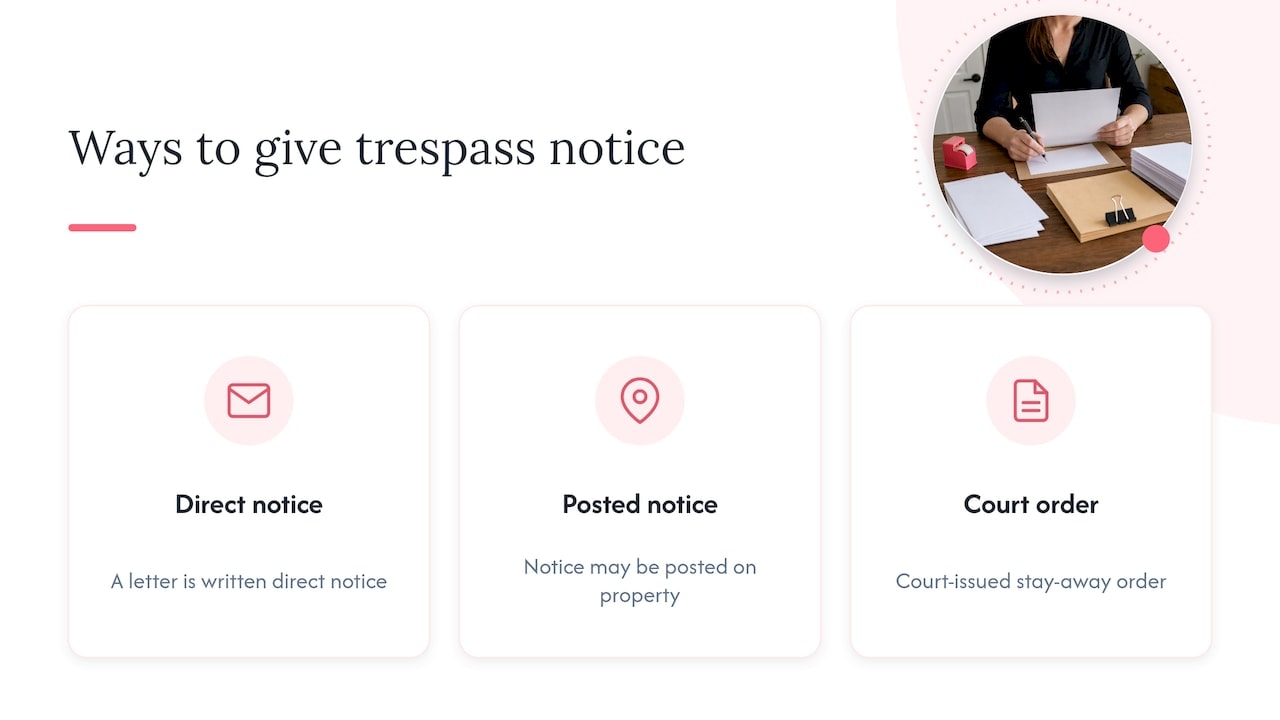
The town of Dover summarizes it the same way: criminal trespassing occurs when a person without legal right enters or remains on property after being forbidden, and notice may be direct, posted, or provided through a court-issued stay-away order.
The letter is the written form of direct notice. Its value is evidence. Police and prosecutors cannot treat a return visit as trespass if nobody can show the person was told to stay away. A dated letter with proof of delivery answers that question before it is asked.
Who can issue one
The power belongs to the person with lawful control of the property. In practice that means:
- Property owners and condo associations, usually through the board or the property manager
- Tenants and commercial tenants, for the space they lawfully control
- Property managers and business managers acting for the owner
- Schools, healthcare facilities, retailers and event venues, through an authorized representative
A person with lawful possession of a property may seek to prevent someone from trespassing on it. If you manage a site for someone else, confirm in writing that you are authorized to sign, and say so in the letter.
When a letter is the wrong tool
The statute does not apply in a landlord-tenant situation where proper eviction procedures have not been followed, as one Massachusetts law firm’s summary of the statute points out. If the person you want off the property lives there, or has a lease or a claim to occupy, stop and speak with a Massachusetts real estate or landlord-tenant attorney. A trespass letter will not substitute for the eviction process.
What to put in the letter
The Billerica Police Department publishes a sample trespass letter. Its structure is a good template, because it is built around what officers need to see. According to that sample, the letter should:
- Identify the recipient by name and address
- State plainly that entry onto the property is forbidden
- Describe the premises in detail
- Identify the sender as having lawful control of the property
- State the consequences under M.G.L. c. 266, § 120
- Say that a copy is being forwarded to the local police
The premises description deserves more care than most people give it. “Our building” is not enough. Give the street address, name the buildings, lots, parking areas, loading docks, common areas or fenced land that are covered, and attach a simple site map if the property has several parcels. An officer reading the letter should be able to tell, with no guesswork, whether the person was on covered ground.
Keep the tone factual
Write it as a notice, not an argument. Leave out accusations, threats and descriptions of what you think the person did. State the instruction, the legal basis and the date. If the letter becomes an exhibit, a plain version helps you and a heated one does not.
A simple outline you can adapt
- Date and your name, title and address
- Recipient’s name and last known address
- A sentence stating that you have lawful control of the premises at [address and description]
- A sentence forbidding the recipient from entering or remaining on those premises
- A sentence noting that under M.G.L. c. 266, § 120, entering or remaining after notice may result in criminal charges
- A sentence stating that a copy is being sent to the police department
- Your signature
Have your attorney review the final wording, especially if the recipient is a former employee, a business partner, a family member or anyone who might claim a right to be there.
How to deliver it and document it
Delivery is where most letters fail. A letter that was written but cannot be proven received is hard to enforce.
The Billerica sample advises sending it by registered mail with return receipt requested, then giving the police the signed receipt and a copy. A Massachusetts criminal defense firm similarly recommends certified mail with return receipt, or service by a constable or police officer, to prove the individual got the notice.

The statute itself says notice may be posted on the property or given directly by a sheriff or constable. Service by someone with official standing gives you a witness who can testify about when and how the person was told.
A practical delivery checklist
- Make two or three signed originals and keep a copy for your records.
- Send one by registered or certified mail with return receipt requested, and keep the tracking number.
- If the person is hard to reach or likely to refuse mail, arrange service by a constable or police officer.
- Deliver a copy and the signed receipt to the police department where the property is located.
- Post signs at entrances if the property is one where posted notice makes sense, and photograph them with a date.
- Keep everything in one file: letter, receipt, photos, incident reports and any camera footage.
Check your local police department first
Local procedures differ. The Barnstable Police Department, for example, says its trespass orders must be completely returned to the department, served in the presence of a police officer or constable, and renewed for continued enforcement, and states that its orders are valid for up to two years. Your department may have its own form, its own service rules or a renewal cycle. A short call to the records division before you send anything can save you from redoing the process.
What happens if the person comes back
If someone returns after valid notice, entering or remaining without right can support a criminal trespass complaint. Under the statute, a person found committing the trespass may be arrested by a sheriff, deputy sheriff, constable or police officer, and the stated maximum penalty is a $100 fine, up to 30 days in jail, or both. Check the current statute text with your attorney, since penalties can be amended.
When the person shows up, follow a short script:
- Do not physically block, grab or chase the person.
- Call the police and give the address, the person’s name and the fact that a no trespass notice was delivered on a specific date.
- Note the time of arrival, what the person did and when they left.
- Save any video and give officers your file, including the delivery receipt.
- Add the incident to your log, so the record shows a pattern.
The reason to keep your hands off is simple: you want the record to show that you gave notice, called the authorities and let them act. Staff who try to remove someone themselves can create liability for the property.
Where hidden cameras, GPS and investigations fit in
Owners who send a no trespass letter often want proof of what is happening on their property. That raises questions about cameras, tracking and investigators, and the answers are legal ones, so they need care.
Massachusetts has a strict statute on secretly recording conversations, and the rules on hidden audio are different from the rules on video of a public or common area. Tracking a vehicle with a GPS device also raises separate legal issues. Before you install a hidden camera, attach a tracker or hire anyone to watch a person, get advice on the specifics. We summarize the basics for residents and businesses on our page about Massachusetts surveillance rules, and an attorney should confirm how they apply to your facts.
The same goes for questions about what a private investigator may look up. Investigators in Massachusetts work within licensing rules and privacy law, and a lawful investigation relies on public records, interviews, observation from lawful vantage points and court process, not on shortcuts to private financial data. If a provider promises to pull someone’s bank account details with no legal process, treat that as a warning sign about the provider.
Private investigator pricing depends on the scope: hours of surveillance, travel, the number of investigators, reports and any court testimony. We do not publish rates, because a fair quote comes from a conversation about what you actually need. Surveillance, background checks, asset searches and process serving are priced differently.
Beyond the letter: a layered approach to keeping people off your property
A letter sets the legal ground. Physical and operational measures make it hold.
- Signage and lighting. Clear signs at every entrance support posted notice and discourage casual entry.
- Access control. Fencing, locks, badge readers and visitor check-in make it clear who belongs.
- Cameras. Cover entrances, parking and common areas, and keep footage retrievable.
- Trained guards. A guard who knows the names and photos of people under notice can spot a return early, call police and write the report.
- Mobile patrol. For sites without full-time staff, patrols between visits add a check on empty buildings and lots.
If you manage an apartment community, our apartment security approach for Boston shows how guard coverage and access practices work together. Construction sites face repeated after-hours entry, which is why we cover them separately under construction site security. Retail owners dealing with repeat shoplifters or disruptive individuals can look at our retail security services. If you are weighing whether an incident creates exposure for the owner, our overview of premises liability security basics is a good next read.
Our perspective
We have worked the other side of these letters for years. A no trespass notice is a good tool, but the notice is the beginning of the process, not the end of it.
The properties that get results treat the letter as one layer. They send it with proof of delivery, they give police the file, and they make sure the people on site know who is under notice. When a banned person returns, the property has a trained guard who stays calm, keeps a safe distance, calls police and writes a clean report. That is what turns a piece of paper into something an officer can act on.
Our approach is built around prevention. We have been in business since 2004, we are licensed in Massachusetts, and our dispatch and guards are our own employees, never subcontractors. That means the guard at your site knows your post orders, including the names on your notice list, and our GPS patrol tracking gives you a record of when checks happened.
Whether the situation calls for an unarmed presence at the front door or an armed guard after a credible threat, we match the coverage to your risk profile, not to a template.
Derek
Work with a licensed Massachusetts security team
If you have a repeat trespasser, a hostile former employee or a property with ongoing after-hours entry, we can help you set up the full picture: guard coverage, patrol, documentation and, where it applies, investigative support. Hub Security and Investigative Group is licensed in Massachusetts (Private Detective Firm License #LP0203L) and carries $3 million in general liability insurance. New clients are matched with a guard within 24 to 48 hours of an approved quote.

See our full list of security and investigative services or, if you need a guard on site now, look at our armed and unarmed guard options. If you are not sure which fits your property, our armed versus unarmed decision guide explains the tradeoffs.
FAQ
Does a no trespass letter have to be served by a constable or police officer?
Not always under the statute, which allows notice to be direct or posted, and names a sheriff or constable as one way to give it directly. Still, documented delivery is what proves the person received it, so registered mail with return receipt or service by a constable or officer is the safer route. Some police departments add their own service and renewal rules, so ask yours first.
Is a no trespass letter the same as a restraining order?
No. A no trespass letter comes from the property’s lawful controller and gives notice under the criminal trespass statute. A restraining order or stay-away order comes from a court. A court-issued stay-away order is one of the ways notice can be established, but the two are separate tools.
Can I send a no trespass letter to a tenant?
Be careful. The trespass statute does not apply in a landlord-tenant situation where proper eviction procedures have not been followed. If the person lives on the property or has a lease, speak with a Massachusetts attorney about eviction process before sending anything.
How long does a no trespass notice last?
The statute summaries we reviewed do not set a single expiration for a direct letter, but local police may. Barnstable, for example, states that its orders are valid for up to two years and must be renewed for continued enforcement. Ask your own police department whether it uses a renewal cycle and keep a calendar reminder.
Sources
- Obtaining a no trespass order in Massachusetts
- Sample trespass letter, Billerica Police Department
- Trespassing Charges and No Trespass Orders in Massachusetts
- Records FAQs, Barnstable Police Department