
 By Derek Kreymer, Operations Manager
A pharmacy looks like any other store from the parking lot. Inside, it holds something most stores don’t: controlled substances that people will take real risks to get. That changes what pharmacy security has to do. It isn’t only about shoplifting at the front. It’s about the counter, the stockroom, the people who work there, and the minutes when the doors are opening or closing.
This guide covers the main risks pharmacies face and how Hub Security and Investigative Group approaches pharmacy security in Massachusetts. It draws on the background of our founder, Ken Huber, who has 40 years of retail security experience, including DEA cases as a CVS security director.
Why Pharmacy Security Is Different From Retail Security
Most retail security is about deterrence on the sales floor: a visible officer, a greeting at the door, and a calm response when someone tries to walk out with merchandise. Pharmacies need all of that, plus attention to a few risks that general retail doesn’t carry.
- Controlled substances. Prescription drugs, especially controlled medications, have a street value far above their shelf price. That makes the pharmacy area a target in a way the snack aisle never is.
- A fixed point of pressure. Everyone who wants what the pharmacy holds has to come to the same counter. Pressure, arguments and robbery attempts tend to happen in one place.
- Theft from inside. Controlled-substance losses aren’t always from customers. Shrinkage that traces back to staff or delivery handling is a real part of pharmacy security, and it needs a careful, documented approach.
- Vulnerable hours. Opening and closing, when one or two employees unlock doors, count drawers or carry deposits, are when a pharmacy is most exposed.
Controlled-Substance Theft
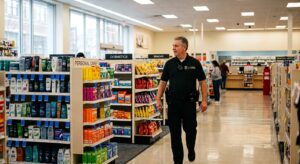
Theft of controlled medications can be a grab-and-run at the counter, a break-in after hours, or a slow loss that only shows up when the counts don’t match. A security officer helps most with the first two. A uniformed presence near the pharmacy area makes a grab-and-run less likely and gives staff someone close by when a customer gets aggressive over a prescription.
Slow losses are a different problem. They call for documentation, a careful look at who had access and when, and, when needed, an investigation. Ken’s years working DEA cases as a CVS security director are the kind of experience that shapes how Hub thinks about this side of pharmacy security: quietly, with records, and without accusing anyone before the facts are clear. Hub also offers private investigation services for workplace matters.
Robbery Risk at the Pharmacy Counter
At a pharmacy, the counter is the natural focus of robbery risk, because that is where the medications are. The goal for staff is to get through any incident safely. A security officer’s job is to make the counter a less attractive target and to support staff if something starts.
- Position the officer where they can see both the pharmacy counter and the main entrance.
- Agree in advance on how staff signal the officer, and what the officer does next.
- Focus on de-escalation, and call police when a situation calls for it. Merchandise can be replaced. People can’t.
- Write up every incident the same day, while details are fresh, so management and police have an accurate record.
Opening and Closing Escorts
The quietest minutes of a pharmacy’s day are often the riskiest. When one employee unlocks the doors in the morning, or two employees count out and leave at night with the deposit, there is no crowd and no one watching. An officer on site for opening or closing changes that. Staff don’t walk to their cars alone, don’t carry the deposit alone, and don’t step into a dark store alone.
Opening and closing escorts can be set up for every day, for late-night closings only, or for specific days when deposits are larger.
Parking Lot Coverage and Remote Camera Monitoring
Many pharmacy problems start or end outside the store: in the parking lot, at the back door, or by the drive-through window. Hub can patrol the lot during pharmacy hours and at closing, so staff and customers aren’t walking to their cars unwatched. Hub can also remotely monitor the store’s cameras, so someone is watching even when no officer is on site. If the cameras have blind spots, a CCTV and surveillance assessment can find them. For more on lot coverage, see our parking lot security page.
How Hub Approaches Pharmacy Security
Hub’s pharmacy security work builds on the same approach as our retail security services: deterrence first, confrontation last.
- A walk-through. We look at the pharmacy counter, the entrances, the stockroom, the parking lot, lighting and the store’s opening and closing routine. For a deeper review, see our security risk assessment.
- Written post orders. The officer gets a plan for that store: where to stand, how staff signal for help, who to call, and what to do at opening and closing.
- Coverage that fits the risk. That might be an officer during pharmacy hours, an escort for opening and closing, parking lot patrols, remote monitoring of the store’s cameras, or a combination.
- Documentation. Every incident is written up, so the store has a record if it needs to involve police, insurance or a regulator.
All of our officers are Hub employees; we do not use subcontractors. Hub Security and Investigative Group was founded in 2004 by police officers, carries $3 million in general liability insurance, and holds Private Detective Firm License #LP0203L, issued through the Massachusetts State Police Certification Unit. Our dispatch line, (617) 857-1200, is staffed 24 hours a day, 7 days a week.
Pharmacy Security Tips for Owners and Managers
- Keep the pharmacy area visible from the front of the store; avoid tall displays that block the view.
- Never have one person open or close alone if you can avoid it.
- Vary the time and route of bank deposits.
- Agree on a simple signal staff can use to call for help without escalating a situation.
- Write down every incident, even small ones. Patterns show up in the records.
For store-wide ideas, see our guide to retail loss prevention strategies.
Frequently Asked Questions
Does a pharmacy need an armed officer?
Most do not. An unarmed, uniformed officer who is visible and trained in de-escalation is enough for many stores. Armed coverage can make sense where there is a specific, known risk, and Hub provides armed security guards when it does. We help you decide during the walk-through.
Can you cover only opening and closing?
Yes. Opening and closing escorts can be set up on their own, without full-day coverage.
Do you handle independent pharmacies as well as chains?
Hub works with businesses of every size across Massachusetts. The approach is the same: a walk-through, written post orders and coverage that fits the store.
Talk to Hub About Pharmacy Security
Call (617) 857-1200, with dispatch staffed 24/7, or request a quote online. Tell us about the store, its hours and what has been happening. For more on how we protect stores, see our retail security services.