
Security Guard Post Orders: A Supervisor’s Complete Guide

Security guard post orders are the site-specific, signed instructions that tell a guard exactly what to do at a post, from the moment they arrive to the moment they are properly relieved. Every effective set of post orders rests on three non-negotiable elements:
- Site overview and primary duties: location name, post name, shift hours, assigned personnel, and a clear list of daily responsibilities
- Emergency procedures and communication protocols: exact steps for fire, medical, evacuation, and active-threat events, plus a current contact list
- Acknowledgment and version control: a signed sign-off block, an effective date, and an approver name so the document is defensible under audit or insurer review
Your immediate next action: download the DC DGS Sample Post Orders PDF as a structural reference, then open a blank document and assign one owner to draft the site-specific version within 48 hours.
Table of Contents
- Why clear post orders protect your site legally, operationally, and financially
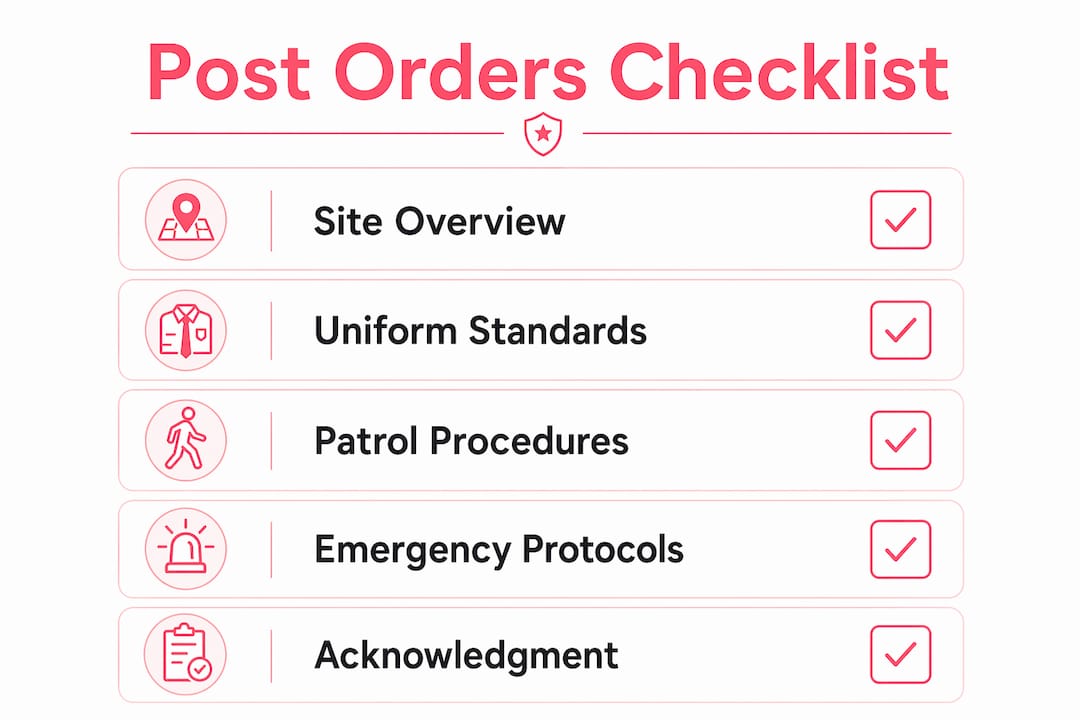
- What every post order must include: a structured checklist you can copy
- How the 11 General Orders and the 5 C’s fit into your post orders
- Ready-to-use templates and sample post orders you can start with today
- How to write site-specific post orders: a step-by-step process
- Keeping post orders live, auditable, and defensible during operations
- What good and poor post orders look like in practice
- Key Takeaways
- Why the conventional wisdom on post orders gets it wrong
- Hubsecurityandinvestigativegroup can draft and audit your post orders
- Useful sources and references for supervisors
Why clear post orders protect your site legally, operationally, and financially
Post orders are the document insurers review first when a claim lands on their desk. A claims adjuster evaluating a premises-liability incident will ask one question before almost any other: “What were the guards instructed to do, and is there a signed document proving they knew it?” If the answer is a vague, generic policy sheet with no acknowledgment block, the insurer’s position on coverage can shift quickly.

Operationally, clear post orders eliminate the guesswork that causes inconsistent guard behavior across shifts. When patrol frequency, access control steps, and visitor processing are spelled out in writing, a new officer on their first night performs the same core duties as a ten-year veteran. That consistency matters most during handovers, when critical information about an unresolved situation or a suspicious vehicle needs to transfer accurately from one shift to the next.
Consider a realistic scenario: a guard at a commercial office building notices a propped-open stairwell door at 2:00 AM. Without post orders, the response depends entirely on that individual’s judgment. With post orders that specify “conduct a security check of all stairwell doors every 60 minutes and radio dispatch immediately if any door is found propped open,” the guard’s action is documented, the response is logged, and the client has a defensible record. That paper trail is precisely what separates a manageable incident from a costly liability dispute.
What every post order must include: a structured checklist you can copy
The sections below represent the minimum required content for a defensible, site-ready post order. Sample phrasing is included so you can adapt each line directly.
| Section | What to Include | Sample Phrasing |
|---|---|---|
| Site Overview | Facility name, address, post name, shift hours, assigned guard(s) | “Post: Main Lobby, 123 Commerce St. Shift: 11:00 PM – 7:00 AM. Assigned: Officer J. Smith” |
| Primary Duties | Access control steps, visitor processing, desk duties, watch standards | “Verify all visitor IDs against the approved access list before issuing a badge.” |
| Patrol Instructions | Routes, frequency, tools, what to observe and report | “Conduct lobby patrols every 30 minutes. Log each patrol in the duty log with time and observations.” |
| Emergency Procedures | Fire, medical, evacuation, active-threat steps with exact radio language | “Radio: ‘Control, Post 1, Code Red, Building A, Floor 3. Evacuating now. Request backup.'” |
| Reporting & Documentation | Incident report timing, daily logs, handover notes | “Complete an incident report within 30 minutes of any event. Submit to supervisor before end of shift.” |
| Communication & Contacts | Supervisor, facilities, emergency services, client contacts | “Supervisor: [Name, phone]. Facilities: [Name, phone]. Police/Fire/EMS: 911.” |
| Special Instructions | Restricted areas, equipment checks, uniform standards | “Server room (Room 204) is restricted. No entry without written client authorization.” |
| Acknowledgment Block | Guard signature, date, version number, approver name | “I have read and understand these post orders. Signature: ___ Date: ___ Version: 2.1” |
For uniform and equipment standards, the acknowledgment block should reference what the officer is expected to wear and carry. Uniform and equipment standards belong in writing, not in verbal tradition, because verbal instructions cannot be audited.
The DHS Maryland Security Guard General Orders exhibit provides a government-contract-grade example of arrival and relief procedures, equipment inspection language, and the strict prohibition on leaving a post without proper relief — all of which belong in your site-specific document.
How the 11 General Orders and the 5 C’s fit into your post orders
The 11 General Orders for sentries originated in U.S. military sentry doctrine and remain the foundational baseline that most civilian security training programs adapt. They belong in the policy-level section of your post orders, framed as standing expectations that apply regardless of site-specific instructions.
The 11 General Orders adapted for civilian site use
- Take charge of your post and all property and personnel within your area of responsibility.
- Patrol your assigned area in a professional manner, remaining alert at all times.
- Report all violations of post orders and any observed laws or regulations to your supervisor.
- Repeat all calls for assistance and relay messages accurately and without delay.
- Quit your post only when properly relieved by an authorized person.
- Receive, obey, and pass on to your relief all orders from your supervisor and client representatives.
- Talk to no one except in the line of duty; do not discuss post details with unauthorized persons.
- Sound the alarm or contact dispatch in any case of disorder, emergency, or threat.
- Call for your supervisor in any situation not covered by your post orders.
- Salute (or acknowledge) all authorized personnel and visitors according to site protocol.
- Be especially watchful during low-visibility conditions; challenge all persons attempting to access restricted areas.
Per SecurityGuardExam.com’s civilian training guidance, these orders are regularly tested in state licensing exams and serve as the behavioral baseline every guard should internalize before reading site-specific instructions.
The 5 C’s: one-line examples for each
The 5 C’s of security give officers a decision framework for any unscripted situation:
- Challenge: “Identify yourself and state your business before I can allow access to this area.”
- Control: “Step to the side and remain calm while I verify your credentials with the front desk.”
- Contain: “Do not allow anyone to enter or exit the lobby until I receive clearance from my supervisor.”
- Communicate: “Control, Post 1: I have an unverified individual at the main entrance. Requesting guidance.”
- Coordinate: “I am holding the individual at Post 1. Please send a second officer and notify the client rep.”
Place the 11 General Orders in the standing-policy section near the front of your post orders document. The 5 C’s work best as a laminated quick-reference card attached to the document or posted at the guard station, where an officer can consult them during a live situation without flipping through pages.
Ready-to-use templates and sample post orders you can start with today
The table below is a full post-order template structure you can copy directly into your own document. Each row represents one section with the recommended content and a formatting note.
| Section | Content to Write | Format Note |
|---|---|---|
| Document Header | Facility name, address, post name, effective date, version number, approver | Bold header block at top of page |
| Site Overview | Building description, access points, hours of operation, client contact | 2–3 sentences, plain language |
| Guard Assignment | Officer name(s), shift times, post location, relief procedures | Table or bulleted list |
| Primary Duties | Numbered list of daily tasks in order of priority | Numbered list, active verbs |
| Patrol Schedule | Route map reference, patrol frequency, checkpoints, logging method | Table with time and checkpoint columns |
| Access Control | Approved access list location, visitor processing steps, badge issuance | Step-by-step numbered list |
| Emergency Procedures | Fire, medical, evacuation, active-threat: exact steps and radio scripts | Separate subsection per emergency type |
| Reporting Requirements | Incident report timing, daily log format, handover note requirements | Checklist format |
| Contact List | Supervisor, client rep, facilities, police, fire, EMS, poison control | Two-column table: Role |
| Special Instructions | Restricted areas, equipment checks, prohibited actions, dress code | Bulleted list |
| Acknowledgment Block | Guard signature, printed name, date, version confirmed | Signature line with version reference |
| Change Log | Version number, date of change, description, approver signature | Table at end of document |
Single-page quick checklist for shift handover or pocket use:
- Post name and shift hours confirmed
- Duty log from previous shift reviewed and signed
- Equipment check completed (radio, flashlight, keys, access cards)
- Patrol route and frequency confirmed
- Emergency contact list current and accessible
- Restricted areas verified secure
- Any open incidents from previous shift briefed and logged
- Acknowledgment of post orders signed (new guards or after any revision)
Authoritative sample PDFs worth downloading:
- DC DGS Exhibit C Sample Post Orders: Best for municipal and government-contract sites; includes arrival procedures, duty logs, and general orders language.
- DHS Maryland Exhibit 3 General Orders: Best for sites that need government-contract-grade arrival and relief procedures and equipment inspection checklists.
How to write site-specific post orders: a step-by-step process
Writing effective post orders is a structured process, not a one-afternoon task. The steps below reflect the workflow we use at Hubsecurityandinvestigativegroup when developing post orders for new client sites.
- Conduct a site walk. Walk every access point, patrol route, restricted area, and emergency exit with the client representative. Note what you observe, not what you assume. This typically takes 1–2 hours for a mid-size commercial property.
- Review the site risk profile. Identify the top three to five threats specific to this location: after-hours intrusion, visitor management gaps, parking structure vulnerabilities, or workplace violence risk. Your post orders should address each one directly.
- Draft the document. Use the template structure above. Write in plain, active language. “Check all exterior doors” is better than “Exterior door security protocols should be observed.” Assign one person to own the draft.
- Client review and approval. Share the draft with the client representative, facilities manager, and, where applicable, legal or HR. Allow five to seven business days for review. Incorporate feedback in a tracked revision.
- Guard training and read-through. Training programs should include a mandatory read-through of the post orders before the first shift. Guards should be able to locate the emergency procedures section and recite the radio script for at least one emergency type without looking.
- Sign-off and file. Collect a signed acknowledgment from every guard assigned to the post. File originals in a secure, searchable location. Retain copies at the post.
Responsibility table:
| Step | Primary Owner | Supporting Role | Timeline |
|---|---|---|---|
| Site walk | Security supervisor | Client facilities rep | Day 1–2 |
| Risk review | Security supervisor | Safety manager | Day 2–3 |
| Draft | Security supervisor | Legal / HR (review) | Day 3–7 |
| Client review | Client rep | Facilities manager | Day — |
| Guard training | Training officer | Supervisor | Day — |
| Sign-off and filing | Security supervisor | Admin / records | Day — |
For sites with complex layouts, such as parking structures or multi-tenant buildings, site-specific patrol planning should inform the route design before the draft is written. Patrol frequency and checkpoint locations discovered during the site walk belong in the document, not added later from memory.
Supervisors managing facility documentation alongside post orders may find that pairing post-order workflows with work order management software helps track hazard reports and maintenance requests that surface during patrols, keeping both operational streams in one auditable system.
Keeping post orders live, auditable, and defensible during operations
A post order written once and filed away is not a security document. It is a liability. Operational post orders require a structured audit cycle and a version-control discipline that most sites underinvest in.
Recommended audit frequency:
- Daily: Supervisor or lead officer confirms duty log is complete, patrol times are logged, and no open incidents are unresolved.
- Monthly: Walk the post with the assigned guard. Verify that patrol routes match the document, equipment is functional, and the contact list is current.
- Quarterly: Formal review with the client representative. Update any changed procedures, personnel, or emergency contacts. Issue a new version with a signed acknowledgment from all assigned guards.
Version control block (include at the end of every post order document):
| Version | Effective Date | Change Summary | Approved By |
|---|---|---|---|
| — | [Date] | Initial issue | [Name, Title] |
| — | [Date] | Updated emergency contacts | [Name, Title] |
| — | [Date] | Added active-threat protocol | [Name, Title] |
Training guidance from Uretsky Security instructs that guards should read and rehearse post orders regularly so they know exactly what to do during an emergency, not just where to find the instructions. Build that rehearsal into your quarterly review cycle as a short tabletop drill.
Pro Tip: Store signed acknowledgment forms and incident reports in a password-protected, cloud-based folder organized by site and version number. When an insurer or attorney requests documentation, you can produce a complete, timestamped record within minutes rather than hours.
Document retention best practice in the U.S. generally calls for keeping signed acknowledgments and incident reports for a minimum of three to five years, though sites subject to specific state licensing requirements or contract terms should confirm the applicable retention period with legal counsel.
What good and poor post orders look like in practice
At Hubsecurityandinvestigativegroup, we have reviewed post orders from dozens of commercial and residential sites across the Boston area and beyond. The difference between a document that holds up under insurer scrutiny and one that creates exposure usually comes down to three specific drafting failures.
Common pitfall 1: Overly generic language. A post order that reads “Guard will patrol the premises as needed” gives no one any guidance. An insurer reviewing a slip-and-fall claim will note that “as needed” is undefined, and the guard’s actual patrol behavior cannot be verified. The fix is simple: specify the route, the frequency, and the logging method. “Officer will conduct a full exterior perimeter patrol every 45 minutes. Each patrol will be logged in the duty log with start time, end time, and any observations.”
Common pitfall 2: No emergency radio scripts. Guards under stress revert to training. If the post orders do not include exact radio language for a medical emergency, the officer will improvise, and the dispatch record will be inconsistent. Include at minimum: the call format, the post identifier, the nature of the emergency, and the location. “Control, Post 2, medical emergency, main lobby, requesting EMS immediately.”
Common pitfall 3: Missing acknowledgment block. A post order with no signed acknowledgment is legally indistinguishable from a document the guard never read. Every revision requires a new signature. Every new guard assigned to the post signs before their first shift.
Professional security guard services that operate under well-drafted post orders produce consistent, auditable behavior across shifts, which is exactly what clients and insurers need to see when an incident is reviewed.
Key Takeaways
Well-drafted security guard post orders are the single most important operational document a supervisor can produce: specific, signed, versioned, and rehearsed.
| Point | Details |
|---|---|
| Specificity over generality | Replace vague language like “patrol as needed” with exact routes, frequencies, and logging requirements. |
| Insurer scrutiny is real | Post orders are the primary document insurers and claims adjusters review to assess whether reasonable security was in place. |
| Acknowledgment is non-negotiable | Every guard must sign before their first shift and after every revision; unsigned documents carry no evidentiary weight. |
| Version control protects you | Maintain a change log with version number, effective date, change summary, and approver name on every document. |
| Hubsecurityandinvestigativegroup | Drafts insurer-ready, site-specific post orders and provides audit support for commercial, residential, and event sites. |
Why the conventional wisdom on post orders gets it wrong
Most guides treat post orders as a compliance checkbox: write it once, file it, move on. That framing misses what actually makes a post order valuable. The document’s real function is behavioral. It is the mechanism by which a security firm transfers its professional judgment to an officer standing alone at 3:00 AM with no supervisor in sight.
The conventional wisdom also underestimates how often post orders are tested not by emergencies but by the mundane. An insurer reviewing a claim about an unauthorized person accessing a server room does not care whether the guard responded heroically. They care whether the post orders specified that the server room was restricted, whether the guard was trained on that restriction, and whether there is a signed acknowledgment proving it. The heroics are irrelevant without the paper trail.
What we have seen at Hubsecurityandinvestigativegroup is that the sites with the fewest liability disputes are not necessarily the ones with the most sophisticated security technology. They are the ones where the post orders are specific, current, and signed. A two-page document that is actually followed beats a twenty-page manual that lives in a filing cabinet. Write for the officer, not for the auditor, and the auditor will be satisfied.
Hubsecurityandinvestigativegroup can draft and audit your post orders

Hubsecurityandinvestigativegroup brings over seventy-five years of combined law enforcement and loss prevention experience to every client engagement, including post-order drafting, on-site security assessments, and audit support. We write insurer-ready post orders that include site-specific patrol schedules, emergency radio scripts, version-control templates, and signed acknowledgment forms, so your documentation holds up whether it is reviewed by a claims adjuster, a state licensing board, or a client’s legal team. Our team conducts the site walk, drafts the document, trains the assigned officers, and schedules the first quarterly review before we hand the file over to you.
If you manage a commercial property, residential building, or event venue and your current post orders are generic, unsigned, or out of date, the right next step is a professional review. Visit our business security guide to understand the full scope of what a layered security program looks like, then contact Hubsecurityandinvestigativegroup to schedule a site-specific post-order review and consultation.
Useful sources and references for supervisors
- DC DGS Exhibit C Sample Post Orders (PDF): A municipal government sample with arrival procedures, duty logs, and general orders language. Best used as a structural model for commercial or government-adjacent sites.
- DHS Maryland Exhibit 3 Security Guard General Orders (PDF): Government-contract-grade arrival and relief procedures, equipment inspection checklists, and the prohibition on leaving a post without proper relief. Use this when your client requires a defensible, government-standard format.
- SecurityGuardExam.com: 11 General Orders for Security Guards: A civilian-focused explanation of each general order with application notes. Useful for training new officers and for adapting military sentry language into site-specific phrasing.
- WestCongress Insurance: Post Orders for Security Guards: Industry commentary on how insurers use post orders during claims and underwriting review. Reference this when briefing a client on why documentation specificity matters financially.
- Uretsky Security Module II.C: Communications and Its Significance (PDF): State-training-level guidance on why guards must read and rehearse post orders regularly. Use to justify building rehearsal drills into your quarterly review cycle.
- Hubsecurityandinvestigativegroup Services: Request a customized post-order drafting engagement, on-site security assessment, or audit support for your facility.
Recommended
- The Power of Professional Appearance: Why Security Guard Uniforms Matter More Than You Think – Hub Security & Investigative Group
- 10 Important Training Programs Every Security Graurds – Hub Security & Investigative Group
- Suicide Prevention : 7 Essential Things Security Guards Should Know – Hub Security & Investigative Group
- 1.Understanding Security Guard Pricing: What Determines the Cost of Protection? – Hub Security & Investigative Group
