
The most effective retail loss prevention strategies follow a three-pillar framework: People, Process, Technology. Start with a portfolio-wide risk assessment, pilot unified incident logging with VMS/POS integration in one to three stores, then lock your evidence workflows before scaling. That sequence, executed in order, produces measurable shrink reduction within a single quarter.
Your first 72 hours:
- Score each location by risk tier (high, mid, low) using incident history, shrink rate, and store layout
- Activate a unified incident log and connect your video management system to POS exception reporting in pilot stores
- Document your evidence chain-of-custody protocol in writing and distribute it to every guard and manager on shift
Table of Contents
- What are the three strategic pillars of retail loss prevention?
- Which physical and technical measures actually reduce shrink?
- What operational controls close the gaps technology misses?
- How should you staff and train your loss-prevention team?
- What does a solid incident response protocol look like?
- How do you build a phased rollout with measurable ROI?
- What questions should you ask a prospective security partner?
- What U.S. legal limits govern your loss-prevention program?
- Real-world results: what coordinated programs actually deliver
- Key Takeaways
- Why the “more cameras” instinct keeps failing retailers
- Hubsecurityandinvestigativegroup can build this program with you
- Useful sources and further reading
What are the three strategic pillars of retail loss prevention?
The three pillars work as a detection-to-disruption loop, not as independent programs. Fund all three or the loop breaks.
People covers uniformed guards, plainclothes investigators, LP coordinators, and the HR controls that reduce insider risk. Process covers inventory cycle counts, POS exception rules, returns authorization thresholds, receiving controls, and audit cadences. Technology covers video management systems (VMS) with AI analytics, electronic article surveillance (EAS), RFID, license-plate recognition (LPR), and case management software.
The Appriss Retail 2026 benchmark shows employee theft accounts for roughly 29% of shrink and inventory errors for 12%. That means more than 40% of your preventable loss originates inside the building, which is why Process and People controls matter as much as cameras.
Prioritize by location risk score:
- Low-risk sites: uniformed observe-and-report guard + EAS + cycle counts
- Mid-risk sites: add VMS/POS integration and POS exception reporting
- High-risk sites: full stack including LPR, plainclothes investigators, and case management
Pro Tip: Default every guard post to observe-and-report. Apprehension authority increases liability sharply and should be reserved for high-shrink, video-documented programs with a written detention policy in place.
Which physical and technical measures actually reduce shrink?
A layered, perimeter-first approach combining video AI, EAS/RFID, and POS analytics is the most scalable framework for a multi-site portfolio.

Item-level vs. store-level controls: Keeper cases and ink tags protect individual high-value SKUs. EAS gates and RFID protect the store perimeter and give near-real-time inventory visibility, catching shrink within days rather than at annual count.
Video: Modern VMS platforms go well beyond passive recording. AI analytics flag concealment gestures and repeated loitering in real time. When your VMS feeds directly into POS exception reporting, a single analyst can correlate a suspicious void transaction with the corresponding video clip in minutes rather than hours.
LPR: License-plate readers at exits often provide the single piece of evidence that converts a retail incident into a patternable, chargeable organized retail crime (ORC) case. Deploy them at primary vehicle exits, not just storefronts.
Active deterrence: Strobe-and-talk-down systems let a remote analyst intervene verbally before a theft completes. Useful for lower-risk sites where a full-time guard is not cost-justified, but they carry their own risk trade-offs around escalation and false triggers.
| Technology | Typical unit cost range | Notes |
|---|---|---|
| IP camera (per unit) | — | Higher end includes AI analytics capability |
| LPR camera (per unit) | — | Cloud software adds recurring fees |
Shrink benchmark: The 2026 Appriss Retail report found $90 billion in total retail shrink, with 73% of that loss preventable through better controls.
What operational controls close the gaps technology misses?
Technology detects. Policy prevents. The two work together, and most retailers underinvest in the policy side.
Core inventory controls:
- Cycle counts on a rolling schedule, not just at year-end
- Blind receiving: staff verify quantities before seeing vendor paperwork
- Dual-approval required for all voids and refunds above a defined dollar threshold
- Restricted-access SKUs logged by associate ID using access-event systems
Returns policy: Returns abuse drove $100 billion in preventable loss in the most recent benchmark period. Require manager authorization above a value threshold, capture ID on cash-equivalent returns, and feed that data into your incident log so repeat abusers surface automatically.
Operations readiness checklist:
- Cycle count schedule documented and assigned by SKU category
- Blind receiving procedure in place for all vendors
- Refund/void dual-approval threshold set and enforced in POS
- Restricted-access SKU list current and access-event logging active
- Vendor invoices cross-referenced against purchase orders before payment
- Incident reports filed within 24 hours for all theft or suspected theft events
- Returns data feeding into incident management system
How should you staff and train your loss-prevention team?
Hiring the wrong people creates more liability than having no program at all. Partnering with a professioneller Sicherheitsdienst für Events ensures professionally trained security staff who align with your risk management needs. Background checks, reference verification, and targeted screening for previous LP experience are non-negotiable starting points.
Deployment model: The default posture for most stores is a uniformed, observe-and-report officer. Visible uniformed presence deters opportunistic theft without the false-arrest and use-of-force exposure that plainclothes apprehension creates. Reserve detention-trained plainclothes staff for high-shrink, video-documented sites with a written detention policy already in place.
Training essentials:
- De-escalation and conflict resolution before any physical intervention
- Evidence preservation: what to document, what not to touch, and when to call law enforcement
- Legal limits of detention under your state’s shopkeeper’s privilege statute
- POS exception response: how to flag and escalate anomalies without tipping off the subject
- Customer service balance: every staff member on the floor is a deterrent when they engage customers
When guards are properly trained and integrated with technology, industry examples show meaningful shrink reductions depending on implementation depth. That range reflects the difference between a guard standing at a door and a guard connected to your VMS, incident log, and escalation chain.
Pro Tip: Use uniformed presence to reduce incidents across your portfolio, then concentrate detention-trained staff only at locations where video documentation and a written detention policy are already in place. This protects the business legally while maximizing deterrence where it counts most.
What does a solid incident response protocol look like?
Every incident that goes undocumented is a case that cannot be prosecuted and a pattern that cannot be detected. Your contract officers and frontline managers need a written protocol they can follow without judgment calls under pressure.
Immediate on-scene rules:
- Observe and document; do not pursue beyond the property line
- Gather vehicle description, direction of travel, and any witness statements from a safe distance
- Do not touch or move physical evidence
Step-by-step response checklist:
- Secure the scene and confirm no one is injured
- Pull and preserve video clips covering the full incident window, plus 10 minutes before and after
- Export LPR data if a vehicle was involved
- Print and attach the relevant POS transaction records
- Create a case file with chain-of-custody documentation for all physical evidence
- Submit the incident report within 24 hours
- Escalate to regional LP review if the incident matches a known ORC pattern
- Refer to law enforcement with a complete evidence package; pursue civil recovery where appropriate
Pro Tip: Concentrating investigative resources on a small cohort of repeat offenders pays off. The top 10% of offenders account for roughly 60% of stolen value. Cross-store intelligence sharing turns individual incidents into chargeable patterns.
How do you build a phased rollout with measurable ROI?
A phased approach protects your budget and produces evidence that justifies the next investment.
Phase 1 — Assessment (2–4 weeks per region): Score every location by risk tier. Audit current technology, policy gaps, and guard deployment against the three-pillar framework.
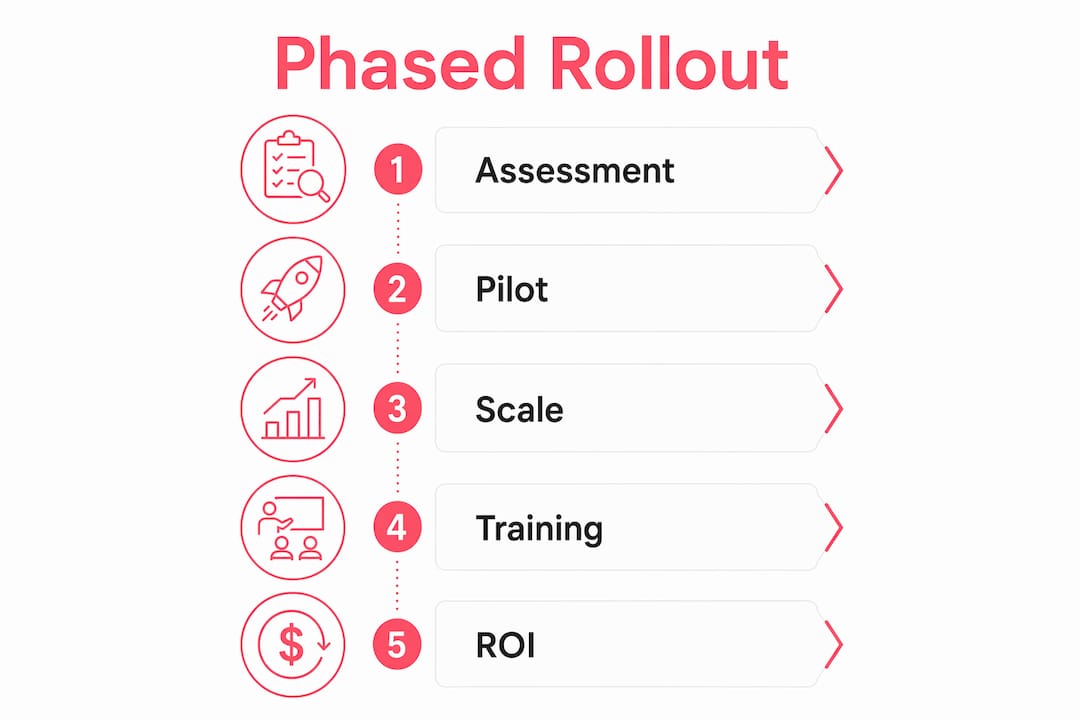
Phase 2 — Pilot (8–12 weeks): Deploy the full stack in two to four representative stores. Establish baseline KPIs before the pilot begins.
Phase 3 — Scale: Quarterly rollouts by risk tier, starting with high-risk sites. Refresh training at each wave.
| KPI | Baseline target | Measurement cadence |
|---|---|---|
| Shrink % of sales | Establish at audit | Monthly |
| Incidents per transactions | Establish at audit | Weekly |
| Time-to-evidence collection | Under 2 hours | Per incident |
| Recovered value | Track from pilot start | Monthly |
| False-arrest incidents | Zero tolerance | Per incident |
ROI framing: Measure prevented loss against total program cost (guard hours, technology licensing, training). A high-risk store with meaningful shrink reduction typically reaches break-even within one to two quarters. Sensitivity is highest at locations where shrink exceeds 2% of sales.
What questions should you ask a prospective security partner?
Procurement conversations fail when buyers focus on price before evaluating capability. Use these criteria to score every candidate.
Essential evaluation criteria:
- Observable KPIs with reporting cadence defined in the contract
- Written training curriculum covering de-escalation, evidence preservation, and legal detention limits
- Liability limits, insurance certificates, and indemnification language reviewed by counsel
- Evidence-handling SOPs that match your chain-of-custody requirements
- Multi-state compliance capability if your portfolio crosses state lines
- Technology integrations: can their officers feed your VMS and incident management platform?
Contract clauses to require:
- Default no-pursuit/no-touch policy in writing
- Evidence-preservation obligations with defined timelines
- Audit rights for training records and incident logs
- Quarterly performance reviews tied to KPIs
Questions to ask in interviews:
- How do your officers document and preserve video evidence?
- What is your protocol when an officer witnesses an ORC group?
- How do you handle a false-arrest claim?
- Can you provide corporate references from multi-site retail clients?
Pro Tip: Outsourcing security to a firm with dedicated LP experience gives you access to trained investigators and evidence-handling SOPs that most in-house programs take years to build.
What U.S. legal limits govern your loss-prevention program?
Retail security in the United States operates inside a patchwork of state laws. Getting this wrong creates liability that dwarfs the shrink you were trying to prevent.
Key legal considerations:
- Shopkeeper’s privilege varies by state. Most states allow brief, reasonable detention based on probable cause, but the standard for “reasonable” differs. A written detention policy and video documentation are required wherever apprehension is authorized.
- Surveillance notice rules: Federal law and most state laws permit video surveillance in public retail areas. Employee-only areas (break rooms, restrooms) carry stricter restrictions. Post notice where required.
- Employee searches: Require written consent policies reviewed by employment counsel. Searches without a documented policy create wrongful-search exposure.
- LPR data retention: Treat LPR records as evidence. Define a retention period, restrict access, and document chain of custody.
- Use-of-force: Guard contracts are not a compliance plan. Maintain a separate workplace-violence prevention program where state law requires it.
Pro Tip: Retailers have faced multimillion-dollar settlements for discriminatory stop-and-detain practices. All interventions must be based on documented, observed behavior, not demographic assumptions. Behavior-based written protocols protect both customers and the business.
Legal note: This article is general information, not legal advice. Confirm current state-specific detention rules, surveillance requirements, and employment law with qualified legal counsel before implementing any apprehension or search policy.
Real-world results: what coordinated programs actually deliver
Case A — Multi-store specialty retailer: A regional chain piloted VMS/POS integration across four stores over 10 weeks. By connecting video clips to POS exception flags, the LP team identified a pattern of after-hours employee voids that had been invisible in standalone reports. The pilot produced a measurable reduction in internal shrink and provided the evidence package needed for terminations and a civil recovery filing.
Case B — Flagship with ORC exposure: A single high-volume flagship deployed LPR at two vehicle exits and connected the data to a cross-store incident log. Within 60 days, three vehicle plates appeared in incidents at four different locations. That pattern gave law enforcement the probable-cause basis for an ORC investigation that would not have been possible from individual store reports alone.
The consistent finding across both cases: technology alone did not produce the result. The outcome came from connecting the technology to a documented process and trained personnel who knew exactly what to do with the data.
Key Takeaways
A three-pillar program (People, Process, Technology) with phased rollout, behavior-based protocols, and cross-store intelligence sharing is the most reliable path to measurable shrink reduction in a U.S. retail portfolio.
| Point | Details |
|---|---|
| 73% of shrink is preventable | The Appriss Retail 2026 benchmark confirms most loss responds to better controls, not just more cameras; $90 billion in shrink was recorded, with 73% preventable and employee theft accounting for roughly 29%. |
| Observe-and-report is the safe default | Plainclothes apprehension increases false-arrest liability; reserve it for high-shrink, video-documented sites only. |
| Top 10% of offenders drive ~60% of loss | Cross-store intelligence sharing converts individual incidents into chargeable ORC patterns. |
| Phase your rollout by risk tier | Assess, pilot in 1–3 stores, then scale quarterly; measure shrink reduction and incidents per transactions. |
| Hubsecurityandinvestigativegroup | Brings 75+ years of combined law-enforcement and LP experience to risk assessments, guard deployment, and investigations. |
Why the “more cameras” instinct keeps failing retailers
Most executives I speak with arrive at loss prevention the same way: a bad quarter triggers a camera upgrade, shrink stays flat, and the cycle repeats. The problem is never the camera count. It is the absence of a connected system where detection leads to documentation, documentation leads to a case file, and a case file leads to a consequence.
The data backs this up. When the top 10% of offenders account for 60% of stolen value, spreading resources evenly across every incident is the wrong strategy. The retailers who outperform their peers on margin protection treat loss prevention as an intelligence operation, not a surveillance installation. They build the process first, then buy the technology that feeds it.
The observe-and-report model is not a compromise. It is the correct default because it preserves deterrence, minimizes liability, and keeps your best investigative resources focused on the cases worth building. Apprehension is a tool for a specific, well-documented situation, not a general posture.
Hubsecurityandinvestigativegroup can build this program with you
Reducing shrink requires the right partner at the assessment stage, not just at the guard-deployment stage. Hubsecurityandinvestigativegroup brings over 75 years of combined law enforcement and loss prevention experience to every engagement, from initial portfolio risk assessments and pilot management to uniformed guard deployment, plainclothes investigations, and evidence-handling SOPs built for prosecution.

We work directly with corporate security directors, operations leaders, and procurement teams to design programs that fit your risk profile and budget, not a generic template. Whether you need a single-site assessment or a phased rollout across a multi-state portfolio, the conversation starts with a call. Contact us to request a risk assessment or proposal today.
Useful sources and further reading
Use these reports and resources when building procurement requirements, setting KPI benchmarks, or briefing legal counsel on detention and surveillance obligations.
- Appriss Retail 2026 Total Retail Loss Benchmark Report — the primary U.S. industry benchmark for shrink composition and preventable loss figures
- Appriss Retail press release: $796B in Total Retail Loss — summary data on returns abuse and AI-based triage
- Spot AI: Retail Loss Prevention Strategies That Actually Reduce Shrink — vendor framework for VMS/AI integration and perimeter-first deployment
- HireSecurityNow: Retail Loss Prevention Security Hiring Guide — best-practice guidance on guard deployment models and detention policy requirements
- Auror: Retail Loss Prevention Strategies — intelligence-led approach to targeting serial offenders and ORC groups
- InVue: 6 Retail Shrinkage Statistics Every LP Leader Should Know — data on locking fixtures and access-event logging adoption
For legal review: Consult your state’s shopkeeper’s privilege statute and your employment counsel’s guidance on employee-search policies before finalizing any detention or apprehension protocol. State variance is significant, and a guard contract alone does not constitute a compliant workplace-violence or detention program.
Recommended
- How Professional Security Guards Prevent Crime on Commercial Properties – Hub Security & Investigative Group
- How Professional Security Guards Prevent Crime on Commercial Properties – Hub Security & Investigative Group
- Protecting Your Business Employee Theft : Why Hub Security And Investigative Group is Your Best Defense – Hub Security & Investigative Group
- Identifying Deception: A Comprehensive Report on Cheating Indicators and Professional Investigation Solutions – Hub Security & Investigative Group