
A security guard’s job is to be a visible deterrent and a trained set of eyes and ears. Guards patrol, control who enters, watch alarms and cameras, respond to incidents, and write down what they see. They do not replace the police. The exact mix of duties depends on the site, the post orders the client writes, and whether the guard is armed or unarmed.
We have staffed Massachusetts businesses, healthcare facilities, retail and bank locations, and events since 2004. This guide covers what the duties are, how they change by setting, where a guard’s authority stops, and how to write post orders that get you the coverage you are paying for.
TL;DR
- Core duties are patrolling, access control, monitoring alarms and cameras, responding to incidents, and documenting everything in reports, which matches the U.S. Bureau of Labor Statistics description.
- Most guards observe and report. They generally do not hold police powers, so serious incidents go to 911.
- Duties change by post: a retail guard watches for theft, a mall guard manages crowds and parking, a hospital guard handles de-escalation and visitor flow.
- Written post orders matter more than the job title. Define what the guard does, and what the guard does not do, before the first shift.
- Armed and unarmed guards share most duties. The difference is the risk profile of the site.
Table of Contents
- The core duties of a security guard
- What a guard does not do
- How duties change by setting
- Unarmed vs. armed guard responsibilities
- Training, licensing and what to expect in Massachusetts
- Our perspective: duties are only as good as the post orders
- Writing post orders that work
- Getting guards matched to your site
- FAQ
- Sources
The core duties of a security guard
The BLS says security guards protect property against theft, vandalism and other illegal activity. Its Occupational Outlook Handbook lists the day-to-day work as patrolling the property, enforcing employer rules, monitoring alarm and surveillance systems, responding to emergencies, controlling building access, conducting security checks, and writing reports on what was observed.
Here is how that looks on a real shift.
1. Patrolling and security checks
Patrols are the most visible part of the job. A guard walks or drives a route, checks that doors and gates are locked, looks for unsafe conditions, and notices anything out of place. A Massachusetts state decision, Primus v. State Board of Retirement, describes an institutional security officer whose primary duty was building and campus checks to make sure doors were locked. It is unglamorous work, and it is where many problems get caught early.
Good patrols are not predictable. Varying times and routes keeps would-be trespassers from learning the pattern. We use GPS patrol tracking so a site manager can confirm that checkpoints were reached, not just take our word for it. For sites that cannot justify a full-time post, mobile patrol delivers the same checks on a scheduled and random basis.
2. Access control
Guards control who gets in. That can mean checking IDs at a front desk, signing visitors in and out, verifying delivery drivers, issuing badges, or managing a gate. Access control is often the single most valuable duty because it stops problems before they reach the building.
The guard’s job is to follow the written visitor policy consistently, including for people who are impatient, senior, or friendly. Consistency is what makes the policy work.
3. Monitoring alarms and surveillance
Many guards watch camera feeds, respond to alarm panels, and check on the cause of an alert. A guard who investigates an alarm is not just resetting it. They are deciding whether it is a false trigger, an open door, or a real intrusion, and what to do next.
4. Responding to incidents and emergencies
Guards are often the first people on scene when something goes wrong: a fire alarm, a medical emergency, a fight in the lobby, a suspicious package. OSHA’s guidance on security personnel notes that guards may be exposed to hazardous substances during emergencies, which is why the employer should define their emergency role, training and protective equipment in advance, not after an incident.
In practice, a guard’s first moves are usually the same: make the area safe, call 911 or the right internal contact, keep people away, and stay on scene to brief responders.
5. Documenting everything
Reports are how a guard’s work becomes useful to you. A daily activity report, an incident report, a trespass notice, and a maintenance observation all create a record that supports insurance claims, HR decisions and, where needed, police or court follow-up. Plain facts, times, names and what was done is the standard. Opinions and guesses do not belong in a report.
What a guard does not do
This is where clients and the public most often get confused. A private guard is not a police officer. Guards generally monitor and report, while police have the authority to investigate crimes, seize evidence and make arrests. The BLS handbook is also clear that guards are not expected to take on law enforcement tasks, and in an emergency they are typically told to contact police rather than engage.
What that means for you:
- Do not write post orders that ask a guard to chase, restrain or interrogate people.
- Do expect a guard to observe, deter, give verbal commands, document and call for help.
- If a site needs more than that, the answer is a different security plan, not a guard asked to act beyond training.
OSHA makes a related point about violence prevention: the most useful thing a guard does is often early identification and reporting of warning signs, not physical confrontation. Training in conflict de-escalation is therefore part of the job, not an extra.
How duties change by setting
The same person can do very different work depending on the post. This table shows how the emphasis shifts.
| Setting | Main focus | Typical daily duties |
|---|---|---|
| Retail store | Loss prevention and customer experience | Greeting at the door, watching for theft behavior, checking receipts when store policy requires, responding to alarms, assisting staff during incidents |
| Shopping mall | Crowd flow, parking and visibility | Foot and vehicle patrol, assisting shoppers, escorting staff to cars, reporting hazards, coordinating with tenants and police |
| Office or commercial building | Access control | Front desk check-in, badge checks, after-hours lockup, camera monitoring |
| Healthcare facility | De-escalation and safe movement | Visitor screening, responding to agitated patients or families, escorts, securing restricted areas |
| Residential building | Resident safety and order | Lobby control, package and guest rules, patrols of common areas and garages |
| Construction site | Theft and trespass | Gate logs, equipment checks, after-hours patrols |
| Event | Crowd management | Entry screening, credential checks, aisle and exit control, coordination with staff |
Retail security guard duties
A retail guard is part deterrent, part customer service. Standing visibly near the entrance discourages theft, and a friendly greeting tells everyone they have been noticed. Guards watch for known theft patterns, respond to door alarms, support staff in tense moments, and write up incidents so managers can see trends. For jewelry and bank locations the emphasis tilts further toward access control and opening and closing procedures.
Mall security guard duties
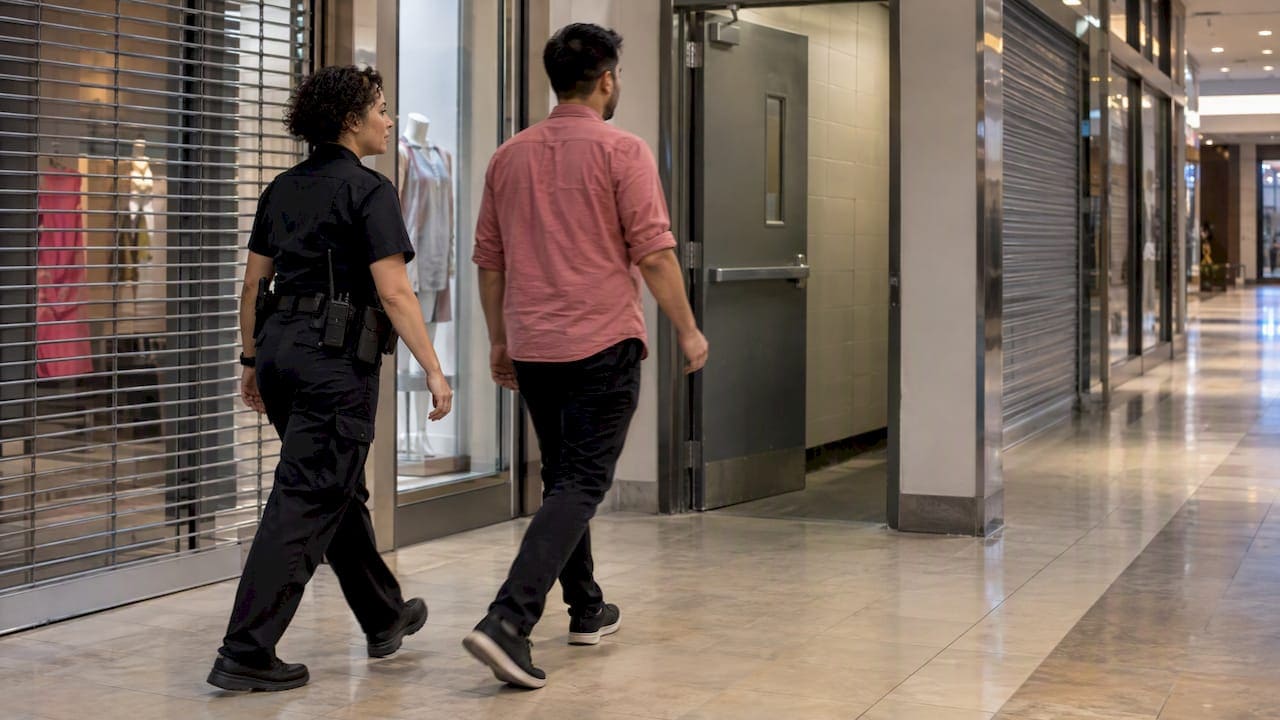
Mall guards cover a large, public space. Expect a mix of patrols on foot or by vehicle, parking lot presence, lost-child and medical response, and escorts for tenant staff at closing. The key skill is being approachable while staying alert.
Healthcare and residential posts
In hospitals and clinics, guards spend more time de-escalating than anywhere else. At condo and apartment buildings, the job is consistency: the same rules for every guest, every night. Our residential security guard service is built around that kind of steady presence.
Unarmed vs. armed guard responsibilities
Most duties are identical. Both patrol, control access, monitor, report and call for help. The difference is the risk the site faces and what the client has decided it needs.
Unarmed guards suit most offices, residential buildings, retail floors, events and healthcare lobbies, where visibility and observation do the work. Armed guards are typically considered where cash, valuables or a higher threat level are involved, such as bank locations or high-risk assets. An armed post adds extra legal and training requirements, and it should be a deliberate decision based on a risk assessment, not an assumption that more is always better.
If you are comparing, start with our pages on unarmed security guards and armed security guards.
Training, licensing and what to expect in Massachusetts
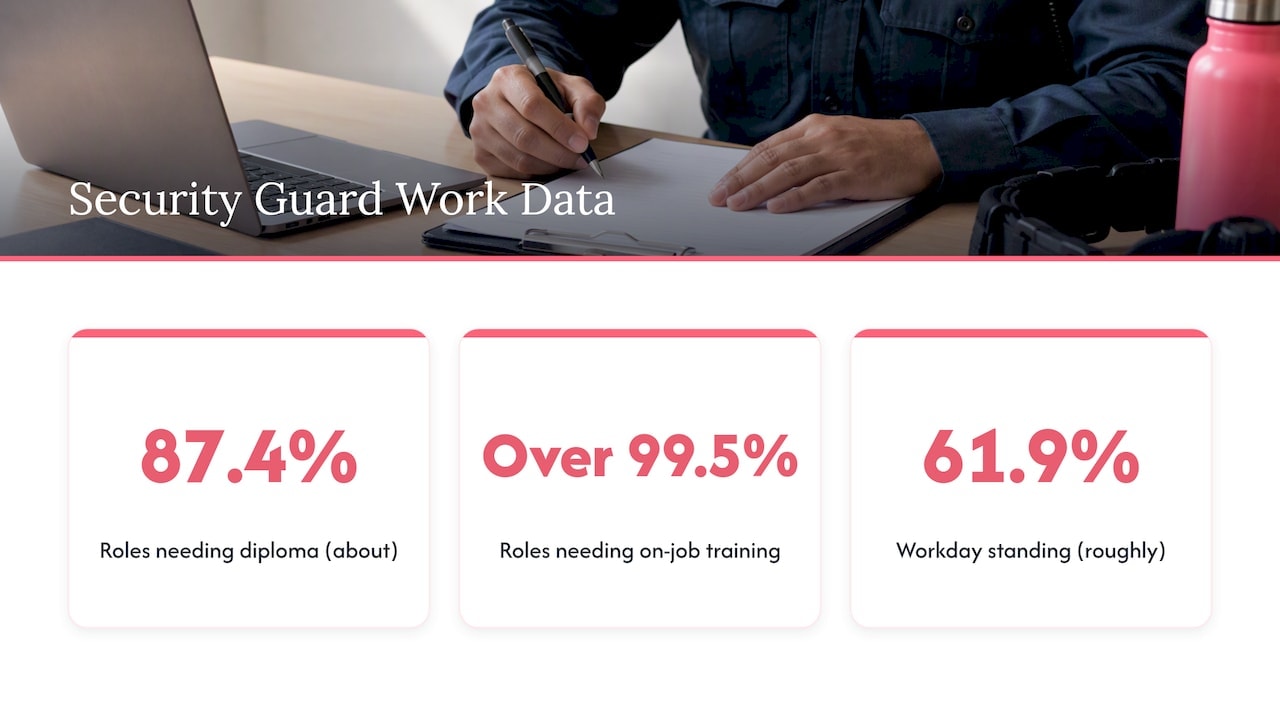
The BLS reports that in 2025 about 87.4% of security guard roles required at least a high school diploma and over 99.5% required on-the-job training, and that standing takes up roughly 61.9% of the average workday, per its Occupational Outlook Handbook data. It is a physical job.
In Massachusetts, security guarding falls under MGL c. 147, sections 23 to 25, which cover private detective and watch, guard and patrol licenses. The state also publishes its process for applying for or renewing a private investigator or watch guard license. Separately, businesses that install, repair or maintain security systems need an S-License, which is a different requirement from guard services.
For a client, the practical point is to ask any company you hire for its license number and proof of insurance. Hub holds Massachusetts Private Detective Firm License #LP0203L and carries $3 million in general liability insurance. For more on the licensing side, see our Massachusetts security officer licensing guide.
Our perspective: duties are only as good as the post orders
We have seen the same problem for years. A client hires a guard, says “keep the place safe,” and is disappointed three weeks later. The guard did what he understood the job to be. Nobody had written it down.
Here is how we approach it:
- Start with the risk profile. A pharmacy, a condo garage and a construction yard are different problems. We walk the site first and ask what has actually gone wrong before.
- Write post orders in plain language. Who gets in, who does not, what triggers a call to 911, who the guard calls second, and what the guard never does.
- Prevent first. Our focus is loss prevention. A guard who is visible at the right time, greets people and notices a change in behavior prevents more than one who reacts well.
- Verify the work. GPS patrol tracking and 24/7 dispatch staffed by our own employees mean we can show you what happened on a shift. We never use subcontractors, so the person on your post is ours and answers to us.
- Keep the guard in a guard’s role. We do not want anyone asked to do police work. That protects the guard, your staff and your liability.
OSHA’s workplace violence guidance stresses that security is one layer, alongside policies, physical controls and training for all staff. We agree. A guard is the first line of defense, not the only one.
— Derek
Writing post orders that work
If you are hiring, use this checklist before the first shift.
- List the posts and hours. Front desk, roving patrol, gate, parking lot.
- Define access rules. Who needs ID, who needs an escort, who is on the approved list.
- Set the patrol plan. Areas, frequency, and what the guard checks at each stop.
- Spell out incident response. When to call 911, who to notify next, and what to write down. If you want guards to act as first responders to hazards like chemical releases, say so, because OSHA notes that triggers additional training requirements.
- State the limits. No pursuit, no restraint unless your policy and training explicitly allow it.
- Agree on reporting. Daily logs, incident reports within a set time, and who reads them.
- Review monthly. Reports show where orders need adjusting.
If workplace violence is a concern, our one-page workplace violence response plan gives employers a starting point. For a wider look at choosing a provider, read our guide to hiring a security company in Massachusetts.
Getting guards matched to your site
If you need guards in Massachusetts, we provide armed and unarmed officers for businesses, property managers, healthcare facilities, retail and bank locations, and events. New clients are matched with a guard within 24 to 48 hours of an approved quote. See our security guard services or contact us through our site to talk through your post orders. We do not publish prices, because the right quote depends on the site, hours and risk.
FAQ
What are the main duties of a security guard?
Patrolling, controlling access, monitoring alarms and cameras, responding to incidents, and writing reports. The BLS handbook lists these as the core of the job. Specific tasks depend on the site and the employer’s post orders.
Can a security guard arrest someone?
Generally, guards do not have the authority of police. Their role is to observe, deter, document and call police. What a guard may do beyond that depends on state law, licensing and the employer’s rules, so ask any provider to explain its policy in writing.
What is the difference between armed and unarmed guard duties?
The daily tasks are largely the same. The difference is the level of risk at the site and the added training and legal requirements for armed posts. Most offices, residential buildings and retail floors are well served by unarmed guards.
Do security guards need a license in Massachusetts?
Massachusetts regulates watch, guard and patrol services under MGL c. 147, sections 23 to 25, and the state describes the process on its watch guard license page. Requirements depend on how the guard is employed, so confirm your provider’s firm license before signing.
What does a retail security guard do?
A retail guard greets customers, watches for theft behavior, responds to alarms, supports staff during tense situations and documents incidents. The goal is deterrence and a safe store experience, not confrontation.
Sources
- Security Guards and Gambling Surveillance Officers, Occupational Outlook Handbook (BLS)
- OSHA 3335: Security Personnel
- OSHA: Workplace Violence Overview
- Primus v. State Board of Retirement, CR-20-0432 (Mass.gov)
- Apply for or renew a private investigator or watch guard license (Mass.gov)
- Massachusetts law about occupational licensing (Mass.gov)
- S-License and Certificate of Clearance (Mass.gov)