
The usual starting point is one security guard for every 50 to 100 guests, and where you land in that range depends on risk. A quiet, seated, daytime event with no alcohol sits near 1:100. Alcohol, standing crowds or late hours push you toward 1:50 or tighter. The ratio is only the first step, because doors, restricted areas and cash rooms need guards of their own on top of it.
We have staffed events across Massachusetts since 2004, and this is how we work through the number with planners, venue managers and organizers.
TL;DR
- Start at 1 guard per 100 guests for a calm, seated, daytime event, and move toward 1 per 50 when there is alcohol, a standing crowd or a late finish.
- Calculate from peak attendance, not from the number of tickets sold or the number of RSVPs.
- Add fixed-post guards (entrances, exits, VIP areas, backstage, cash handling) after you apply the ratio. They are not part of it.
- Some jurisdictions set their own minimums for alcohol areas, so check local licensing rules before you finalize staffing.
- Treat any ratio as a baseline for a risk assessment, never as a final headcount.
Table of Contents
- Where the 1:100 rule comes from
- Ratios by event type
- What moves the number up or down
- Fixed posts come on top of the ratio
- Worked examples
- Rules and guidance that set minimums
- Our perspective: the ratio is where the conversation starts
- Plan your event staffing with us
- A short checklist before you book
- FAQ
- Sources
Where the 1:100 rule comes from
The one-guard-per-100-guests figure is the number you will see on most security company pages and planning blogs. It survives because it is easy to remember and works as a rough budgeting tool. One event-ticketing guide describes the baseline industry standard as one guard for every 50 to 100 attendees, depending on how risky the event is.
It is not a law, and it is not a promise of safety. Professional planners describe ratios as a starting point for risk assessment, not a legal mandate or a final staffing number. A 1:100 crew at a seated awards luncheon may be generous. The same crew at a standing-room concert with a bar may be badly short.
Think of the ratio as the roaming layer of your plan: the guards who watch the crowd, respond to problems and de-escalate conflict. Everything else in the plan is built around that layer.
Ratios by event type
The table below gathers the figures that appear in the sources we use. Treat them as planning starting points to test against your own event.
| Event situation | Typical starting ratio | What to add |
|---|---|---|
| Quiet, seated, daytime, no alcohol | About 1:100 | Entrance and exit posts |
| Alcohol served, standing crowd or late hours | Toward 1:50 or tighter | Guards at bars and at the alcohol service area |
| Large, open footprint | 1:25 to 1:50 | Perimeter and parking coverage |
| Nightlife venue (NYC guidance) | 1:75 patrons, with discretion to add | Extra guards based on crowd and event |
| Utah alcohol consumption area (state minimum) | 1:50 people in the area at one time | Posts outside the consumption area |
The first three rows come from the TickPick planning guide, which notes that alcohol, standing-room crowds and late hours move planning from 1:100 toward 1:50, while large open footprints may call for 1:25 to 1:50. The last two come from regulators and are covered in the rules section below.
If you want a deeper look at how these bands play out, we break down the ratios from 1:25 to 1:250 in a separate guide.
What moves the number up or down
Two events with 500 guests can need very different crews. These are the variables we weigh first.
Alcohol
Alcohol is the single biggest reason to tighten a ratio. It lowers inhibitions, raises the chance of disputes and adds the job of checking IDs and watching for overserved guests. If your event pours drinks, start at 1:50 or tighter rather than 1:100, and put at least one guard where drinks are served. Our alcohol service security guide covers what managers should do at the bar and the door.
Crowd posture and hours
A seated audience watching a speaker is easier to manage than a standing crowd moving between stages. Late hours matter for the same reason: fatigue, drinking time and darkness all add risk. Standing crowds and late finishes belong in the 1:50 conversation.
Venue layout
A single-room ballroom can be watched by a few well-placed guards. A campus with several buildings, parking lots and open lawns cannot. Large open footprints may call for 1:25 to 1:50 because guards cannot see each other or the whole crowd. Multiple floors, loading docks and back-of-house corridors each need their own coverage.
Who is attending
The Murrieta, California police department’s event staffing matrix looks at more than headcount. It weighs attendance, alcohol, private security, venue, guest or artist profile, age group and threat assessment. That is a good checklist for any planner. A school dance, a political rally and a corporate holiday party have different risk profiles even at the same size.
Public profile
A controversial speaker, a public official or a high-profile guest changes the plan entirely. For those events, we recommend reading our guides on political event security and VIP event security planning.
Fixed posts come on top of the ratio
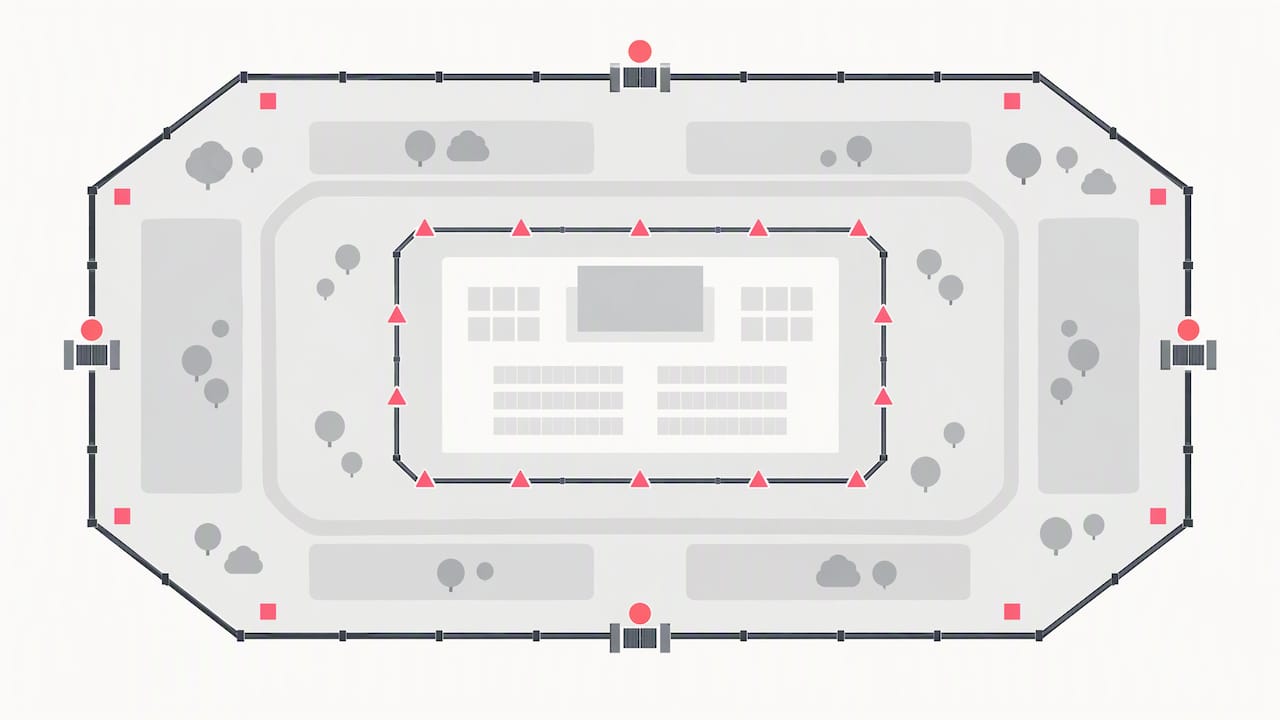
This is where many budgets break. The ratio covers guards who move through the crowd. Fixed posts are guards who stay in one place and do one job:
- Main entrances, where bag checks, ticket scans or ID checks happen
- Emergency exits that must stay clear and not be propped open
- VIP areas and green rooms
- Backstage and load-in areas
- Cash rooms, coat checks and merchandise tables
- Restricted zones such as kitchens, mechanical rooms and offices
The correct method is to calculate ratio coverage from peak attendance using a risk-adjusted ratio, then add staff for fixed posts such as doors, VIP areas, backstage, cash rooms and restricted zones. If you fold your door guards into the ratio count, the crowd is left without roaming coverage as soon as the doors need attention.
High-profile security planning works the same way at a larger scale. Reporting on how the Secret Service operates explains that an advance team assesses site vulnerabilities and identifies the personnel needed to secure inner, middle and outer perimeters. You do not need a presidential detail, but the idea of layers holds at any event: outer perimeter, entry points and inner areas each get their own people.
Worked examples
These are our own illustrations of the arithmetic, not data from a real event. Adjust them to your venue.
A 200-person seated corporate lunch, no alcohol
At 1:100, the roaming layer is 2 guards. Add one guard at the main entrance and one near the speaker or VIP table if senior executives are present. That gives you 4 guards in total, and two of them are fixed posts.
A 400-guest evening reception with an open bar
With alcohol and an evening finish, we start at 1:50. That is 8 roaming guards. Add 2 entrance guards, 1 at the coat check or cash area and 1 for the parking lot. The total is 12. If the same event ran as a daytime seated event with no alcohol at 1:100, the roaming layer would be 4, which shows how much one variable changes the headcount.

A 1,000-person outdoor festival on an open site
An open footprint may call for 1:25 to 1:50. At 1:40, that is 25 roaming guards. Then add gate teams, backstage security, a cash room guard and perimeter coverage. Many planners are surprised that the fixed posts at a festival can add another 10 to 15 guards to the count. The only way to be sure is a site walk.
Check your peak, not your average
Always use peak attendance. If 600 people are registered but 450 are in the room at 9 p.m., staff for the peak the venue will actually see, and confirm how many people can legally be inside.
Rules and guidance that set minimums
In most of the U.S., no single law sets a security-guard-to-attendee ratio for all events. But some regulators do set numbers for alcohol, and police departments publish their own planning tools.
- Utah: the state’s alcohol regulator requires a minimum of one security person for every 50 people estimated to be in the alcohol consumption area at one time.
- New York City: the NYPD’s nightlife guidelines recommend one guard for every 75 patrons, with management free to add guards based on the event or crowd.
- Police coordination: the Murrieta matrix cites an industry standard of one sworn officer for every three to five private security staff. It also notes that private security lets officers focus on public safety and emergency response while guards manage access and monitoring.
- Federal planning guidance: the U.S. Department of Justice COPS Office publication on planning and managing security for major events stresses incident response, emergency medical access and coordination between public safety and private security.
These examples come from Utah, New York and California, and they are not Massachusetts rules. If your event is in Massachusetts, check with your city or town licensing office and the venue’s liquor license conditions before you lock in staffing. Local police may also have requirements for large gatherings, road closures and detail officers.
Our perspective: the ratio is where the conversation starts
Planners often call us and ask for a number. We understand why. A number fits in a budget line. But in our experience, the first number is almost always wrong in one direction or the other, because it ignores how the event actually runs.
We start with a risk profile. Who is coming, what is being served, how long it lasts, where the doors are, and what happens if something goes wrong at 10 p.m. when the crowd is at its peak. Only then do we set a ratio and add fixed posts. A lean structure helps here: the person who walks the site with you is the person who stays involved in the plan, and we can adjust staffing without routing a change through layers of management.
Two habits matter more than any ratio. First, we never use subcontractors, so the guards at your event are our employees, and our own staff run dispatch around the clock. Second, we would rather you hire a few extra guards for the first hour and the last hour, when doors and exits are busiest, than spread a thin crew evenly across the whole event.
And a note on cost. A tighter ratio is not always the right answer. Sometimes a better layout, a controlled single entrance or a clear alcohol policy lets a smaller crew do a better job. That is a better use of your budget than adding bodies.
— Derek
Plan your event staffing with us
If you are planning an event in Massachusetts, we can turn your attendance, venue and risk profile into a staffing plan. Hub Security and Investigative Group provides armed and unarmed guards, event security and executive protection, with GPS patrol tracking and 24/7 dispatch. We are licensed in Massachusetts (Private Detective Firm License #LP0203L) and carry $3 million in general liability insurance. New clients are matched with a guard within 24 to 48 hours of an approved quote.

See our security guard services in Massachusetts or our full list of services to request a quote. If you want to understand what drives the price first, read our guide on what determines security guard pricing. For a structured start, our event risk assessment page explains how we size up a venue, and our event security planning playbook walks through the full process.
A short checklist before you book
- Confirm peak attendance and the legal capacity of the venue.
- Decide whether alcohol will be served, and where.
- Choose a starting ratio from 1:100 to 1:50 (or tighter for open sites) based on risk.
- List every fixed post: entrances, exits, VIP, backstage, cash, restricted zones.
- Add the fixed posts to the roaming count, not inside it.
- Check local licensing and liquor license conditions.
- Decide whether armed or unarmed guards fit your venue and risk. We explain armed security separately.
- Hold a walkthrough with your security provider before the event day.
FAQ
How many security guards do I need for 100 people?
For a quiet, seated, daytime event with no alcohol, one roaming guard is the usual baseline. Add at least one fixed post for the main entrance, so most 100-person events need two guards. With alcohol or a late finish, plan for two roaming guards plus the entrance.
Is there a legal guard-to-guest ratio in Massachusetts?
We are not aware of a single statewide rule that sets one ratio for all events. Some places set minimums for alcohol areas, such as Utah’s one-per-50 requirement, but those do not apply here. Ask your city or town licensing office and review your venue’s license conditions before you finalize staffing.
Do fixed posts count toward the ratio?
No. The ratio covers guards who watch and respond across the crowd. Entrance, exit, backstage, VIP and cash posts are added on top. If you count them inside the ratio, you remove roaming coverage as soon as those posts get busy.
Should guards be armed at my event?
It depends on the venue, the guest profile and the threat assessment, and many events are well served by unarmed guards trained in conflict de-escalation. Armed guards make sense when the risk profile calls for it, such as cash handling or a credible threat. We help you decide during the risk assessment.
When should I book event security?
Book as soon as you have a date, venue and rough attendance, so the guard count can be tied to a site walk. Last-minute bookings limit your options for layout changes. For current availability, contact us through our services page.
Sources
- How Many Security Guards Does Your Event Need? (TickPick)
- Murrieta Police Department Event Staffing Matrix
- Utah DABS Multiple Event Location Form
- NYPD Best Practices for Nightlife Establishments
- NBC News: How the Secret Service protects presidents
- U.S. DOJ COPS Office: Planning and Managing Security for Major Events