

By Derek Kreymer, Operations Manager
Property managers often ask us: do I need a security guard, or can cameras and remote monitoring do the job? The honest answer is that they solve different problems. Here is how we think about the choice at Hub Security and Investigative Group, and when it makes sense to use both.
What an On-Site Security Guard Does Best
A guard is a person on the property. That matters when the job involves people: 
- Talking to people. Greeting visitors, checking who belongs, answering questions and calmly asking someone to leave, the core of a concierge or front-desk post.
- Being seen. A uniformed officer at the door or walking the lot is a deterrent before anything happens.
- Acting right away. A guard on site is already there when a resident needs help, a medical call comes in or a disturbance starts.
- Doing the job the post requires. Running a front desk, checking IDs at an event, opening and closing a building, escorting staff to their cars across a parking lot.
The tradeoff is that a guard covers one place for set hours. Covering a large site around the clock takes more than one person.
What Remote Video Monitoring Does Best
Remote monitoring puts trained eyes on cameras from somewhere else. At Hub, the people watching are Hub employees, and the response is a Hub unit, or the police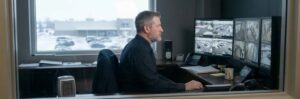 if no Hub unit is within a reasonable distance. It fits when:
- The property is empty for long stretches. Construction sites at night, car lots after closing, warehouses on weekends, homes while the owners travel.
- The site is spread out. Cameras can watch several areas at once, where one guard can only be in one place.
- You need checks, not a full-time post. Some Hub clients have their feed watched live; others have Hub check the cameras when they ask.
- You want a record. Hub clients get a daily email, plus video clips depending on the severity of what happened.
The tradeoff is that a camera can’t greet or question anyone, and it only sees what it’s pointed at. A response still has to travel to the property.
Questions to Ask Before You Choose
- Are people coming and going? If visitors, residents or customers need to be greeted, checked or helped, you need a person, armed or unarmed.

- Is the property empty when problems happen? If trouble comes at night or on weekends when no one is there, monitoring is a strong fit.
- Do you already have cameras? Hub can monitor existing cameras. If you need new ones, we arrange installation through an outside installation partner.
- How fast does a response need to be? A guard on site is immediate. Monitoring depends on how close the nearest Hub unit or police officer is.
- What’s the problem you’re actually trying to stop? Theft of materials, trespassing and vandalism point one way; disruptive visitors and access control point another. If you are not sure, a security risk assessment can sort it out.

Using Both Together
Common combinations:
- Monitoring plus mobile patrol. Cameras watched remotely, with an officer making in-person checks on a schedule. See our mobile patrol.
- A guard by day, monitoring by night. A staffed site during business hours, such as an office building, with cameras watched after everyone leaves.
- Monitoring during a closure. Seasonal properties, a business between tenants or a home while the family is away. See residential security.
For more on how Hub watches cameras and responds, see our remote video monitoring page. For on-site coverage, see our security guard services.
Talk It Through With Hub
Hub Security and Investigative Group was founded in 2004 by police officers, and all of our officers are Hub employees. Call (617) 857-1200, with dispatch staffed 24/7, or request a quote online. Tell us about the property and what has been happening, and we’ll tell you which option makes sense.