
A security master plan is a written, organization-wide roadmap that sets out your security philosophy, goals, programs and processes, and ties them to the way your business actually operates. It tells you which risks matter most, what you will do about them, in what order, and with what money. If you manage a facility, a property portfolio, a healthcare site or a retail operation, this guide walks you through building one in plain steps.
TL;DR
- A security master plan is a multi-year framework, endorsed by leadership, that links security decisions to business goals. It is more than a one-time assessment.
- Start with a risk and asset assessment, then cover policies, physical security technology and emergency response.
- Rank risks by probability and impact, then budget against that ranking so every dollar has a reason.
- Assign tasks, dates and metrics, and treat the plan as a living document that you update after incidents and changes.
- Most organizations get further faster by pairing internal knowledge with licensed local security professionals who know the sites.
Table of Contents
- What a security master plan actually is
- Who should help write it
- Step 1: Assess your risks, assets and vulnerabilities
- Step 2: Decide what the plan must cover
- Step 3: Prioritize and set the budget
- Step 4: Put the plan into action
- Step 5: Test, measure and update
- Common mistakes to avoid
- Turning your plan into coverage on the ground
- FAQ
- Sources
What a security master plan actually is
A security master plan (SMP) is a document that delineates an organization’s security philosophies, strategies, goals, programs and processes, developed consistently with the business plan and laying out risks and mitigation plans over a multi-year horizon. The same report describes it as an enterprise-wide framework endorsed by leadership, not just an assessment. That distinction matters. An assessment tells you where you are exposed today. A master plan tells you what you will do about it over the next several years.
Industry writing describes it as a dynamic, ongoing process that creates a conceptual construct and vision for strategic security, usually over a four to six year window. In practice, that means the plan is neither a binder that sits on a shelf nor a shopping list of cameras. It is the thing you open when a budget request lands on your desk, when a lease is up, or when something goes wrong at a site.
Here is what a good plan does for you:
- Gives leadership one picture of risk instead of a dozen competing opinions.
- Prevents piecemeal spending, such as buying access control for one door while another entrance stays unmonitored.
- Makes it easier to explain why guards, patrols, technology or policy changes are needed.
- Creates a record that shows you took reasonable, documented steps to protect people and property.
Master plan versus risk assessment versus policy
These three get confused constantly. A risk assessment is an input: it measures threats, vulnerabilities and consequences. A security policy is an output: it sets the rules people follow day to day, which we cover in our corporate security policy guide. The master plan sits above both. It decides which assessments you run, which policies you write, and how both connect to your mission. If you are unsure whether you need a vulnerability review or a broader risk review first, our piece on vulnerability vs risk assessment explains when to hire which.
Who should help write it
A plan written by one person in one department rarely survives contact with the rest of the organization. Guidance on the topic says development requires input from key organizational stakeholders and senior-management buy-off, and that the plan should stay in sync with the organization’s overall master plan so the corporate mission and vision line up.
A workable team usually includes:
- An executive sponsor. Someone who can approve money and settle disputes.
- Operations or facilities. They know how buildings, shifts and deliveries really work.
- Human resources. They handle terminations, workplace violence concerns and background screening.
- IT. Physical and cyber risks overlap more every year.
- Legal or compliance, and insurance contacts. They know your obligations and what your carrier expects.
- Front-line staff. Receptionists, managers and security officers notice problems no org chart shows.
- An outside security professional. A licensed provider brings comparisons from many sites and a fresh set of eyes.
Security consultant Tim Giles has noted that how you build a plan varies with business size, organizational structure, and whether you rely on internal staff or contract guards. A 40-unit condominium association in Lowell and a multi-site healthcare group near Boston will not produce the same document, and they should not.
Step 1: Assess your risks, assets and vulnerabilities
Everything else rests on this step. CISA’s Security Planning Workbook advises organizations to identify threats and hazards, perform on-site inspections, interview personnel and stakeholders, and review public records. It also says critical assets must be identified and valued, including tangible ones such as people and property and intangible ones such as reputation and proprietary information.
Walk the sites, then talk to people
Start with the physical walk-through. Visit every site at the hours it is busiest and at the hours it is emptiest. Check lighting, sightlines, door hardware, parking areas, loading docks, after-hours entry and what happens when an alarm trips. Then interview the people who work there. Ask what makes them uneasy, which door is always propped open, and where incidents have happened before even if nothing was reported.
Pull your own records too: incident reports, police calls to the address, insurance claims, shrinkage data and complaints. If your incident reporting is inconsistent, fixing that early pays off for the whole plan, and our security incident reporting procedures guide gives facility managers a five-step structure.
Name and value your assets
List what you need to protect and rank it by how badly you would be hurt if it were lost, damaged or exposed. People come first. Then come inventory, cash, equipment, records, keys and credentials, and the reputation that took years to build. CISA’s workbook says a vulnerability assessment should identify countermeasures for specific threats by considering feasibility, complexity, expected benefits, cost and resource availability. Keep those five filters in mind. They stop you from choosing measures that look impressive but are too complex or costly to sustain.
For storage and distribution sites, a look at how warehouse CCTV and security protect revenue shows how threats and consequences feed into the equipment you choose. Supply chains and outside vendors belong in this step too, because a weak vendor can become your weak point. A practical approach to vendor risk assessment for smaller teams can help you gather evidence without enterprise tools.
A note on frameworks
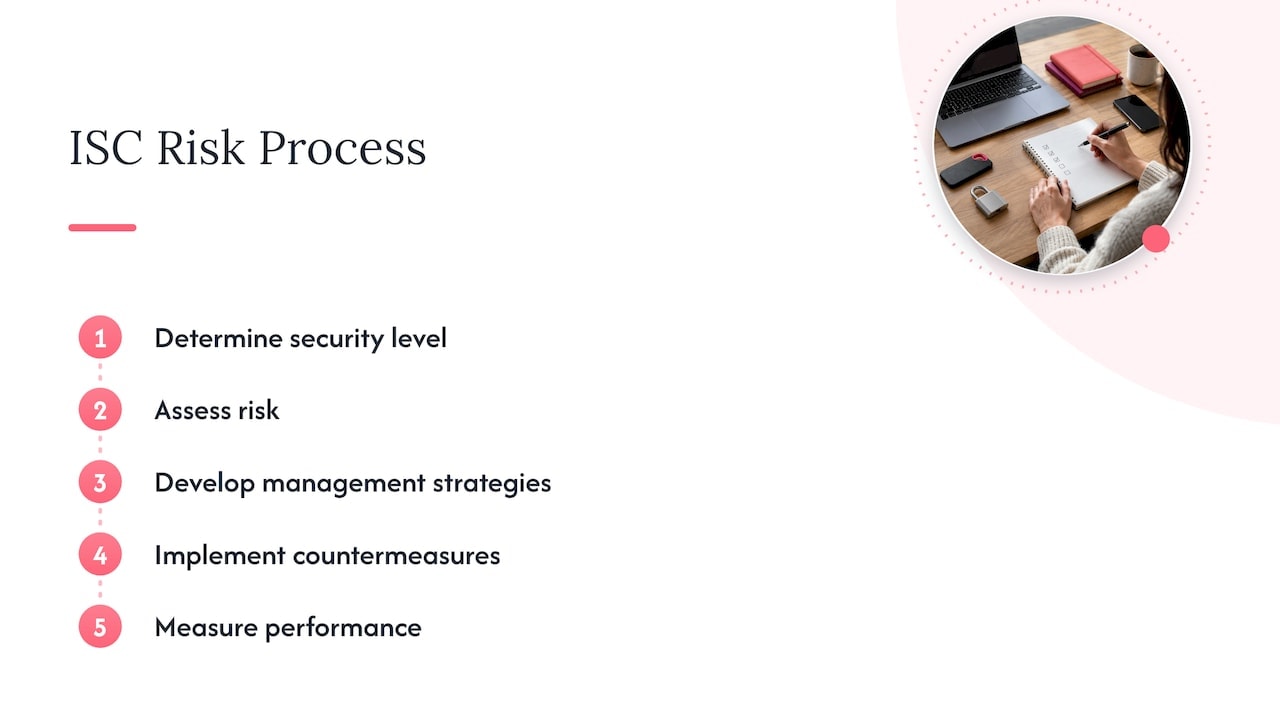
You do not need to adopt a federal standard, but borrowing from one saves time. The Interagency Security Committee’s 2024 standard sets out a five-step risk management process for federal facilities: determine the security level, assess risk, develop management strategies, implement countermeasures and measure performance. Private organizations often mirror that sequence because it is logical and repeatable. If you handle digital assets as well, NIST’s Cybersecurity Framework 2.0 says that understanding your assets, suppliers and cyber risks helps you prioritize consistently with your risk strategy and mission needs.
If you would rather have a licensed professional run this step, see how a security risk assessment in Massachusetts works, or read our two-page physical security risk assessment guide.
Step 2: Decide what the plan must cover
CISA’s workbook points to three broad areas: security policies, procedures, protocols and operations; physical security technology and equipment; and emergency planning and response. Build your table of contents around those and add what your sector demands.
| Plan section | What goes in it | Typical owner |
|---|---|---|
| Governance and goals | Mission link, scope, roles, review cycle | Executive sponsor |
| Policies and procedures | Access rules, visitor handling, key control, incident reporting, workplace violence | Operations, HR, legal |
| Staffing and operations | Armed or unarmed guards, patrol coverage, dispatch, post orders | Security manager |
| Technology and hardware | Cameras, access control, alarms, lighting, barriers | Facilities, IT |
| Emergency response | Lockdown, evacuation, medical, communication trees, drills | Safety lead |
| Special situations | Events, terminations and layoffs, high-profile individuals, construction | Department heads |
| Metrics and review | KPIs, audit schedule, update triggers | Security manager |
Staffing decisions inside the plan
The people side of a plan is where many organizations stall. Do you need a visible officer at the front desk, roving patrols across several buildings, or an armed presence because of cash handling or a credible threat? Our guides on armed vs unarmed security and when to hire armed guards lay out the decision, and what security guards do on the job helps you write realistic post orders. Let the risk assessment drive the choice, not habit or fear.
Plan for the situations that stress your site
Good plans include short annexes for predictable high-risk moments. Events are one example: crowd flow, credential checks and emergency exits need their own thinking, which we cover in our event security planning playbook. Layoffs and sensitive terminations are another. They carry a different risk profile than a normal workday and deserve a written protocol before you need it.
Step 3: Prioritize and set the budget
You will never fund everything at once, so rank. The CISA workbook advises organizations to rate risks by probability of occurrence and consequence, consider their own risk tolerance, and align mitigation decisions with goals and available resources. A simple three-by-three grid of likelihood against impact is enough for most small and midsized organizations.
A worked example, using a hypothetical property manager with three mixed-use buildings:
- High likelihood, moderate impact: after-hours trespassing in a parking structure. Address first with lighting changes and scheduled mobile patrol.
- Low likelihood, high impact: a violent incident at a ground-floor retail tenant. Address with training, a written response protocol and a camera upgrade at the entrance.
- Moderate likelihood, low impact: package theft in a lobby. Address with a procedure change and a log, no major spend.
The ranking changes the budget conversation. Instead of asking leadership for money for “security,” you ask for specific items tied to named risks.
Build the business case
Leadership approves what it understands. The 2023 ISC guide on making a business case for security describes using the Office of Management and Budget methodology after a risk assessment is complete. It also recommends opening with a Bottom Line Upfront, then following with project descriptions, business impacts, costs and benefits. Put your ask and your reason in the first paragraph, then back it up.
Costs for outside assessments and services depend on site size and scope. For a sense of what drives price, read what a security assessment costs in the U.S.. Count recurring costs as well as one-time ones: monitoring, maintenance, staffing hours and training.
Step 4: Put the plan into action
A plan that no one owns will not happen. The CISA workbook says organizations implement by assigning specific tasks, schedules and milestones to personnel and measuring performance against defined metrics. The ISC guide describes the same idea as an implementation plan that breaks the strategy into identifiable steps, assigns tasks, sets a project schedule and defines metrics for success.
In practice:
- Break the plan into phases, usually quick wins in the first 90 days, then larger projects across the following years.
- Name one accountable person for each item, not a committee.
- Write the success measure next to each item: response time, incident count, drill completion rate, audit findings closed.
- Brief every shift. A policy that never reaches the night staff does not exist.
When the plan calls for added coverage, plan the transition. Onboarding new officers, writing post orders and testing dispatch communication take time. Ask any provider how fast they can staff a site and how they supervise it.
Step 5: Test, measure and update
Treat the plan as a living document. CISA’s workbook says plans should be reviewed or updated after major incidents, changes in resources or technology, or formal updates to standards. The ISC standard adds that the final step, measuring performance, may send you back to earlier steps if standards are not being met. And NIST describes cybersecurity risk management as a continuous process that must account for evolving risks and technology changes.
A simple review rhythm:
- Quarterly: check metrics, open action items and incident trends.
- Annually: walk each site again and revisit the risk ranking.
- After any trigger: a serious incident, a move, a merger, a new tenant, a major technology change.
- Drills: run at least one realistic exercise a year, such as an evacuation or lockdown, and write down what failed.
Keep the plan flexible. Industry guidance notes that master plans should remain scalable and address new and emerging technologies, and that keeping current with trusted contractors, consultants and manufacturers supports long-term planning.
Common mistakes to avoid
- Starting with products. Choosing cameras before you know your risks puts the cart before the horse.
- Skipping leadership. Without a sponsor, the plan loses every budget fight.
- Ignoring the people layer. Technology without trained, supervised staff leaves gaps.
- Writing it once. A plan older than your last renovation or last incident is out of date.
- Leaving out vendors. Cleaners, contractors and delivery services all have access.
Our perspective on security master plans
We have been protecting Massachusetts businesses, property managers, healthcare facilities, retail and bank locations and events since 2004, and the pattern we see is consistent. The organizations that feel safest are rarely the ones with the most equipment. They are the ones that decided in advance what they were protecting, who was responsible, and what would happen on the worst night of the year.
Our approach is built around loss prevention: tailored security designed around preventing an incident rather than documenting one afterward. That is a layered security approach, and it works best when the plan names the first line of defense at each site, whether that is a visible officer, a patrol schedule, controlled entry, or a combination.
We also believe a plan is only as good as the people carrying it out. That is why our dispatch is staffed by our own employees around the clock, why our patrols are GPS tracked so you can verify the coverage you are paying for, and why we never use subcontractors. When something in your plan depends on a guard showing up and doing the job properly, you should know exactly whose employee that is.
Finally, we keep our management structure lean. That lets us give you personalized attention and a straight answer on whether you need armed or unarmed coverage, patrol or a fixed post, without the overhead of a much larger firm.
Derek
Turning your plan into coverage on the ground
Once your risks are ranked, the staffing and patrol pieces of the plan can move quickly. We provide armed and unarmed security guards, mobile patrol, event security, executive protection and security risk assessments across Massachusetts, with GPS patrol tracking and 24/7 dispatch staffed by our own employees. New clients are matched with a guard within 24 to 48 hours of an approved quote.

If you want a licensed team to help you assess a site or staff the measures your plan calls for, review our security services or start with a physical security assessment in Massachusetts. Our team will tell you plainly what your risk profile calls for.
FAQ
How long should a security master plan cover?
Most guidance points to a multi-year horizon. One industry source describes four to six years, while the PARAS report describes mitigation plans laid out within a five-year business plan. Whatever horizon you choose, review it at least once a year and after any major incident or change.
Is a security master plan only for large organizations?
No. The structure scales down. A single-site business can use a shorter document with the same parts: assets, risks, priorities, actions, owners and review dates. What changes is the depth, not the logic. Smaller organizations often benefit most because one clear plan prevents scattered, unplanned spending.
Who should own the plan?
Senior leadership should endorse it, and one named security or operations lead should manage it day to day. Guidance describes the plan as endorsed by leadership so that it carries enterprise-wide weight. Without that endorsement, departments tend to treat it as optional.
Do I need an outside consultant to write one?
Not necessarily, but an outside professional helps with the site walk-through, with benchmarking against similar facilities, and with credibility in front of leadership. Many organizations draft internally and bring in a licensed provider for the assessment and for staffing the measures the plan calls for.
How do I decide what to fund first?
Rank each risk by probability and consequence, compare it with your risk tolerance, and fund the highest-ranked items that are feasible within your resources. CISA’s workbook recommends this approach, and it gives you a defensible answer when someone asks why one project came before another.
Sources
- PARAS Security Master Planning Final Report
- Security Master Plan protects organisation against threats (Source Security)
- CISA Security Planning Workbook (September 2023)
- The Risk Management Process: An Interagency Security Committee Standard (2024 Edition)
- Making a Business Case for Security (ISC, 2023 Edition)
- The NIST Cybersecurity Framework (CSF) 2.0
- Tim Giles on security master plan development (Security Executive Council)
- Warehouse CCTV and security: how to protect your revenue
- SMB vendor risk assessment