
Corporate Security Policy: A Complete Guide for Managers

A corporate security policy is a formal, strategic document that defines how your organization protects its people, physical assets, digital information, and intellectual property. It sets the “what” and “why” behind your security program, while standards, procedures, and guidelines address the operational “how.” Without this foundation, security decisions become reactive, inconsistent, and nearly impossible to defend in court or during a regulatory audit.
A well-built policy does four things at once:
- Defines scope by specifying which assets, personnel, locations, and organizational units fall under its authority
- Sets enforceable rules covering access controls, acceptable use, incident response, and physical security
- Assigns ownership so every requirement has a named role responsible for compliance and enforcement
- Requires ongoing review to stay current with changing threats, regulations, and business operations
The policy hierarchy matters here. Policies sit at the top, expressing management’s intent. Standards translate that intent into measurable requirements. Procedures describe step-by-step tasks. Guidelines offer recommended practices. Confusing these levels is one of the most common mistakes organizations make, and it leads to documents that are either too vague to enforce or too granular to survive a business change.
What every corporate security policy must include
An effective policy is not a long document. According to SANS guidance on policy templates, the core policy is kept concise to enhance readability and enforceability, with detailed procedures moved to annexes to preserve readability and enforceability. What matters is that every required element is present and clearly written.
The six non-negotiable components are:
- Purpose and scope: State what the policy covers, why it exists, and which business units, systems, and personnel it applies to. Ambiguity here creates enforcement gaps.
- Policy statements: Specific, mandatory rules employees must follow. These cover access management, acceptable use, incident reporting, data classification, physical security, employee training, and monitoring.
- Roles and responsibilities: Name the positions, not just the departments, responsible for implementing, enforcing, and auditing each requirement.
- Exception process: Describe how deviations are requested, evaluated, approved, and documented. Every policy will face exceptions; the question is whether you handle them formally or informally.
- Review schedule: Specify when the policy will be reviewed regularly, and what triggers an unscheduled update, such as a major incident, a regulatory change, or a significant shift in business operations.
- Document metadata: Policy ID, version number, approval date, document owner, and next review date. These fields are what make a policy auditable.
Pro Tip: Add a one-page policy summary or “quick reference” annex for employees. The full policy document is for compliance and audit purposes; the summary is what actually changes day-to-day behavior.
Beyond structure, the content must cover the right security domains. Critical areas include physical security controls, cybersecurity requirements, data classification rules, employee training obligations, and incident response procedures. A policy that covers only IT systems while ignoring physical access or personnel security leaves your organization exposed on multiple fronts. Think of it as a layered security approach: each domain reinforces the others.
How do the three main types of security policies work together?
NIST SP 800-14 identifies three distinct policy types that every organization should maintain. Understanding how they nest is what separates a coherent security program from a collection of disconnected documents.
- Program Policy operates at the highest level. It establishes your organization’s overall security direction, assigns program-wide responsibilities, and addresses compliance obligations. This is the document your board or executive team approves. It does not describe technical controls; it declares management’s commitment and sets the governance structure.
- Issue-Specific Policies address particular risks or technologies in detail. Examples include a remote access policy, an acceptable use policy for company devices, an email privacy policy, or a social media policy. Each one targets a specific area of concern that the program policy cannot address with sufficient precision.
- System-Specific Policies govern individual hardware, software, or systems. They define who can access a particular database, what actions are permitted on a given server, and how a specific application must be configured. These are the most technical of the three and are typically owned by IT or system administrators.
The three types work as a hierarchy. Program policy sets the direction. Issue-specific policies translate that direction into rules for particular risks. System-specific policies implement those rules at the technical level. Gaps appear when organizations write system-specific rules without the issue-specific or program-level context to support them, leaving enforcement without authority.
Mapping each policy type to your regulatory requirements, whether that is HIPAA, SOC 2, ISO 27001, or GDPR, ensures you are not writing policies in a vacuum. Each framework has specific documentation requirements, and a well-structured three-tier policy architecture tends to satisfy multiple standards simultaneously.

How to build a corporate security policy that actually gets enforced
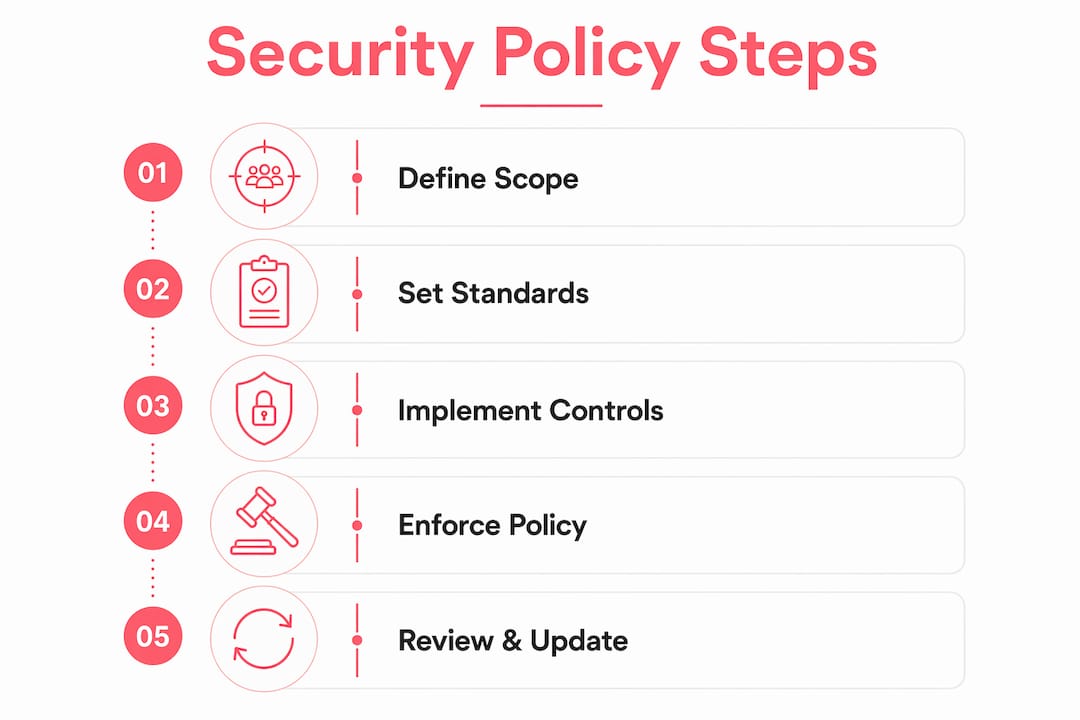
Most security policies fail not because they are poorly written, but because the development process skips critical steps. Here is the process that produces a policy your organization will actually follow.
- Assess your current security environment. Before drafting a single sentence, document what assets you have, what threats are relevant to your industry, what regulations apply, and where your current controls fall short. This assessment becomes the business justification for every policy requirement you write.
- Assemble a cross-functional team. Security policy affects every department. Bring in representatives from IT, legal, HR, operations, and executive leadership. Legal counsel reviews for regulatory alignment. HR ensures the policy is enforceable under employment law. Operations confirms the rules are workable in practice.
- Draft with clarity and specificity. Write what employees must do, not what they should consider doing. “Employees must use multi-factor authentication to access all company systems” is enforceable. “Employees should use strong passwords” is not. Keep the core document concise, and push detailed procedures into supporting annexes.
- Secure formal management approval. A policy without executive sign-off carries no authority. The approval process should be documented, with signatures or electronic approvals from the relevant stakeholders, including the CISO, legal counsel, and the executive sponsor.
- Communicate and train. Distributing a PDF is not the same as implementing a policy. Employees need training that explains what the policy requires and why it matters. Policy awareness and training are what convert a document into actual behavior change.
- Collect written acknowledgments. Every employee should sign or electronically confirm that they have read and understood the policy. This acknowledgment is your legal and operational defense if a violation occurs later.
- Schedule reviews and maintain the document. Annual reviews are the minimum standard. Update the policy after any significant incident, regulatory change, or major operational shift. Version control and a documented change log are not optional for audit-ready organizations.
Pro Tip: Do not wait for final approval to start the acknowledgment process. Circulate a draft for stakeholder comment early, then collect formal sign-offs on the approved version. This builds buy-in before the policy goes live and dramatically reduces resistance during rollout.
Corporate security policy templates: what a real document looks like
A template gives you a starting structure, but the value comes from customizing it to reflect your actual environment. Generic templates copied without modification tend to include requirements that do not apply to your organization and miss risks that are specific to your industry or operations.
A well-structured policy document follows this outline:
- Section 1: Introduction and purpose. One paragraph explaining why the policy exists and what it is designed to protect.
- Section 2: Scope. Explicit statement of which systems, locations, personnel, and third parties the policy covers.
- Section 3: Policy statements. The core rules, organized by domain. Example provisions include:
- Access control: “Access to company systems is granted on a least-privilege basis. All access requests require manager approval and are reviewed quarterly.”
- Incident response: “Any suspected security incident must be reported to the IT security team within two hours of discovery.”
- Physical security: “All visitors to company facilities must sign in, wear a visible badge, and be escorted by an employee at all times.”
- Acceptable use: “Company devices may not be used to access, store, or transmit material that violates applicable law or company standards.”
- Section 4: Roles and responsibilities. A table listing each role, its security obligations, and who it reports to.
- Section 5: Exception process. The formal request and approval workflow for deviations.
- Section 6: Review schedule and document control. Version history, approval dates, and the next scheduled review.
Templates aligned with frameworks like ISO 27001, SOC 2, HIPAA, and GDPR share this basic architecture. The difference lies in the specific controls required by each framework. ISO 27001, for example, requires documented risk treatment decisions. HIPAA adds specific requirements around protected health information. SOC 2 focuses on the trust service criteria relevant to your service commitments. When you build your template with these frameworks in mind, a single well-written policy can satisfy multiple compliance requirements at once.
For a deeper look at how workplace security policies connect to broader protection planning, the principles here apply directly to physical and operational security as well.
Best practices and compliance considerations that protect your organization
Compliance is not a checkbox exercise. Cybersecurity policies are a prerequisite for securing cyber insurance, demonstrating reasonable security in litigation, and satisfying regulatory regimes including GDPR, SOC 2, and ISO 27001. An organization that cannot produce a current, approved, and acknowledged security policy is in a weak position on all three fronts.
The best practices that separate effective programs from paper exercises are:
- Management endorsement must be visible. A policy signed by the CISO alone carries less weight than one endorsed by the CEO or board. Visible leadership support signals that security is a business priority, not just an IT concern.
- Clarity over comprehensiveness. A policy employees cannot understand will not be followed. Write at a reading level your entire workforce can act on, and keep the core document to the 2–5 page range recommended by security practitioners.
- Continuous monitoring and audits. Training and communication get the policy into employees’ hands. Audits and monitoring confirm whether the rules are actually being followed. Both are necessary; neither alone is sufficient.
- Integration with corporate governance. Security policies should not exist in isolation. Integrating them within risk management frameworks ensures that security controls satisfy multiple compliance standards simultaneously and that security decisions are made with full business context.
- Documentation rigor. Every version of every policy should be archived with its approval records and acknowledgment logs. When a regulator or insurer asks for evidence of your security program, these records are your proof.
At Hubsecurityandinvestigativegroup, we have seen firsthand how organizations with documented, enforced security policies respond to incidents faster, recover more cleanly, and face far less legal exposure than those operating on informal practices. Our team brings over seventy-five years of combined law enforcement and loss prevention experience to corporate risk management, and the pattern is consistent: the organizations best prepared for a security event are the ones that treated policy development as an operational priority, not an afterthought.
Pro Tip: Before finalizing any policy, run it through a “can we actually enforce this?” test with your HR and legal teams. A rule that cannot be consistently enforced is worse than no rule at all, because it creates selective enforcement risk and undermines the credibility of your entire program.

Common pitfalls that undermine security policies and how to avoid them
Even well-intentioned security programs fall into predictable traps. Knowing where they are is half the battle.
Outdated policies are a liability, not just a gap. A policy last reviewed three years ago may reference systems that no longer exist, regulations that have changed, or roles that have been reorganized. During an audit or litigation, an outdated policy can actually work against you, suggesting that your security program is not actively managed. Schedule reviews at least annually and assign a named owner responsible for initiating them.
Treating distribution as implementation. Emailing a PDF to all staff and checking a box is one of the most common failures in policy management. True implementation requires training, acknowledgment, and follow-up. Many organizations mistake policy distribution for implementation, but documented stakeholder approvals and employee acknowledgments are what create legal and operational enforcement. Without them, the policy exists on paper only.
Writing policies that are too broad to enforce. Vague language like “employees should protect sensitive data” gives no one a clear obligation. Every policy statement needs to answer: who must do what, under what circumstances, and what happens if they do not. Specificity is what makes a policy defensible. security Policy
Siloing the policy development process. When security policies are written by IT alone, they tend to miss HR, legal, and operational realities. A policy that legal has not reviewed may conflict with employment law. One that HR has not approved may be unenforceable in a termination proceeding. Cross-functional development is not bureaucracy; it is how you build a policy that survives contact with the real world. security Policy
Neglecting physical security in favor of cyber. Physical access controls, visitor management, and asset protection are just as critical as network security, yet they are frequently underrepresented in corporate policy frameworks. A physical security policy template should address facility access, surveillance, visitor protocols, and the handling of physical assets alongside your digital controls.
Failing to build a security culture. Policies enforce minimum standards. Culture determines whether people go beyond the minimum. Organizations that invest in security awareness alongside their formal policies see fewer incidents and faster reporting when incidents do occur. The policy is the floor; culture is what you build above it.
Key Takeaways
A corporate security policy is only as effective as the process used to build, approve, communicate, and maintain it — organizations that treat it as a living governance document consistently outperform those that treat it as a one-time compliance task.
| Point | Details |
|---|---|
| Policy hierarchy matters | Policies define “what” and “why”; standards, procedures, and guidelines address the operational “how.” |
| Six core elements required | Every policy needs purpose, scope, statements, roles, an exception process, and a review schedule to be auditable. |
| Three policy types work together | Program, issue-specific, and system-specific policies nest to provide coverage from strategy down to technical controls. |
| Compliance depends on acknowledgment | Written sign-offs from stakeholders and employees are what convert a distributed document into a legally defensible policy. |
| Annual review is the minimum standard | Policies must be updated after major incidents, regulatory changes, or significant operational shifts, not just on a fixed calendar. |
Recommended
- Understanding the 5 C’s of Security: A Complete Guide for Effective Protection – Hub Security & Investigative Group
- The Ultimate Guide to Business Security: Protecting Your Assets, Employees, and Future – Hub Security & Investigative Group
- 1.Workplace Security: Why Every Business Needs a Strong Protection Plan – Hub Security & Investigative Group
- Building a Culture of Security Awareness: The Key to Long-Term Protection – Hub Security & Investigative Group
Refrences
https://www.linkedin.com/learning/corporate-security-policies-by-infosec
https://www.youtube.com/watch?v=ooJpKTUewYs
security Policy security Policy security Policy security Policy
security Policy security Policy security Policy security Policy security Policy security Policy