
Security risk appetite is the type and amount of risk your organization is willing to accept while pursuing its goals. In practice it is a decision made by leadership, written down, and then used to judge every security choice: how many guards a site gets, which systems need redundancy, and which losses you will absorb instead of prevent. The Australian government’s cyber security agency describes it as statements that communicate senior management’s expectations about acceptable risk, which then serve as a benchmark for identifying risks, planning treatments and measuring whether they worked.
This guide covers the definition, the difference between appetite and tolerance, the common appetite levels, how to write a statement, and how to carry it from the boardroom to the front door. We work on the physical side of that chain every day, so we also show where cyber and physical risk meet.
TL;DR
- Risk appetite is the broad level and type of risk leadership will accept. Risk tolerance applies it to a specific objective, with a measurable limit.
- A usable statement is measurable, written in business terms, and has a named owner.
- Appetite means little if it is not funded. An unfunded threshold becomes an unwritten, implicit appetite.
- Translate appetite into thresholds, then into controls: guards, patrols, access control, monitoring and response times.
- Review it when your exposure, budget or operations change, not only on a calendar.
Table of Contents
- What security risk appetite means
- Risk appetite vs. risk tolerance
- The levels of risk appetite
- Who decides, and how to write the statement
- Turning appetite into thresholds and controls
- Where appetite programs fail
- Testing appetite against reality
- Perspective: appetite is decided at the door
- Put your appetite into practice
- FAQ
- Sources
What security risk appetite means
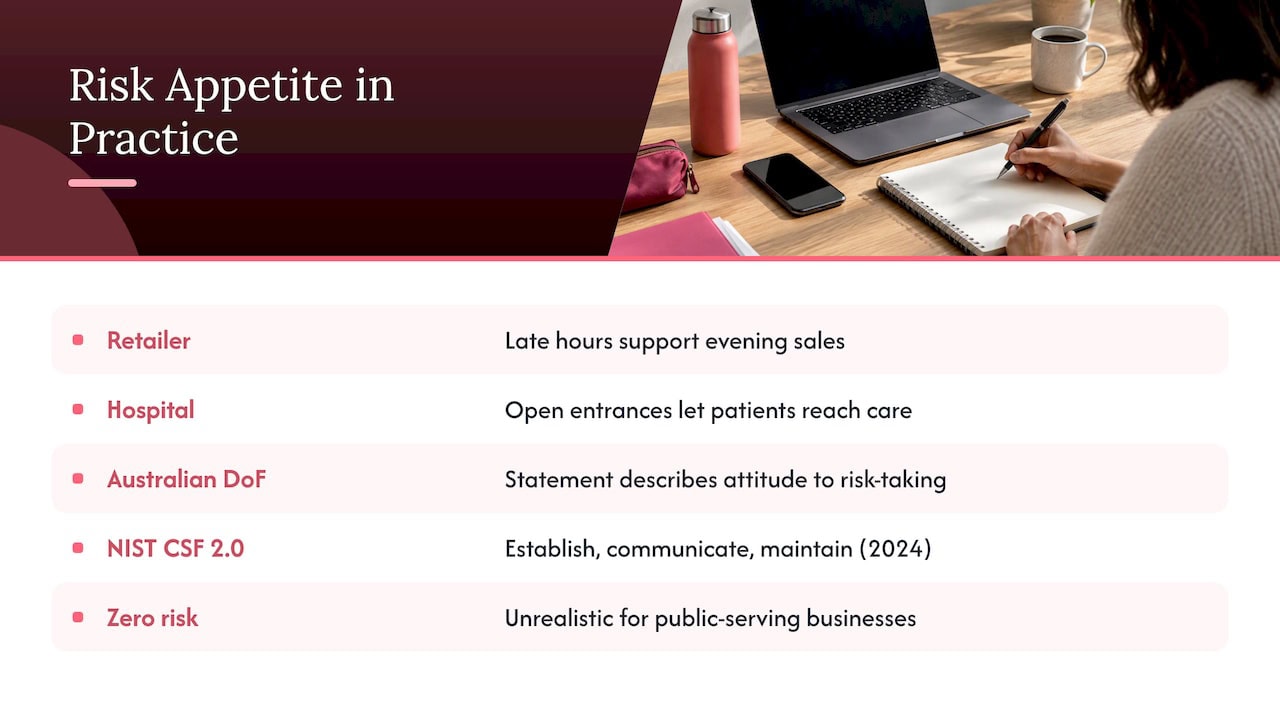
Every organization takes risk on purpose. A retailer keeps its doors open late because evening sales matter. A hospital keeps public entrances open because patients must reach care. Risk appetite is the formal version of those decisions: what you will accept, where, and why.
The U.S. National Institute of Standards and Technology makes the idea part of its framework. The Cybersecurity Framework 2.0 says risk appetite and tolerance statements set the parameters for acceptable risk and support operational decisions. Under the framework’s governance function, as of 2024, such statements must be established, communicated and maintained.
The Australian Department of Finance gives a plain definition: a statement or series of statements describing an entity’s attitude toward risk-taking, which helps leaders balance threats against opportunities. That balance is the point. Appetite is not a wish to avoid all risk. Zero risk is not a realistic target for any business that serves the public, employs people or holds valuables.
Risk appetite vs. risk tolerance
These terms get swapped constantly, and that is why the second query people type is about the difference. The short version: appetite is the strategy, tolerance is the limit.
The Australian Department of Finance says appetite sets the overall attitude to risk-taking, while tolerance applies it to specific objectives or risk categories, using quantitative measures where possible. COSO frames tolerance as the acceptable variation around an objective, measured in the same units as that objective, and notes that staying within tolerances helps keep the organization within its appetite. ISACA calls them two sides of one coin: appetite is about taking risk, tolerance is about controlling it.
| Risk appetite | Risk tolerance | |
|---|---|---|
| Scope | Organization-wide, strategic | Specific objective or risk category |
| Expressed as | Qualitative statement of attitude | Numeric limit or range |
| Who sets it | Board and senior leadership | Business and risk owners, within the appetite |
| Security example | “We have a low appetite for harm to employees and customers on our premises.” | “Response to an alarm at any site within 10 minutes.” |
The security example in the last row is ours, not a standard. Your numbers should come from your own sites and your own leadership.
There is a third term worth knowing. Risk capacity is the maximum risk an organization can take on and still survive. EY describes appetite as the level you are willing to assume inside that capacity, and suggests the gap between the two acts as a buffer for extreme, unforeseen events. A company that sets its appetite right at its capacity has no margin left for a bad day.
The levels of risk appetite
People often ask whether there are three standard types of risk appetite. There is no single universal list. Frameworks use different scales, usually three to five levels. One widely used five-step scale, described by a risk consultancy, runs like this:
- Averse: avoiding risk and uncertainty is a key objective.
- Minimal: a preference for ultra-safe options with limited reward.
- Cautious: a preference for safe, low-risk options, accepting limited reward.
- Open: willing to consider all options and pick the one most likely to succeed with acceptable reward.
- Hungry: eager to pursue higher rewards despite greater inherent risk.
Some organizations compress this into low, moderate and high. Either way, the level is not one setting for the whole company. A university can be cautious about digital risks overall yet open to risk in research. A property manager can have almost no appetite for life-safety failures and a moderate one for minor property damage. Set a level for each category that matters to you.
Who decides, and how to write the statement
Risk appetite is not an IT or security-department document. McKinsey advises treating it as a team activity involving the board, the business, technology and second-line risk stakeholders, with statements that are measurable, written in business terms, aligned to business objectives and clearly owned.
A practical drafting sequence
- List what you must protect. People first, then revenue-critical operations, data, cash and inventory, reputation, and regulated obligations.
- Identify the risk categories. Workplace violence, theft and shrinkage, trespass, unauthorized access, fraud, system downtime, data exposure, compliance failure.
- Gather stakeholder views. ISACA’s 2024 guidance says acceptable levels should rest on stakeholder feedback, including emotional responses to a threshold and the materiality of a cyber event. Ask leaders what loss would make them lose sleep, then put a figure on it.
- Pick a level per category. Use the averse-to-hungry scale or your own.
- Attach measures. Each statement gets a metric, a limit and an owner.
- Approve and communicate. A statement that only the author has read does not change behavior.
What a statement looks like
McKinsey’s guidance says statements should hold measurable thresholds tied to risks such as breaches, downtime or compliance failures, with an example along the lines of no more than a set number of minutes of unplanned downtime for systems behind critical business services. Physical security statements follow the same pattern. Illustrative examples, to be adapted to your own figures:
- “We have no appetite for unescorted access to patient areas outside visiting hours.”
- “We accept inventory loss up to a stated percentage of sales, and escalate above it.”
- “We have a low appetite for a lapse in coverage at any site during operating hours.”
Notice what these avoid. They do not say “we take security seriously.” They say what is acceptable, so a manager can tell whether a given decision fits.
Turning appetite into thresholds and controls
A statement on paper does not protect anyone. McKinsey suggests a cascade: from a risk taxonomy to control objectives, supported by key risk indicator thresholds for risk and key control indicator thresholds for control performance. ISACA adds that tolerance is often expressed in numbers, such as percentages for budget overruns or uptime requirements, and that appetite only shapes decisions once it is built into the control environment through those tactical measures. ISACA also suggests materiality is a sound place to start when setting thresholds.
Here is how that cascade can look for a physical site:
| Appetite | Risk indicator (KRI) | Control indicator (KCI) | Typical control |
|---|---|---|---|
| Low appetite for unauthorized entry | Number of tailgating or forced-entry incidents per quarter | Share of patrol checkpoints completed on schedule | Access control, front-desk officer, patrol with GPS verification |
| Low appetite for escalation of aggressive behavior | Incidents requiring police response | Time from alarm to on-site response | Trained guards, de-escalation, dispatch |
| Moderate appetite for minor theft | Shrinkage as a percentage of sales | Audit findings closed on time | Loss prevention staffing, camera coverage, receiving controls |
The same logic applies on the technology side. Where your thresholds say downtime or data loss must stay small, controls such as cybersecurity measures for e-commerce operations help reduce residual risk to the level you have said you can live with.
Choosing the right protection level
Once thresholds exist, staffing decisions get easier. A low appetite for violent incidents at a location with a credible threat history points toward armed protection, while a lobby with visitor-flow risks may need only visible, trained, unarmed officers. Our armed vs. unarmed security decision guide walks through that choice, and when to hire armed guards covers the threshold that should trigger it.
Where appetite programs fail
The most common failure is a mismatch between words and money. ISACA warns that if an organization has an explicit threshold but does not fund the program enough to support it, it creates an implicit risk appetite that undermines good governance. If leadership writes “low appetite for after-hours intrusion” and then cuts overnight coverage to save budget, the real appetite is whatever the cut allows.
The same source says to periodically refine objectives and appetite based on known exposure and residual risk, and to revisit the appetite if you will not fund the controls it requires. In security terms, these are the triggers we see most often:
- You open a new site, extend hours, or add a high-profile event or executive.
- An incident, near miss or threat changes your exposure.
- A lease, insurance renewal or regulatory change alters your obligations.
- Budget shifts and the funded controls no longer match the stated appetite.
- An assessment finds gaps between the statement and what is actually in place.
Two other mistakes show up repeatedly. Statements written in technical language that executives cannot weigh, and thresholds with no owner, so nobody acts when a limit is crossed.
Testing appetite against reality
The quickest way to find out whether your appetite is honest is to measure your exposure against it. A formal assessment compares what you say you will accept with what your sites actually allow. Our security risk assessment work does this for Massachusetts businesses, and a vulnerability assessment pinpoints the weak points. If a specific person or situation concerns you, threat assessment examines credibility and likelihood rather than guessing.
If you want to start on your own, the security assessment checklist and the two-page physical security risk assessment guide give you a working structure. For the broader program view, see our guide to enterprise security risk management. Culture matters too: thresholds are only as good as the people who report what they see, which is why we also recommend building a culture of security awareness.
Perspective: appetite is decided at the door
We have worked on Massachusetts sites since 2004, and the pattern is consistent. Leaders can describe their appetite in a meeting, but the real answer shows up in the schedule: who stands at the entrance at 2 a.m., how fast someone responds, and whether anyone notices a missed patrol.
That is why we build around prevention and loss prevention expertise. We design coverage from your risk profile, then tie it to things you can check, such as GPS patrol tracking and 24/7 dispatch staffed by our own employees. We never use subcontractors, so the people carrying out your thresholds are the people we trained and vetted.
Our lean management structure also means the conversation about appetite is with people who make decisions. If your statement says low appetite, we will tell you what coverage that implies. If your budget points to a different level, we will help you write the statement honestly instead of leaving a gap.
Derek
Put your appetite into practice
If you have written a statement and want to see what it implies on the ground, or you have no statement yet and want a starting point, we can help. Hub Security and Investigative Group provides armed and unarmed guards, mobile patrol, executive protection, security risk assessments and consulting for businesses, property managers, healthcare facilities, retail and bank locations, and events. New clients are matched with a guard within 24 to 48 hours of an approved quote.

See our full list of security services or start with a security risk assessment in Massachusetts to turn your appetite into a coverage plan.
FAQ
What does risk appetite indicate?
It indicates how much risk leadership is willing to accept to reach its objectives, and in which areas. It also gives managers a benchmark: a decision that fits within the stated appetite can proceed, and one that does not goes up for review.
Are there three types of risk appetite?
Not universally. Some organizations use low, moderate and high, while others use a five-level scale from averse to hungry. Pick the scale your leadership can apply consistently, and set a level for each risk category rather than one for the whole organization.
How is risk tolerance different from risk appetite?
Appetite is the broad attitude toward risk across the organization. Tolerance is the specific, usually measurable limit for an objective or category, such as a maximum response time or loss percentage. Staying within tolerances helps keep you within your appetite.
How often should we review our risk appetite?
Review it on a regular schedule and whenever exposure or funding changes: a new location, a serious incident, a budget cut or a regulatory change. If you will not fund the controls your appetite requires, revise the appetite to match what you will actually do.
Sources
- Security risk appetite, Australian Cyber Security Centre glossary
- NIST Cybersecurity Framework 2.0 (NIST SP 1308)
- Understanding Risk Appetite and Tolerance, Australian Department of Finance
- COSO guidance on risk appetite and tolerance
- ISACA: Risk appetite vs. risk tolerance
- ISACA Journal 2024, Volume 5: From Measurement to Management
- McKinsey: Creating a technology and cyber risk appetite framework
- EY: What’s your true cyber risk appetite
- Risk Tip 5: understanding risk appetite, Paladin Risk