
If your property was stolen, take four steps now: report to police and get a case number, document ownership with serial numbers, photos, and receipts, notify your insurer and financial institutions, and, if identity data was taken, report at IdentityTheft.gov and place fraud alerts or a credit freeze. Each step builds the paper trail that drives recovery.
TL;DR:
- For completed thefts, use the department’s nonemergency line or online portal, and record the case number, officer’s name, and badge number.
- Within the first 48 hours, assemble receipts, serial numbers, photos, and a narrated video inventory, then back up copies in two places.
- Notify your insurer promptly after getting the case number; deductibles and policy limits determine payment, while appraisals may support claims for jewelry, art, or collectibles.
- If wallets, devices, or financial papers were taken, report at IdentityTheft.gov, alert all three credit bureaus, and contact banks to freeze accounts and dispute charges.
- Monitor pawnshops and online listings, preserve screenshots and timestamps, and send leads to police rather than confronting sellers; recovery can take weeks or months.
Table of Contents
- Report the theft to police and get a case number
- Build a proof-of-loss packet with receipts, serials, and photos
- File your insurance claim and manage documentation timelines
- Protect your identity if personal data was taken
- Search pawnshops, marketplaces, and repair records for your property
- When a private investigator becomes the right move
- What realistic recovery looks like
- How Hub Investigative Group supports stolen property recovery
- FAQ
- Sources
Report the theft to police and get a case number
Call 911 only if you are in danger or the theft is in progress. For a completed theft with no immediate threat, contact your local department’s non-emergency line or use its online reporting portal. Usa notes that most agencies now offer online reporting for property crimes, which saves a trip to the station and creates a timestamped digital record.
Come prepared with specifics. Vague descriptions slow everything down and give officers less to work with.
- Exact item descriptions, brands, models, and serial numbers.
- Photos of the items and the scene, including any damage.
- Time and location of the theft, plus names of any witnesses.
- Any surveillance footage sources, yours or a neighbor’s.
Ask for the case number before you leave, and write down the responding officer’s name and badge number. That number is what your insurer, your bank, and any investigator will ask for first. If an officer declines to file a report, note the date, time, and the reason given, then ask to speak with a detective or escalate to a state agency. A documented attempt still has value later.
Build a proof-of-loss packet with receipts, serials, and photos
Insurers and investigators both work from the same foundation: proof that you owned the item, what it was worth, and when it went missing. The NAIC’s claims guidance recommends documenting losses with photos and an itemized inventory, since insurers require proof of ownership and condition before they pay out.
- Pull together receipts, bank or credit card statements, and manufacturer registration records for each item.
- Record serial numbers wherever they exist; engrave or photograph them in advance when possible.
- Walk through each room and narrate a phone video that shows the item, its serial number, and its surroundings.
- Back up everything in two places: a cloud folder and either an email to yourself or an external drive.
- Label the finished set clearly, by room or category, so a claims adjuster or investigator can move through it quickly.
Pro Tip: Film the narrated walkthrough even before anything is stolen. A pre-loss inventory is the fastest, most defensible proof of ownership you can hand an insurer or the police.
File your insurance claim and manage documentation timelines
Report to your insurer as soon as you have a police case number. Many policies require timely notice to preserve coverage, so waiting rarely helps your case. Standard homeowners and renters policies typically cover stolen property, though coverage depends on your specific policy limits and deductible.
- Submit an itemized list with receipts or serial numbers attached to each entry.
- Include a copy of the police report and case number with your claim.
- For jewelry, art, or collectibles, attach appraisals or point to a scheduled-article endorsement if your policy includes one.
- Keep a dated log of every call and email with your adjuster, along with receipts for any temporary repairs or replacements.
Deductibles and policy limits determine your actual payout, so ask your adjuster early how those figures apply to your specific claim.
Protect your identity if personal data was taken
When a theft includes your wallet, laptop, or financial documents, treat it as an identity theft case, not just a property loss. Report it at IdentityTheft.gov, which generates a personalized recovery plan and an Identity Theft Report that businesses and creditors recognize alongside your police report.
- File your report at IdentityTheft.gov and save the Identity Theft Report it produces.
- Place a fraud alert or credit freeze with Equifax, Experian, and TransUnion.
- Contact your banks and card issuers immediately to freeze accounts and dispute unauthorized charges.
- Save confirmation numbers for every freeze and alert, along with your FTC affidavit, in case a bank or collection agency asks for proof.
Credit bureaus must act fast: the FTC’s identity theft guidance confirms that IdentityTheft.gov’s pre-filled letters and recovery plan are built specifically to speed up these disputes with creditors and bureaus.
Search pawnshops, marketplaces, and repair records for your property
Stolen goods often resurface in predictable places. Knowing where to look, and how to document what you find, turns a hunch into a lead police can act on.
- Call local pawnshops and secondhand dealers, give them your case number, and ask them to check serial numbers against items they have taken in.
- Monitor online marketplaces for your item’s description, and capture screenshots of the listing, the seller’s profile, and timestamps the moment you spot a match.
- Never arrange a solo meetup to confront a seller. Forward everything you capture to the officer handling your case.
- Understand that repair shops and service records can also surface leads. The Office of Justice Programs’ guide to recovering stolen property describes how investigators match serial numbers and service dates against stolen-property files to generate leads, then verify each one against the original crime report before taking any field action.
A verified match moves fast. An unverified one wastes everyone’s time, which is why investigators treat that verification step as mandatory.
When a private investigator becomes the right move
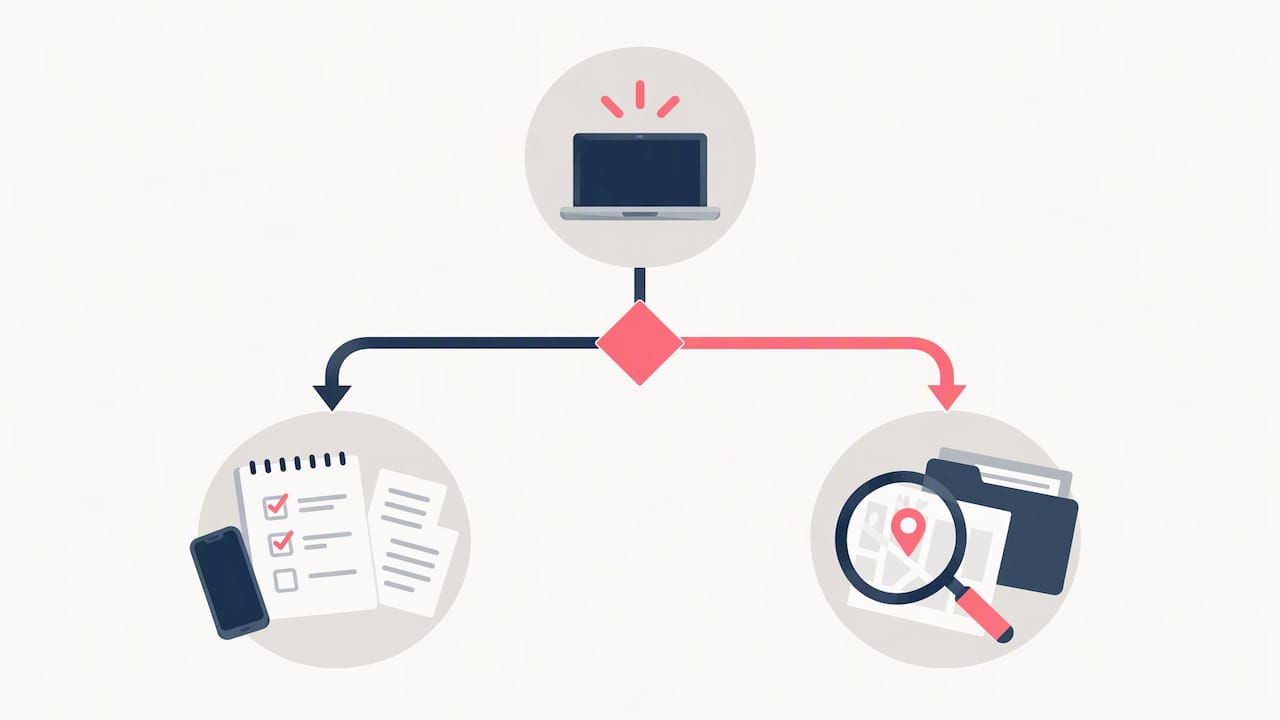
Some cases outgrow a standard police report, a stalled lead, a high-value item, suspected employee theft, or goods that appear to be moving through an organized resale network. A licensed investigator can pick up where patrol resources run thin.
Investigators working recovery cases typically combine asset searches, surveillance, and repair-records matching, coordinating findings with both law enforcement and legal counsel so evidence holds up later. Before retaining anyone, ask directly about their license, their experience with asset recovery specifically, how they document findings, their fee structure, and whether they can provide references.
- Confirm the investigator is licensed in your state before sharing case details.
- Ask how they preserve chain-of-custody on evidence meant for insurers or prosecutors.
- Request a sample report format so you know what a finished case package looks like.
Pro Tip: Ask any investigator you’re considering how they package findings for insurers versus prosecutors. The two audiences need different documentation, and a firm that handles both routinely will say so without hesitation.
What realistic recovery looks like
Serial numbers and documentation drive recoveries far more than luck does. Without them, even a strong police response has little to match against.
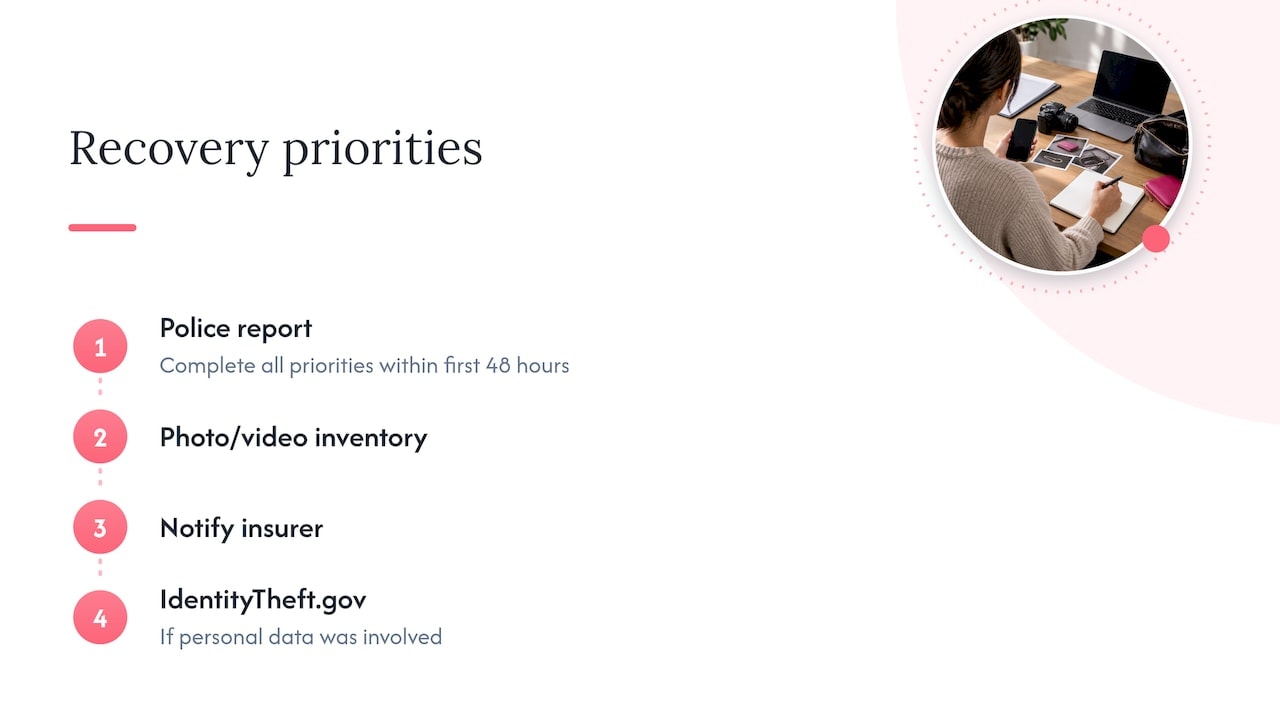
Expect weeks, sometimes months, not days. Prioritize your police report, a photo and video inventory, insurer notification, and IdentityTheft.gov if personal data was involved, all within the first 48 hours.
— Derek
How Hub Investigative Group supports stolen property recovery
Once you have filed a police report and started your insurance claim, a licensed investigator can carry the search further than most victims can alone. We built Hub Investigative Group on more than seventy-five years of combined law enforcement and loss prevention experience, and we apply that background directly to recovery cases.

Our relevant services include:
- Asset Search Investigation, tracing where stolen property or its proceeds have moved.
- Private Investigator Services, covering surveillance, recovery leads, and case documentation.
- Surveillance Investigation, for monitoring suspected resale activity or persons of interest.
A first consultation starts with your police case number, your proof-of-loss packet, and a clear picture of what you have already pursued. From there, we coordinate with your insurer and local law enforcement so that anything we uncover arrives documented and ready for a claim or a prosecution. If your case has stalled or involves significant value, reach out to schedule a consultation and we will walk you through next steps.
FAQ
How to legally recover stolen property?
Start with a police report and case number, then document ownership with receipts and serial numbers for your insurer. If goods surface at a pawnshop, dealer, or online listing, report the match to police rather than confronting the seller yourself, since law enforcement and licensed investigators are equipped to verify and act on leads safely.
How do you know if someone stole cash from you?
Cash theft is harder to prove than item theft since there is rarely a serial number to trace, so timing and access usually matter most: compare when you last confirmed the amount against who had opportunity to take it. A police report still matters even without physical proof, since it creates an official record you may need later.
Can police help retrieve stolen property?
Yes, police can retrieve stolen property, particularly when you provide serial numbers, photos, and a detailed description at the time of your report. Recovery often depends on matching your documentation against pawnshop records, marketplace listings, or repair-records analysis, which is why thorough documentation matters so much.
How to get someone to admit they stole from you?
Confronting a suspected thief directly can put you at risk and may complicate a police investigation, so the safer path is to report what you know, including names, timelines, and any evidence, to the responding officer or detective. Let law enforcement or a licensed investigator handle questioning as part of a documented process.
Sources
- Report a crime | USAGov
- What to know about identity theft | ConsumerFTC
- Identification and Recovery of Stolen Property Using Automated Information Systems – OJP
- Navigating the claims process: recover & rebuild | NAIC