
In Massachusetts, secretly recording someone’s conversation is a crime: audio requires all-party consent under the wiretap statute, while video is governed by location and privacy-expectation rules. Storing footage that can identify people also triggers 201 CMR 17.00 security obligations. Getting this wrong can mean criminal charges, suppressed evidence, or a data breach claim.
TL;DR:
- Doorbell cameras, body cameras, and security systems can violate the statute when they secretly capture conversations; disable microphones unless documented consent covers everyone recorded.
- Keep cameras out of bathrooms, bedrooms, changing areas, break rooms, and rented homes; long running networks can raise concerns even when aimed at public areas.
- Identifiable footage needs written safeguards for access, encryption, vendors, and deletion; breaches require prompt notice to state offices and affected residents.
- Courts may suppress illegally captured audio and associated video, while people recorded can seek civil damages and attorney fees; consult counsel before using disputed footage.
Table of Contents
- The Massachusetts wiretap statute: what counts as illegal interception
- Where cameras are allowed and where they are not
- Employer surveillance: staying inside the legal lines
- Storing footage: 201 CMR 17.00 and your breach notification duties
- Penalties, suppressed evidence, and civil liability
- Practical compliance checklist for homeowners, landlords, and businesses
- How a Massachusetts investigative firm supports lawful surveillance
- GPS tracking and electronic location monitoring in Massachusetts
- Body camera rules for Massachusetts law enforcement
- Facial recognition technology and surveillance law in Massachusetts
- Drone and aerial surveillance rules in Massachusetts
- Public spaces versus private property: the line that matters most
- Balancing safety and the law: a practitioner’s view
- When compliance gets complicated, bring in a licensed team
- FAQ
- Sources
The Massachusetts wiretap statute: what counts as illegal interception
M.G.L. c.272, §99 is the backbone of Massachusetts surveillance law, and it is stricter than what most of the country follows. Unlike one-party consent states, Massachusetts requires all parties to a conversation to agree before anyone records it. To convict someone under this statute, prosecutors generally need to show three things: a device was used to capture the communication, the recording was done secretly, meaning without the knowledge of at least one party, and the act was willful rather than accidental.
The word “interception” covers more than hidden microphones in a conference room. It extends to any mechanical, electronic, or other device used to secretly record oral or wire communications. A smartphone propped up during a tense family conversation, a doorbell camera that happens to pick up a conversation on the porch, or a body camera running without disclosure can all trigger the statute if the audio capture was secret.
There are narrow exemptions. Law enforcement officers acting under a warrant, or within specific statutory exceptions, can record without triggering liability. Beyond that, the exceptions are limited and fact-specific, which is why we always recommend treating audio capture as presumptively restricted unless consent is documented.
One recent example worth knowing: in 2023, an appeals decision found that real-time audio-visual streaming without statutory authorization violated the wiretap statute, and the court suppressed the resulting recordings. That case, Commonwealth v. Du, illustrates a pattern Massachusetts courts follow closely: when the audio portion of a recording is unlawful, the video that came with it often gets swept into the same ruling. Practitioners who work with novel surveillance tools, live-streaming apps included, generally recommend seeking a warrant or confirming an exception applies before relying on that evidence in any legal proceeding.
Here is how the exposure breaks down by device type:
- Smartphone voice memos or video with audio: covered by the wiretap statute if recorded secretly, regardless of whether the footage also captures images.
- Doorbell and porch cameras: generally fine for video, but many models record audio automatically, which can create liability if a conversation is captured without consent.
- Workplace or home security systems with microphones: audio channels should be disabled unless every person likely to be recorded has given consent.
- Body-worn cameras used by private citizens or businesses: audio capture during interactions with the public or employees carries the same all-party consent requirement as any other recording device.
The practical takeaway is simple: video alone rarely creates wiretap exposure, but audio almost always does. Anyone installing a camera system in Massachusetts should know exactly whether the microphone is on before worrying about anything else.
Where cameras are allowed and where they are not
Camera placement in Massachusetts hinges on whether the people in frame have a reasonable expectation of privacy, and whether the space is public, shared, or exclusively private.
- Bathrooms, bedrooms, and changing areas are off-limits. Massachusetts disorderly conduct and voyeurism-related provisions bar recording in places where someone has a reasonable expectation of privacy, including bathroom stalls and private bedrooms. This applies at home, in a rented unit, and in commercial settings like gyms or spas.
- Rental units carry extra landlord restrictions. M.G.L. c.186, §15B limits how and when landlords can enter a tenant’s unit, and covert surveillance inside a rented apartment raises serious legal risk well beyond the entry rules themselves. A landlord who wants cameras in common areas should stick to hallways, lobbies, and exteriors, never inside the leased space.
- Porches, yards, and building exteriors are usually fine for video. Recording the outside of a property, including a shared porch or driveway, is generally permissible because these areas carry a lower expectation of privacy. The caveat is aggregation: Massachusetts courts have applied what’s sometimes called a “mosaic” theory, where a dense or long-running camera network can implicate constitutional protections even in public-facing areas, a concern raised in cases like Commonwealth v. McCarthy and Commonwealth v. Mora as described in the state’s digital evidence guide.
- Sensitive facilities face added disclosure duties. Nursing homes, childcare centers, and similar licensed facilities often operate under rules that require extra notice or consent before cameras go up, on top of the general privacy statutes.
Out-of-state advice does not transfer cleanly here. What passes in a one-party consent state can be illegal in Massachusetts, so relying on a national surveillance guide without checking the specifics is a common and costly mistake.
Employer surveillance: staying inside the legal lines
Employers in Massachusetts can monitor the workplace, but the right to do so is not unlimited. Courts and agencies generally weigh an employer’s legitimate business interest, like preventing theft or ensuring safety, against the degree of intrusion into employee privacy. The Massachusetts Commission Against Discrimination enforces protections under M.G.L. c.151B that become relevant the moment monitoring starts to look targeted.
Audio is the biggest trap for employers. The same all-party consent rule that applies at home applies in the break room, the warehouse floor, and the sales office. Covert audio monitoring, especially anywhere employees might discuss wages, working conditions, or union activity, can also expose an employer to National Labor Relations Act claims, since surveillance near protected concerted activity is treated as a serious violation regardless of whether it was framed as a security measure.
Practical steps we recommend to employers:
- Draft a written surveillance policy and distribute it to every employee before cameras go live.
- Keep camera coverage limited to work areas with a legitimate business purpose, not break rooms or locker areas.
- Disable audio capture unless every employee affected has given documented consent.
- Apply monitoring consistently across departments and shifts to avoid the appearance of targeting any protected group.
Posting a sign is not enough on its own. Practitioners note that signage does not cure an audio-capture violation. Audio must be openly disclosed and consented to, or it is simply unlawful, no matter how visible the warning sticker is.
Pro Tip: Have HR and legal counsel review any new monitoring system before installation, not after an employee files a complaint.
Storing footage: 201 CMR 17.00 and your breach notification duties
The moment a camera captures footage that can identify a Massachusetts resident, that footage can count as “personal information” under 201 CMR 17.00, and the regulation applies to anyone, business or individual, who owns or licenses that kind of data about a Commonwealth resident. A camera system alone does not satisfy the law; organizations must document policies, access controls, and retention practices in writing.
The written information security program, or WISP, has to cover a specific set of controls:
- Access restrictions so only authorized people can view or export footage.
- Secure authentication for any login to a camera system or storage platform.
- Encryption for footage both while it is being transmitted and while it sits in storage.
- A defined retention and deletion schedule so footage is not kept indefinitely.
- Oversight of any third-party vendor, like a cloud storage provider, that touches the data.
If a breach happens, exposing footage or data tied to it, Massachusetts law under M.G.L. c.93H requires notification to the Attorney General’s office, the Office of Consumer Affairs and Business Regulation, and the affected residents themselves, and that notice has to go out as soon as practicable once the exposure is discovered.
For small landlords and businesses, the cost-effective path is usually straightforward: choose a camera system with built-in encryption, set a retention window (30 to 90 days is common for routine footage), restrict login access to one or two people, and put the WISP in writing even if it’s only a few pages. Technical safeguards matter, but camera cybersecurity gaps are often the weak point that turns a minor lapse into a reportable breach.
Penalties, suppressed evidence, and civil liability
Violating Massachusetts surveillance law carries real teeth, both criminal and civil.
- Criminal exposure under §99 ranges from fines to imprisonment, and the voyeurism-related provisions carry their own separate criminal penalties for recording someone in a place where they expected privacy.
- Civil damages are available to people whose communications were illegally intercepted, and courts can also award attorney’s fees, which raises the financial stakes for anyone who assumes a quiet recording is a victimless shortcut.
- Suppression of evidence is the remedy that trips up the most people, including well-meaning landlords and employers. If audio was captured illegally, courts have suppressed the recording and, in several cases, treated any paired video as tainted by the same violation.
- Fruit of the unlawful interception is the doctrine at play: once audio crosses the line, the visual evidence collected alongside it can become unusable, even if the video portion would have been lawful on its own.
Anyone facing a dispute involving a questionable recording, whether as the person who recorded or the person recorded, should talk to an attorney before relying on that footage in any proceeding. Enforcement typically starts with a complaint or a motion to suppress, not a criminal investigation out of nowhere, so early legal advice can change the outcome significantly.
Practical compliance checklist for homeowners, landlords, and businesses
Getting surveillance right in Massachusetts comes down to a short list of habits, not a legal degree.
- Disable audio by default. Unless every person likely to be recorded has agreed in writing, turn off the microphone on any camera system.
- Post clear notice. Signage at entrances and in shared spaces helps establish that video monitoring is happening, even though it does not substitute for consent on audio.
- Get written consent for private or shared interior spaces. This applies especially to rental units, shared offices, and any room where people have a reasonable expectation of privacy.
- Log who accesses footage. Keep a simple record of who viewed or exported recordings and when.
- Set a retention limit. Decide how long footage is kept, delete it on schedule, and document that schedule in the WISP.
- Secure storage with encryption. Whether footage lives on a local drive or in the cloud, encryption in transit and at rest is a baseline expectation under 201 CMR 17.00.
- Draft a written policy for employers and landlords. Cover scope, purpose, audio restrictions, and consistent application across all tenants or employees.
- Train staff on the policy. A written policy only protects the business if the people operating the cameras understand it.
- Avoid targeted monitoring. Never concentrate cameras or review on a specific protected group, department, or individual without a documented, neutral business reason.
- Vet vendors contractually. Any cloud storage or camera monitoring vendor should be bound by contract to maintain safeguards consistent with the WISP.
Pro Tip: If you are unsure whether a planned camera setup crosses a legal line, a short consultation with a licensed investigator or attorney is far cheaper than a suppressed case or a breach notification.
Some situations call for more than a checklist. Forensic handling of footage for a legal case, drafting a defensible WISP from scratch, or sweeping a property for hidden devices after a suspected privacy violation are tasks that benefit from licensed, experienced hands.
How a Massachusetts investigative firm supports lawful surveillance
We have significant experience helping clients collect evidence the right way. Our surveillance investigation and counter-surveillance services exist precisely because DIY camera setups often miss the consent and data-handling details that make footage usable later. When a case involves disputed recordings, suspected hidden devices, or a WISP that needs a second look, a licensed firm can provide assistance.
GPS tracking and electronic location monitoring in Massachusetts
Massachusetts treats covert GPS tracking as a serious privacy matter, not a gray area. Placing a tracking device on someone’s vehicle or person without their consent, particularly when done to monitor movements secretly, can expose the person installing it to civil and criminal liability depending on the circumstances and relationship between the parties.
Employers who want to track company vehicles are on firmer ground when the tracking is disclosed in a written policy and limited to business hours or company property. Parents tracking minor children, or individuals monitoring their own property, generally face fewer restrictions than someone secretly tracking another adult’s personal movements without any legitimate relationship or consent.
The safest practice mirrors the audio-consent principle running through the rest of Massachusetts surveillance law: disclose the tracking, document the business or safety purpose, and avoid using location data to monitor someone in a context where they’d reasonably expect privacy, like tracking a spouse’s personal vehicle without their knowledge. Divorce and custody disputes are a common source of GPS tracking complaints, and courts have shown little patience for covert tracking introduced as evidence when it was installed without consent or legal authority.
Body camera rules for Massachusetts law enforcement
Police body cameras operate under a different framework than private surveillance because officers are acting in an official capacity, often under department policy and, in some cases, statutory authorization that functions as an exception to the general wiretap consent rule. Even so, the footage these cameras generate is still subject to records retention, public records requests, and privacy considerations once it’s stored.
Departments that deploy body cameras typically need written policies covering when cameras must be activated, how long footage is retained, and who can access it, mirroring the same WISP-style discipline that applies to private businesses under 201 CMR 17.00. Footage captured inside a private home or in a space with a heightened privacy expectation, such as during a medical emergency, can raise additional sensitivity even when the recording itself is lawfully authorized.
For residents, the practical point is that body camera footage is not automatically public or automatically private. Access depends on the specific incident, ongoing investigations, and public records exemptions, which is why requests for this footage often go through a formal records process rather than a simple ask.
Facial recognition technology and surveillance law in Massachusetts
Facial recognition sits at the edge of where Massachusetts surveillance law is still catching up to the technology. The core privacy statutes, the wiretap law, the voyeurism provisions, and 201 CMR 17.00 were not written with facial recognition in mind, but they still apply once a system starts collecting and storing biometric identifiers tied to real people.
The aggregation concern raised in the digital evidence guide, sometimes called the mosaic theory, is especially relevant here. A camera network paired with facial recognition software can build a detailed, long-term picture of a person’s movements and associations, which courts have signaled may implicate constitutional protections even when each individual camera is lawfully placed in a public-facing area.
For businesses considering facial recognition, the practical questions are the same ones that apply to any biometric data collection: is the data encrypted, who has access, how long is it retained, and is there a written policy governing its use? Any system that stores facial data on Massachusetts residents likely falls under the same WISP obligations as traditional video footage, and the lack of a specific facial recognition statute does not mean the practice is unregulated.
Drone and aerial surveillance rules in Massachusetts
Drones add an airspace layer on top of the usual privacy rules. Federal aviation regulations govern where and how drones can fly, but Massachusetts privacy law still applies to what a drone’s camera captures once it’s airborne over private property.
A drone recording video of a backyard, a private event, or the exterior of a home can raise the same reasonable-expectation-of-privacy concerns that apply to a fixed camera, especially if the flight path is designed to look into windows, fenced yards, or other areas shielded from public view. If the drone also captures audio, the all-party consent requirement under the wiretap statute applies exactly as it would to any other recording device.
Businesses using drones for site security, real estate photography, or event coverage should treat the aerial footage the same way they’d treat footage from a ground-based camera: disable audio capture unless consent is documented, avoid flight paths that peer into private spaces, and apply the same retention and storage rules required under 201 CMR 17.00 once the footage lands on a hard drive or cloud server.
Public spaces versus private property: the line that matters most
The single biggest factor in Massachusetts surveillance law is whether someone had a reasonable expectation of privacy in the place being recorded, not simply whether the property is technically public or private.
Public sidewalks, parks, and building exteriors generally carry little expectation of privacy, which is why video recording in these settings is usually fine. But private property does not automatically mean a camera is lawful either: a camera inside a tenant’s apartment, in an employee break room, or pointed through a neighbor’s bathroom window raises serious legal risk regardless of who owns the land the camera sits on.
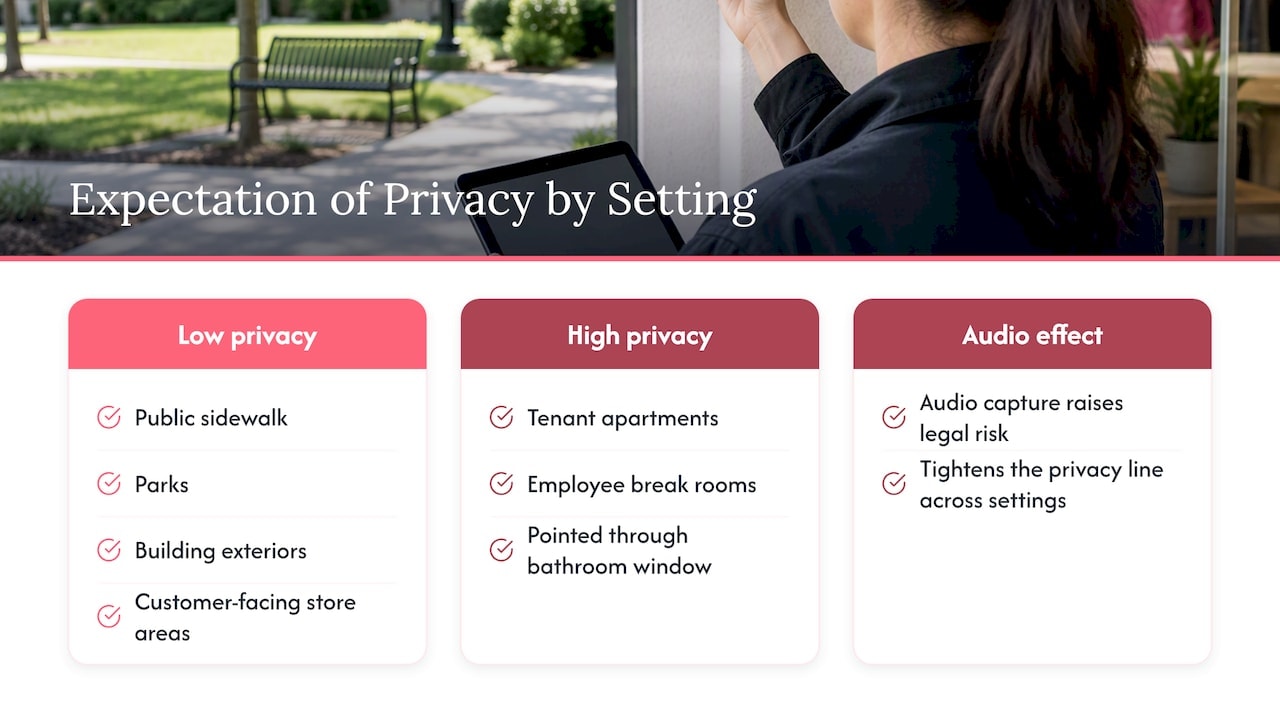
The reverse is also true. A business open to the public, like a retail store or restaurant, can lawfully run video surveillance throughout customer-facing areas because customers have little expectation of privacy in an open commercial space. The dividing line consistently comes back to expectation of privacy in the specific space, not the property line, and audio capture tightens that line considerably no matter which side of it the camera sits on.
Balancing safety and the law: a practitioner’s view
Surveillance is a legitimate safety tool, and most of the clients we work with install cameras or request investigations for good reason: protecting a property, documenting a dispute, or keeping employees safe. The risk isn’t the camera itself, it’s treating consent as an afterthought. The one habit that prevents the most legal trouble is disabling audio until consent is documented in writing.
— Derek
When compliance gets complicated, bring in a licensed team
Reviewing camera placement, drafting a WISP, or confirming whether a recording holds up as evidence is exactly the kind of work handled by licensed professionals. Our CCTV and surveillance assessment service reviews existing systems for consent gaps and storage weaknesses, while our surveillance investigation team handles evidence collection the right way when a dispute is already underway.

This article is informational and not a substitute for legal advice; consult an attorney for formal legal questions specific to your situation. If you’d rather have a licensed team review your setup, explore our full range of services and request a consultation.
FAQ
Did the Massachusetts Data Privacy Act pass?
Massachusetts has not enacted a comprehensive data privacy act comparable to laws in states like California. Data protection obligations tied to surveillance footage in Massachusetts currently come primarily from 201 CMR 17.00 and the state’s breach notification law.
What is considered a violation of privacy?
In Massachusetts, a privacy violation typically involves recording someone’s conversation without all-party consent under the wiretap statute, or capturing video or images in a place where a person has a reasonable expectation of privacy, such as a bathroom or bedroom, under the state’s voyeurism-related provisions. Storing identifiable footage without proper safeguards can also raise data security concerns.
What is the 3-hour rule in Massachusetts?
There is no recognized “3-hour rule” under Massachusetts surveillance or recording law. If you encountered this term elsewhere, it likely refers to a different jurisdiction or a misunderstanding of retention guidance, since Massachusetts law focuses on consent and data security rather than a fixed recording-duration rule.
What are the legal restrictions on video recording in Massachusetts?
Video recording without audio is generally permissible in public areas and spaces visible from the street, but it becomes restricted in places with a reasonable expectation of privacy, like bathrooms, bedrooms, or inside a tenant’s rented unit under M.G.L. c.186, §15B. Adding audio to that video triggers the stricter all-party consent requirement under the wiretap statute, regardless of where the camera is placed.
Is it legal to record my landlord or employer without their knowledge?
Recording video of your landlord or employer without their knowledge is often lawful if it captures no audio and occurs in a space without a strong privacy expectation, but recording any conversation secretly, even your own, violates the wiretap statute unless the other party consents. Anyone considering this should weigh the suppression risk: an illegally recorded conversation is rarely usable as evidence later.
Sources
- Mass. Gen. Laws ch. 272, § 99
- 201 CMR 17.00: Standards for the protection of personal information of residents of the Commonwealth