
A vendor fraud investigation starts with quiet fact-finding, not a confrontation. You secure the records, limit who knows, bring in counsel, and test the vendor’s invoices, ownership and payments against what you actually received. Done in that order, you protect both the evidence and your legal position. Done in reverse, a vendor or an insider can alter files before you have looked at them.
This guide is for business owners, property managers, finance leads and HR or compliance staff who have a vendor payment that does not look right. It covers the schemes to know, the red flags that deserve a closer look, how to run the first weeks, when to report, and where an outside investigator fits.
TL;DR
- Vendor fraud is any scheme in which a supplier, or someone working with one, takes money through false invoices, inflated billing, kickbacks, substituted goods or rigged bidding.
- The strongest early signals are documents that are altered or missing, a vendor that delays access to records, round-number or just-under-threshold invoices, and unexplained growth in business with one supplier.
- Before you confront anyone, preserve records, suspend routine deletion, talk to counsel and tell your insurer if your policy requires notice.
- The median fraud scheme runs about 12 months before it is caught, so a suspicion worth raising is worth acting on quickly and quietly.
- An outside investigator can verify who a vendor really is, trace assets, document conduct and keep the file in a form counsel and prosecutors can use.
Table of Contents
- What counts as vendor fraud
- Red flags that justify a closer look
- The first 72 hours: what to do and what to avoid
- Preserving evidence before it disappears
- How the investigation itself runs
- How long a vendor fraud investigation takes
- Our perspective: why prevention and local presence matter
- When and where to report suspected vendor fraud
- Where an outside investigator helps
- Prevention that works in practice
- Work with Hub on a suspected vendor issue
- FAQ
- Sources
What counts as vendor fraud
Vendor fraud covers schemes where money leaves your business for goods or services that were never delivered, were delivered in lesser form, or were priced through a corrupt process. Sometimes the vendor is the fraudster. Sometimes an employee is working with the vendor. Sometimes an outsider is impersonating a vendor.
The federal Procurement Fraud Handbook, written for government auditors but applicable well beyond them, lists the recurring schemes: bid rigging, collusion, bribery and kickbacks, conflicts of interest, and product or service substitution. Private organizations meet the same patterns, plus a few that live in accounts payable:
- Fictitious vendors. A company that exists only on paper, set up so payments land in an account someone controls.
- Inflated or duplicate invoices. Real work billed at a higher amount, or the same invoice submitted twice with small changes.
- Kickbacks. A vendor overcharges and shares the excess with the employee who approves the work.
- Substitution. You pay for one grade of material, equipment or labor and receive another.
- Bank-detail changes. Someone submits a request, often with convincing documents, to move a real vendor’s payments to a new account.
- Conflicts of interest. An employee or relative holds a hidden stake in a vendor the company uses.
Property managers see this in maintenance, cleaning and construction contracts. Retailers see it in delivery and merchandise shortfalls. Healthcare administrators see it in supply and staffing contracts. The mechanics differ, but the paper trail looks alike.
Red flags that justify a closer look
A red flag is not proof. It is a reason to look at the record more carefully. Several together, or one that repeats, is where an inquiry begins.
Warning signs in the vendor’s behavior
The GSA Office of Inspector General’s list of fraud red flags points to contractors who delay or refuse access to records, have missing files, reports, data or invoices, or hand over altered documents. A legitimate vendor with nothing to hide generally produces its paperwork without a fight. Stalling is information.
Warning signs in bids and contracts
The same source flags bidders that appear to share contact information, bids with identical line items, and bids that come in far above the estimate. If three “competing” quotes share a phone number, a typo or a formatting quirk, treat them as one quote until proven otherwise.
Warning signs in relationships
For bribery and kickbacks, the indicators named there include overly friendly relationships between employees and contractors, unexplained increases in business with one contractor, and employees or their families acquiring a financial interest in a contractor. In a small company this often looks harmless: the same vendor keeps winning work, and the manager who approves it never asks for a second bid.
Warning signs in invoices and payments
Practitioner guidance on invoicing fraud points to repeated invoices just below approval thresholds and duplicate invoices with slight differences. In practice, also watch for:
- Invoices without purchase orders or receiving records.
- Vendors with a post office box or residential address, and no website or phone line you can verify.
- Sequential invoice numbers from a vendor that supposedly serves many clients.
- Payments to accounts in a different name from the vendor.
- Rush requests to pay outside the normal cycle.
If you want a structured review of where your controls leave gaps before anything goes wrong, a security risk assessment is a reasonable place to start.
The first 72 hours: what to do and what to avoid
The early decisions matter more than the later analysis. Here is the order we recommend.
- Write down what you saw. Record the specific invoices, dates, amounts and the reason they looked wrong. Keep your own notes factual, not speculative.
- Limit the circle. Tell only the people who need to know: usually a senior executive, legal counsel and whoever controls the records. If an insider may be involved, do not tell that person or their direct reports.
- Preserve before you probe. Lock down records before anyone asks a vendor a question (details in the next section).
- Bring in counsel. The federal handbook directs its auditors who suspect contractor fraud to go to audit management, get legal advice from counsel and consult investigators before confronting the contractor. The private-sector equivalent is the same: your attorney first, then the vendor.
- Hold off on confrontation. Do not call the vendor, withhold payment in a way that tips them off, or fire the employee until counsel agrees on timing. A confrontation destroys the one advantage you have: they do not know you are looking.
- Check your insurance. Many policies require timely notice of potential claims, so the Association of Certified Fraud Examiners’ Fraud Examiners Manual advises considering notice to your insurer once evidence of fraud appears. Read your crime or fidelity coverage for notice deadlines.
Preserving evidence before it disappears
The same ACFE manual chapter says management should preserve relevant contracts, invoices, correspondence and emails by issuing a litigation hold, suspending record-retention policies, and involving IT personnel to safeguard electronic data. It also warns that digital spoliation is a real risk: electronic data is fragile, and a fraudster who learns of an inquiry can delete it fast.
In practical terms:
- Suspend auto-deletion on email, chat tools, shared drives and accounting systems.
- Image, don’t browse. Have IT make forensic copies of the relevant mailboxes and files rather than opening them in ways that change timestamps.
- Secure the paper. Move original contracts, signed delivery tickets and check copies to a locked location, and log who touched them.
- Capture access and approval logs. Who created the vendor in your system, who changed its bank details, and who approved each payment.
- Do not forget video. Camera systems at loading docks, back offices and job sites often overwrite on a short cycle. If footage may show deliveries that were billed but never made, or a vendor representative in a restricted area, request it immediately. Questions about how quickly footage is overwritten and how to safeguard it after a credible allegation are covered in this guide to surveillance video retention.
Keep a record of who held each item and when. A clear chain of custody is what lets evidence be used later without an argument over whether it was tampered with.
How the investigation itself runs
The U.S. Government Accountability Office’s audit guide on purchase card fraud recommends involving fraud investigators early, including in planning tests of controls and in identifying criteria for data mining. The principle carries to a private company: bring investigative thinking in before the conclusions are formed, not after. Auditors are also told to keep professional skepticism, meaning a questioning mind and a critical look at the evidence, throughout the process.
Step 1: Define the allegation narrowly
State what you suspect in one or two sentences: for example, “Vendor X may have billed for 14 service visits in which no one was on site.” A narrow question gives the work a direction and keeps costs in check.
Step 2: Verify the vendor exists and is who it claims to be
Check the entity’s registration, officers, address, tax identification and history. Compare the vendor’s address, phone and bank account against employee records. A shared address or account with an employee is a serious finding. This is the same discipline as due diligence investigation before a deal, applied to a supplier you already pay.
Step 3: Trace the money and the owners
Follow payments from your records to the receiving accounts, and look at who benefits. When the beneficial owner is hidden behind a shell or a relative, an asset search investigation can help connect property, entities and holdings to the people involved.
Step 4: Test the invoices against reality
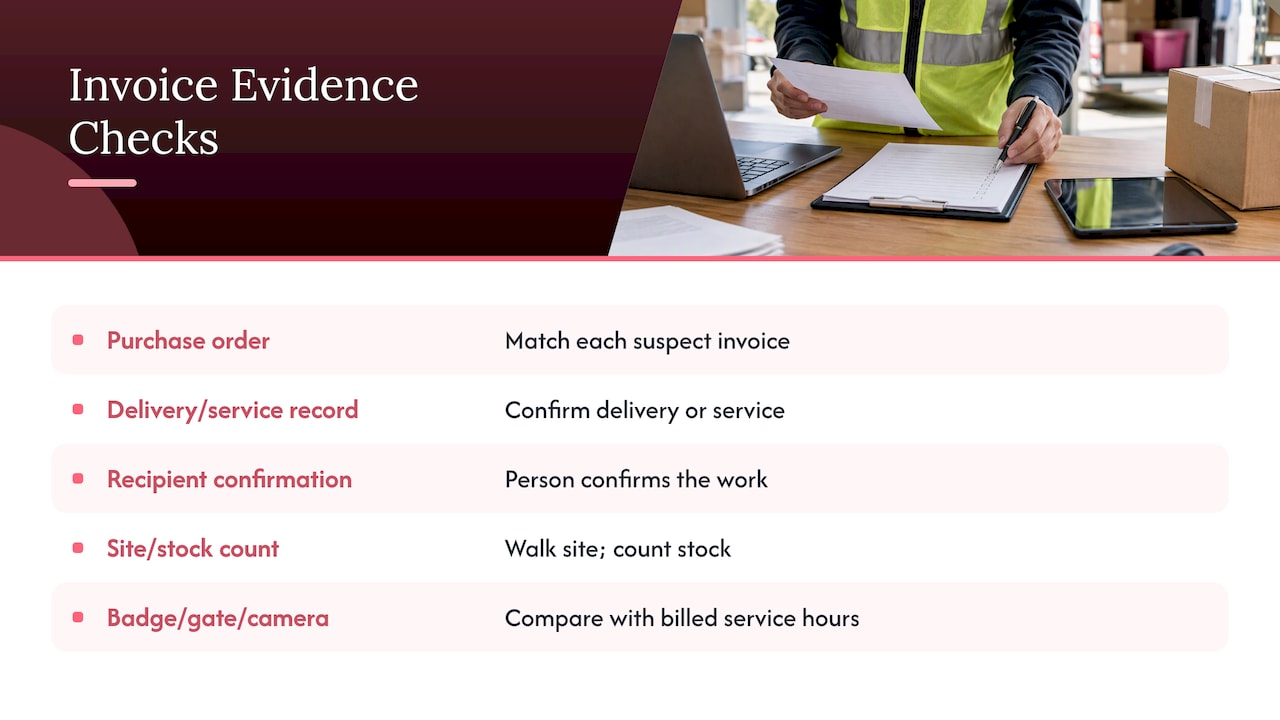
Match each suspect invoice to a purchase order, a delivery or service record, and a person who can confirm the work. Walk the site. Count the stock. Ask the department that supposedly received the service. For services such as cleaning, patrol, landscaping or maintenance, compare billed hours with badge logs, gate logs and camera footage.
Step 5: Document conduct in the field
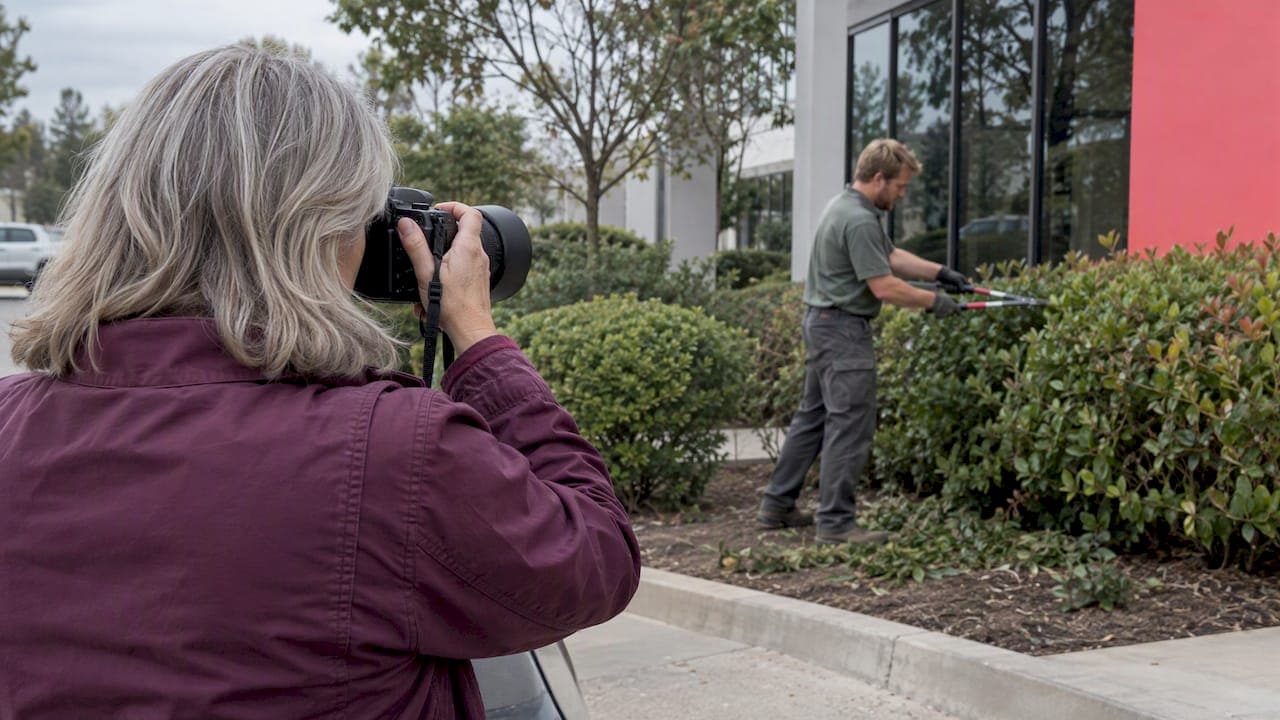
When the question is whether work is really being done, or whether a vendor and an employee are meeting privately, lawful surveillance investigation produces timed observations and original media rather than impressions. For a sense of what good documentation looks like, see what clients should expect in minute-by-minute surveillance logs.
Step 6: Interview last
Interviews come after the documents, so the person across the table cannot simply deny what you cannot yet show. Counsel should decide who is interviewed, in what order, and by whom. For a step-by-step view of the internal side, see our guide to corporate fraud investigation steps.
Step 7: Build the file
Organize findings by allegation, evidence and outcome, with exhibits indexed. Each finding should say what it shows, where it came from and who handled it. This matters even if you never go to court, because it is the document your attorney, insurer and, if needed, law enforcement will read.
How long a vendor fraud investigation takes
There is no fixed answer, and anyone who promises one before seeing the records is guessing. A narrow question about a handful of invoices can be settled in weeks. A scheme spanning several vendors, years of payments and hidden owners can take many months. Five things drive the timeline:
- The age and scope of the scheme. Longer schemes leave more transactions to test.
- Condition of the records. Complete, searchable, unaltered files move fast; missing or altered files slow everything.
- Cooperation. A vendor that stalls adds weeks.
- Hidden ownership. Tracing shell companies and related parties takes time.
- Legal steps. Subpoenas, insurer review and prosecutor decisions are outside your control.
Delay itself has a cost. In its 2026 occupational fraud findings, the ACFE reports that the median scheme lasted 12 months before detection, with a median loss of $104,000 per case, and that longer schemes produced dramatically larger losses. The takeaway is not panic. It is that a credible suspicion should move to a scoped, quiet review within days.
Our perspective: why prevention and local presence matter
We have worked in Massachusetts since 2004, and the vendor problems we see most often are not exotic. They are ordinary arrangements nobody looked at twice: a cleaning contractor billing for nights nobody saw, a maintenance vendor owned by a relative of the person approving the work, an invoice stream that grows a little each quarter.
Our view is that most of this is preventable, and that loss prevention is a design problem before it is an investigation problem. When we build security for a site, we think in layers: who can enter, who can sign for a delivery, who can approve a payment, and who is looking at the logs. A guard who records every vendor arrival and departure gives accounts payable something to check an invoice against. GPS patrol tracking and dispatch records do the same for services billed by the hour. Our own employees staff dispatch and we do not use subcontractors, which means the person who logged an event is someone we can put in front of you.
When something has already gone wrong, we would rather start small. Define the question, protect the evidence, and let the facts decide how far to go. Our lean management structure means the investigator you speak with at the start is usually the person doing the work, not a handoff to a larger team.
— Derek
When and where to report suspected vendor fraud
Not every case belongs with the police, and some do. Counsel should help you decide, but know the routes.
- Federal contracts or funds. If the vendor serves a federal agency, or the money is federal grant or contract funding, the GSA Inspector General runs a fraud hotline (www.gsaig.gov/hotline or 202-501-1780). The Department of Justice describes the National Procurement Fraud Task Force, established in 2006, as a coordinating body among Inspectors General, law enforcement and the DOJ to detect, investigate and prosecute procurement and grant fraud, as noted in a DOJ Inspector General grant oversight guide.
- Private losses. For a purely private loss, the usual path is counsel, then your local police or prosecutor’s office, sometimes alongside a civil claim to recover funds.
- Your insurer. Report according to your policy terms, as described above.
What you hand over matters. The ACFE’s guidance on submitting case reports to prosecutors says the final package should be clear, comprehensive and logically structured, defining the allegation, the evidence and the outcomes. Prosecutors have limited time. A well-organized file is how a case earns it.
Where an outside investigator helps
Some of this you can do in house. Some of it should not be done by the people closest to the problem.
| Task | In house | Outside investigator |
|---|---|---|
| Reviewing your own invoices and approvals | Usually fine, if no insider is suspected | Useful when an insider may be involved |
| Verifying a vendor’s identity and ownership | Possible, but records are scattered | Faster and better documented |
| Tracing related parties and assets | Rarely practical | Core investigator work |
| Observing vendor conduct on site | Risky and visible | Discreet, logged, lawful |
| Preparing a file for counsel or prosecutors | Depends on experience | Built to be handed over |
Independence is the main value. Employees who work with the vendor every day cannot credibly investigate it, and an employee who suspects a colleague is placed in an uncomfortable position. An outside team has no stake in the answer.
Prevention that works in practice
Controls do not need to be elaborate. They need to be consistent.
- Separate duties. The person who adds or edits a vendor should not be the person who approves payment.
- Verify bank-detail changes by calling a number you already had on file, never one in the request.
- Require competing bids above a set amount, and look at who actually bid.
- Match three ways. Purchase order, receiving record and invoice should agree before payment.
- Watch thresholds. Review clusters of invoices just under approval limits.
- Vet new vendors. Confirm identity and ownership before the first payment, and recheck periodically for high-spend suppliers.
- Rotate and review. Change who reviews a long-standing vendor relationship.
- Log physical access. Vendors on site should sign in and out, with guards or access control to back it up.
Data tools can help flag patterns such as payments just under approval thresholds or invoices split to avoid controls, as SAS notes in its procurement fraud paper. But tools only point at transactions. Someone still has to go and see whether the work was done.
Work with Hub on a suspected vendor issue
Hub Security and Investigative Group handles private investigations, due diligence, asset searches, surveillance and background checks, along with armed and unarmed security staffing and risk assessments, for Massachusetts businesses, property managers and law firms. We are licensed in Massachusetts (Private Detective Firm License #LP0203L) and carry $3 million in general liability insurance. If you have a vendor concern, we can scope the question with you and your counsel before any work begins. See our private investigator services or go to our services page to request a consultation.
FAQ
What evidence is needed to prove vendor fraud?
You generally need to show a false statement or deception, that it was material, and that money was lost because of it. In practice that means contracts, invoices, payment records, delivery or service records, communications and ownership records that tie the pieces together. Your attorney will tell you what a specific claim requires.
What are the most common vendor fraud examples?
The most common are fictitious vendors, inflated or duplicate invoices, kickbacks to the employee who approves work, product or service substitution, bid rigging and changed bank details. Each leaves a different trail, which is why the review starts with the specific allegation rather than a general audit.
Should I confront the vendor first?
No. Preserve records and speak with counsel before anyone contacts the vendor or the employee who manages the relationship. Federal guidance for auditors says the same: involve legal counsel and investigators before confronting a contractor.
How long does a vendor fraud investigation take?
A narrow review of a few invoices can take weeks, while multi-year or multi-entity schemes can take many months. The condition of the records, the vendor’s cooperation and any legal steps set the pace. A scoping conversation up front gives you a realistic estimate for your case.
Sources
- Procurement Fraud Handbook (GSA Office of Inspector General)
- Red Flags of Fraud (GSA Office of Inspector General)
- GAO audit guide GAO-03-678G
- ACFE Fraud Examiners Manual sample chapter
- ACFE Occupational Fraud 2026 key findings
- ACFE: Submitting case reports to prosecutors
- DOJ OIG guide to grant oversight
- SAS procurement fraud paper