
Start a prompt, impartial, and documented investigation whenever you have a good-faith reason to believe workplace misconduct occurred. A workplace misconduct investigation is a structured process for gathering facts about a complaint and deciding what happened. The EEOC calls for prompt, thorough, impartial fact-finding, and the NLRB requires certain employees get representation during the process.
TL;DR:
- A verbal, secondhand, or anonymous report can justify opening an investigation; first address safety, preserve evidence, define scope, and limit internal notifications.
- Use an outside investigator when allegations involve executives, HR, credible conflicts, potential crimes, or violence; document the selection rationale before the process begins.
- Preserve original digital files with access records and timestamps, and honor a union employee’s request for representation during a potentially disciplinary interview.
- Base findings on credibility, consistency, and corroboration, apply a stated proof standard, and tie corrective action directly to supported conclusions.
- Use neutral interim measures, such as paid leave or temporary reporting changes, and schedule documented meetings for the weeks after findings to monitor retaliation.
Table of Contents
- When to Investigate: Triggers, Thresholds, and Immediate Triage
- Who Should Conduct the Investigation: Roles and Neutrality
- Step-by-Step Investigation Process From Intake to Report
- How to Conduct Investigative Interviews That Hold Up
- Gathering and Preserving Evidence: Practical Steps
- Interim Measures and Timeline Expectations
- Legal Obligations and Employee Rights to Respect
- Writing Findings and Communicating Outcomes
- Post-Investigation Follow-Up and Preventing Retaliation
- When to Bring in an Outside Investigative Firm
- A Note on Fairness and Defensibility
- Where Hub Investigative Group Fits When You Need Outside Support
- FAQ
- Sources
When to Investigate: Triggers, Thresholds, and Immediate Triage
The threshold for opening an investigation is low by design: a good-faith reason to believe misconduct occurred is enough, even if the report came in verbally, secondhand, or anonymously. Waiting for a written complaint before acting is one of the most common mistakes employers make, and it can expand liability rather than limit it, according to SHRM’s 2025 guidance on HR investigations.
Some situations leave no room for delay, including allegations of harassment or discrimination, threats of violence, and reports that raise immediate safety concerns. Once a report lands on your desk, triage comes first.
- Confirm the safety of everyone involved before anything else.
- Preserve relevant evidence, including emails, badge logs, and camera footage, before it can be altered or deleted.
- Define the initial scope: who is involved, what policy may have been violated, and what timeframe matters.
- Notify the right internal stakeholders without widening the circle more than necessary.
If the allegation touches senior leadership, involves potential criminal conduct, or raises a credible conflict of interest for your HR team, pause and loop in counsel or an outside investigator before taking another step.
Who Should Conduct the Investigation: Roles and Neutrality

Neutrality is the foundation of a defensible investigation. Your investigator should have no stake in the outcome, no reporting relationship with either party, and no history of conflict with the people involved.
Internal HR can usually handle routine complaints. A few signals tell you it is time to look outside:
- The complaint involves an executive, HR team member, or someone with influence over the investigator’s own role.
- There is a real or perceived pattern of bias in past internal investigations.
- The allegations involve potential criminal conduct, such as fraud or workplace violence.
Keep the decisionmaker, the investigator, and legal counsel in distinct roles. Blurring them invites a bias claim later.
Pro Tip: Write down the reasoning behind your investigator choice at the time you make it, not after a complaint about the process surfaces.
Step-by-Step Investigation Process From Intake to Report
A defensible investigation follows a consistent sequence rather than an improvised one. The steps below give HR a repeatable structure.
- Intake: Record the complaint in the complainant’s own words, note the date and method of the report, and flag any immediate safety or retaliation risk.
- Preserve evidence immediately: Lock down relevant files, communications, and footage before routine deletion cycles run, and alert IT if systems need to be put on hold.
- Define scope: Write down the specific allegations, the relevant timeframe, and the people who might have direct knowledge of events.
- Identify witnesses: List everyone who may have observed the conduct or who the respondent or complainant names, and prioritize interviews by relevance.
- Collect documentary evidence: Gather emails, chat logs, schedules, personnel files, and any physical evidence tied to the allegations.
- Engage specialists when needed: Bring in IT for electronic data, or an outside investigator for surveillance or forensic needs that exceed internal capability.
- Conduct interviews: Talk with the complainant first, then relevant witnesses, then the respondent, adjusting the order only when safety or evidence integrity demands it.
- Analyze the evidence: Weigh credibility, consistency, and corroboration rather than treating every account as equally weighted.
- Write findings: Summarize what the evidence shows, applying a clear standard (commonly preponderance of the evidence) to reach a conclusion.
- Recommend action: Tie any disciplinary or corrective recommendation directly to the findings, not to assumptions made before the evidence was reviewed.
Each step produces its own paper trail, which matters as much as the conclusion itself.
How to Conduct Investigative Interviews That Hold Up
A good interview starts with a plan, not a conversation. Draft a short script of objectives and open-ended questions for each person you plan to interview, tailored to what that individual is likely to know.
Open every interview the same way: explain your role, the limits of confidentiality, and the employer’s commitment to non-retaliation. If the interviewee is a union-represented employee who reasonably believes the interview could lead to discipline, remind them of their Weingarten rights to have a representative present, since the request has to come from the employee.
- Ask who, what, when, where, and how before asking why.
- Avoid leading or suggestive questions that hand the interviewee the answer.
- Let silence sit; don’t rush to fill a pause with your own theory of events.
- Follow up on inconsistencies calmly, without framing it as an accusation.
Take contemporaneous notes during the interview rather than reconstructing them afterward, and follow your organization’s recording policy consistently across every interview.
Gathering and Preserving Evidence: Practical Steps
Evidence loses value the moment it is altered, deleted, or handled inconsistently. Email and chat logs, CCTV footage, device data, and personnel records each need their own collection method, and all of it needs a documented chain of custody showing who accessed it and when.
- Export digital evidence in its original format rather than screenshots when possible.
- Store physical and digital evidence in a secure, access-limited location.
- Timestamp every note and document as you create it, not after the fact.
- Loop in IT or a forensic specialist when data spans multiple systems or devices.
The EEOC’s employer checklist calls for a reporting system, trained neutral investigators, and documented timely investigations as baseline practice. Skipping documentation at this stage is one of the easiest ways to undermine an otherwise sound investigation.
Workers’ compensation claims sometimes surface alongside misconduct allegations, particularly when timecards or injury reports are disputed; our workers’ compensation investigation overview covers how that overlap gets handled.
Interim Measures and Timeline Expectations
While an investigation runs, you still have to manage day-to-day working conditions for everyone involved. Neutral interim measures protect people without pre-judging the outcome.
- Offer paid, non-disciplinary leave rather than unpaid suspension where safety requires separation.
- Adjust schedules or reporting lines temporarily instead of transferring the complainant.
- Put a limited no-contact arrangement in place between the parties if needed.
Avoid shifting the burden onto the complainant through a transfer or schedule change, since that pattern can look like retaliation even when it isn’t intended that way. Document the reasoning behind every interim step as you take it. Move quickly on the initial steps, and if the investigation runs long, give both parties a status update rather than leaving them guessing about timing or next steps.
Legal Obligations and Employee Rights to Respect
The EEOC expects employers to investigate promptly, thoroughly, and impartially, then take corrective action proportional to the findings. Retaliation against anyone who reports misconduct or participates in the investigation is a separate violation on its own.
Union-represented employees have the right to request a representative during an investigatory interview they reasonably believe could lead to discipline.
- Honor Weingarten requests for union-represented employees once the request is made.
- Keep confidentiality instructions narrow enough that they don’t restrict activity protected under the NLRA.
- Check whether the allegations trigger a separate reporting duty, such as an OSHA workplace violence record or an EEOC charge deadline.
Balancing EEO obligations against NLRA-protected speech takes judgment. A blanket gag order on discussing an open investigation is the kind of policy that draws scrutiny from both agencies.
Writing Findings and Communicating Outcomes
A findings report needs a clear structure: scope of the investigation, methodology, a summary of the evidence, credibility assessments where accounts conflict, and a conclusion tied to a stated standard of proof. Recommended action should follow logically from that conclusion, not from unrelated history between the parties.
- Keep discipline proportional to the severity and pattern of the conduct found.
- Document corrective action taken, including training or policy changes.
- Share full reports only with those who need them to act; give others a summary.
- Use neutral, factual language throughout, avoiding conclusions the evidence doesn’t support.
Vague or exaggerated findings create as much legal exposure as no findings at all.
Post-Investigation Follow-Up and Preventing Retaliation
The investigation isn’t finished when the report is signed. Retaliation often surfaces weeks or months later, and a documented follow-up plan catches it early.
- Schedule check-ins with the complainant and relevant supervisors over the following weeks.
- Watch for subtle retaliation signals, like sudden negative reviews or exclusion from projects.
- Restore any leave, assignments, or evaluation scores affected by the interim measures, where appropriate.
- Feed findings back into training or policy updates so the same gap doesn’t resurface.
Pro Tip: Put a 30 and 90-day check-in on the calendar the day you close the investigation, not as an afterthought later.
When to Bring in an Outside Investigative Firm
Conflicts of interest, high-stakes allegations, threats of violence, or conduct that overlaps with criminal activity are the clearest signals that an outside investigator belongs on the case.
- Independent interview summaries that carry weight precisely because they come from outside the organization.
- Forensic evidence handling and chain-of-custody documentation that holds up if the matter escalates.
- A final report built for both internal decisionmakers and, when needed, outside counsel or regulators.
Our corporate investigations work and stalking and harassment investigation services exist for exactly these situations, where employers need a structured, outside look that an internal team can’t credibly provide on its own. Interview technique matters as much here as evidence handling; this guide to interview-driven audit evidence covers methodology that translates well into misconduct inquiries.
A Note on Fairness and Defensibility
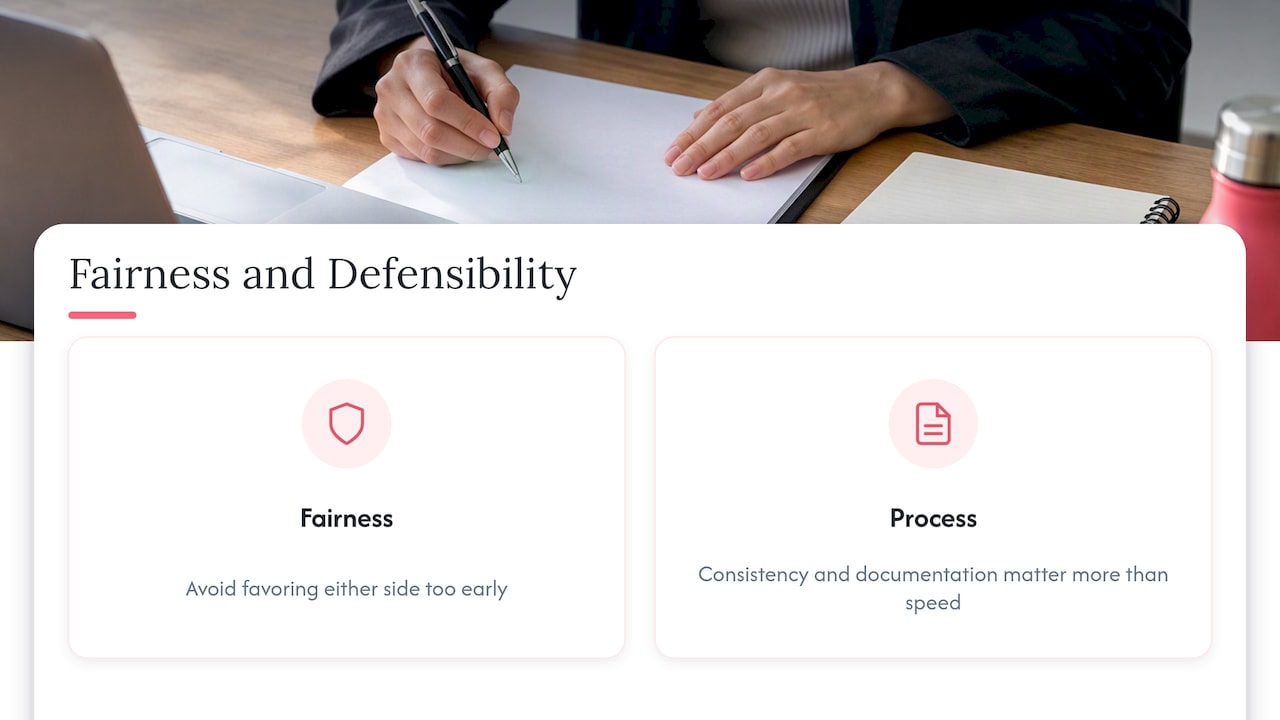
Every investigation asks you to hold two things at once: fairness to the person accused and a real duty to act on behalf of the person who came forward. Favoring either side too early undermines both.
The employers who avoid long-term liability aren’t the ones who move fastest. They’re the ones who invest in a consistent, documented process before they ever need one.
— Derek
Where Hub Investigative Group Fits When You Need Outside Support
When an investigation calls for distance from internal politics, specialized surveillance, or evidence collection that can stand up to outside scrutiny, we step in as a dedicated resource rather than an afterthought. Our work spans private investigation services, corporate investigations, surveillance, and evidence collection built for employers who need findings that hold up.

- Request a consultation when internal bias, safety concerns, or criminal overlap put a case beyond routine HR handling.
- Retain us early in a high-stakes matter rather than after the process has already stalled.
- Rely on documented, chain-of-custody evidence packages suitable for internal review or outside counsel.
Visit our services page to see the full range of investigative support available and start a conversation about your specific situation.
This article is general information, not a substitute for advice from a qualified lawyer. Consult a qualified legal professional about your own circumstances before acting on anything here.
FAQ
How should a manager handle harassment reported directly to them?
A manager who receives a harassment report should document what was said, escalate it to HR immediately, and avoid investigating it personally. Taking swift action to protect the reporting employee from retaliation matters as much as the escalation itself, consistent with EEOC guidance on prompt, impartial handling.
What should employers do to prevent workplace harassment overall?
Maintaining a clear reporting system, training neutral investigators, and acting quickly on complaints are the core steps the EEOC’s employer checklist recommends. Consistent documentation and visible anti-retaliation enforcement reinforce that the system actually works when used.
What resources do employees have to raise a harassment concern?
Employees can report internally through HR or a designated reporting channel, and they retain the right to file a charge with the EEOC if internal resolution fails. Union-represented employees also have Weingarten rights to request representation during any investigatory interview that could lead to discipline.
How can an employee get outside help with a workplace harassment issue?
Beyond internal HR channels, an employee can contact the EEOC to file a formal charge or consult an employment attorney for guidance specific to their situation. When an investigation involves safety threats or stalking elements that extend beyond the workplace, a stalking and harassment investigation may also be warranted.
Sources
- Promising Practices for Preventing Harassment (EEOC)
- Weingarten rights (NLRB)
- How to conduct bulletproof HR investigations (SHRM, 2025)