
The fastest way to reduce theft and liability in a parking garage is a tailored mix of visible patrols, lighting corrections, and integrated reporting. That combination works because it addresses the three conditions that allow crime to take hold: concealment, low perceived risk, and slow response. Before you contact a single vendor, pull together a short site packet: property type and square footage, your busiest and quietest hours, a log of incidents from the past 12 months, current camera and lighting status, and your preferred coverage model (night-only, peak-hours, or 24/7).
Here is the checklist to have ready:
- Property type and total size (levels, stalls, surface vs. structured)
- Peak-traffic windows and low-activity hours
- Prior incident log (theft, vandalism, assaults, trespassing)
- Camera coverage map and lighting audit status
- Access-control points (gates, elevators, stairwells)
- Preferred coverage model and budget range
That packet lets any credible provider give you a meaningful proposal rather than a generic quote.
Table of Contents
- What does a parking garage security patrol service include?
- What do patrol officers actually do, and what outcomes should you expect?
- How do patrol services integrate with cameras, access control, and reporting?
- How do you vet and choose a parking garage patrol provider?
- What licensing, training, and documentation should you require?
- How Hubsecurityandinvestigativegroup structures parking garage patrol coverage
- What does the contract initiation and start-up timeline look like?
- What does parking garage patrol actually cost, and what fees should you expect?
- Key Takeaways
- What most facility managers get wrong about patrol timing
- Request a proposal from Hubsecurityandinvestigativegroup
- Authoritative sources for further reading
What does a parking garage security patrol service include?
Professional parking garage security covers more service types than most facility managers expect. Understanding the full menu helps you match the right model to your site’s actual risk profile.
Core service types:
- Armed officers: Appropriate for high-risk urban garages, facilities with prior violent incidents, or properties storing high-value vehicles.
- Unarmed officers: Suitable for routine deterrence, corporate campuses, and mixed-use facilities where visible presence is the primary goal.
- Mobile vehicle patrols: Efficient for perimeter coverage and large surface lots, but vehicle patrols alone miss critical interior details in multi-level structures.
- Foot and bicycle patrols: Cover interior stairwells, elevator lobbies, and under-vehicle blind spots that a patrol car cannot reach.
- Stationary posts and gate attendants: Control access at entry/exit points and provide a consistent visible presence during peak hours.
- Remote monitoring with audio deterrence: A live operator watches camera feeds and broadcasts audio warnings when unauthorized activity is detected.
- Fire watch: Required when suppression systems are offline; a dedicated officer monitors for fire hazards and documents compliance.
- After-hours and special-event coverage: Surge staffing for concerts, sporting events, or late-night retail peaks.
For a multi-level garage, the most effective model combines vehicle patrols on the perimeter with foot officers on interior levels and a stationary attendant at the main entry. A surface lot with a single access point can often be served with mobile patrols supplemented by remote monitoring.
Pro Tip: Insist on randomized patrol patterns from day one. Predictable routes undermine deterrence because experienced offenders observe timing before acting. GPS-logged Detailed Activity Reports (DARs) confirm randomization and create documentation you can use in insurance claims and premises liability defense.
What do patrol officers actually do, and what outcomes should you expect?
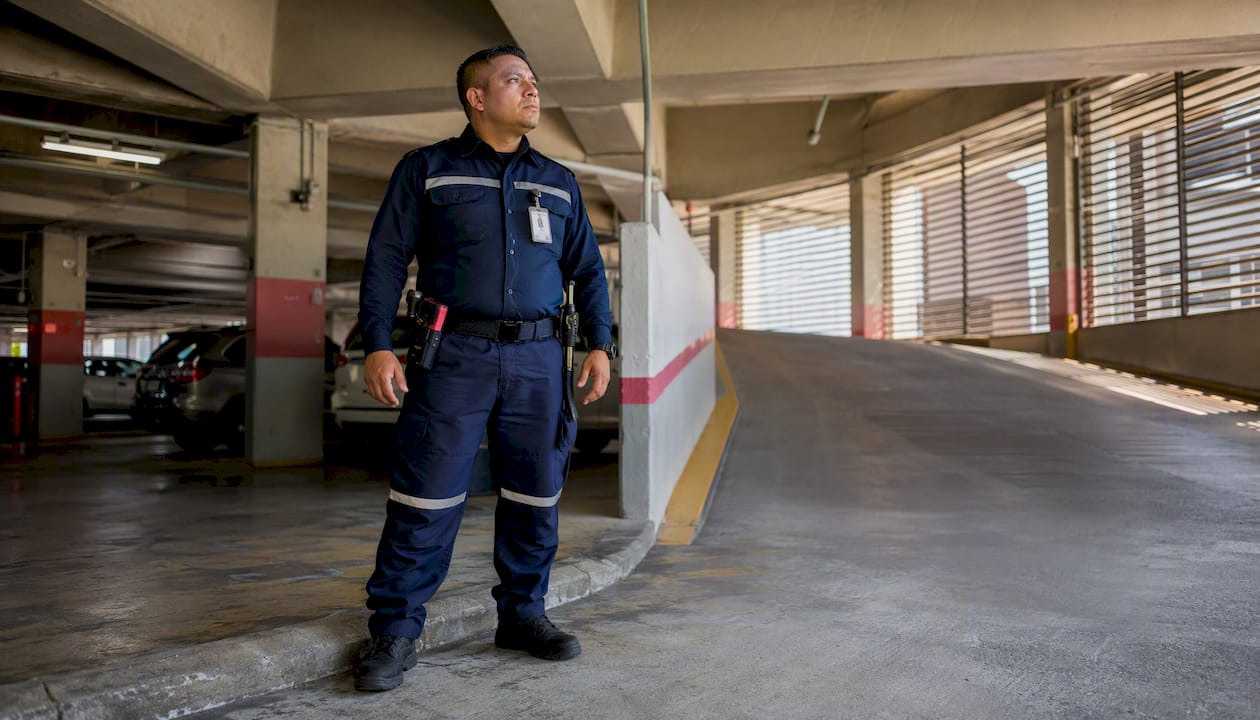
A patrol officer’s shift in a parking facility covers more ground than most people picture. The visible presence alone raises the perceived effort required by potential offenders, which is why security experts consistently pair camera systems with human patrols rather than relying on cameras alone. Cameras record; officers intervene.
Routine patrol duties include:
- Visibility sweeps of all levels, stairwells, and elevator lobbies
- Payment station monitoring (especially critical as cashless pay-by-plate systems replace staffed booths and create new loitering risks)
- Access control verification at gates and restricted areas
- Welfare checks for stranded motorists or individuals in distress
- Incident response: approaching suspicious activity, calling law enforcement, and preserving the scene
- Liaison with local police, including sharing intelligence on emerging theft patterns
Operational outcomes you can measure:
- Reduced vehicle break-ins and property theft
- Faster incident resolution through on-site response rather than waiting for police dispatch
- Evidence collection: officer observations, photos, and video timestamps that support insurance claims and legal proceedings
- Documentation for premises liability defense when a claim is filed against your property
Poor lighting is the primary contributor to concealment opportunities in parking facilities, according to CPTED-focused guidance from Parking Operator Hub, which recommends annual lighting audits using a light meter after dark. Patrol officers can flag burned-out fixtures and litter accumulation during their rounds, reinforcing the “broken windows” signal that active management is present. Facilities that communicate neglect through dark corners and accumulated debris invite opportunistic crime; those that signal active oversight deter it.
Vehicle-related crime patterns also shift quickly. Insurance claims data tracked by CB Security Solutions indicate a notable increase in catalytic converter theft claims in recent years, illustrating why patrol priorities need regular review and intelligence-sharing with local law enforcement.
How do patrol services integrate with cameras, access control, and reporting?
Technology and human patrol work best when they are deliberately connected, not running in parallel silos. AIA design guidance recommends that patrols be integrated with clear sightlines, intercoms, emergency call stations, and camera placement from the design stage. For existing facilities, integration happens at the operational level.
Common integration points:
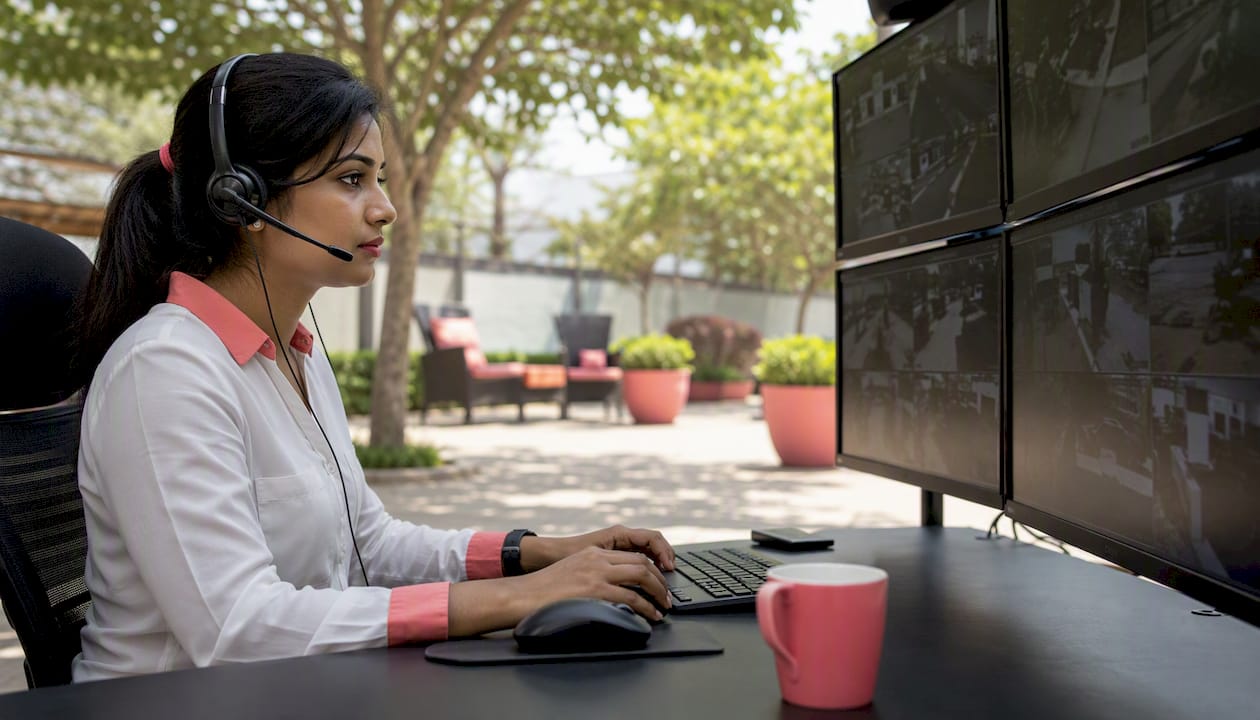
- Remote CCTV monitoring feeding alerts directly to on-site officers
- Camera-linked audio deterrence systems that broadcast warnings before an officer arrives
- Gate and access-control alerts triggering patrol dispatch to specific zones
- Emergency call station responses routed to the patrol officer on duty
Remote monitoring with audio deterrence can reduce the need for fixed-post guards at lower-risk facilities, but it does not replace human presence when an active incident requires physical intervention.
What to expect in reporting:
| Report Type | Frequency | Key Fields |
|---|---|---|
| Patrol log (DAR) | Every shift | Timestamped GPS points, observations, actions taken |
| Incident report | Per incident | Date/time, location, parties involved, video reference, follow-up |
| Supervisory visit log | Weekly/monthly | Supervisor name, findings, corrective actions |
| Management summary | Monthly | Incident trends, patrol coverage metrics, recommendations |
When reviewing vendor proposals, ask specifically for sample incident reports and DAR exports. A provider who cannot produce clean, timestamped documentation is a liability risk, not an asset.
How do you vet and choose a parking garage patrol provider?
Selecting the wrong provider costs more than the contract. A guard company without proper licensing or documentation exposes you to liability the moment an incident occurs on your property. Work through this checklist before signing anything.
Step-by-step vetting checklist:
- Confirm the company holds a valid state guard license and carries general liability insurance plus workers’ compensation.
- Request a certificate of insurance naming your property as an additional insured.
- Ask for sample incident reports and DAR exports to verify documentation quality.
- Review their written standard operating procedures (SOPs) for escalation and emergency response.
- Confirm GPS logging is standard, not optional, and that you receive regular DAR exports.
- Ask about their background-check process: what databases are searched, how often re-checks occur.
- Request references from comparable parking facilities.
Critical questions to ask during the RFP process:
- What coverage models do you offer, and how do you structure mixed patrol teams for multi-level garages?
- How do you randomize patrol patterns, and can you demonstrate this in GPS logs?
- What is your guaranteed response time for an active incident?
- How do you coordinate with our existing camera and alarm vendors?
- How often does a supervisor physically inspect the site?
- What is your substitution policy when an officer calls out, and how quickly can you fill the post?
- What are your overtime, holiday, and cancellation fee structures?
Red flags to walk away from:
- No GPS tracking or DAR documentation
- No written escalation protocols
- Missing or expired state guard license
- Inability to produce sample incident reports
- Fixed, predictable patrol schedules with no randomization policy
- Vague or absent training records for officers assigned to your site
Pricing varies by service type. Unarmed officers generally run at a lower hourly rate than armed officers, and vehicle patrols carry additional costs for fuel and vehicle maintenance. Remote monitoring credits can offset some fixed-post costs at lower-risk properties. Expect minimum shift requirements, contract retainer terms, and potential surge premiums for holidays and special events. Travel and dispatch fees may apply for properties outside a provider’s primary service zone.
What licensing, training, and documentation should you require?
Documentation is where credible providers separate themselves from cut-rate operators. Vendor selection guidance is clear: defined vendor roles, documented escalation protocols, and usable reporting are non-negotiable for any facility that faces premises liability exposure.
Must-have trust signals:
- Valid state guard license (verify directly with your state’s licensing authority)
- General liability insurance certificate, typically $1 million per occurrence minimum
- Workers’ compensation coverage for all officers on your property
- Bond coverage where your state or lease agreement requires it
Training and vetting standards to require:
- Criminal background checks on all officers assigned to your site
- De-escalation training and CPR/first aid certification
- Site-specific orientation before an officer’s first shift
- Ongoing in-service training and documented performance audits
Training that emphasizes de-escalation and quality documentation substantially improves a guard team’s legal defensibility and operational value. An officer who can write a clear, timestamped incident report is worth considerably more in a liability proceeding than one who cannot.
Document checklist to request during vetting:
- Copies of state guard license and insurance certificates
- Sample incident report and DAR export
- Officer training matrix showing completed courses and dates
- Supervisory visit schedule and inspection log template
- Two to three client references from comparable facilities
For more on what professional guard training programs should cover, including de-escalation, first aid, and patrol documentation, that resource outlines the standard your provider should meet.
How Hubsecurityandinvestigativegroup structures parking garage patrol coverage
Hubsecurityandinvestigativegroup brings over seventy-five years of combined law enforcement and loss prevention expertise to every parking facility engagement. That background shapes how we approach coverage: not as a staffing exercise, but as a risk management problem with a specific site profile.
For a multi-level structured garage, we typically recommend a layered model: a vehicle patrol covering the perimeter and entry/exit points, foot officers rotating through interior levels and stairwells on randomized schedules, and remote monitoring integration tied to the facility’s existing camera system. For a surface lot with lower foot traffic, a mobile patrol with remote monitoring backup often delivers the right coverage at a proportionate cost.
What a Hubsecurityandinvestigativegroup proposal includes:
- On-site assessment and CPTED/lighting audit to identify concealment risks before coverage begins
- A randomized patrol plan with GPS/DAR logging built in from day one
- Written escalation SOPs covering incident response, law enforcement liaison, and after-action reporting
- Armed and unarmed officer options based on your facility’s risk profile
- A start-up timeline from site assessment to first patrol shift
Pro Tip: Request a lighting audit as part of your initial site assessment, not as an afterthought. Addressing poor lighting as the primary concealment contributor before patrols begin means your officers are working in a facility that already signals active management, which multiplies the deterrent effect of their presence.
To request a site assessment or proposal, contact Hubsecurityandinvestigativegroup directly through our building security services page.
What does the contract initiation and start-up timeline look like?
Most facility managers are surprised by how quickly a professional patrol program can be operational. The typical sequence runs as follows:
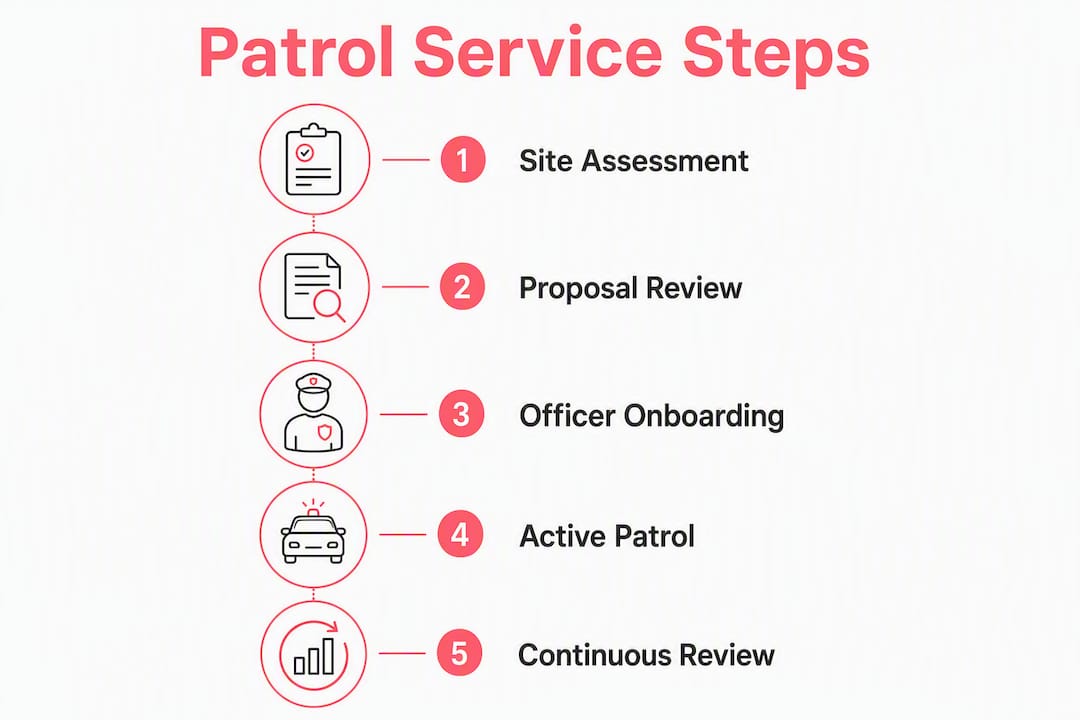
Phase 1: Site assessment (Days 1–5). A security consultant visits the property, reviews the incident log, walks all levels and access points, and documents lighting, camera coverage, and CPTED gaps. This visit produces the foundation for your proposal.
Phase 2: Proposal and contract (Days 6–14). The provider delivers a written proposal covering coverage model, officer count, patrol schedule, reporting structure, and pricing. Contract review, negotiation, and signing typically take one to two weeks depending on your procurement process.
Phase 3: Onboarding and orientation (Days 15–21). Officers assigned to your site complete a site-specific orientation: facility layout, access codes, escalation contacts, camera system overview, and your specific reporting requirements. Supervisors confirm readiness before the first shift.
Phase 4: First patrol shift and 30-day review (Day 22 onward). Patrols begin. Most providers schedule a formal 30-day review to assess coverage gaps, adjust patrol patterns based on early incident data, and confirm that reporting meets your needs.
From initial contact to first patrol shift, the realistic window is two to six weeks, depending on the complexity of your site and your internal approval process. Facilities with urgent needs, such as a recent spike in incidents, can often compress this to ten to fourteen days.
What does parking garage patrol actually cost, and what fees should you expect?
Pricing for patrol services is driven by several variables, and understanding them helps you evaluate proposals on equal terms.
Primary cost drivers:
- Armed vs. unarmed officers: Armed officers carry a higher hourly rate, reflecting licensing, training, and liability requirements.
- Vehicle vs. foot patrol: Vehicle patrols add fuel and maintenance costs; foot patrols on interior levels are typically billed at a straight officer rate.
- Coverage hours: Night-only coverage is less expensive than 24/7 contracts. Peak-hours-only models can be cost-effective for facilities with concentrated risk windows.
- Remote monitoring integration: Adding a remote monitoring layer can reduce the number of fixed-post hours needed, which may lower overall cost.
Additional fees and surcharges to ask about:
- Minimum shift requirements (commonly four or eight hours per post)
- Holiday and special-event premiums (often 1.5x to 2x the standard rate)
- Overtime charges when a shift runs long
- Travel or dispatch fees for properties outside the provider’s primary zone
- Equipment fees for body cameras, radios, or vehicle use
Contract and payment terms:
Most professional providers work on a monthly retainer or a fixed-term contract (commonly six or twelve months). Ask specifically about:
- Cancellation notice requirements (30 to 90 days is standard)
- Early termination fees and conditions
- Rate adjustment clauses for multi-year contracts
- Payment terms: net-30 is typical for commercial accounts
Avoid providers who cannot give you a written fee schedule. Verbal assurances about “no hidden fees” are not a substitute for a line-item contract. Reviewing the full fee structure before signing protects you from billing surprises during the contract term.
Key Takeaways
A tailored parking garage security patrol combining visible officers, randomized GPS-logged routes, lighting corrections, and integrated reporting is the most effective and legally defensible approach for facility managers.
| Point | Details |
|---|---|
| Gather your site packet first | Collect incident history, camera status, lighting gaps, and coverage preferences before requesting proposals. |
| Require GPS/DARs and written SOPs | Providers without timestamped patrol logs and documented escalation protocols create liability exposure, not protection. |
| Fix lighting before patrols begin | Poor lighting is the primary concealment contributor; a lighting audit should precede or accompany your first patrol shift. |
| Understand all fees upfront | Ask for a written fee schedule covering minimums, holiday premiums, cancellation terms, and payment structure before signing. |
| Hubsecurityandinvestigativegroup | Offers armed and unarmed patrols, CPTED/lighting audits, GPS-logged coverage, and a two-to-six-week start-up timeline. |
What most facility managers get wrong about patrol timing
The conventional wisdom is that parking garage security is a night problem. Most incidents happen after dark, so most contracts are written for night-only coverage, and facility managers feel they have addressed the risk. The data on catalytic converter theft tells a different story: those thefts happen in broad daylight, often during business hours, precisely because offenders know patrol coverage drops off when the sun comes up.
The deeper issue is that patrol programs are often designed around comfort rather than risk. A facility manager signs a night-only contract because that is what feels intuitive, not because an incident analysis actually supports it. The right coverage model comes from your incident log, not from convention.
There is also a tendency to treat the patrol contract as the finish line. It is not. A patrol program running in a facility with burned-out lights, predictable routes, and no camera integration is operating at a fraction of its potential. The patrol is one layer. Lighting, access control, CPTED design, and reporting are the others. When those layers work together, the deterrent effect compounds. When they are managed separately, gaps appear, and experienced offenders find them.
The facility managers who get the best outcomes from patrol programs are the ones who treat the site assessment as seriously as the contract negotiation. They show up with an incident log, a camera map, and a lighting audit. They ask hard questions about randomization and documentation. And they review the 30-day report with the same attention they gave the proposal.
Request a proposal from Hubsecurityandinvestigativegroup
Hubsecurityandinvestigativegroup delivers patrol programs built around your facility’s actual risk profile, not a generic shift schedule. With over seventy-five years of combined law enforcement and loss prevention experience, our team conducts a thorough site assessment, identifies lighting and CPTED gaps, and designs a randomized, GPS-logged patrol plan before your first officer sets foot on the property.
To request a proposal, send us the following information:
- Site address and property type (structured garage, surface lot, mixed-use)
- Operating hours and peak-traffic windows
- Summary of incidents from the past 12 months
- Current camera and lighting status
- Preferred coverage model (night-only, peak-hours, 24/7)
After we receive your details, we schedule a site visit, deliver a written proposal with a recommended coverage model and start-up timeline, and provide sample contract terms for your review. Most engagements move from first contact to first patrol shift in two to six weeks.
Contact us to schedule your site assessment or submit your RFP details today.
Authoritative sources for further reading
These primary sources support the technical claims in this guide and are worth consulting directly when developing your facility’s security policy.
-
Crime Prevention Through Environmental Design in Parking Facilities, Research in Brief | National Institute of Justice: The foundational NIJ research brief on CPTED applied specifically to parking facilities. Covers design principles, natural surveillance, and the evidence base for environmental crime prevention. Essential reading for any facility planning a security assessment.
-
AIA Best Practices: Designing Secure Parking: The American Institute of Architects’ design guidance for secure parking structures, covering sightlines, intercom placement, emergency call stations, and patrol integration. Useful when evaluating a new build or a major renovation.
-
Parking Garage/Parking Lot Security | IFPO: The International Foundation for Protection Officers’ practical brief on patrol patterns, lighting, landscaping, and security equipment for parking facilities. A solid reference for writing patrol SOPs and evaluating provider proposals.
-
Parking Structure Security | Beverly Police Department: A law enforcement perspective on the two most frequent crime types in parking facilities (theft and crimes against persons) and the environmental and operational measures that reduce opportunity. Useful for briefing ownership or a board on the risk case for patrol investment.
Recommended
- 1.Enhancing Safety in Parking Garages: The Critical Role of Security Guards in Preventing Crime, Trespassing, and Homeless Incidents – Hub Security & Investigative Group
- How Professional Security Guards Prevent Crime on Commercial Properties – Hub Security & Investigative Group
- How Professional Security Guards Prevent Crime on Commercial Properties – Hub Security & Investigative Group
- Professional Security Guards Prevent Crime on Properties