
Massachusetts requires the consent of all parties before you record any oral or electronic communication. That rule comes directly from M.G.L. c. 272, § 99, the state’s wiretap statute, which makes secret interception a felony regardless of whether the conversation happens in a private home or a public street. The Digital Media Law Project puts it plainly: the controlling test is whether a recording is secret, and a person who knows a recording is happening cannot later claim interception.
Quick implications at a glance:
- Criminal exposure. Violating § 99 is a felony offense.
- Civil liability. Any recorded party can sue you in civil court for damages.
- Safe default. Tell every participant before you press record.
- Narrow law-enforcement exception. Private citizens cannot rely on it.
Key Takeaways
Massachusetts recording law targets secret audio, not merely nonconsensual recording, so visible disclosure before you press record is the single most effective compliance step for individuals and professionals alike.
| Point | Details |
|---|---|
| All-party consent default | Massachusetts requires all parties to know about a recording; secret audio is a felony under M.G.L. c. 272, § 99. |
| Secrecy is the trigger | The statute criminalizes secret recording; actual knowledge by participants eliminates the “secret” element and reduces liability. |
| Law-enforcement exception is narrow | Only officers investigating designated offenses with a warrant or authorization qualify; private citizens have no equivalent exception. |
| Civil and criminal exposure | A single unlawful recording can trigger simultaneous criminal prosecution and a private civil lawsuit for damages. |
| Hubsecurityandinvestigativegroup | Our Boston investigations team handles consent documentation, chain-of-custody, and lawful evidence collection for cases where recordings must hold up in court. |
Table of Contents
- What does Massachusetts recording law actually prohibit?
- Which conversations and recordings does § 99 cover?
- What are the narrow exceptions to the all-party rule?
- What are the criminal penalties and civil remedies for secret recording?
- What do Massachusetts courts say about secret recording?
- How do you record legally in Massachusetts?
- How should licensed investigators and security firms handle recording in Massachusetts?
- A Massachusetts investigator’s perspective on recording compliance
- Hubsecurityandinvestigativegroup handles lawful evidence collection so you don’t have to
- Primary sources and further reading
- Sources
What does Massachusetts recording law actually prohibit?
M.G.L. c. 272, § 99 is often called a “two-party consent” law, but that label is slightly misleading. The statute does not require formal, signed consent from every participant. What it prohibits is secret interception. Understanding that distinction is the foundation of every compliance decision you will make.
The statute’s core prohibition covers the willful interception, use, or disclosure of any wire or oral communication by means of any intercepting device. Key definitions from the statute itself:
- Interception. Secretly hearing, secretly recording, or aiding another person to secretly hear or record the contents of any wire or oral communication.
- Oral communication. Any spoken word uttered by a person exhibiting an expectation that the communication is not subject to interception under circumstances justifying that expectation.
- Intercepting device. Any device or apparatus that can be used to intercept a wire or oral communication, with limited exceptions for standard telephone equipment.
- “Secretly.” The operative word. Courts focus on whether the recorded party had actual knowledge that a recording was occurring.
As the Boston Bar Journal explains, “two-party consent” is a colloquial shorthand. The statute criminalizes secret recording, not merely nonconsensual recording. Knowledge, not formal verbal consent, often controls the outcome. When a participant knows a recording is underway, the “secret” element of the offense is not met, and liability is substantially reduced.
Which conversations and recordings does § 99 cover?
The statute’s reach is broad, and several common scenarios trip people up.
Covered by § 99:
- Phone calls between two or more parties when at least one is in Massachusetts
- In-person conversations recorded without the participants’ knowledge
- Conference calls and video calls where audio is captured secretly
- Electronic communications intercepted in transit
- Cloud storage or transmission of audio recordings made without consent (as Commonwealth v. Du demonstrated)
Generally not covered:
- Silent video recording with no audio capture, in a location where there is no reasonable expectation of privacy
- Voicemails you receive and play back (you were the intended recipient)
- Recordings where all participants are informed and proceed with the conversation
The public-place misconception. Many people assume that recording in a public space is automatically lawful. Massachusetts law does not work that way. Massachusetts recording law makes clear that secret audio recording is prohibited regardless of location. Being on a Boston sidewalk or in a crowded restaurant does not make a hidden microphone legal. The Reporters Committee for Freedom of the Press notes that a narrow First Amendment carve-out exists for openly recording police in public following the Project Veritas line of First Circuit decisions, but that exception is tightly bounded and does not extend to private citizens recording other private citizens.
Hidden cameras. Silent video surveillance, such as a security camera recording movement without capturing audio, generally falls outside § 99’s scope. The moment that camera also captures audio secretly, the statute applies. Massachusetts security camera laws do not prohibit video-only surveillance in areas where people lack a reasonable expectation of privacy, but audio capture changes the analysis entirely.
What are the narrow exceptions to the all-party rule?
The exceptions in § 99 are genuinely narrow. Private citizens have no meaningful carve-out. The statute’s exceptions are designed for law enforcement, not for individuals who believe they have a good reason to record secretly.
The law-enforcement investigative exception permits interception only when:
- A law enforcement officer is a party to the communication, or has obtained prior authorization from a judge or the Attorney General.
- The investigation involves a designated offense, a specific list of serious crimes enumerated in the statute.
- The officer has obtained a warrant or court authorization through an ex parte application.
Massachusetts official guidance confirms that this exception is limited to law enforcement investigating designated offenses and requires either that the officer be a party or that a warrant be obtained. It does not apply to private citizens under any circumstances.
The warrant process requires law enforcement to demonstrate probable cause, identify the specific communications to be intercepted, and show that other investigative methods have been tried or would be inadequate. Courts issue these orders on an ex parte basis, meaning the target is not notified in advance.
What this means for you. If you are a private citizen, a business owner, or even a licensed private investigator, you cannot invoke the law-enforcement exception. There is no “I had a good reason” defense. There is no protective-purpose exception. As one legal guide notes, § 99 contains no carve-out for recordings made to protect victims, including domestic violence situations. Secret recordings remain prosecutable even when made with entirely protective motives.
Pro Tip: If you believe you need to record a conversation for legal protection, consult a Massachusetts attorney before you press record. The cost of that consultation is a fraction of the criminal and civil exposure you risk by recording first and asking questions later.
What are the criminal penalties and civil remedies for secret recording?
The consequences for violating § 99 are serious enough to demand attention from anyone who handles recordings professionally.
Criminal penalties under § 99:
Civil remedies. The statute also creates a private cause of action. Any person whose communication was secretly recorded can sue the recorder for:
- Actual damages (including mental anguish and reputational harm)
- Punitive damages
- Injunctive relief to stop further disclosure
- Attorney’s fees and litigation costs
Sheehan & Associates confirms that secret recordings can trigger both criminal prosecution and a private civil action, meaning a single unlawful recording can expose you to simultaneous criminal charges and a civil lawsuit.
Evidentiary consequences. An unlawfully obtained recording is not simply inadmissible. Courts can suppress the recording itself and, in some circumstances, derivative evidence obtained because of it. The distinction between using a recording as direct testimony versus as recorded evidence matters procedurally, but neither path is safe when the recording was obtained in violation of § 99. Suppression motions in criminal cases routinely succeed when the recording method violated the statute.
What do Massachusetts courts say about secret recording?
Several decisions have shaped how § 99 operates in practice. Each one carries a lesson worth knowing.
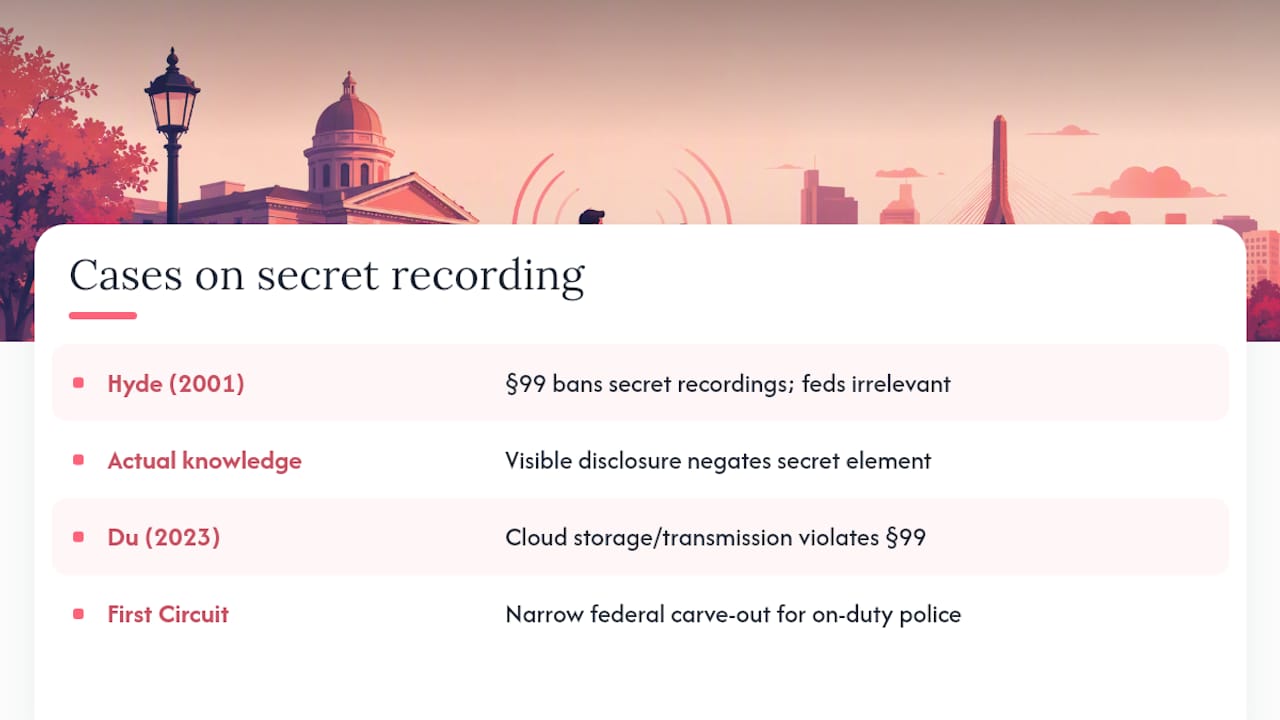
Commonwealth v. Hyde (SJC, 2001). Hyde is the foundational case. The Supreme Judicial Court held that § 99 strictly prohibits secret recordings by private individuals, including recordings of police officers, absent a statutory exception. Critically, the court grounded its analysis in the statute’s plain text, not in any expectation-of-privacy framework. The Massachusetts Legislature intentionally created a statute more restrictive than federal one-party consent rules, and federal legality offers no protection from state prosecution. Lesson: federal law is irrelevant to your Massachusetts exposure.
The “actual knowledge” doctrine (Curtatone and Jackson). The Boston Bar Journal’s analysis of Curtatone and related cases explains that when a recorded party has actual knowledge that recording is occurring, the “secret” element of § 99 is not satisfied. Openly placing a recorder in view, or verbally announcing that you are recording, typically eliminates interception risk even if a participant later claims they were misled about the recorder’s identity. Lesson: visible disclosure is your best protection.
Commonwealth v. Du (Mass. Appeals Ct., 2023). This case extended § 99’s reach into modern technology. The court found that transmitting and storing audio recordings in the cloud without consent violated the statute, and that law enforcement could not rely on the officer exception absent a clear nexus to designated offenses. Even recordings made by officers were suppressed when the statutory requirements were not met. Lesson: cloud storage and transmission of audio are not safe harbors.
Project Veritas / First Circuit. The Reporters Committee summarizes that the First Circuit created a narrow First Amendment protection for secretly recording police officers performing their duties in public. This carve-out is specific to on-duty police in public spaces and does not extend to recording private individuals, private conversations, or off-duty officers. Lesson: this exception is narrower than most people believe.
How do you record legally in Massachusetts?
Compliance with Massachusetts recording law is straightforward once you know the steps. The goal is to eliminate the “secret” element entirely.
- Announce the recording before it begins. State clearly, at the start of the call or conversation, that you are recording. Something as simple as “I want to let you know this call is being recorded” satisfies the notice requirement.
- Capture verbal consent on the recording itself. After your announcement, give the other party a moment to respond. If they continue the conversation, that continuation is evidence of knowledge. Better still, ask them to confirm: “Do you consent to this call being recorded?” and capture their “yes” on the recording.
- Use written consent for sensitive or ongoing matters. For employee monitoring, workplace investigations, or any situation where the recording may become evidence, get written consent before recording begins. A simple one-paragraph consent form, signed and dated, is far more defensible than a verbal acknowledgment.
- Post visible signage for continuous recording environments. If your business records calls as a standard practice, post clear notices at the point of contact: on your website, in your phone system’s hold message, and at physical locations where conversations may be captured. Signage must be visible and legible, not buried in fine print.
- Document and retain consent records. Keep a log of when consent was obtained, by whom, and in what form. For recorded calls, retain the recording itself as proof. For written consents, store signed copies in a secure, organized file.
- Handle multi-jurisdiction calls with the strictest standard. If any participant is in Massachusetts, Massachusetts law applies. When you are unsure of a participant’s location, default to Massachusetts rules. On interstate calls involving states with one-party consent laws, the Massachusetts participant is still bound by § 99.
- Consult counsel before recording in any ambiguous situation. If you are unsure whether a planned recording is lawful, the answer is to ask an attorney, not to record and hope for the best.
Sample compliant opening for a recorded call: “Before we begin, I want to let you know that this call is being recorded for [purpose]. By continuing this conversation, you consent to the recording. Do you have any questions about that?”
How should licensed investigators and security firms handle recording in Massachusetts?
For licensed security professionals and private investigators operating in Massachusetts, the stakes around recording compliance are higher than they are for private citizens. A recording that violates § 99 does not just expose the firm to criminal and civil liability. It can destroy the evidentiary value of an entire investigation.
Written consent is the professional standard. When a client engagement may involve audio recording, get written consent from your client and, where possible, from any third party whose communications will be captured. Verbal consent documented on the recording itself is a minimum floor, not a ceiling.
Coordinate with counsel before any covert audio work. There is no private investigator exception in § 99. Licensed investigators face the same prohibition as private citizens. If an investigation requires audio recording without the subject’s knowledge, the only lawful path runs through law enforcement coordination and proper statutory authorization. Our confidential investigation workflows are built around this principle.
Courts treat professional recordings with heightened scrutiny. A recording gathered by a licensed firm and offered as evidence in a civil or criminal proceeding will face suppression motions if the consent chain is not clean. Judges and opposing counsel will examine the circumstances of the recording’s creation, the consent documentation, and the chain of custody. A gap in any of those areas can render the recording inadmissible and undermine the case it was meant to support.
Client-facing procedures matter. Before any surveillance or recording operation, document the scope of the engagement in writing, specify what recording methods will be used, and confirm the client’s authorization. After the operation, maintain a clear chain of custody for all recordings: who created them, where they are stored, who has accessed them, and how they will be transferred to counsel or court. Professional investigative services that follow these procedures produce evidence that holds up.
Security camera compliance. Massachusetts security camera laws permit video-only surveillance in areas without a reasonable expectation of privacy, but any audio capture requires compliance with § 99. For commercial properties, post clear notice of video surveillance. For any system that captures audio, obtain consent or disable the audio function entirely.
A Massachusetts investigator’s perspective on recording compliance
Massachusetts § 99 is one of the strictest recording statutes in the country, and in twenty years of working investigations and security in this state, the most common mistake we see is not malicious intent. It is the assumption that a good reason to record is the same as a legal right to record. Those are not the same thing.
The “two-party consent” label creates a false sense of what the law requires. People hear “consent” and think they need a signed form. They hear “two-party” and think it only applies to private conversations. Neither is accurate. The statute targets secrecy. The moment a participant knows a recording is happening, the legal risk drops substantially. That is why our standard operating procedure starts with disclosure, every time, before any recording begins.
What concerns us more than the criminal exposure is the evidentiary consequence. A recording obtained in violation of § 99 is not just inadmissible. It can taint an entire investigation. Clients who come to us after attempting their own covert recordings often find that the evidence they gathered cannot be used and that they have created new legal exposure for themselves in the process. The statute has no sympathy for good intentions.
The practical answer is simple: announce the recording, document the consent, and consult counsel before you do anything that feels like a gray area. That process costs almost nothing. The alternative can cost everything.
This article is general information, not legal advice. For guidance specific to your situation, consult a licensed Massachusetts attorney.
Hubsecurityandinvestigativegroup handles lawful evidence collection so you don’t have to
When a recording may become evidence in a legal proceeding, the margin for error is zero. Hubsecurityandinvestigativegroup has operated in Boston since 2004, with over seventy-five years of combined law enforcement and loss prevention experience behind every engagement. Our private investigation services are built around Massachusetts compliance from the ground up: consent documentation, chain-of-custody protocols, and direct coordination with legal counsel when recordings are destined for court.
Whether you need surveillance for a workplace investigation, evidence collection for a civil matter, or executive protection that includes lawful monitoring, we handle the legal complexity so the evidence you need is actually usable. We work with corporate clients, attorneys, and individuals across Massachusetts who cannot afford to have their case undermined by a procedural misstep.
Ready to work with a firm that knows Massachusetts recording law from the inside out? Contact our Boston investigators to discuss your situation confidentially.
Primary sources and further reading
The following primary sources and authoritative guides were used throughout this article and are recommended for deeper research or primary text review:
- M.G.L. c. 272, § 99 — Massachusetts Legislature: The full statutory text of the Massachusetts wiretap and interception law.
- Mass: Official state guidance on the statute’s application and the law-enforcement exception.
- Commonwealth v. Du — Massachusetts official case summary (2023): Appeals Court decision on cloud storage, transmission, and the limits of the officer exception.
- Commonwealth v. Hyde, 434 Mass. 594 — SJC: Foundational SJC decision establishing strict prohibition on secret recordings by private individuals.
- Reporters Committee for Freedom of the Press — Massachusetts Recording Guide: Practical guide covering journalist and professional recording rights, including the Project Veritas/First Circuit carve-out.
- Digital Media Law Project — Massachusetts Recording Law: Plain-language summary of the statute and the “always notify” recommendation.
- Boston Bar Journal — Secretly Recording Public Officials: Legal commentary on the “actual knowledge” doctrine, Curtatone, and challenges to § 99.
- Sheehan & Associates — Secret Recordings, Evidence and the Law: Practical overview of criminal and civil exposure for unlawful recordings.
For case-specific legal questions, consult a licensed Massachusetts attorney. Recording law analysis changes with new court decisions, and this article reflects the law as understood at the time of publication.
This article is general information, not a substitute for advice from a qualified lawyer. Consult a qualified legal professional about your own circumstances before acting on anything here.
Sources
- General Laws – Part IV, Title I, Chapter 272, Section 99 (Massachusetts Legislature)
- Wiretapping, Interception and Related Procedures (Massachusetts official guidance)
- Wiretap statute violated by undercover purchase of drugs (Massachusetts official case summary)
- Hyde, Commonwealth v., 434 Mass. 594 (Mass. SJC)
- Secretly Recording Public Officials: Challenges to the Massachusetts Wiretap Act (Boston Bar Journal)
- Reporters Committee: Recording guide — Massachusetts
- Massachusetts recording law | Digital Media Law Project
Recommended
- Security Officer Licensing and Certification in Massachusetts: 2025 Requirements and Process – Hub Security & Investigative Group
- 1.“Why Massachusetts Has Become More Dangerous — And How Private Security Can Help Protect What Matters” – Hub Security & Investigative Group
- Condo and Apartment Security in Massachusetts: Why It’s Crucial for Safety, Trust, and Long-Term Value – Hub Security & Investigative Group
- Importance of Security: Protecting People and Assets