
A corporate fraud investigation follows seven ordered steps: initial assessment (predication), investigation planning and team assembly, evidence preservation, interviews, transaction analysis, law enforcement or regulatory coordination, and reporting with remediation. The Association of Certified Fraud Examiners (ACFE) emphasizes that timeliness in the first step directly reduces evidence loss and financial damage, which means your first 24–72 hours are not administrative, they are forensic.
The sequence matters because each step creates the foundation the next one depends on. Skipping predication leads to overbroad investigations that expose uninvolved employees. Delaying evidence preservation risks spoliation sanctions. Interviewing the subject before peripheral witnesses destroys your ability to corroborate or contradict their account. Get the order right, and every subsequent action is defensible.
First 24–72 hours: what to do immediately
- Issue a litigation hold covering all potentially relevant custodians, systems, and date ranges.
- Restrict system access for anyone suspected of involvement, without alerting them to the investigation.
- Preserve electronically stored information (ESI) in place before any routine deletion cycles run.
- Notify legal counsel and, if warranted, the audit committee or board.
- Document every decision made during this window, including decisions not to act.
- Identify and secure physical records (contracts, invoices, expense reports) relevant to the allegation.
- Do not interview the primary subject yet.
Pro Tip: Write a brief predication memo on day one. A single page documenting what you know, what you don’t know, and why you opened the inquiry protects the company if the investigation is later challenged.
Key Takeaways
A corporate fraud investigation is only as strong as its first 48 hours: predication, evidence preservation, and counsel engagement set the conditions for every step that follows.
| Point | Details |
|---|---|
| Predication first | Document the basis for opening an investigation before taking any other action. |
| Litigation hold is urgent | Issue the hold as soon as litigation or regulatory inquiry is reasonably anticipated to avoid spoliation risk. |
| Interview order matters | Start with peripheral witnesses and move inward; interview the primary subject last. |
| Corroborate every finding | Support each material conclusion with at least two independent sources before reporting. |
| Hubsecurityandinvestigativegroup | Provides forensic investigation, evidence preservation, and counsel-coordinated engagements for corporate fraud cases. |
Table of Contents
- What are the corporate fraud investigation steps you should follow first?
- How do you plan the investigation scope and assemble the right team?
- How do you preserve and collect evidence without creating legal risk?
- How should you plan and conduct investigative interviews?
- How do you reconstruct a fraud timeline and trace transactions?
- When should you involve law enforcement or regulators?
- How do you write the investigative report and drive remediation?
- What are the most common red flags and forensic techniques to know?
- When should you bring in an outside specialist?
- Why timeliness, documentation, and counsel coordination define every outcome
- Hubsecurityandinvestigativegroup handles corporate fraud investigations when the stakes are high
- Sources
What are the corporate fraud investigation steps you should follow first?
Predication is the threshold question: do you have enough credible information to justify a formal investigation? The answer does not require proof of fraud. It requires a reasonable basis to believe that fraud may have occurred, based on a specific allegation, an anomaly in financial data, a whistleblower report, or an audit flag. The AICPA guidance on fraud investigation engagements requires that scope be tailored to the facts and that investigators confirm competence and conduct conflict checks before proceeding.
Document the predication decision in writing. Record the source of the allegation (anonymous tip, internal audit finding, vendor complaint), the date received, who reviewed it, and the basis for the decision to investigate or not. If you decide not to investigate, that decision needs the same written justification as the decision to proceed. Regulators and plaintiffs’ counsel will ask for it.
Pro Tip: Run a conflict check before assigning any investigator. An internal auditor who approved the transactions under review cannot lead the inquiry. Independence is not optional; it is the first thing outside counsel will assess.
Interim containment actions should follow predication immediately. Depending on the nature of the allegation, these may include placing a hold on payment runs, suspending corporate card privileges for the suspected individual, restricting access to financial systems, and preserving backup tapes or cloud snapshots before scheduled purges. None of these steps require alerting the subject. Speed matters here because ongoing fraud compounds loss, and delayed containment gives a subject time to destroy records or move funds.
How do you plan the investigation scope and assemble the right team?
A written investigation plan is not a formality. Companies with documented fraud response strategies respond faster, preserve more evidence, and present a cleaner record to regulators when the matter surfaces in enforcement proceedings. The plan should define the specific allegations being investigated, the time period in scope, the systems and entities covered, the investigative hypotheses, and the measurable criteria for closing the inquiry.
Team composition decisions to make at the outset:
- Outside counsel: Retain early to establish attorney-client privilege over the investigation and its work product. Counsel directs the investigation; investigators work at counsel’s direction.
- Forensic accountants: Needed when the allegation involves financial statement manipulation, complex transaction tracing, or loss quantification. Their work product, prepared at counsel’s direction, can carry privilege protection.
- IT forensics specialists: Required whenever ESI collection, imaging, or metadata preservation is involved. Do not let IT staff with ties to the subject handle collection.
- Internal audit: Can assist with document gathering and control testing but should not lead an investigation where their prior work is under scrutiny.
- HR: Involved in disciplinary decisions after findings are made, not during the active investigation.
The AICPA guidance requires an engagement letter that documents scope, fee arrangements, privilege structure, and the process for handling scope changes. Treat scope changes as formal amendments requiring written authorization. Scope creep is one of the most common ways investigations lose focus and generate unnecessary exposure for uninvolved parties.
Communication protocols deserve equal attention. Determine at the outset who is notified, in what sequence, and through what channel. Typically: general counsel, the audit committee chair, and the CEO (unless the CEO is implicated). Whistleblower communications must be handled through a separate, protected channel. Coordinate with your law firm on how to handle incoming inquiries from employees who have heard rumors. Silence is not always the right answer, but uncoordinated communication is always the wrong one. For companies working with outside legal teams, Hub’s coordination with law firms illustrates how investigative specialists integrate with counsel to keep communications controlled.
How do you preserve and collect evidence without creating legal risk?
Evidence preservation is where most internal investigations fail, and the consequences are severe. Under U.S. law, a litigation hold must be issued promptly once litigation or regulatory inquiry is reasonably anticipated. LegalClarity’s overview of corporate fraud investigations notes that delayed holds risk spoliation sanctions, which can include adverse inference instructions at trial, meaning a jury may be told to assume the destroyed evidence was harmful to your client.
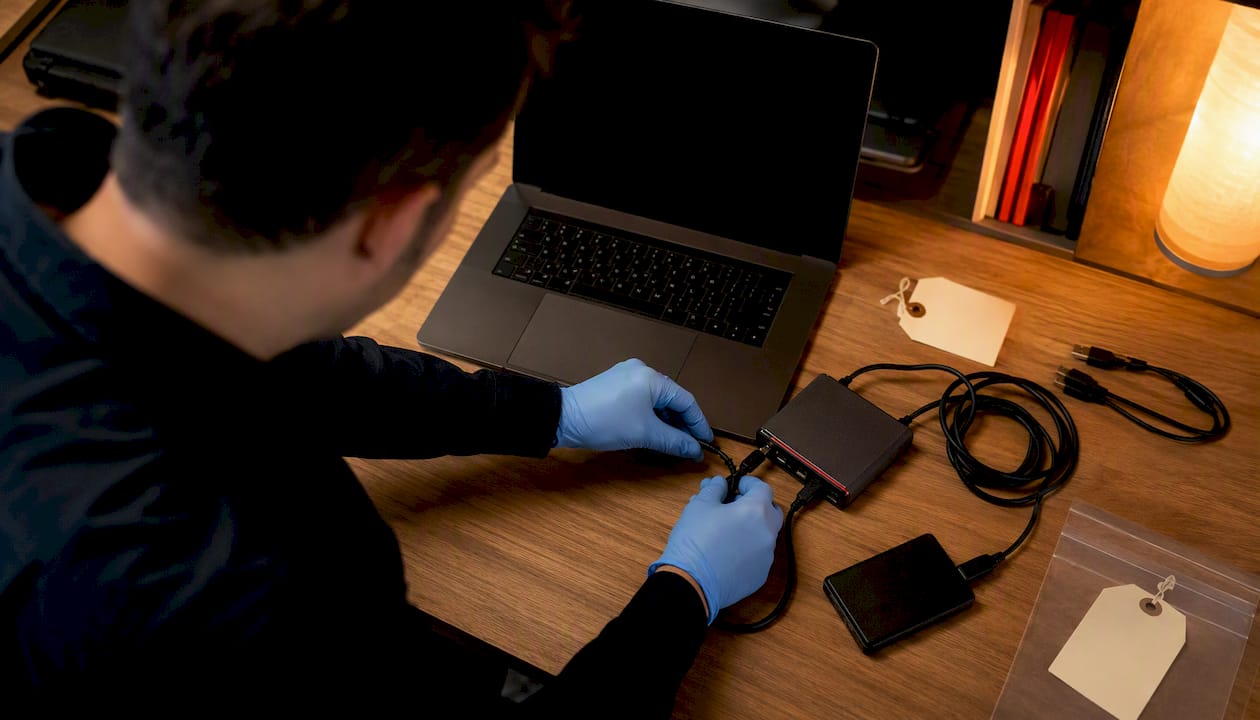
The hold notice must identify custodians by name, specify the categories of records covered, and instruct recipients to suspend all routine deletion. It should cover email, instant messaging platforms, shared drives, mobile devices, and any third-party systems (cloud storage, payroll processors, expense management platforms) where relevant data lives. Ephemeral messaging apps used for business communications present a specific challenge: if the company has not already disabled auto-delete on those platforms, do it now.
Evidence collection: key standards
| Evidence Type | Collection Method | Key Requirement |
|---|---|---|
| Email and ESI | Forensic imaging by qualified IT forensics specialist | Preserve metadata; document tools used |
| Physical records | Secured retrieval with logged chain of custody | Date, time, collector identity recorded |
| Financial system data | Exported with hash verification | Maintain original and working copy |
| Mobile devices | Forensic extraction with write-blocker | Device state documented before extraction |
| Third-party records | Formal written request or subpoena | Log all communications with the provider |
Chain of custody is not bureaucratic overhead. Every piece of evidence must have a log entry recording who collected it, when, from where, and every subsequent transfer. Hash values (cryptographic digests) verify that digital files have not been altered after collection. The Global Investigations Review’s forensic accounting guide identifies defensible collection procedures and metadata preservation as foundational requirements for any forensic investigation that may later support litigation or regulatory proceedings.
Pro Tip: Always work from a forensic copy, never the original. The original goes into secured, logged storage immediately after imaging. Any analysis performed on the original risks tainting the evidence and undermining admissibility.
For teams that need structured guidance on evidence handling protocols, crime scene security and evidence documentation training covers chain-of-custody procedures applicable to professional investigative contexts.
How should you plan and conduct investigative interviews?
Interview sequencing is one of the most consequential decisions in the fraud investigation process. Start at the periphery: interview witnesses who have indirect knowledge first (vendors, administrative staff, colleagues who observed unusual behavior). Move progressively inward toward employees with direct knowledge, and interview the primary subject last. This sequence lets you build a corroborated factual record before the subject has the opportunity to explain it away or align their account with what they know you already have.
Interview preparation checklist:
- Prepare a written question outline for each interview, organized by topic area.
- Identify which documents you will show the witness and in what order.
- Confirm the recording rules for your state. Many U.S. states require all-party consent to record a conversation; others require only one-party consent. Violating state consent laws can make recordings inadmissible and expose the company to liability.
- Decide whether counsel will be present. For subject interviews, counsel should almost always be present.
- Assign one interviewer to ask questions and one to take notes. Never rely on memory alone.
- Issue a Upjohn warning at the start of any interview with an employee: explain that counsel represents the company, not the individual, and that the conversation is privileged but the company controls the privilege.
Documentation standards matter as much as the interview itself. Prepare a memorandum of interview (MOI) within 24 hours of each session. The MOI should capture the date, location, attendees, topics covered, and a factual summary of what was said. It is not a verbatim transcript unless you have a recording. Prepared at counsel’s direction, the MOI carries privilege protection. Retain all notes taken during the interview; do not destroy them after the MOI is finalized.
Behavioral indicators during interviews can be as informative as the answers themselves. Reviewing Hub’s published resource on identifying deception provides a practical framework for recognizing inconsistency patterns that experienced investigators use to guide follow-up questioning.
How do you reconstruct a fraud timeline and trace transactions?
Analysis is where raw evidence becomes a coherent case. The goal is to build a transaction timeline that links documentary evidence (invoices, contracts, journal entries) to email communications, system access logs, and financial records, then test whether the pattern has a plausible business explanation. When it does not, you have the foundation for a finding.
Forensic accountants and data analytics specialists commonly use cross-system comparisons: subledger data versus bank records versus email metadata, looking for transactions that appear in one system but not another, or that were approved by someone who had no documented authority to do so. The Global Investigations Review’s U.S. forensic accounting guide describes pattern recognition, anomaly detection, and reverse-proof testing as the core analytical techniques, each designed to reduce a large data set to a focused set of high-risk transactions.
| Technique | What It Tests | Typical Output |
|---|---|---|
| Anomaly detection | Unusual transaction size, timing, or frequency | Flagged transaction list for review |
| Reverse-proof testing | Whether a transaction lacks a plausible business explanation | Transactions requiring further documentation |
| Vendor validation | Duplicate vendors, shell entities, address mismatches | Vendor risk register |
| Journal entry testing | Unusual entries, round-dollar amounts, off-hours postings | Entries requiring authorization review |
| Timeline reconstruction | Sequence of events across systems and communications | Chronological narrative of the scheme |
PCAOB AS 2401 instructs auditors to examine journal entries and unusual adjustments specifically because those are the most common manipulation points in financial statement fraud. Even if your investigation is not an audit, applying the same scrutiny to journal entries, particularly those posted near period-end or by individuals with override authority, is standard forensic practice.
Corroboration is the discipline that separates a finding from an allegation. Every material conclusion should be supported by at least two independent sources: a bank confirmation and a vendor invoice, an access log and an email, a journal entry and a supervisor approval. OSINT techniques can supplement internal records by cross-checking external data sources, including public filings, corporate registrations, and social media, to validate or contradict what internal documents show.
When should you involve law enforcement or regulators?
The decision to contact law enforcement or a regulator is irreversible and carries significant strategic consequences. It should be made by outside counsel, not by internal investigators acting alone. That said, there are objective criteria that typically trigger the conversation.
Factors that point toward law enforcement or regulatory notification:
- Evidence of criminal conduct (wire fraud, embezzlement, money laundering) that exceeds internal disciplinary authority.
- Mandatory reporting obligations under applicable law (e.g., Suspicious Activity Reports under the Bank Secrecy Act for financial institutions, or SEC disclosure obligations for public companies).
- The subject has fled, destroyed evidence, or is believed to be continuing the scheme.
- The loss amount is large enough that criminal restitution is the only realistic recovery mechanism.
- A government subpoena or civil investigative demand has already arrived.
Parallel proceedings, where a civil regulator (SEC) and a criminal prosecutor (DOJ) are both active, are increasingly common in corporate fraud matters. LegalClarity’s analysis of corporate fraud investigations notes that coordination with counsel across both forums is essential to avoid producing materials in one proceeding that damage defenses in another. Privilege waivers made to the DOJ do not automatically extend to civil plaintiffs, but the practical risk of cross-forum disclosure is real and must be managed deliberately.
Self-reporting to the DOJ or SEC, when done proactively with documented root-cause analysis and remediation, can meaningfully affect enforcement outcomes. The Global Investigations Review notes that timely root-cause analysis and demonstrable remediation are valued by the DOJ and can mitigate enforcement consequences when a company shows it addressed control failures in good faith. That calculus changes if the company waits to be caught.
If a subpoena arrives, stop all document destruction immediately, even if a litigation hold is already in place. Notify counsel within hours. Do not communicate with government investigators without counsel present. Document every communication with the government, including informal conversations.
How do you write the investigative report and drive remediation?
The investigative report is the permanent record of what you found, how you found it, and what the company did about it. Its structure determines whether it is useful to regulators, defensible in litigation, and actionable for management.
A well-constructed report covers: the scope of the investigation and the allegations addressed; the methodology used (evidence collected, interviews conducted, analytical techniques applied); factual findings organized chronologically or by scheme element; supporting exhibits with clear cross-references; identified control failures; and recommended corrective actions. Thomson Reuters’ fraud investigation overview is explicit that reports should document methodology and exhibits, identify control failures, and recommend remediation steps, while avoiding legal conclusions. The report documents facts. Counsel draws legal conclusions separately.
Present findings to the audit committee or board through counsel, not through the internal investigation team directly. This preserves privilege over the presentation and ensures that board members receive findings in a legally appropriate context.
Remediation priorities after findings are confirmed:
- Control fixes: Close the specific gap the fraud exploited (segregation of duties, approval thresholds, system access controls).
- Disciplinary action: Apply consistent, documented discipline based on findings. Inconsistency in discipline creates discrimination exposure.
- Policy updates: Revise the policies the subject circumvented, and train affected staff.
- Monitoring plan: Implement transaction monitoring or audit procedures targeted at the scheme type for at least 12 months post-investigation.
- Insurance notification: Notify your crime or fidelity insurer promptly; delayed notification can void coverage.
Document every remediation step with dates, responsible parties, and evidence of completion. This documentation is what you show regulators to demonstrate good-faith corrective action.
What are the most common red flags and forensic techniques to know?
Recognizing fraud indicators early compresses the timeline between occurrence and detection. The most reliable financial red flags include: round-dollar transactions (particularly in expense reports or vendor payments), duplicate invoice numbers or vendor addresses, journal entries posted outside business hours or by individuals with system override access, vendor addresses that match employee addresses, and unusual spikes in accruals near period-end.
Behavioral indicators are equally important. An employee who refuses to take vacation, insists on handling a process alone, or reacts defensively to routine audit questions warrants closer attention. The Department of Veterans Affairs’ framework for spotting fraud identifies pressure, problem, pretense, and payoff as behavioral filters useful for triaging allegations before a formal inquiry begins.
Core forensic techniques used in corporate investigations:
- Background checks and vendor validation: Confirm that vendors are real, licensed entities with no undisclosed relationships to employees.
- Timeline reconstruction: Map events across email, system logs, and financial records to establish sequence and identify gaps.
- OSINT: Cross-check external public records (corporate registrations, court filings, property records) against internal data.
- Transaction link analysis: Map relationships between entities, accounts, and individuals to identify undisclosed connections.
- Collusion detection: Look for transactions that require two approvals but show consistent approval patterns from the same pair of individuals, or approvals that happen unusually fast.
When collusion is suspected, expand the investigation scope immediately. Collusion schemes typically involve at least one person with system access and one with approval authority. Expanding the custodian list for the litigation hold and broadening the transaction review period are the first practical steps.
Pro Tip: Triage red flags by proximity to cash or financial statements. A duplicate vendor in accounts payable is higher priority than an unusual expense report. Focus forensic resources where the evidence of loss is most likely to exist.
When should you bring in an outside specialist?
Some investigations can be handled internally. Most significant ones cannot, and the signals that distinguish the two are worth knowing before you are in the middle of a case.
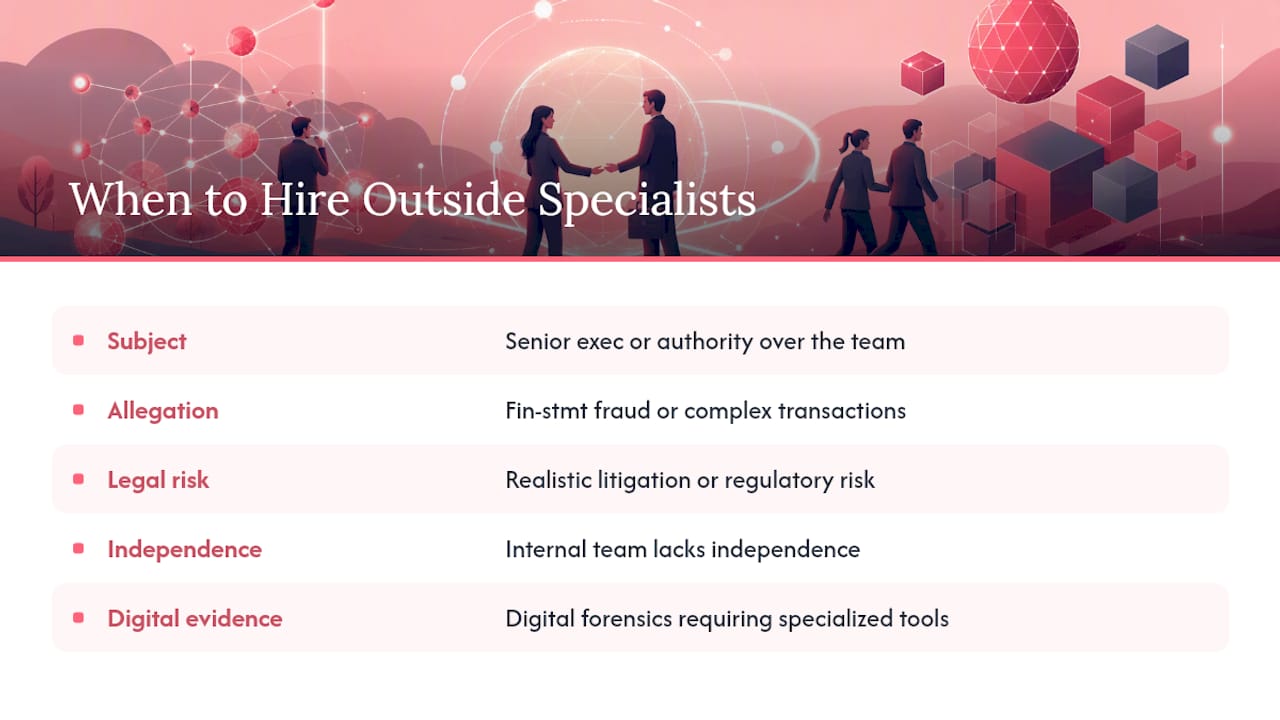
Bring in outside specialists when: the subject is a senior executive or someone with authority over the internal investigation team; the allegation involves financial statement fraud or complex transaction structures that exceed internal forensic capacity; there is a realistic possibility of litigation or regulatory proceedings; the internal team lacks independence from the relevant business unit; or the matter involves digital forensics requiring specialized tools and defensible collection procedures.
What outside specialists add is not just technical skill. It is independence, which regulators and courts treat as a proxy for reliability. A neutral, multidisciplinary team assembled early, including outside counsel, forensic accountants, and computer forensics specialists, reduces bias and the risk of evidence tampering. Isolating the investigation from management chains of command suspected of involvement is not optional when credibility of findings matters.
Hubsecurityandinvestigativegroup brings over 75 years of combined law enforcement and loss-prevention experience to corporate fraud engagements. Our team structures investigations to protect chain of custody from the first evidence collection through final reporting, coordinates directly with your legal counsel to preserve privilege, and applies forensic techniques calibrated to the specific allegation rather than a generic template. Investigations are not one-size-fits-all: the Global Investigations Review notes that forensic specialists design bespoke procedures driven by facts, not templates, to preserve admissibility and avoid chain-of-custody gaps. That is exactly how we approach every engagement.
What to expect from an outside engagement: an initial scoping consultation to assess the allegation and identify immediate containment needs; a written engagement letter covering scope, team composition, privilege structure, and fee arrangements; phased deliverables with defined timelines; and a final report prepared in coordination with counsel. Confidentiality safeguards are built into every phase, from communication protocols to secure evidence storage.
For companies evaluating whether outside investigators add value in financial matters, Hub’s financial investigation resource outlines the practical case for external engagement when internal resources face independence or capacity constraints.
Why timeliness, documentation, and counsel coordination define every outcome
Speed is the variable most internal investigators underestimate. The first 48 hours of a fraud investigation determine whether the evidence you need still exists, whether the subject has had time to coordinate a story with others, and whether the company’s response will look proactive or reactive to regulators. Every hour of delay after predication is a window for evidence destruction, fund movement, or witness contamination.
Documentation is the second discipline that separates defensible investigations from ones that collapse under scrutiny. The DOJ’s evaluation of corporate cooperation, the SEC’s assessment of remediation, and the AICPA’s standards for fraud engagements all converge on the same point: what you did matters, but what you can prove you did matters more. A well-documented investigation, with predication memos, litigation hold notices, chain-of-custody logs, interview memoranda, and a structured final report, is the company’s best evidence of good faith.
Counsel coordination is not about limiting the investigation. It is about ensuring that the investigation’s work product is protected, that the company’s legal exposure is managed across all potential forums simultaneously, and that findings are presented in a way that serves the company’s interests rather than creating new ones. The ACFE, AICPA, and DOJ all expect companies facing fraud to involve qualified legal counsel early. That expectation is not a suggestion.
The balance between thoroughness and operational disruption is real. Investigations that run too long, involve too many people, or generate unnecessary document requests create their own organizational damage. Scope discipline, clear timelines, and a defined endpoint are as important as the investigative steps themselves.
Hubsecurityandinvestigativegroup handles corporate fraud investigations when the stakes are high
When the allegation is serious enough to require outside investigators, you need a team that can move fast, protect evidence, and coordinate with your legal counsel from day one. Hubsecurityandinvestigativegroup has been doing exactly that since 2004, with a team carrying over 75 years of combined law enforcement and loss-prevention experience. We handle the forensic investigation, evidence preservation, and investigative coordination that internal teams cannot always provide independently, particularly when a senior employee or executive is involved.
An engagement with us starts with a confidential consultation to assess the allegation, identify immediate containment priorities, and define the scope of work. From there, we build a proposed team, issue an engagement letter, and begin work under your counsel’s direction. Every deliverable is designed to hold up in litigation, regulatory review, or internal disciplinary proceedings. To schedule a confidential consultation, contact us through our private investigations service page or reach our team directly at Hubsecurityandinvestigativegroup.
Sources
These are the primary references your outside counsel and forensic partners will expect you to know. Sharing them with your investigation team before the inquiry begins demonstrates the kind of good-faith preparation that regulators notice.
- Association of Certified Fraud Examiners (ACFE)
- AICPA guidance (excerpts) — Fraud investigation engagement considerations
- Forensic accounting skills in investigations: the US perspective – Global Investigations Review
- How a corporate fraud investigation works – LegalClarity
- PCAOB AS 2401 — Auditing standards related to fraud
- Fraud investigation: An overview – Thomson Reuters Legal Solutions
This article is general information, not a substitute for advice from a qualified lawyer. Consult a qualified legal professional about your own circumstances before acting on anything here.
Recommended
- Identifying Deception: A Comprehensive Report on Cheating Indicators and Professional Investigation Solutions – Hub Security & Investigative Group
- Betray Of Financial Infidelity: 5 Reasons You Should Hire Hub Investigative Group – Hub Security & Investigative Group
- Private Investigator Ethics: The Essential Guide to Good Morals – Hub Security & Investigative Group
- Preventing Workers’ Compensation Fraud with a Security Team