
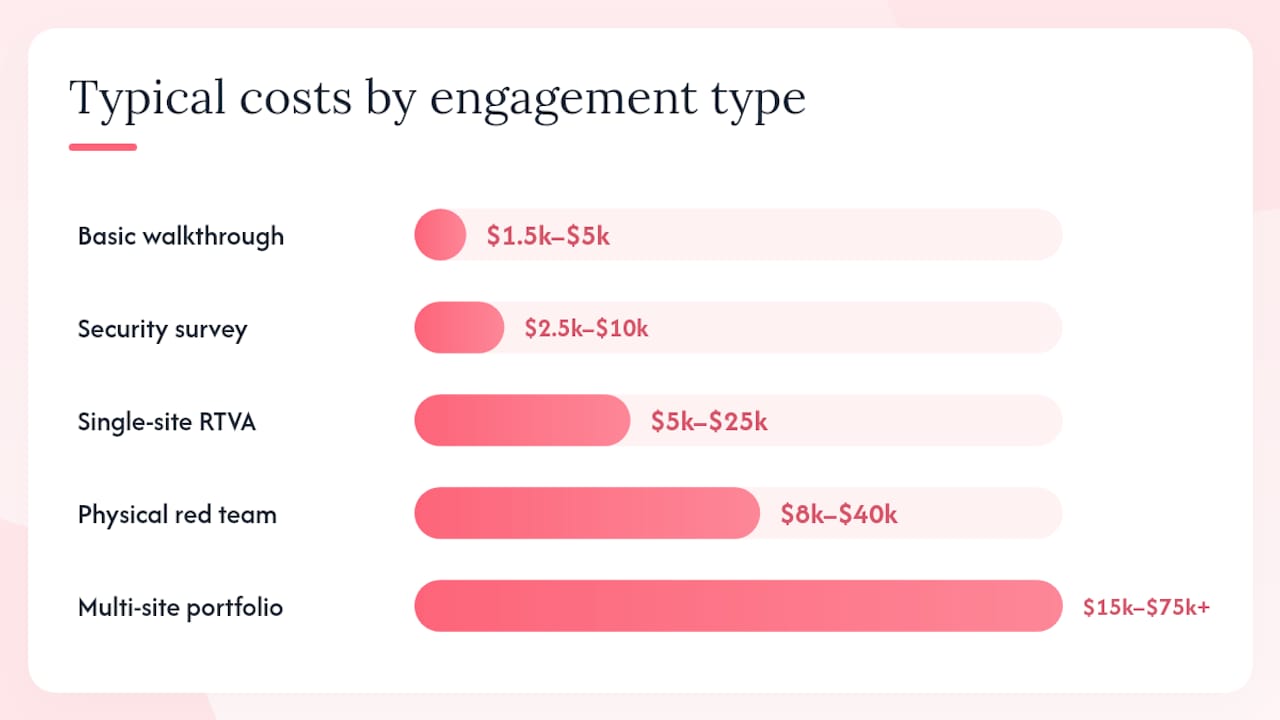
A typical on-site physical security assessment for U.S. premises runs roughly $2,000–$25,000 for a single site, depending on scope, credentials, and deliverables. Basic single-location assessments start around $1,500–$5,000, while a defined-scope risk, threat, and vulnerability assessment (RTVA) for a commercial property more commonly falls in the $5,000–$25,000 range. Multi-site portfolio plans scale into the tens of thousands.
To put that in perspective: industry estimates place the average cost of a commercial break-in at $8,000–$30,000 once you factor in property damage, stolen assets, and business disruption. An assessment fee is a fraction of that exposure.
The simplest next step: request a fixed-fee assessment with a defined deliverable and timeline from a licensed, credentialed provider. Hubsecurityandinvestigativegroup offers exactly that, with a written report and prioritized remediation plan delivered at the close of every engagement.
Common assessment types and their typical U.S. price bands:
- Quick walkthrough / basic survey: $1,500–$5,000
- Standard single-site RTVA: $5,000–$25,000
- Physical penetration / red-team test: $8,000–$40,000
- Multi-site portfolio plan: $15,000–$75,000+
- Event security planning assessment: $2,500–$10,000
Key Takeaways
A single prevented commercial incident typically covers a physical security assessment fee several times over, making the cost of a professional evaluation one of the most defensible line items in any security budget.
| Point | Details |
|---|---|
| Typical U.S. price bands | Single-site assessments run $1,500–$5,000 for a basic survey and $5,000–$25,000 for a full RTVA. |
| Always request a fixed fee | A fixed fee tied to a named deliverable prevents scope creep and makes bids comparable. |
| Labor drives cost | On-site hours, credential level, and documentation requirements are the primary cost variables. |
| Phase remediation | Address high-risk findings first; phasing keeps implementation costs within budget cycles. |
| Hubsecurityandinvestigativegroup | Provides fixed-fee assessments with written reports, prioritized remediation plans, and implementation support. |
Table of Contents
- What does a physical security assessment actually examine?
- What factors drive the cost of a security assessment?
- How are physical security assessments priced?
- What should you receive for the price?
- How do you get an accurate quote?
- How can you reduce cost without cutting critical protections?
- What hidden or additional costs should you plan for?
- Is a security assessment worth the cost?
- What most buyers get wrong about security evaluation pricing
- Hubsecurityandinvestigativegroup delivers fixed-fee assessments with written deliverables
- Sources
What does a physical security assessment actually examine?
Most buyers assume an assessment means checking camera angles and testing door locks. A thorough physical security assessment reviews people, procedures, and technology together, and it routinely surfaces vulnerabilities that hardware alone cannot fix.
A standard assessment covers:
- Perimeter controls: fencing, lighting, vehicle barriers, and natural surveillance lines
- Entry and access control: door hardware, credential systems, tailgating risk, and interlock design
- Interior controls: internal zoning, server room access, and high-value asset storage
- Surveillance coverage: camera placement, blind spots, recording retention, and monitoring protocols
- Staff procedures: post orders, patrol patterns, shift-change handoffs, and conflict de-escalation training
- Visitor management: sign-in processes, escort policies, and contractor credentialing
- Emergency response plans: evacuation routes, lockdown procedures, and communication chains
- Physical barriers: window film, safe rooms, and delay-and-detect layering
The human-centric elements, specifically staff training and visitor flow, are where most organizations have the widest gaps. A guard with unclear post orders is a vulnerability no camera upgrade will close.
Pro Tip: Ask your assessor to walk the visitor arrival path from the street to a sensitive area without any escort. That single exercise reveals more about your actual risk profile than reviewing your access-control logs.
What factors drive the cost of a security assessment?
Quote line items typically include on-site survey labor, threat and risk analysis, technical assessment tools, report generation, remediation planning, and travel. Labor is almost always the dominant driver, and several factors determine how many hours a qualified assessor needs.
- Facility size and complexity: A 5,000-square-foot retail location takes one day on-site. A multi-building campus with loading docks, parking structures, and a data center may require three to five days, plus a separate systems review.
- Number of access points: Each controlled entry adds survey time, credential testing, and documentation.
- Credential level: A board-certified ASIS CPP or PSP consultant, or a former law enforcement professional with expert-witness experience, commands a premium. That premium is worth paying when findings may support litigation or insurance claims.
- Documentation requirements: A standard executive summary costs less to produce than a litigation-grade report with photographic evidence, annotated site maps, and chain-of-custody documentation.
- Testing scope: A red-team physical penetration test, where assessors attempt to bypass controls unannounced, adds significant labor and planning time.
- Travel and urgency: Remote sites, same-week scheduling, and after-hours access all add cost.
A two-day single-site visit for a mid-size commercial property typically lands in the $5,000–$12,000 range. A multi-week portfolio review covering six or more locations, with a master security plan at the end, can reach $50,000–$75,000+.
How are physical security assessments priced?
Physical security consultants commonly bill $100–$250 per hour, approximately $1,000–$2,500 per day, or as a fixed project fee. Fixed-fee engagements tied to a clear deliverable generally give buyers better cost control and clearer expectations.
| Engagement type | Typical cost band | Typical timeline | Primary deliverable |
|---|---|---|---|
| Basic walkthrough / survey | $1,500–$5,000 | Half-day to 1 day | Summary memo, priority list |
| Security survey / audit | $2,500–$10,000 per site | 1–2 days | Written report, vulnerability matrix |
| Single-site RTVA | $5,000–$25,000 | 2–5 days | Full RTVA report, remediation plan |
| Physical penetration / red team | $8,000–$40,000 | 3–10 days | Findings report, video evidence |
| Multi-site portfolio plan | $15,000–$75,000+ | 2–8 weeks | Master security plan, phased roadmap |
| Event security planning | $2,500–$10,000 | 1–3 days | Event security plan, staffing spec |
Hourly billing suits short, advisory engagements where scope is genuinely uncertain. Daily rates work well for site visits. For anything that produces a written report, a fixed fee protects both parties from scope creep.
What should you receive for the price?
Standard deliverables you should expect from any credentialed provider:
- Executive summary written for leadership, not just technical staff
- Prioritized mitigation list with rough cost estimates for each recommendation
- Vulnerability matrix mapping findings to likelihood and impact
- Annotated site maps showing where vulnerabilities were observed
- Implementation timeline with phased recommendations
Premium deliverables that raise price but add real value in specific situations:
- Litigation-grade reports with photographic and video evidence
- Vendor-neutral technical specifications and RFP packages for procurement
- Tabletop exercises and staff training sessions
- Ongoing implementation oversight and re-assessment
Report checklist for evaluating proposals: confirm the bid includes an executive summary, a prioritized finding list, a site map, a remediation cost estimate, and a defined revision round. If any of those are missing, ask why before signing.
How do you get an accurate quote?
Providing complete information upfront reduces back-and-forth and prevents surprise fees after the engagement starts.
- Gather site documents: floor plans, site maps, and as-built drawings for all areas in scope.
- Pull access logs and incident history: the past 24 months of security incidents, near-misses, and access-control alerts.
- Document staffing patterns: guard schedules, shift changes, contractor access windows, and visitor volume by day.
- List special events or operational constraints: planned events, sensitive periods (layoffs, executive transitions), and hours of operation.
- Ask for a fixed-fee option: request a firm price tied to a named deliverable and delivery date, not an open-ended hourly estimate.
- Verify credentials: ask for ASIS CPP or PSP certification, proof of licensing and insurance, and a sample redacted report.
- Confirm travel and revision assumptions: clarify whether travel is included, how many revision rounds are covered, and what triggers additional fees.
- Request vendor-neutral specs: if you expect to procure equipment after the assessment, ask whether the report includes vendor-neutral specifications you can use for competitive bidding.
How can you reduce cost without cutting critical protections?
The most effective cost-reduction strategy is phasing. Address the highest-risk findings first, then schedule lower-priority work in a second phase. This keeps the initial assessment fee manageable and lets remediation costs follow your budget cycle.
- Hybrid remote and on-site review: a consultant can review policies, post orders, and camera footage remotely before the site visit, reducing on-site hours and travel cost.
- Portfolio bundling: if you manage multiple properties, bundling them into a single engagement reduces per-site cost compared to separate contracts.
- Prioritize inexpensive, high-impact fixes: a simple walkthrough often surfaces lighting gaps and procedural weaknesses that cost very little to correct. Improved perimeter lighting, clearer visitor sign-in procedures, and updated post orders frequently deliver strong risk reduction per dollar spent.
Pro Tip: Pay your assessor to produce vendor-neutral specifications and run a competitive bid for any recommended equipment. That consultant fee is often recovered through lower system procurement costs when vendors compete on a level spec rather than their own proprietary proposals.
What hidden or additional costs should you plan for?
The assessment fee is rarely the total cost. Plan for these common additions:
- Remediation costs: the report will recommend physical upgrades, from access-control hardware to fencing. Budget separately for implementation, which can range from a few thousand dollars for procedural changes to six figures for a full access-control overhaul.
- Staff training: if the assessment identifies procedural gaps, training sessions add cost. Factor in time off the floor for your team.
- Follow-up assessments: a re-assessment six to twelve months after remediation confirms that fixes held. Some providers offer this at a reduced rate when bundled upfront.
- Litigation-grade documentation: if findings may support an insurance claim or legal proceeding, the upgraded report format adds cost. Confirm this requirement before the engagement starts, not after.
- Equipment procurement support: vendor-neutral RFP development and bid management is a separate service. It pays for itself, but it is not included in a standard assessment fee.
Is a security assessment worth the cost?
The ROI calculation is straightforward. A standard single-site assessment runs $5,000–$25,000. A single commercial break-in costs $8,000–$30,000 on average, and that figure does not include reputational damage, regulatory exposure, or the cost of a workplace-violence incident. One prevented incident typically covers the assessment fee several times over.
Beyond incident prevention, a well-documented assessment strengthens your position with insurers, demonstrates due diligence to regulators, and gives your leadership team a defensible record of proactive risk management. For event planners, a pre-event security assessment for your event reduces liability exposure and gives venue staff clear protocols to follow. For property managers, it provides the documented basis for capital improvement requests.
The organizations that treat security assessments as a one-time compliance checkbox tend to underinvest in follow-through. The ones that treat the report as a living document, revisiting it annually and tracking remediation progress, consistently see the strongest return on their security spend.
What most buyers get wrong about security evaluation pricing
Most organizations approach security evaluation pricing the same way they approach an IT audit: they search for the lowest bid, compare hourly rates, and assume the deliverables are roughly equivalent. They are not.
A $3,000 walkthrough from an uncredentialed vendor and a $12,000 RTVA from a board-certified ASIS CPP consultant produce fundamentally different documents. The first gives you a list of observations. The second gives you a prioritized, defensible risk analysis you can take to your board, your insurer, or a court. Confusing those two products because they share a category name is the most expensive mistake buyers make in this space.
The conventional advice, “get three bids and pick the middle one,” also fails here. Security assessments are not commodity services. The assessor’s background, methodology, and report format determine whether the findings are actionable. A cheaper report that misses a critical vulnerability is not a savings. It is a liability.
What actually matters: ask for a sample deliverable before you sign anything. If the provider cannot show you a redacted report from a comparable engagement, that tells you everything you need to know about the quality of what you will receive.
Hubsecurityandinvestigativegroup delivers fixed-fee assessments with written deliverables
Hubsecurityandinvestigativegroup has been protecting people, properties, and events since 2004, drawing on 75+ years of combined law enforcement and loss prevention experience across our team. We are licensed, insured, and ASIS-aligned, and every assessment we conduct produces a written report with a prioritized remediation plan, annotated site findings, and a realistic implementation timeline.
Our process covers the full picture: on-site survey, threat and vulnerability analysis, staff and procedure review, and vendor-neutral specifications for any recommended upgrades. For property managers, we offer comprehensive building security services that carry an assessment through to implementation. For event planners, our event security planning service pairs a pre-event assessment with trained on-site personnel. We also provide executive protection budgeting guidance for organizations managing high-profile principals.
Request a fixed-fee quote with a sample deliverable and timeline at Hubsecurityandinvestigativegroup.
Sources
- Security Risk Assessment: Full Guide for Commercial Properties (2026)
- Hiresecuritynow
- Physical Security Assessment Cost: Pricing for U.S. Buyers 2026 – Current Cost
- Physical Security Risk Assessment: 10 Step Guide + Checklist
Recommended
- Understanding Security Guard Pricing: What Determines the Cost of Protection? – Hub Security & Investigative Group
- Physical Security Risk Assessment: A 2 Page Guide
- Physical Security Risk Assessment: A 2 Page Guide
- 1.Understanding Security Guard Pricing: What Determines the Cost of Protection? – Hub Security & Investigative Group