
Secure your venue this week by enforcing a strict ID-and-refusal policy, staffing to a defensible guard-to-patron ratio, and locking down entry points with active CCTV coverage. Those three controls, working together, catch the failures that get bars sued, shut down, or both. This guide is built for security managers, bar owners, and hospitality leads who need to move from “we should probably tighten things up” to a written plan they can defend to an insurer, a liquor board, or a plaintiff’s attorney.
Here’s the priority order we recommend, broken down into what you can act on immediately versus what takes longer to build.
- This week: Update your ID-checking process and give bartenders a written refusal script they can use without hesitating.
- This month: Reassess your security staffing against your actual capacity and run a training refresher, including ServSafe Alcohol or your state’s RBS program.
- This quarter: Audit your CCTV retention policy, walk your perimeter for blind spots, and run a full written security assessment.
Do these three things well and the payoff shows up fast: fewer overservice incidents, a lower dram shop exposure profile, and staff who actually enforce policy instead of guessing at it in the moment.
Key Takeaways
Alcohol service security works when ID verification, staffing ratios, and documented incident response operate together as one system, not three separate checklists.
| Point | Details |
|---|---|
| Enforce ID and refusal policy | Check anyone appearing under 30 and give bartenders a scripted refusal line they’ll actually use. |
| Staff to a defensible ratio | Use the 1:75 guard-to-patron baseline and scale up for late-night or bottle-service events. |
| Document everything | Log every ejection, refusal, and training session; retention gaps are what plaintiffs’ attorneys look for. |
| Bring in professionals when needed | Hubsecurityandinvestigativegroup scopes staffing plans, written security plans, and incident reporting for venues that have outgrown internal coverage. |
Table of Contents
- Alcohol Service Security Starts With Three Core Pillars
- Who Staffs the Floor, and How Many Guards Do You Need?
- Training and Certifications Managers Should Require
- Physical and Technical Controls That Actually Reduce Incidents
- Building a House Policy That Holds Up Under Scrutiny
- How to Run a Practical Alcohol Event Risk Assessment
- Legal Exposure Every Manager Needs to Understand
- Your Implementation Checklist: This Week, This Month, This Quarter
- Signs You Need Outside Professional Security
- Why We Treat This as an Operations Problem, Not a Compliance Checkbox
- How Hub Security & Investigative Group Can Operationalize This Plan
- Where to Go for Deeper Training and Guidance
- Sources
Alcohol Service Security Starts With Three Core Pillars
Every liquor liability claim we’ve seen traces back to a failure in one of three areas: age verification, overservice prevention, or premises control. Get these right and you eliminate most of the risk that alcohol service security is designed to manage.
Preventing underage service. Arizona’s Department of Liquor Licenses and Control, like most state liquor authorities, tells licensees to check ID on anyone who appears to be under 30, not just anyone who “looks young.” That extra margin matters because bouncers and bartenders routinely misjudge age by five to ten years under bar lighting. Your ID checklist should require staff to check for a raised seal, matching photo and physical description, and a birth date that holds up to quick mental math. Train staff to look at the card edges for peeling or reprinting, the classic signs of a doctored ID.
Preventing overservice. This is where ServSafe Alcohol and state RBS (Responsible Beverage Service) programs earn their keep. Both teach staff to recognize the visible signs of intoxication, slurred speech, poor coordination, argumentative behavior, before a patron becomes a liability. A bartender who’s completed ServSafe Alcohol training isn’t guessing when to cut someone off. They’re following a checklist.
Give your team a refusal script they don’t have to improvise:
That single sentence keeps the interaction calm, offers an alternative, and creates a defensible paper trail if the refusal ever gets questioned later.
Keeping the premises orderly. Posted capacity limits aren’t a fire-code formality. They’re your first crowd-control tool. When a room is packed past capacity, de-escalation gets harder, exits get blocked, and staff lose the ability to spot problems early. Enforce your posted number as strictly as you enforce your ID policy.
Who Staffs the Floor, and How Many Guards Do You Need?
Alcohol service security depends on clear role definitions. Without them, everyone assumes someone else is watching the exit.
A functional venue team typically breaks down into five roles:
- Door supervisor / ID checker – controls entry, verifies age, manages the line, and enforces capacity counts.
- Floor security – patrols the room, watches for escalating conflict, and supports bar staff on refusal calls.
- Manager in command – the single point of authority for ejection decisions, medical calls, and law enforcement contact.
- Bar and service staff – execute the refusal policy and flag concerns to floor security before things escalate.
- Parking and egress monitors – watch the lot and exits, especially at closing, when most alcohol-related incidents cluster.
On staffing ratios, the NYPD’s nightlife best-practices guidance recommends a baseline of roughly one security guard per several dozen patrons, with staffing increased for late-night events, bottle service, or crowds with a history of rowdiness. Treat 1:75 as a floor, not a target. A packed Saturday night with DJ-driven crowds and heavy pours needs a tighter ratio than a quiet Tuesday happy hour.
Pro Tip: Deploy security in paired teams rather than solo posts. Paired teams give each other a witness during disputed incidents, provide immediate backup, and can be distributed across entry, floor, and exits instead of clustering everyone at the door.
Radio protocols matter more than most owners realize. Every team member should know the escalation chain: floor staff flags a concern, security intervenes, and the manager in command makes the call on ejection or a 911 call. Ambiguity here is where things go wrong fastest.
Training and Certifications Managers Should Require
Documentation of training is often the difference between “we did everything right and this was unforeseeable” and a six-figure settlement. Bar safety training that combines responsible alcohol service, crowd management, and emergency response measurably reduces both incident rates and the venue’s insurance exposure when it’s properly logged.
Here’s how the requirements typically break down by role:
| Role | Required training | Recommended refresh interval |
|---|---|---|
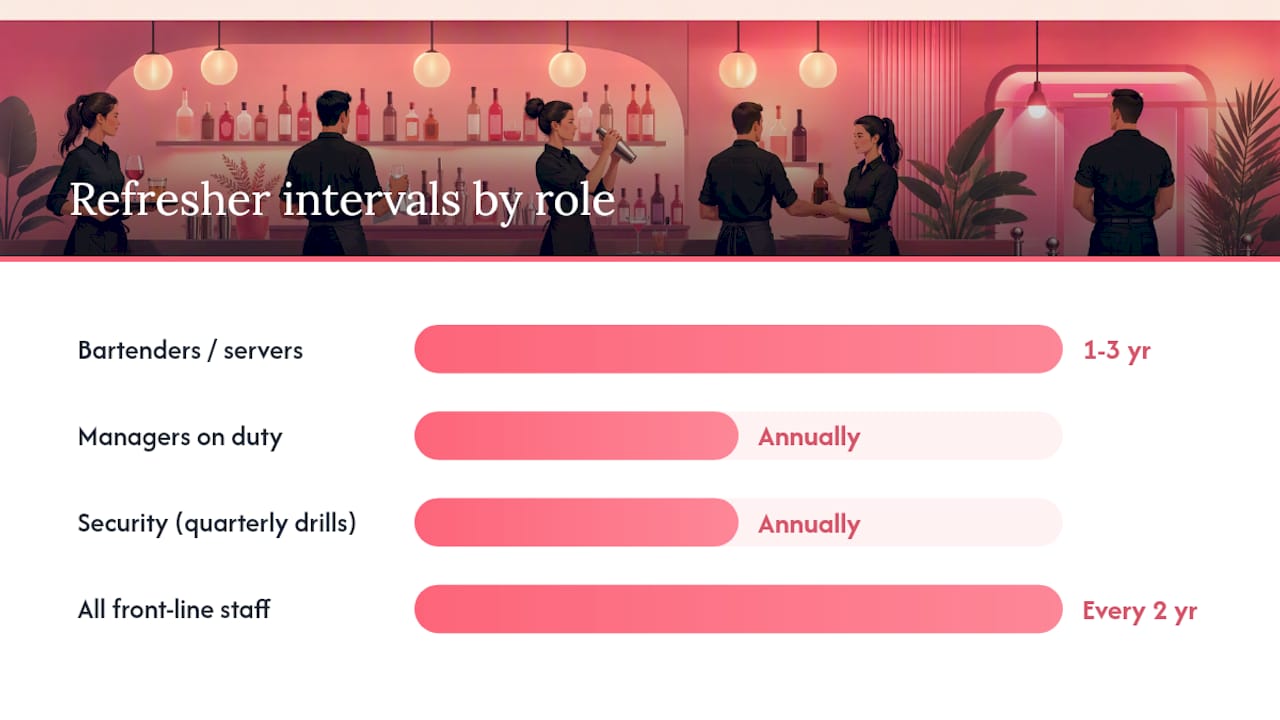
| Bartenders and servers | ServSafe Alcohol or state RBS certification | Every 1 to 3 years, depending on state requirements |
| Managers on duty | RBS certification plus incident documentation training | Annually |
| Contracted security / door staff | State security guard license, de-escalation training | Annually, with quarterly scenario drills |
| All front-line staff | Basic first aid and CPR awareness | Every 2 years |
When evaluating a training program, look past the certificate. A strong program includes scenario practice (mock refusals, mock ejections), scripted language staff can actually use under pressure, and content aligned to your specific state’s liquor laws. A generic national course that never mentions your state’s dram shop statute is missing half the point.
Keep training records in a file you can produce on short notice. If your license ever comes under review, or a claim gets filed, the first thing an investigator or attorney asks is: “Can you show me your staff was trained?”
Physical and Technical Controls That Actually Reduce Incidents
Trained staff catch a lot. Cameras, lighting, and access control catch what staff miss, and they document everything for later.
Your entrance is your highest-leverage control point. A single, well-lit, controlled entry point, ideally with queuing that keeps the line visible from inside, does more to prevent overcrowding than any amount of after-the-fact enforcement. Where local code requires panic hardware on exits, treat it as non-negotiable, not a suggestion.
| Control type | Primary function | Where it matters most |
|---|---|---|
| CCTV coverage | Documents incidents, deters bad behavior, supports legal defense | Entrances, bar area, exits, parking lot |
| Perimeter lighting | Reduces blind spots, discourages loitering and altercations | Parking areas, side entrances, smoking areas |
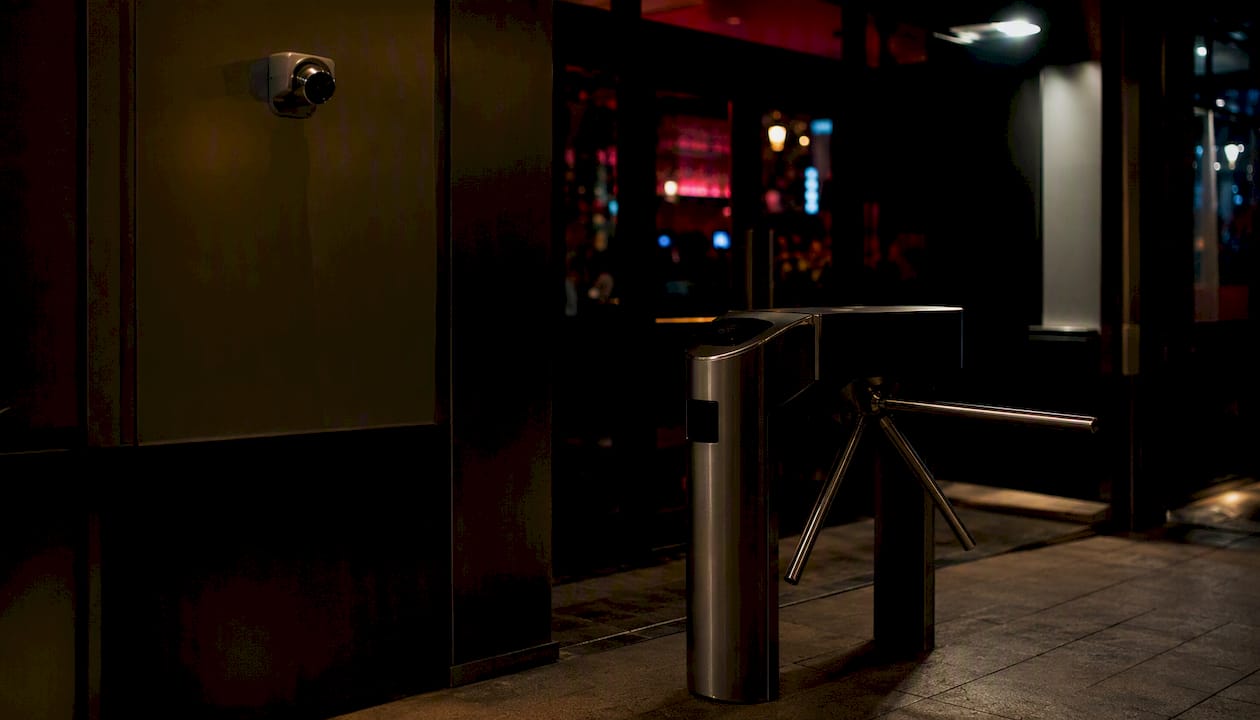
| Access control / turnstiles | Enforces capacity counts, slows unauthorized entry | Main entrance, VIP or bottle-service sections |
| Signage | Sets expectations (ID policy, capacity, house rules) | Entry, bar, restrooms |
For access control patterns and entry hardware suited to smaller venues, a practical access control guide covers the hardware options worth comparing before you invest. If your venue runs timed entry or ticketed events, a queuing and admission workflow resource is worth a look for tying capacity counts directly to your door process.
None of this works in isolation. The NYPD’s guidance frames an effective security plan around five functions: deter, detect, delay, deny, and respond. Cameras alone don’t respond to anything. They need a door team and a floor team watching the same feed, on the same radio channel, ready to act on what the cameras catch.
Building a House Policy That Holds Up Under Scrutiny
A written house policy isn’t paperwork for its own sake. It’s the document that shows a court or investigator you took the risk seriously before something happened.
Your policy should spell out:
- ID requirements and who has authority to refuse entry or service.
- Refusal and ejection procedures, including who makes the final call.
- Bottle-service and promotional-pour limits, since these drive some of the fastest overservice.
- Rules for staff who arrive intoxicated or drink on shift, an area many venues leave unwritten until it becomes a problem.
Incident response, step by step:
- Recognize. Staff spots signs of intoxication, aggression, or an underage attempt.
- De-escalate. Floor security or the manager engages calmly, offering an alternative before a hard refusal.
- Refuse or eject. If de-escalation fails, the manager in command authorizes removal, following the house policy’s script.
- Call for help if needed. Medical concerns go to 911 immediately, not after a delay to “handle it internally.”
- Document. Write the incident down within the hour: time, staff involved, what was said, and any camera footage timestamp.
On force, the standard to hold your team to is reasonable, proportionate, and last resort. Legal commentary on bar liability is consistent on this point: bars get sued as often for inadequate security response as for overserving, and documented policy is central to defending either kind of claim.
Pro Tip: Log every ejection the same way you’d log an insurance claim, even the ones that felt routine. The incident nobody thought to write down is the one that gets deposed a year later.
How to Run a Practical Alcohol Event Risk Assessment
Staffing and controls should scale to actual risk, not a flat number you picked once and never revisited. Here’s a repeatable process:
- Profile the venue. Note capacity, layout, number of exits, and any history of past incidents.
- Profile the crowd. Age range, typical group size, and whether the event draws a rowdier late-night audience.
- Profile the event. A quiet dinner service needs a different plan than a promoted DJ night with bottle service.
- Check the modifiers. Guest lists, drink promotions, live music, and late closing hours all push risk upward and should trigger added staffing.
- Convert findings into a one-page plan. List roles, staffing counts, and the specific triggers (capacity hit, first altercation, first medical call) that activate each response.
- Set a review cadence. Revisit the plan after any incident, whenever your typical crowd shifts, and at minimum every quarter.
This process doesn’t need to be complicated. A one-page document that names who’s on the door, who’s on the floor, and what triggers an escalation beats a thick binder nobody reads before doors open.
Legal Exposure Every Manager Needs to Understand
Dram shop laws exist in most states, and they hold licensed venues liable when overserving a visibly intoxicated patron leads to harm, whether that’s a DUI crash or an on-premises assault. Legal scholarship on venue liability centers on foreseeability: if a venue knew, or reasonably should have known, about a risk, such as a history of fights or a bartender who’s slow to cut people off, and did nothing, a negligence finding becomes far more likely.
The practical response is not complicated:
- Train and document that training, consistently, not just after an incident happens.
- Refuse service before a patron becomes visibly intoxicated, not after.
- Call medical help early. Delay is one of the most common findings against venues in post-incident reviews.
- Keep incident logs and CCTV footage retained long enough to matter for a claim, generally 90 days at minimum, longer if your insurer or state requires it.
Risk advisories from insurers consistently point to the same pattern: venues that document incidents, train staff in refusal techniques, and review house policy regularly face lower claims exposure than venues that treat these as afterthoughts. When an incident does escalate toward litigation, involve counsel early and hand over your training records, incident logs, and camera footage as a complete package, not piecemeal.
Your Implementation Checklist: This Week, This Month, This Quarter
- This week: Update ID-check procedures and post them where bar staff can reference them. Owner: shift manager. Success = every staff member can recite the refusal script without prompting.
- This week: Confirm your capacity count is posted and enforced at the door. Owner: door supervisor.
- This month: Reassess your guard-to-patron staffing against the 1:75 baseline and your actual crowd profile. Owner: security lead.
- This month: Schedule a training refresher covering ServSafe Alcohol or your state’s RBS program. Owner: general manager.
- This quarter: Audit CCTV coverage and confirm your footage retention window meets insurer requirements. Owner: security lead.
- This quarter: Run a full written risk assessment and update your one-page security plan. Owner: general manager.
Communicate changes to staff directly in a shift meeting, not just an email nobody reads. A short line of signage at the door (“ID required for anyone appearing under 30”) also sets patron expectations before they reach the bar.
Signs You Need Outside Professional Security
Internal staff and a solid house policy handle most nights. Some signal that it’s time to bring in a contracted provider:
- Repeat incidents at the same time slot or event type, even after policy changes.
- High-capacity events, VIP guests, or bottle-service sections that concentrate risk in one area.
- Staff compliance gaps, where refusal scripts exist on paper but aren’t followed under pressure.
- Off-duty police used as your only door coverage. They bring authority but often lack the hospitality-specific de-escalation training and stamina for repetitive ID checks that dedicated hospitality security personnel bring to a long shift.
When you engage a professional provider, expect a formal scoping process: staffing levels tied to your actual capacity and event type, a written security plan, incident reporting after every shift, and proof of liability insurance. Your vendor checklist should confirm licensing, documented training, nightlife-specific experience, references from comparable venues, and a clear escalation procedure if an incident goes beyond what floor staff can handle.
Contract terms worth negotiating up front include guaranteed staffing hours, defined scope (door only versus door and floor), a named on-site supervisor, standardized incident reporting, and a replacement-staffing guarantee if a guard calls out.
Why We Treat This as an Operations Problem, Not a Compliance Checkbox
Most venues treat alcohol service security as a licensing requirement to satisfy rather than a system to run. That’s backward, and it shows up in the data: the venues that get sued or shut down almost always had a policy on paper that nobody enforced consistently, not an absence of policy.
The uncomfortable truth is that training alone doesn’t fix this. A bartender who completed ServSafe Alcohol two years ago and never practiced a refusal script since is functionally untrained the moment a real confrontation happens. Security is a muscle, not a certificate. The venues we see doing this well run scenario drills, review incident logs monthly, and treat their guard-to-patron ratio as a living number that shifts with the calendar, not a static line item set once during a license renewal.
There’s also a bias toward under-staffing that we think deserves more scrutiny than it gets. Owners see security payroll as pure cost until the night it isn’t, and by then the incident has already happened. The 1:75 baseline from NYPD’s nightlife guidance is a floor precisely because most venues that get into trouble were staffed at or below it during their worst incidents, not above it.
How Hub Security & Investigative Group Can Operationalize This Plan
You’ve got the framework now: ID policy, staffing ratios, training cadence, physical controls, documented incident response. Turning that framework into a working plan on a live floor is where most in-house teams run out of bandwidth, and it’s exactly where we come in.
Hubsecurityandinvestigativegroup builds scoped event security staffing plans specific to your venue’s capacity, hours, and event calendar, rather than handing you a generic guard count. Engagements include a written security plan, defined door and floor roles, incident reporting after every shift, and staff who are trained in de-escalation rather than just standing post. For higher-risk events, VIP guests, or venues that have had prior incidents, we also offer armed security coverage with the licensing and insurance documentation your insurer will want to see.
Before you reach out, have three things ready: your current occupancy capacity, your typical operating hours, and a brief summary of any incidents from the past year. That’s enough for us to scope a staffing plan and give you a straight answer on what your venue actually needs. Start with a security assessment through Hub Security & Investigative Group and get a written plan instead of a guess.
Where to Go for Deeper Training and Guidance
For hands-on certification, ServSafe Alcohol remains one of the most widely recognized responsible service programs and a strong baseline for bartender and server training. Check your own state’s liquor authority for its RBS program requirements. Arizona’s DLLC responsible service guidance is a solid model for the kind of ID verification and refusal standards most states now expect. For staffing and physical security benchmarks, the NYPD’s nightlife best-practices guide offers the most detailed public framework available, covering everything from door staffing to electronic systems integration. Use each resource for what it does best: certification programs for staff training, state guidance for legal compliance, and municipal best practices for physical security planning.
This article is general information, not a substitute for advice from a qualified lawyer. Consult a qualified legal professional about your own circumstances before acting on anything here.
Sources
- Best practices for nightlife establishments — NYPD (2018)
- Responsible service — Arizona Department of Liquor Licenses and Control
- SERVSAFE ALCOHOL — course overview
Recommended
- Hotel Security Management: What Every Property Must Require
- What to do 15 Minutes Before a Party ends – Hub Security & Investigative Group
- Corporate Security Policy: A Complete Guide for Managers
- Corporate Security Policy: A Great Guide for Managers In 5 Min read – Hub Security & Investigative Group