
A security assessment checklist is a professional physical security review that inspects perimeter controls, access points, surveillance, lighting, credentialing, staffing, and emergency systems. The single most important thing to demand from that review isn’t the walkthrough itself. It’s what comes out the other end: a prioritized risk register paired with costed remediation and a realistic implementation timeline.
That distinction separates a genuinely useful assessment from a glorified photo tour. Standards bodies agree on the core elements you should expect in any professional proposal:
- A defined scope document and methodology, not a vague “we’ll take a look around.”
- Site photographs and diagrams supporting every finding.
- A prioritized risk register ranking issues by severity and likelihood.
- A recommendation register with cost and timeline estimates for each fix.
- An executive summary written for decision-makers, not just security staff.
The CISA Venue Guide and Motorola Solutions’ physical security audit guidance both frame the assessment as a structured, multistep process ending in an actionable roadmap, not a checklist that sits in a drawer.
TL;DR:
- A thorough physical security assessment should produce a prioritized risk register with clear cost estimates and a realistic implementation timeline.
- Assessments must include functional testing of alarms, cameras, and access controls rather than just visual inspections.
- Different scopes like site, multi-site, event, or executive protection require tailored checklists and hazard vulnerability scoring.
- Assessment providers should have law enforcement or loss prevention backgrounds, certified credentials, and provide detailed, actionable reports.
- The effectiveness of security improvements depends on translating assessment findings into funded, tiered remediation plans, not merely completing a checklist.
Table of Contents
- What Is a Security Assessment Checklist Supposed to Deliver?
- The Core Physical Checklist: What Assessors Should Actually Test
- What Changes for Events and Executive Protection Assessments
- How the Assessment Process Actually Runs
- Turning Findings Into Funded Action
- What to Require From a Provider Before You Sign
- Legal and Regulatory Compliance Considerations in Security Assessments
- Integration of Cybersecurity Considerations With Physical Security Assessments
- Training and Qualifications Assessors Should Have
- Hub Investigative Group: What a Real Engagement Looks Like
- The Gap Between a Checklist and a Funded Fix
- Get an Assessment Built Around Your Risk Profile
- Key Takeaways
- Sources
What Is a Security Assessment Checklist Supposed to Deliver?
Before you sign a contract, decide what kind of review you actually need. A vulnerability or site survey is a snapshot: it flags weak points in fencing, lighting, or camera coverage on a given day. A full risk assessment goes further, weighing the likelihood and impact of each vulnerability against your specific threat profile, then ranking fixes by urgency.
Scope depends on what you’re protecting:
- Single-site facility review — one building or campus, typically the most straightforward engagement.
- Multi-site portfolio assessment — property managers or retail chains comparing risk across locations.
- Event security assessment — a defined date, venue, and crowd size with its own hazard profile.
- Executive protection program review — ongoing exposure tied to a person rather than a building.
Getting the right people in the room matters as much as scope. Facilities staff know the physical plant. HR flags workplace violence history. Legal weighs in on liability and data handling. Operations understands how security measures will affect daily workflow. An executive sponsor makes sure the findings get funded instead of filed away.
Whatever the scope, insist on the same deliverable package: a scope document defining what was and wasn’t reviewed, a prioritized risk register, a recommendation register with cost and timeline attached to each item, an executive summary, and an implementation roadmap. A physical security risk assessment guide is a useful reference point for what that package should look like before you commission one.
The Core Physical Checklist: What Assessors Should Actually Test
A facility security checklist is only as good as what the assessor physically verifies, not what they assume works. Here’s what a competent on-site inspection covers, and what you should ask to see documented in the final report.
- Perimeter and vehicle access: fencing condition, gate operation, vehicle barriers, and whether unauthorized approach routes exist.
- Building entry points: how many doors allow entry, whether reception staff can actually see who’s coming in, and anti-tailgating controls at turnstiles or mantraps.
- Video surveillance: camera coverage against actual sightlines, not just camera count, plus footage retention periods and confirmed blind spots.
- Lighting and CPTED: whether landscaping or structures create concealment zones, and whether lighting levels support both natural surveillance and camera performance at night.
- Credentialing and visitor management: badge issuance workflow, how quickly a lost credential gets deactivated, and whether visitors are logged and escorted.
- Intrusion detection: alarm zone coverage, monitoring response times, and whether alarm paths are tested regularly rather than assumed functional.
- Guarding posture: post orders in writing, patrol frequency and randomization, training records, and supervisory check frequency.
- Communications redundancy: radio coverage with cell backup (a PACE plan, meaning Primary, Alternate, Contingency, Emergency), public address capability, and staging areas for first responders.
An assessor who skips functional testing (actually walking the perimeter at night, testing a door alarm, checking a camera’s real field of view) is doing a desk review with a flashlight, not an assessment.
Pro Tip: Ask your assessor to test at least one alarm-to-response cycle in real time during the site visit. A camera that “should” trigger a guard response and one that actually does are two different findings, and only one of them belongs in your risk register.
If your facility includes warehouse or logistics space, a 40-point warehouse security checklist covers loading dock and inventory control items a general facility review sometimes glosses over.
What Changes for Events and Executive Protection Assessments
Events and principals carry different exposure logic than a fixed building, and the checklist has to shift accordingly.
- Credential design and issuance control: who can produce credentials, how they’re distributed, and how staff verify them at each checkpoint without creating bottlenecks.
- Crowd flow and egress planning: entry and exit capacity, traffic management around the venue, and hostile vehicle mitigation at vulnerable approach points.
- Advance reconnaissance for principals: route planning, venue walkthroughs before arrival, and pre-identified safe rooms.
- Hazard prioritization: both CISA’s Venue Guide and BJA’s planning primer appendices use hazard vulnerability worksheets that score risks by frequency and impact, which keeps a long list of “possible” threats from swamping the two or three that actually matter for your event.
Executive protection assessments in particular differ from a standard site survey because they focus on predicting threats and building decision-ready intelligence for travel and appearances, not just cataloging fixed vulnerabilities. A VIP event security playbook walks through how advance work and credentialing fit together for a principal’s public appearance.
How the Assessment Process Actually Runs
A professional physical security audit follows a predictable sequence, and knowing the phases helps you evaluate whether a proposal is thorough or rushed.
- Scoping call and documentation request. The assessor asks for site plans, incident logs, existing policies, and prior assessment reports before ever visiting.
- Threat and vulnerability analysis. This includes open-source research, incident history review, and local context (crime patterns, nearby venues, recent events affecting your risk profile).
- On-site inspection and functional testing. Lighting measurements, camera field-of-view checks, access control tests, and interviews with guard staff.
- Analysis and reporting. The findings become a risk register, a recommendation register with cost and timeline estimates, and an executive summary.
Timelines vary by scope, but a single-site corporate risk assessment typically runs four to eight weeks from scoping call to final report. Expedited timelines apply when there’s been a recent incident or an imminent high-profile event, and a credible provider should be able to compress that schedule without skipping the functional testing phase.
Turning Findings Into Funded Action
A risk register that never becomes a budget line item is just an expensive document. The way to read one is to sort findings into critical (address within 30 days), high (this quarter), and deferred (next budget cycle), then attach real numbers to each tier.
- Low-cost, low-complexity fixes: lighting upgrades, signage, lock rekeying. Usually fundable immediately.
- Moderate investments: camera additions, access control upgrades, guard post restructuring.
- High-cost, high-complexity items: structural perimeter changes, full CCTV system replacement, or new guard staffing contracts.
That cost/complexity tiering mirrors how CISA classifies security measures for venues, balancing effectiveness against budget reality rather than recommending everything at once. Verification matters just as much as prioritization: insist on punch-list acceptance criteria for each fix, and consider a follow-up assessment or advisory retainer so remediation doesn’t stall once the report is filed.
What to Require From a Provider Before You Sign
Demand a report that includes scope and methodology in writing, site photos and diagrams, a prioritized risk register, a recommendation register with cost and timeline for every item, and an executive summary a non-security executive can actually read. Ask for proof of law enforcement or loss-prevention background, examples of comparable event or executive protection work, and redacted client references where confidentiality applies. Contractually, push for a follow-up assessment window, an implementation advisory retainer option, and confidentiality clauses if the engagement touches a principal’s personal information.
Legal and Regulatory Compliance Considerations in Security Assessments
Security assessments don’t happen in a legal vacuum, and skipping this step creates liability that outlasts the engagement itself. Employers generally owe a duty of care to employees and visitors, and courts increasingly look at whether a business took reasonable, documented steps to identify foreseeable risks. An assessment report becomes evidence, either that you acted responsibly or that you knew about a hazard and didn’t fix it.
Industry-specific rules add another layer. Financial institutions face vault and cash-handling security requirements tied to banking regulations. Healthcare facilities have to weigh physical security against HIPAA’s privacy and access controls, particularly around records storage and restricted areas. Retail and hospitality properties often carry premises liability exposure that hinges on whether lighting, locks, and staffing met a reasonable standard for the neighborhood and property type.
Data handling during the assessment itself matters too. If your assessor photographs server rooms, badge systems, or floor plans, that material needs the same confidentiality protection you’d apply to any sensitive business record. Ask how the provider stores and disposes of assessment materials, especially for executive protection engagements where a principal’s home address, travel patterns, or family details might appear in working notes.
None of this replaces legal counsel. A qualified attorney should review how assessment findings intersect with your specific regulatory obligations, insurance requirements, and local ordinances. What the assessment can do is create the documented record that shows you took the risk seriously and acted on what you learned.
Integration of Cybersecurity Considerations With Physical Security Assessments
Modern access control systems, IP cameras, and alarm panels run on networks, which means a physical security gap can become a cybersecurity gap in the same breath. A camera system with a default admin password is a physical security asset with an IT security checklist item hiding inside it.
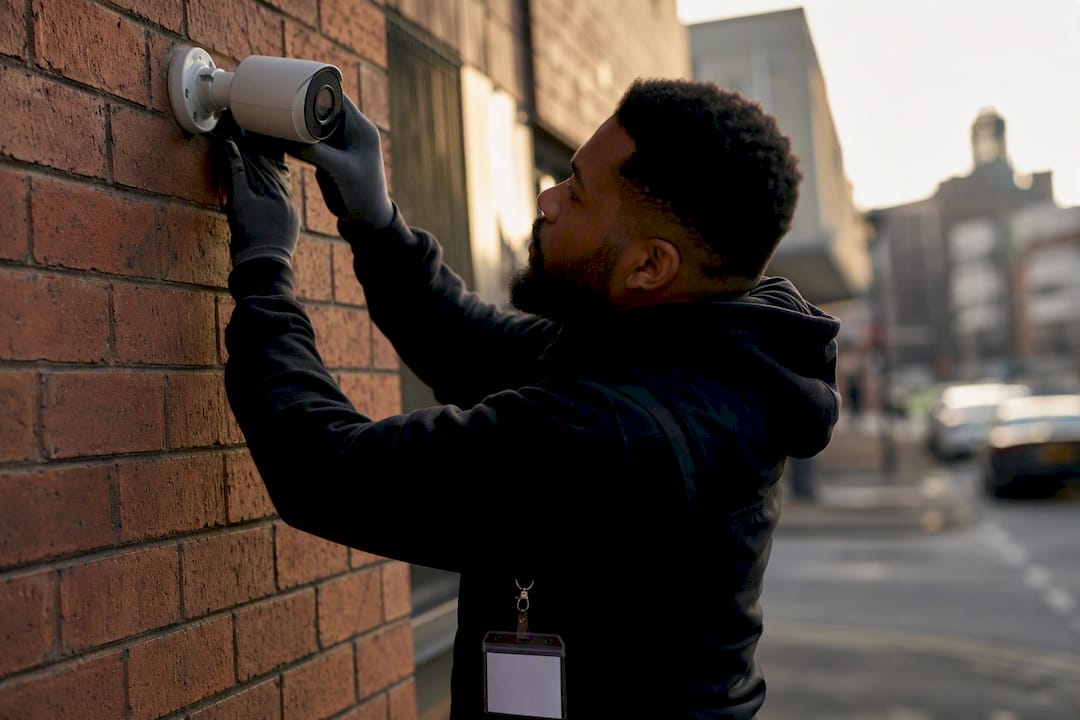
A thorough physical assessment should at least flag where physical and digital risk overlap, even if a full cybersecurity risk assessment falls outside its scope. That includes checking whether access control software receives regular firmware updates, whether camera feeds are encrypted in transit, and whether a departing employee’s badge and network credentials get deactivated on the same day rather than weeks apart.
Partner organizations that specialize in network hardening can extend this further. A managed cybersecurity assessment can evaluate whether your networked security devices are exposed to the kind of vulnerabilities a purely physical review won’t catch, like an unpatched access control server sitting on the same network as payroll data. For businesses with heavier compliance exposure, folding a structured information security risk framework into the broader assessment conversation helps translate technical gaps into the same prioritized language leadership already uses for physical risk.
The point isn’t that every physical security firm needs to double as an IT department. It’s that the line between a door lock and a login credential has blurred enough that your assessment provider should at least know where to point you when a finding crosses that line.
Training and Qualifications Assessors Should Have
Not every security consultant is qualified to run a facility-wide risk assessment. Look for assessors with a documented background in law enforcement, military police work, or corporate loss prevention, ideally with specific experience in the type of property or event you’re evaluating. A retail loss-prevention specialist and an executive protection specialist bring genuinely different skill sets, and the mismatch shows up in the quality of the findings.
Beyond field experience, credible assessors typically hold certifications like Certified Protection Professional (CPP) or Physical Security Professional (PSP) through ASIS International, which test knowledge of risk methodology, security systems, and legal considerations. For executive protection work specifically, ask about training in threat assessment, advance work, and route analysis, since those skills don’t overlap much with general facility security.
Ask providers directly how their assessors stay current. Camera technology, access control systems, and threat patterns all shift over time, and an assessor running the same checklist they learned a decade ago will miss things a continuously trained professional catches. A firm’s willingness to name specific credentials and ongoing training requirements tells you more than a generic claim of “experienced staff” ever will.
Hub Investigative Group: What a Real Engagement Looks Like
Hub Investigative Group has operated in the security and investigative field since 2004, built on more than 75 years of combined law enforcement and loss-prevention experience among its staff. That background shapes how we scope an assessment: not as a generic walkthrough, but as a review built around your actual risk profile.
- A tailored scope document defining exactly what gets inspected and what doesn’t.
- A prioritized risk register ranking findings by real-world likelihood and impact.
- A recommendation register with cost and timeline estimates for each fix.
- Advisory retainer options so implementation doesn’t stall after the report lands.
| Point | Details |
|---|---|
| Core deliverable | A prioritized risk register with costed recommendations, not a checklist alone. |
| Typical timeline | Single-site assessments generally run four to eight weeks depending on complexity. |
| Event vs. facility scope | Event and executive protection reviews require hazard worksheets and advance reconnaissance, not just a site walkthrough. |
| Provider vetting | Confirm certifications, law enforcement background, and redacted references before signing. |
The Gap Between a Checklist and a Funded Fix
Here’s what the conventional advice on this topic gets wrong: it treats the checklist as the finish line. Most guides walk you through perimeter fencing, camera coverage, and lighting levels, then stop, as if listing the right inspection points automatically produces safer buildings. It doesn’t. A checklist that never becomes a prioritized, costed, time-bound recommendation register is a document, not a decision.
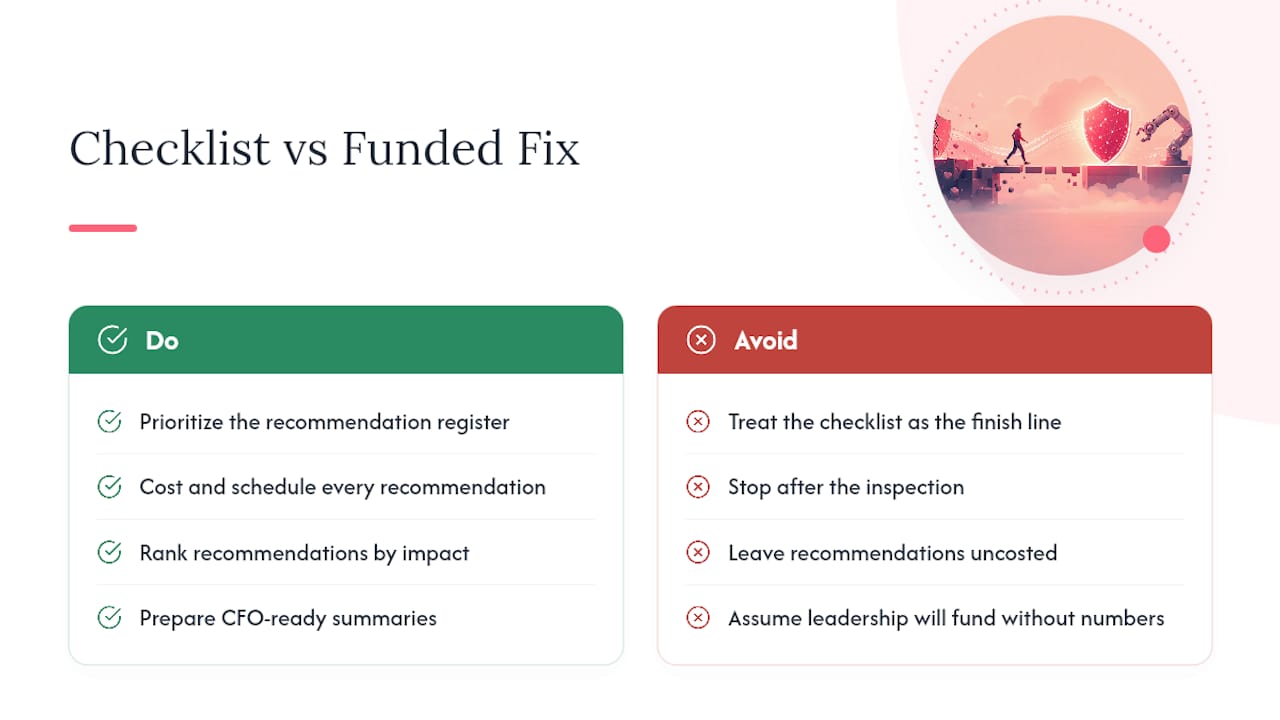
The uncomfortable truth is that most “delivery drop-off” happens after a perfectly competent assessment, not because of a bad one. Leadership reads the executive summary, nods at the findings, and then nothing gets funded because nobody translated “install access control on the loading dock” into a number a budget committee can approve. That’s not a security failure. It’s a communication failure dressed up as a security report.
If you take one thing from this article, prioritize the recommendation register over the inspection itself. Any competent assessor can find your vulnerabilities. Far fewer can hand you a document your CFO will actually act on.
— Derek
Get an Assessment Built Around Your Risk Profile
Hub Investigative Group is the alternative to a generic security audit for property managers, event planners, and executives who need findings that actually get funded, not a checklist that ends up in a filing cabinet. Our assessors bring decades of law enforcement and loss-prevention background to every scope call, and every engagement ends with a prioritized risk register and a recommendation register your leadership can turn into a real budget decision.
The first call is a scoping conversation: we ask about your facility or event, your existing security measures, and what’s driving the request, whether that’s a recent incident, an upcoming high-profile event, or routine due diligence. From there, we quote cost and timeline based on your actual site, not a flat-rate package. If you want to see what a tailored review includes before committing, our physical security risk assessment guide breaks down scope and deliverables in two pages. When you’re ready to move forward, visit our security services page to request a consultation and get a firm quote for your site or event.
Key Takeaways
A security assessment checklist only earns its cost when it ends in a prioritized risk register with costed remediation and a clear implementation timeline.
| Point | Details |
|---|---|
| Demand the register, not just the walkthrough | A prioritized risk register with cost and timeline estimates is the deliverable that matters most. |
| Match scope to the actual risk | Single-site, multi-site, event, and executive protection reviews require different checklists and hazard worksheets. |
| Insist on functional testing | Ask assessors to verify alarms, camera fields of view, and access controls live, not just visually. |
| Budget in tiers | Sort findings into critical, high-priority, and deferred fixes to get faster leadership buy-in. |
| Work with vetted, credentialed teams | Hub Investigative Group builds every assessment around a prioritized risk register and recommendation register backed by law enforcement and loss-prevention experience. |
Sources
- Physical Security Risk Assessment: 10 Step Guide + Checklist
- Venue Guide for Security Enhancements
- Planning Primer Appendices (BJA)