
The fastest way to protect a vacant property is a documented, multi-layer security plan that combines deterrents, monitored detection, and weekly verified inspections. That single sentence captures what separates properties that stay intact from those that become targets within days of going empty. Vacant property security measures are not a one-time task; they are an ongoing protocol that needs to be in place before the last tenant walks out.
Your 72-hour priority list:
- Secure every entry point: rekey or change locks, board vulnerable windows, and confirm all doors close and latch properly.
- Activate exterior lighting on timers or motion sensors so the property never looks dark and abandoned.
- Notify your alarm monitoring company of the vacancy status, and call your local police non-emergency line to register the address for periodic drive-bys.
TL;DR priority order:
- Lock down the property and make it look occupied.
- Add monitored detection (alarm system, CCTV, or both).
- Establish and document a recurring inspection and maintenance schedule.
Every section below expands on one of those three priorities, maps it to a specific security objective, and tells you what your insurer expects to see.
Table of Contents
- What threats does a vacant property actually face?
- How do the 5 D’s apply to vacant property security?
- What should your inspection schedule and records look like?
- How should you manage utilities and fire protection in a vacant building?
- How do you physically harden a vacant property?
- How do you stop illegal dumping and vandalism at a vacant site?
- How does vacancy affect your insurance coverage and what do insurers require?
- When should you hire professional security, and how do you vet a provider?
- Vacant property security checklist: weekly, monthly, and seasonal tasks
- Real-world signs you need patrols or guards, from the field
- Key Takeaways
- The security gap most owners don’t see until it’s too late
- Hubsecurityandinvestigativegroup protects vacant properties across the Boston area
- Useful sources and references
What threats does a vacant property actually face?
A property becomes a target the moment it looks unoccupied. The six most common threats are theft of copper and HVAC equipment, vandalism, squatting, arson, illegal dumping, and water damage from unmonitored leaks or frozen pipes. Each one compounds the others: a broken window invites squatters, squatters bring fire risk, and a single pipe burst can cause structural damage that costs tens of thousands of dollars to remediate.
The financial consequences are real and often underestimated. Copper theft alone can strip an HVAC system or electrical panel in under an hour, leaving repair bills that run well into five figures. Graffiti and broken windows trigger what criminologists call the “broken windows effect,” where visible neglect signals low risk to additional offenders, accelerating deterioration. Squatters create liability exposure beyond property damage: eviction proceedings in many states take weeks, and any injury on the premises can generate litigation.
Insurance exposure note: According to Risk Placement Services, insurers commonly restrict or exclude coverage after a property has been vacant for an extended period unless a documented security plan is in place. Transitioning to a vacant-property policy before that threshold is reached is the single most important administrative step you can take.
Vacancy length changes how underwriters view your risk profile. A property empty for two weeks is treated very differently from one empty for three months. After the initial vacancy period, many standard commercial policies begin limiting covered perils; longer vacancies can lead to exclusions of fire, vandalism, and water damage unless upgraded to a vacancy-specific endorsement or policy. The longer the vacancy, the more your insurer will want to see documented evidence that the property is being actively managed.
How do the 5 D’s apply to vacant property security?
The 5 D’s of perimeter security — Deter, Detect, Deny, Delay, and Defend — give you a practitioner-tested framework for deciding which measures to deploy and in what order. Applied to vacant properties, the framework works as concentric layers: each D addresses a different stage of a potential intrusion, and together they create a defense that is far harder to defeat than any single measure alone.
Deter: make the property an unattractive target
Deterrence is your first and cheapest line of defense. Visible measures signal that the property is monitored and that intrusion carries real risk.
- Install motion-activated floodlights at all entry points and along the perimeter. Good exterior lighting is one of the highest-ROI deterrents available.
- Post “No Trespassing” and “Property Under Video Surveillance” signage at every access point.
- Maintain the exterior: mow grass, clear mail, and keep the property looking actively managed. US Assure recommends using timed interior lighting and suspending mail delivery to make the property appear occupied.
- Park a vehicle on-site periodically or arrange for a neighbor or key-holder to visit visibly.
Detect: know when someone is on the property
Detection converts a passive deterrent into an active alert. For vacant sites, monitored systems are far more effective than record-only options because a recording you review three days later does not stop an intrusion in progress.
- Install a UL-listed, cellular-monitored intrusion alarm. Cellular communication avoids the vulnerability of a cut phone line.
- Add CCTV cameras at entry points, parking areas, and any side or rear access. Cloud-based platforms allow remote review from any device.
- Deploy IoT water and freeze sensors near plumbing, mechanical rooms, and basements. Chubb’s portfolio risk guidance specifically recommends these sensors as a cost-effective way to catch leaks before they become major claims.
Deny, Delay, and Defend: physical hardening
These three Ds work together through physical controls. Deny access with solid-core doors, Grade 1 commercial deadbolts, and boarded or secured windows. Delay any intruder who gets past the perimeter with secondary locks, interior door reinforcement, and secured stairwells. Defend by ensuring that your monitoring and patrol response is fast enough to intercept before significant damage occurs.
Pro Tip: If your budget allows only one investment beyond basic locks and lighting, make it a UL-listed monitored alarm with cellular backup. It satisfies insurer requirements, triggers a documented response, and costs far less per month than a single incident of copper theft.
| Measure | Deter | Detect | Deny/Delay | Insurer Credit |
|---|---|---|---|---|
| Motion-activated lighting | ✓ | Often required | ||
| Monitored intrusion alarm | ✓ | ✓ | Commonly required | |
| CCTV (record-only) | ✓ | Partial | Sometimes credited | |
| CCTV + remote monitoring | ✓ | ✓ | Stronger credit | |
| Grade 1 locks + board-ups | ✓ | Often required | ||
| Mobile patrol | ✓ | ✓ | ✓ | Strong credit |
| Perimeter fencing | ✓ | ✓ | Credited for commercial |
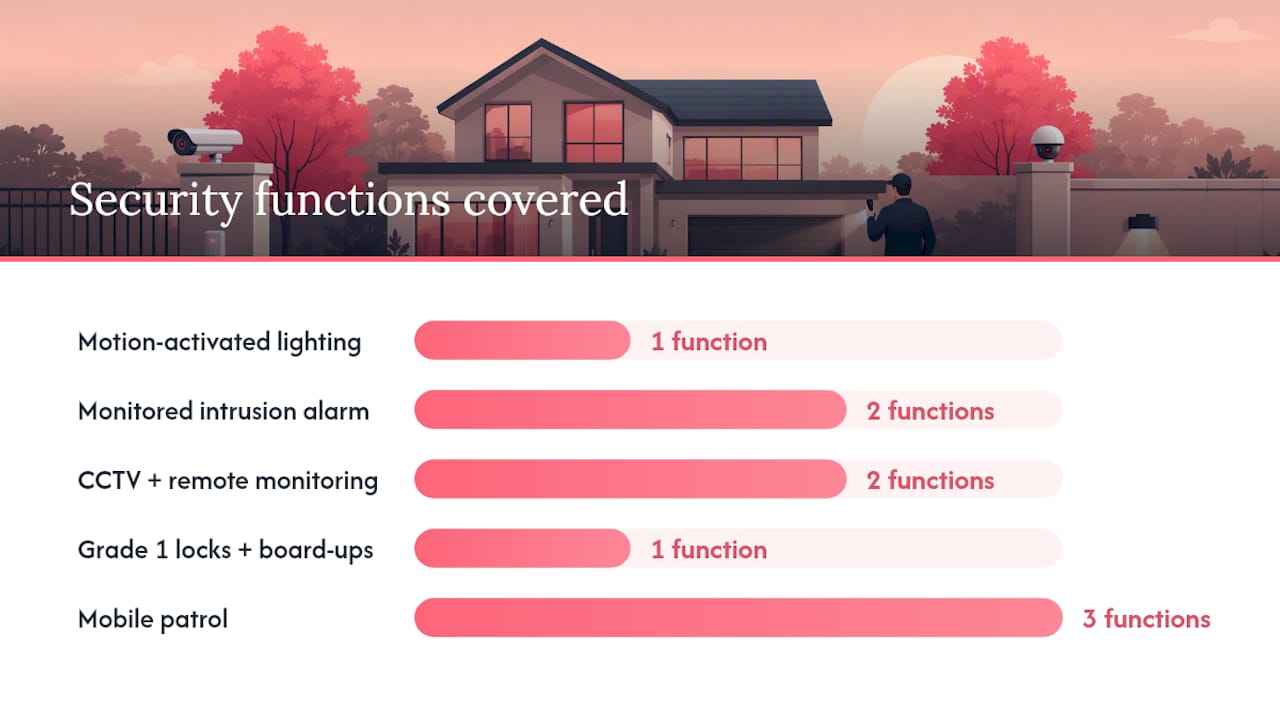
Insurers commonly require monitored alarms, documented inspection logs, and maintained perimeter fencing as conditions of coverage. Implementing all three before your vacancy threshold is reached puts you in the strongest possible position with your broker.
What should your inspection schedule and records look like?
Documented, variable-time inspections — weekly exterior walkarounds and monthly interior checks when accessible — with date- and time-stamped photos are the standard that insurers and courts accept. “Variable-time” matters: arriving at the same time every Tuesday tells a would-be intruder exactly when the property is unmonitored.
Sample inspection log fields
Every inspection record should capture:
- Date, time, and name of inspector
- Weather conditions at time of visit
- Condition of all doors, windows, and locks (note any damage or tampering)
- Roof, gutters, and drainage condition
- Evidence of trespass, dumping, or vandalism
- Utility readings or status (heat, water, fire system)
- Photographs with embedded timestamps
- Remedial actions taken and follow-up required
The Hartford’s vacant building guidance and SISC member district guidance both emphasize that documented weekly tours are a minimum standard for maintaining coverage and demonstrating due diligence in a claim dispute.
Inspection and maintenance timeline
| Frequency | Task |
|---|---|
| Weekly | Exterior perimeter walk; check all entry points; photograph any changes; confirm lighting is operational |
| Monthly | Interior inspection (if accessible); check HVAC, plumbing, and fire systems; clear debris and mail |
| Seasonal (fall) | Clean gutters; inspect roof; service heating system; test fire alarm and sprinkler systems per NFPA 25 and NFPA 72 |
| Seasonal (spring) | Check for winter damage; inspect foundation drainage; restart or test deactivated systems |
| After severe weather | Immediate exterior check; document any damage; notify insurer within required timeframe |
Good documentation does more than satisfy your insurer. If a claim is disputed, a complete log with photos is often the difference between a paid claim and a denial. It also creates a paper trail that supports law enforcement if trespass or theft leads to prosecution.
How should you manage utilities and fire protection in a vacant building?
The direct rule: maintain every system that protects the property (fire suppression, monitored sprinkler alarms, exterior lighting) and shut off non-essential services only after a deliberate risk assessment. Turning off everything to save money is one of the most common and costly mistakes vacant-property owners make.
What to shut off
- Gas service to non-essential appliances (stoves, dryers) after confirming fire protection systems are unaffected.
- Domestic water supply at the main shutoff if the building will be unoccupied through winter and pipes have been drained.
- Non-essential electrical circuits, while keeping power to security systems, lighting, and fire panels.
Pro Tip: Install a remote water sensor and an automatic shutoff valve at the main water supply line. Chubb’s vacant asset guidance identifies water damage as the leading source of vacant-property loss, and a $150–$300 sensor-and-valve combination can prevent a six-figure remediation bill.
Fire risk note: The Hartford’s vacant building guidance notes that removing combustible materials from the interior and maintaining monitored fire protection are among the most impactful steps for reducing fire-related loss in vacant buildings. A fire in an unoccupied structure often burns longer before detection, causing total losses that an occupied building would never sustain.
How do you physically harden a vacant property?
Lock the site, board vulnerable openings, and limit vehicle access. Those three actions, done well, stop the majority of opportunistic intrusions before any alarm is triggered.

Board-ups and window security
Board-ups are appropriate for broken or vulnerable windows, but they require more than a sheet of plywood nailed over a frame. Use 5/8-inch or thicker plywood secured from the interior with through-bolts where possible, not just surface nails that can be pried off in minutes. In many municipalities, exterior board-ups require a permit; check local codes before proceeding. Where appearance matters (a commercial property in a visible location), polycarbonate security panels are a more professional alternative that still provides impact resistance.
Ventilation is a real concern in boarded buildings. Completely sealed structures can develop moisture and mold problems faster than partially ventilated ones. Leave small ventilation gaps at the top of boarded openings or use vented security panels.
Locks and access control
For commercial properties, install ANSI/BHMA Grade 1 deadbolts on all exterior doors. Grade 2 is the minimum for residential vacant properties, but Grade 1 is worth the modest price difference when the property will be empty for months. Rekey or replace all locks immediately on vacancy; you rarely know how many key copies are in circulation from prior occupants.
- Use hasp-and-padlock combinations on outbuildings, gates, and utility access panels.
- Install door reinforcement plates (hinge bolts and strike plate reinforcements) on hollow-core or lightweight doors.
- Consider a key-lockbox accessible only to authorized inspectors and emergency responders.
Fencing and vehicle access
Perimeter fencing deters vehicle-based dumping and slows any intruder who needs to move equipment or materials. Chain-link with barbed-wire topping is the standard for commercial vacant lots. For properties where aesthetics matter, welded-wire or ornamental steel provides comparable security.
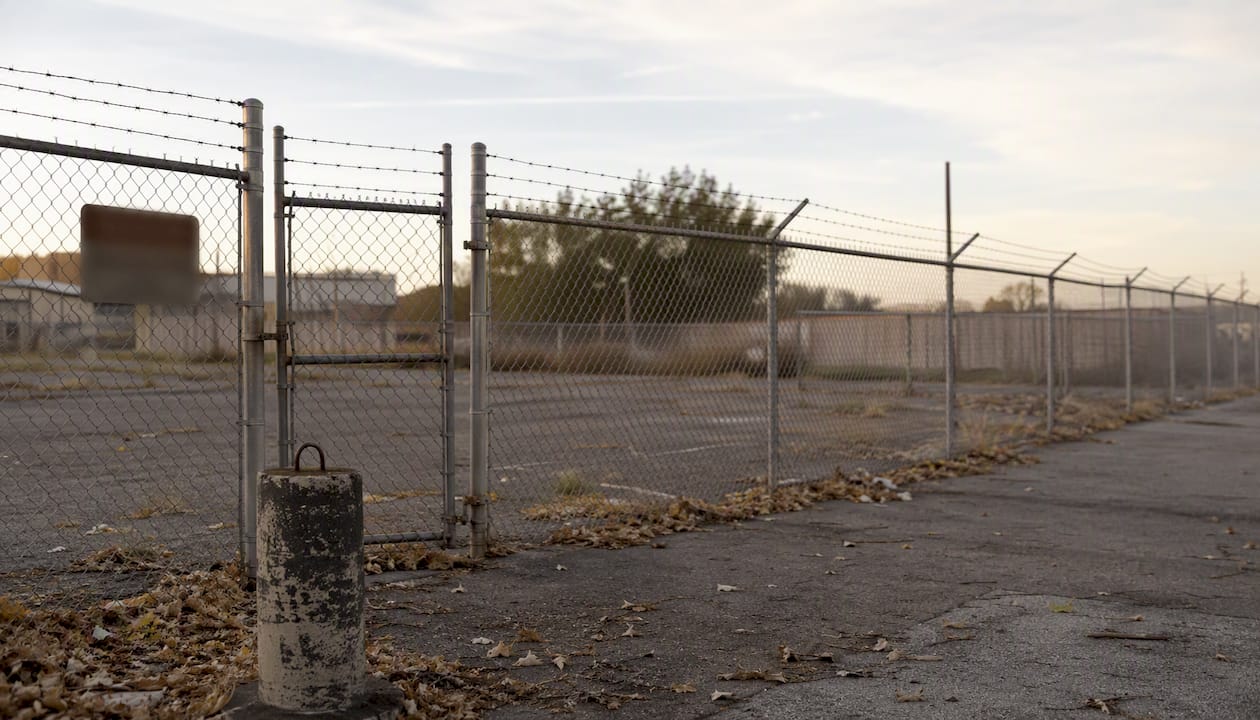
Removable bollards or concrete barriers at driveway entrances are highly effective against illegal dumping, which often involves a truck backing up to an open lot. They cost relatively little to install and can be removed when the property is re-occupied.
Pro Tip: Pair every physical barrier with a sign. A fence with no signage is a challenge; a fence with “No Trespassing — Video Surveillance in Operation — Violators Will Be Prosecuted” is a deterrent. The combination of physical and psychological barriers is consistently more effective than either alone.
How do you stop illegal dumping and vandalism at a vacant site?
Visible deterrents, focused detection, and a community reporting system reduce dumping incidents more reliably than any single measure. The U.S. EPA’s illegal dumping prevention guidance identifies lighting, signage, physical barriers, and targeted surveillance as the core tactics, and documents cases where surveillance-backed enforcement led to successful prosecutions.
- Post “No Dumping” signs with the applicable fine amount at every vehicle access point. Specific penalty amounts increase deterrence compared to generic signs.
- Install discreet cameras at angles that capture vehicle license plates, not just the dumping act itself. A plate number is what law enforcement needs to pursue a case.
- Rapid cleanup is not just cosmetic: the EPA’s guidance confirms that sites cleaned promptly after a dumping incident attract significantly less repeat dumping than sites left with existing waste.
- Establish a community reporting line or coordinate with neighbors to report suspicious activity. Local business improvement districts and neighborhood watch programs are practical partners.
- Document every incident with timestamped photos, vehicle descriptions, and GPS coordinates before cleanup. This evidence package is what supports both prosecution and insurance claims.
For persistent dumping problems, a temporary solar-powered camera tower positioned to capture the access point is often the most cost-effective solution. The visible presence of a camera tower alone has deterred dumping in documented EPA case studies, even before a single citation is issued.
How does vacancy affect your insurance coverage and what do insurers require?
Vacancy usually changes your policy terms. Most standard commercial and residential property policies restrict or exclude coverage after 30–60 days of vacancy unless a vacant-property plan is in place and documented. This is not a technicality buried in the fine print; it is a primary underwriting trigger that can result in a denied claim for fire, vandalism, or water damage.
According to Risk Placement Services, commercial vacant underwriting commonly requires a documented security plan, inspection logs, and evidence of maintained protective systems. Daly & Alexander’s vacant property insurance guide confirms that implementing basic security measures — monitored alarms, lighting, and regular inspections — reduces risk and can reduce premiums, while policy terms require ongoing maintenance to keep coverage active.
What insurers typically require
- A monitored intrusion alarm (UL-listed central station preferred)
- Weekly site inspections with dated, signed logs
- Maintained fire protection systems (operational or properly drained per NFPA 25 and NFPA 72)
- Removal of valuables, combustibles, and hazardous materials
- Maintained exterior lighting
- A documented vacant-site security plan shared with your broker
Documentation checklist for your broker
- Copy of your alarm monitoring agreement (confirm UL-listed central station)
- Inspection log covering the past 30 days (signed, dated, with photos)
- Written vacant-site security plan (patrol schedule, inspection cadence, emergency contacts)
- Service invoices for any fire system testing or maintenance
- Confirmation that fire protection systems are operational or properly decommissioned
- Evidence of perimeter security (fencing, board-up permits if applicable)
- Utility status documentation (what is on, what is off, and why)
Premium impact: Property managers who treat security as a mechanism to reduce insurance costs — by implementing monitored alarms, patrols, and documented inspection logs — can often negotiate lower premiums or preserve coverage that would otherwise be denied. The investment in a $50/month monitored alarm is modest compared to the cost of a policy that excludes your most likely claims.
Confirm your specific coverage conditions with your broker before the 30-day threshold. Every policy is different, and the consequences of missing that window can be severe.
When should you hire professional security, and how do you vet a provider?
Hire professional patrols when repeat intrusion, arson risk, or significant asset exposure exceeds what sensors and cameras can mitigate on their own. A camera records what happened; a patrol stops it. The comparison between guard coverage and alarm systems is not always either/or, but for high-risk vacant sites, patrols are the escalation that changes outcomes.
How to vet a security provider
- Confirm state licensing: every security company and individual guard must hold a valid license in the state where they operate. Verify directly with your state’s licensing board.
- Check insurance coverage: the provider should carry general liability and workers’ compensation at minimums appropriate for your site’s risk profile.
- Request local references: a provider with experience in your specific market understands local threat patterns and has established relationships with local law enforcement.
- Ask about background check policies for all personnel assigned to your site.
- Review patrol reporting format: you need written, timestamped reports after every visit, not just a verbal confirmation.
- Confirm liability limits and indemnification language in the contract.
Contract items to request
- Patrol frequency and specific time windows (or randomized patrol protocols)
- Response time SLA for alarm activations or reported incidents
- Incident reporting format and delivery timeline (within 24 hours is standard)
- Key-holder policy: who holds access, how it is logged, and what happens on personnel changes
- Escalation protocol to law enforcement, including who makes the call and when
- Termination and transition clauses that protect your access to records
Pro Tip: Audit patrol effectiveness by placing a simple, dated inspection card inside a locked area that only a legitimate patrol should access. If the card is not initialed on the expected schedule, you have a documentation gap worth addressing immediately.
Cost considerations
| Service type | Typical use case | Relative cost |
|---|---|---|
| Unarmed mobile patrol (periodic) | Low-to-medium risk vacant properties | Lower |
| Unarmed stationary guard | High-value assets, active construction sites | Medium |
| Armed mobile patrol | High-risk sites, repeat intrusion, arson history | Higher |
| Armed stationary guard | Highest-value assets, documented threat level | Highest |
Armed guards are appropriate when the threat level is documented and specific: repeat forced entry, evidence of organized theft, or a site with high-value equipment that cannot be removed. For most vacant residential and small commercial properties, unarmed mobile patrols on a randomized schedule provide strong deterrence at a manageable cost.
Vacant property security checklist: weekly, monthly, and seasonal tasks
Use this checklist as a printable reference. Assign each task to a responsible party (owner, property manager, or contracted patrol) and attach completed copies to your inspection log.
Weekly tasks (owner or property manager)
- [ ] Walk the exterior perimeter; photograph any changes, damage, or evidence of trespass
- [ ] Confirm all doors, windows, and gates are secured
- [ ] Check that exterior lighting is operational
- [ ] Verify alarm system is active and monitoring is confirmed
- [ ] Clear any mail, flyers, or debris that signals vacancy
- [ ] Document inspection in the log (date, time, inspector name, findings)
Monthly tasks (owner or contracted inspector)
- [ ] Conduct interior inspection if accessible; check HVAC, plumbing, and fire systems
- [ ] Test smoke detectors and fire alarm panel
- [ ] Check for signs of water intrusion, mold, or pest activity
- [ ] Review CCTV footage for any unlogged activity
- [ ] Confirm alarm monitoring agreement is current and paid
- [ ] Update emergency contact list if personnel have changed
Seasonal tasks
- [ ] Fall: clean gutters, inspect roof, service heating system, test fire suppression per NFPA 25 and NFPA 72
- [ ] Winter: verify minimum heat (40°F) or confirm pipes are drained; check freeze sensors
- [ ] Spring: inspect for winter damage, check foundation drainage, restart deactivated systems
- [ ] Summer: check for pest activity, confirm humidity controls are functioning
Re-occupancy checklist
When the property is ready to be re-occupied, work through this list before handing over keys. A property manager’s re-occupancy guide covers this process in detail for multifamily properties.
- Restore all utilities and test each system before occupancy
- Test and certify fire alarm and suppression systems
- Inspect and service HVAC
- Rekey all locks and account for all key copies
- Remove all boards, barriers, and temporary security hardware
- Clear accumulated mail and any exterior debris
- Notify alarm company of occupancy status change
- Notify insurer and transition back to an occupied-property policy
- Document final vacant-period inspection and file with your records
Real-world signs you need patrols or guards, from the field
Specific triggers justify immediate escalation to professional patrols: repeat forced entry, evidence of coordinated theft, arson attempts, or continuous trespass that cameras and alarms alone have not stopped. At that point, the question is not whether to hire security but how quickly you can get patrols on-site.
From our experience working with property owners across the Boston area, the pattern is consistent. A single break-in is often opportunistic. A second break-in within 30 days at the same entry point is a signal that someone has assessed the property and found the response time acceptable. A third incident means the current deterrence level is not working, and a physical presence is needed.
Practical thresholds that should trigger a call to a professional security provider:
- Two or more forced-entry incidents within 60 days
- Any evidence of arson attempt (accelerant, fire damage, or suspicious burn marks)
- Discovery of squatters who have established living arrangements (not just a single overnight)
- Theft of fixed assets (copper wiring, HVAC units, plumbing fixtures) requiring contractor repair
- Illegal dumping that recurs within days of cleanup despite signage and barriers
Pro Tip: Document every incident with a police report number, timestamped photos, and a written description of what was taken or damaged. This documentation serves three purposes: it supports insurance claims, it builds the evidentiary record for prosecution, and it demonstrates to your insurer that you are actively managing the risk. Professional security guards can also provide written incident reports that carry weight with both law enforcement and underwriters.
Key Takeaways
A documented, multi-layer security plan combining deterrents, monitored detection, and weekly verified inspections is the most effective approach to protecting a vacant property and maintaining insurance coverage.
| Point | Details |
|---|---|
| Act within 72 hours | Secure entries, activate lighting, notify your alarm company and local police of the vacancy immediately. |
| Hit the insurance threshold early | Most policies restrict coverage after 30–60 days; transition to a vacant-property policy and document your security plan before that window closes. |
| Monitored alarm is the priority system | A UL-listed, cellular-monitored alarm satisfies insurer requirements and triggers a documented response at the lowest ongoing cost. |
| Inspection logs are your legal protection | Dated, signed inspection records with photos are what prevent claim denials and support law enforcement if incidents escalate. |
| Hubsecurityandinvestigativegroup for escalation | When repeat intrusion, arson risk, or high asset exposure exceeds what sensors can handle, Hubsecurityandinvestigativegroup’s mobile patrols and security assessments provide the physical presence and documentation that changes outcomes. |
The security gap most owners don’t see until it’s too late
There is a pattern we see repeatedly in vacant-property cases: owners invest in the right technology, set up a camera system, and install a decent alarm, then treat the job as done. What they miss is that technology detects; it does not respond. A camera that records a theft in progress at 2:00 AM on a Tuesday is useful evidence. It does not stop the loss.
The conventional wisdom in property security leans heavily on hardware because hardware is tangible, purchasable, and easy to point to. But the properties that come through extended vacancies with minimal loss are the ones where someone is actually showing up, varying their schedule, and treating each visit as a genuine inspection rather than a checkbox. That human element is what makes the difference between a deterrent and a documented record of what you lost.
There is also a tendency to treat insurance compliance and security planning as separate tasks; they are not. Every measure you implement for security purposes, documented correctly, is an argument you make to your insurer before a claim is filed. The owners who understand this use their security plan as a negotiating tool with their broker, not just a liability shield. That shift in perspective, from reactive to proactive, is what separates a well-managed vacant property from one that becomes a problem.
The checklist in this guide is a starting point. The inspection log is a legal document. And the decision to bring in professional patrols is a business calculation, not an admission of failure.
Hubsecurityandinvestigativegroup protects vacant properties across the Boston area
Vacant properties need more than a camera and a hope. Hubsecurityandinvestigativegroup brings over seventy-five years of combined law enforcement and loss prevention experience to every vacant-site engagement, with mobile patrols, armed and unarmed guard options, alarm monitoring integration, and formal security assessments that satisfy insurer requirements and hold up in court.

Where most property owners are working from a checklist, we work from a site-specific risk profile. Our team conducts on-site vulnerability assessments that identify the gaps your current setup leaves open, then builds a patrol and monitoring plan around your actual threat level, not a generic template. For properties in active construction or renovation, our construction site security services extend the same layered approach to sites with active equipment and material exposure.
Whether you need a one-time security assessment, a recurring mobile patrol contract, or building security services that integrate with your existing alarm infrastructure, we can put a plan together quickly. Contact Hubsecurityandinvestigativegroup to schedule your site assessment and get a documented security plan your insurer will accept.
Useful sources and references
The following sources informed this guide. Each one is worth bookmarking if you manage vacant properties or advise clients who do.
| Source | Why it matters |
|---|---|
| The 5 Ds of Outdoor Perimeter Security — Security Magazine | Defines the Deter/Detect/Deny/Delay/Defend framework used to structure layered vacant-site protection. |
| Vacant Commercial Property Insurance Guide — Risk Placement Services | Explains 30–60 day vacancy thresholds, underwriting requirements, and how security plans affect coverage. |
| Protecting Vacant Property — SISC Member Districts | Lists minimum protective measures for vacant sites: monitored alarms, weekly visits, exterior lighting, and utility guidance. |
| Safeguarding Vacant Assets — Chubb | Recommends weekly inspections, IoT water sensors, and maintained fire protection as core loss-reduction tactics. |
| Illegal Dumping Prevention Guide — U.S. EPA Region 5 | Details signage, lighting, barriers, surveillance, and enforcement case studies for preventing illegal dumping. |
| Vacant & Idle Building Protection — The Hartford | Comprehensive checklist covering utilities, fire protection (NFPA 25 and NFPA 72), inspection schedules, and combustible removal. |
| Vacant Property Insurance Guide — Daly & Alexander | Explains how security measures and maintenance practices affect vacant property underwriting and premiums. |
| 6 Ways to Keep Your Vacant Property Secure — First Response Group | Practical operational checklist: regular visits, securing entries, motion lighting, and CCTV as deterrent and evidence. |
| 7 Tips to Protect Vacant Homes — US Assure | Covers making a property look occupied (timed lighting, mail suspension, key-holder plan) and remote monitoring options. |
This article provides general information for property owners and managers. It is not legal, insurance, or professional security advice. Confirm your specific coverage requirements with a licensed insurance broker and consult a qualified security professional for site-specific guidance.