
Hire licensed event security for any Boston wedding involving alcohol, 100 or more guests, high-value gifts, or VIP attendees. Request a written quote and confirm your venue’s permit requirements before you sign a contract with anyone. The next step is simple: call your venue’s event coordinator this week and ask what security conditions are already written into your rental agreement.
TL;DR:
- Staffing ratios should be based on the event risk level, with one guard per 100 guests for low-risk events, and up to one per 20-30 in high-risk areas.
- Security plans require detailed venue layouts, schedule information, and specific guest list controls shared early with providers, not just at the last minute.
- A security provider must demonstrate proper licensing, tailored written plans, appropriate guard-to-supervisor ratios, and relevant experience for similar venues.
- Insurance coverage from the security provider is essential, especially when alcohol is served, to cover liability for incidents related to crowd control and guest behavior.
- Planning should occur months in advance, with a focus on venue-specific needs and alcohol policies, rather than solely on guest count or generic staffing formulas.
Table of Contents
- What Does Wedding Security Actually Do on the Day?
- How Do You Plan Wedding Security Step by Step in Boston?
- What Do Guard Ratios and Wedding Security Costs Look Like in Boston?
- What Permits and Venue Rules Apply to Massachusetts Weddings?
- What Should You Look for in a Boston Wedding Security Provider?
- What Insurance and Liability Issues Come with Wedding Security?
- How Do Security Teams Handle Incidents During a Wedding?
- What Do Successful Boston Wedding Security Setups Have in Common?
- What Actually Matters When Planning Wedding Security in Boston
- Ready to Plan Your Boston Wedding Security?
- Sources
What Does Wedding Security Actually Do on the Day?
A security detail earns its cost through a handful of specific jobs, not a vague “presence” near the bar. On a typical Boston wedding, officers manage entry control and guest verification against a list, direct parking and traffic flow at venues with limited curb space, and patrol the perimeter to keep uninvited guests or wandering strangers away from the reception.
They also watch the gift table and any overnight belongings, step in early to de-escalate conflicts before they become scenes, and coordinate with caterers and vendors during load-in so nobody wanders into a kitchen fire lane or blocks a service elevator.
Coverage style matters as much as headcount. Uniformed officers are the right call when you want visible deterrence at entrances or parking areas. Plainclothes staff work better inside the reception itself, where you want protection without a security presence dominating the photos. Executive protection specialists come into play when a VIP, public figure, or high-net-worth family member is on the guest list and needs closer, discreet coverage.
- Entry control and guest list verification
- Parking direction and perimeter patrol
- Gift table and overnight asset watch
- Conflict de-escalation before it escalates
- Vendor and load-in coordination with venue staff
Good security teams also loop in EMS and Boston Police contacts ahead of time, not after something happens.
Pro Tip: Ask your venue coordinator whether they’ve worked with your security provider before. A team that already knows the loading dock, the elevator quirks, and the closest police detail contact will move faster than one learning the building for the first time.
How Do You Plan Wedding Security Step by Step in Boston?
Wedding security planning works best as a sequence, not a single phone call two weeks before the ceremony. Follow this order and you’ll avoid the two most common failures: under-staffing a venue with tight sightlines, and hiring a team that shows up without a written plan.
- Estimate peak attendance and risk level. Guest count sets your starting guard ratio, but an open bar, a celebrity guest, or a historic downtown venue with multiple entrances all push that number up.
- Share your venue layout and schedule early. Floor plans, guest list controls, the alcohol service plan, VIP details, and load-in/load-out windows should go to your security provider before you ask for a quote, not after.
- Confirm the paperwork. Ask for proof of licensing and insurance, a written security plan specific to your event, radio communication between staff, a named on-site supervisor, relief shift coverage for anything running past four hours, and a list of emergency contacts.
- Lock in your booking timeline. Peak wedding season in Massachusetts runs May through October, and providers matching hosts to security teams in the state generally recommend booking six to twelve months out for Saturday dates. Confirm final headcounts two to four weeks before the event.
Layout and alcohol policy drive staffing decisions more than raw guest count. A 150-person seated dinner in a single ballroom needs less coverage than a 150-person cocktail reception spread across three floors with an open bar on each one.
Guard-count guidelines from industry event security estimators start at roughly one guard per 100 guests for low-risk events, which gives you a defensible baseline to bring to your first vendor conversation rather than guessing.
- Get everything in writing: scope, hours, rates, and cancellation terms
- Confirm supervisor presence for any event running past a few hours
- Ask about relief shifts so no single guard covers an entire reception alone
What Do Guard Ratios and Wedding Security Costs Look Like in Boston?
Staffing ratios shift with risk, not just headcount. A quiet seated ceremony with no alcohol can run as light as one guard per 100 guests. Add an open bar and that ratio tightens to roughly one guard per 50, because alcohol is the single biggest driver of the incidents security teams actually respond to at weddings. VIP zones, dance floors packed past midnight, or events with a public figure on the guest list often call for one guard per 20 to 30 people in that specific area, even if the rest of the venue is calmer.
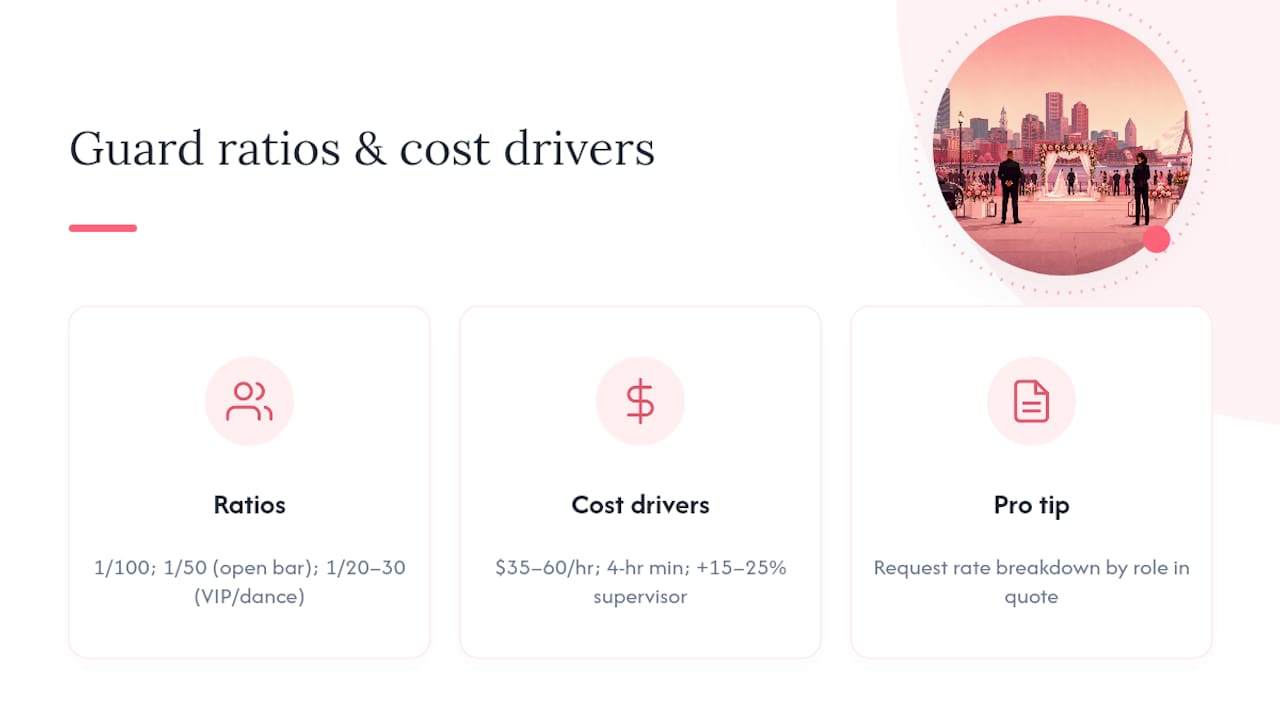
Pricing follows a fairly predictable shape across the US market. Industry pricing guides put unarmed guard rates in the $35 to $60 per hour range, with most companies enforcing a four-hour minimum per guard and adding a premium of 15 to 25 percent for an on-site supervisor. Armed protection, off-duty police officers, and overnight watch add further to the base rate.
Typical security staffing for Boston weddings scales with event size and features multiple guards and supervisors; costs vary according to the number of staff, event duration, and additional services but generally follow industry ranges without specific figures.
Add a 10 to 15 percent contingency to any quote for weddings running past midnight or serving alcohol until close.
Pro Tip: Ask for a rate breakdown by role, not just a flat total. A quote that separates guard hours, supervisor premium, and any armed or VIP add ons is easier to compare against a competing bid.
What Permits and Venue Rules Apply to Massachusetts Weddings?
Start with your venue rental agreement. Many Boston venues, especially those hosting 150 or more guests, already require licensed security or a written security plan as a condition of the booking, and that requirement is often buried in the contract fine print rather than announced up front.
Massachusetts crowd-manager regulations under 527 CMR can apply to larger assemblies, particularly in venues with fixed occupancy limits or multiple exits. Whether your event triggers a formal requirement depends on guest count, venue type, and the specific municipal permit tied to that address, so this is a question for your venue and the city’s special-event permit office, not a guess.
- Ask your venue directly whether security or a written plan is a contract requirement
- Check with Boston’s special-event permit office if your event involves street closures, tents, or outdoor space
- Put any permit or security conditions in writing and fold them into your security contract’s scope of work
What Should You Look for in a Boston Wedding Security Provider?
Hub Investigative Group has operated in Boston since 2004, built on more than seventy-five years of combined law enforcement and loss-prevention experience across its team. That background shows up in the details planners rarely think to ask about until something goes wrong, like knowing which downtown venues have tight loading docks or which waterfront properties lose cell signal near the water.
Ask any provider you’re considering these four questions before signing anything:
- Can you show proof of current licensing and insurance for every officer assigned to my event?
- Will you provide a written security plan specific to my venue and guest list, not a generic template?
- What’s your guard-to-supervisor ratio for an event of my size?
- Can you share an example of a similar Boston wedding you’ve staffed, including venue type and guest count?
A provider that hesitates on any of these four is worth reconsidering. Hub’s event security services cover planning, VIP and executive protection, parking and overnight gift watches, and direct venue coordination.
What Insurance and Liability Issues Come with Wedding Security?
Liability at a wedding doesn’t sit in one place. Venues typically carry general liability coverage, caterers carry their own, and your wedding insurance policy (if you have one) covers a different slice again. Security sits at the intersection of all three, which is exactly why a written scope of work matters more here than in almost any other vendor relationship.
Ask any security provider you’re evaluating whether they carry their own general liability and workers’ compensation coverage, separate from your venue’s policy. A provider without their own insurance shifts risk back onto you and your venue if an incident occurs on their watch, and that’s a liability gap most couples never think to check until it’s too late.
Alcohol service adds a distinct layer of risk. If your reception serves alcohol, your caterer or bar service likely carries liquor liability coverage, but that policy typically covers service errors, not crowd control or a guest who becomes aggressive after drinking. That’s the security team’s job, and it’s worth confirming in writing that their scope explicitly includes intoxicated-guest de-escalation, not just static posts at the door.
Venues increasingly require a certificate of insurance from your security provider before granting building access. Ask your venue coordinator directly whether this applies to your booking, and request the certificate from your provider early enough to clear that requirement without a last-minute scramble the week of the wedding.
How Do Security Teams Handle Incidents During a Wedding?
Most wedding incidents are small and forgettable: an argument between two guests who’ve had too much champagne, an uninvited plus-one trying to talk their way past the entrance, a family member who needs to be walked outside to cool off. A trained team handles these quietly, usually before most guests notice anything happened at all.
The response protocol that matters most is the escalation chain. One supervisor on-site should be the single point of contact for any incident, coordinating between floor staff, the venue’s own team, and outside responders if needed. Without that single point, a minor issue can spiral simply because three people are making three different decisions at once.
For anything beyond de-escalation, a rehearsed incident response typically follows three steps: isolate the situation away from other guests, notify the on-site supervisor immediately, and contact venue management or Boston Police if the situation requires it. Officers experienced in wedding work know how to do this without stopping the music or pulling the couple away from their own celebration.
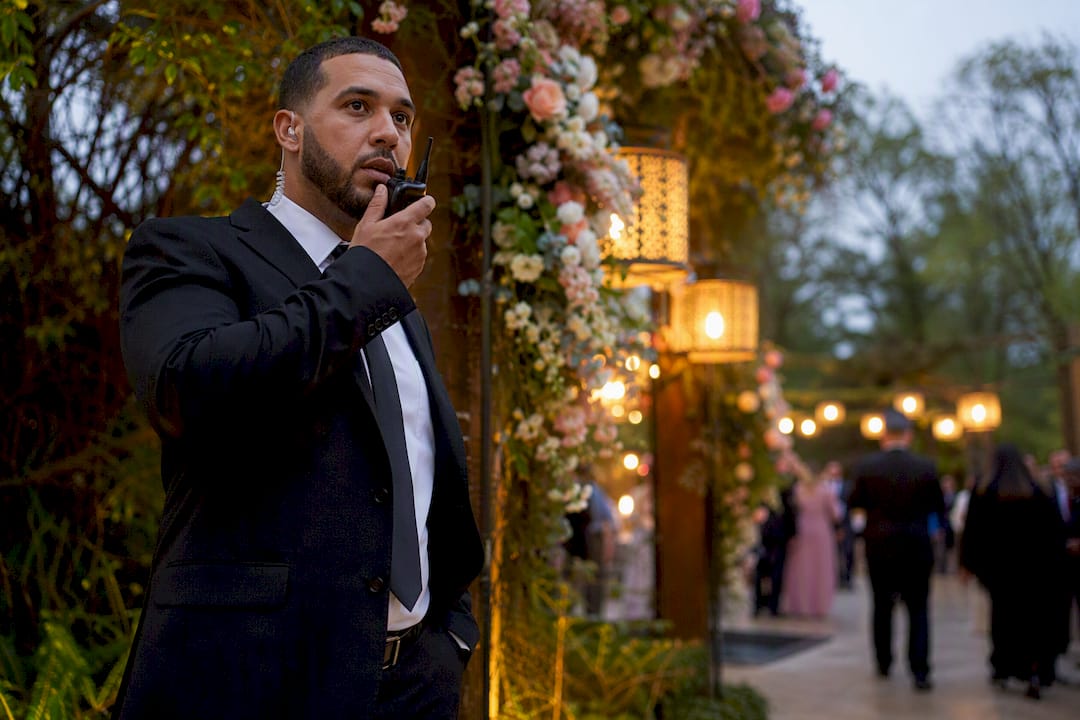
Radio communication between posted officers is what makes this work in practice. A guard at the entrance who spots a problem needs to reach the supervisor and the gift-table watch within seconds, not minutes, and that only happens with equipment and a clear chain established before the first guest arrives.
What Do Successful Boston Wedding Security Setups Have in Common?
The Boston weddings that go smoothly from a security standpoint share a common pattern: the security team was involved in planning weeks before the event, not hired as an afterthought once the invitations went out. A historic Beacon Hill venue with narrow stairwells and a single elevator needs a different staffing plan than a waterfront property with outdoor tent access and unpredictable foot traffic from the harbor walk.
Local Boston directories and marketplaces show a healthy number of active event security providers competing for wedding bookings, which means couples and planners genuinely have options to compare rather than a single default choice, according to local marketplace listings. The couples who report the smoothest experiences are almost always the ones who requested multiple written quotes and compared scope of work line by line, not just the bottom-line price, a pattern also noted by security matching services operating in Massachusetts.
A country club wedding with a strict dress code and a controlled guest list at the door tends to need lighter staffing than an open-invitation reception in a public-adjacent space, but every venue type benefits from the same core habit: a supervisor who knows the building, a written plan specific to that building, and a team that’s walked the floor before the first guest arrives.
What Actually Matters When Planning Wedding Security in Boston
The advice most couples get on wedding security is backwards. It focuses on guard headcount first and venue specifics second, when it should be the other way around. A 200-guest wedding at a historic Beacon Hill townhouse with three floors and one narrow staircase needs a fundamentally different plan than the same guest count at a single-level waterfront tent, even though the ratio math might spit out a similar number of guards.
Where conventional advice really falls short is treating alcohol service as one line item among many. It’s the single biggest variable in how much coverage you need and how experienced that coverage should be. A team that’s worked Boston’s historic downtown venues, waterfront properties, and country clubs will spot the choke points and blind spots a generic staffing formula misses entirely.
If you take one thing from this guide, prioritize getting your venue’s floor plan and alcohol plan in front of a provider before you ask for a number. The quote that comes back after that conversation will be more accurate, and more honest, than any price you get from a company that only asked how many guests are coming.
— Derek
Ready to Plan Your Boston Wedding Security?
Hub Investigative Group is the local alternative to guessing your way through a wedding security plan built on generic templates. Every plan is written for your specific venue, whether that’s a Beacon Hill brownstone, a Seaport waterfront property, or a country club reception hall, and staffed by licensed, insured officers with law enforcement and loss-prevention backgrounds rather than a rotating pool of unfamiliar contractors.
To get an accurate quote, have your wedding date, venue name, expected guest count, alcohol service plan, any VIP attendees, and a rough floor plan ready before you reach out. That handful of details lets a planner give you a real number instead of a placeholder estimate. Request a consultation through Hub’s event security services page and get a written plan built around your actual venue, not a generic checklist.
Sources
- Hiresecuritynow
- 15 Event Security Services serving Boston, MA | GigSalad
- Wedding security in Boston | Pro-vow
- Find a Security Guard in Massachusetts | Bark