
Start your event security planning with three immediate actions: conduct a site-specific risk assessment, convene a core planning team using an Incident Command System (ICS) structure, and download a government-issued template to begin populating your Event Emergency Action Plan (EAP). These three steps are not sequential suggestions — they happen in parallel, and starting them late is the single most common reason security plans fail on event day.
Your first-week downloads and contacts:
- CISA Mass Gathering Security Planning Tool: generates a downloadable report of venue features and suggested planning considerations; designed for collaborative planning, not submission to CISA
- BJA Large-Scale Special Events Planning Primer: covers 18 operational areas with checklists and a Planning Toolkit built for law enforcement and lead planners
- CISA Venue Guide for Security Enhancements: catalogs security measures with estimated cost ($/$$/$$$) and complexity ratings
- CISA Security Planning Workbook: part of CISA’s Securing Public Gatherings compendium; covers training, pre-event collaboration, and incident response planning
Your first phone calls:
- Local law enforcement liaison: notify them of the event, request a planning meeting, and confirm permit requirements
- Fire marshal and EMS coordinator: establish medical response thresholds and evacuation routes early
- Venue operations manager: walk the site together before any planning document is drafted
Key Takeaways
Effective event security planning requires a site-specific risk assessment, a formalized ICS-style command structure, and government-issued templates adapted to your venue before any other planning decisions are made.
| Point | Details |
|---|---|
| Start with a site risk assessment | Walk the venue, apply a CPTED checklist, and build a risk register before selecting any security measures. |
| Use the BJA and CISA templates | Download the BJA Planning Primer, CISA Mass Gathering Tool, and Venue Guide to populate your EAP with defensible, structured content. |
| Formalize command before event day | Assign named ICS roles in writing; overlapping authority between private security and public agencies causes response delays. |
| Test the plan with exercises | Run at least one tabletop and one functional exercise; full-scale drills reveal choke points that tabletops miss. |
| Hubsecurityandinvestigativegroup | Provides site assessments, EAP development, staffing, and on-site command support for events of all sizes. |
Table of Contents
- How does event scope affect your planning timeline and budget?
- Who belongs on your core planning team and command structure?
- How do you run a site-specific risk assessment for your event?
- What security layers should you build around your event?
- How do you build a staffing plan, credential system, and crowd-flow strategy?
- What belongs in your Event Emergency Action Plan?
- How do you train staff and test your plan before event day?
- What are the C-IED and suspicious item procedures for your event?
- Which templates should you download and how do you adapt them?
- When should you hire professional security and what should you ask them?
- What most event security plans get wrong
- Hubsecurityandinvestigativegroup’s event security services and next steps
- Sources
How does event scope affect your planning timeline and budget?
Getting the scope wrong at the start cascades into every downstream decision. A 300-person corporate dinner and a 15,000-person outdoor festival share almost no security requirements, yet planners routinely apply the same generic checklist to both.
Event size categories and lead times
| Event Category | Attendance | Recommended Planning Lead Time | Cost Band |
|---|---|---|---|
| Small | Under 500 | 4–12 weeks | $ |
| Medium | 500–5,000 | 3–9 months | $$ |
| Large | 5,000 | 9–18 months | $$$ |
| Mass Gathering / NSSE | 15,000 | 18+ months | $$$ |
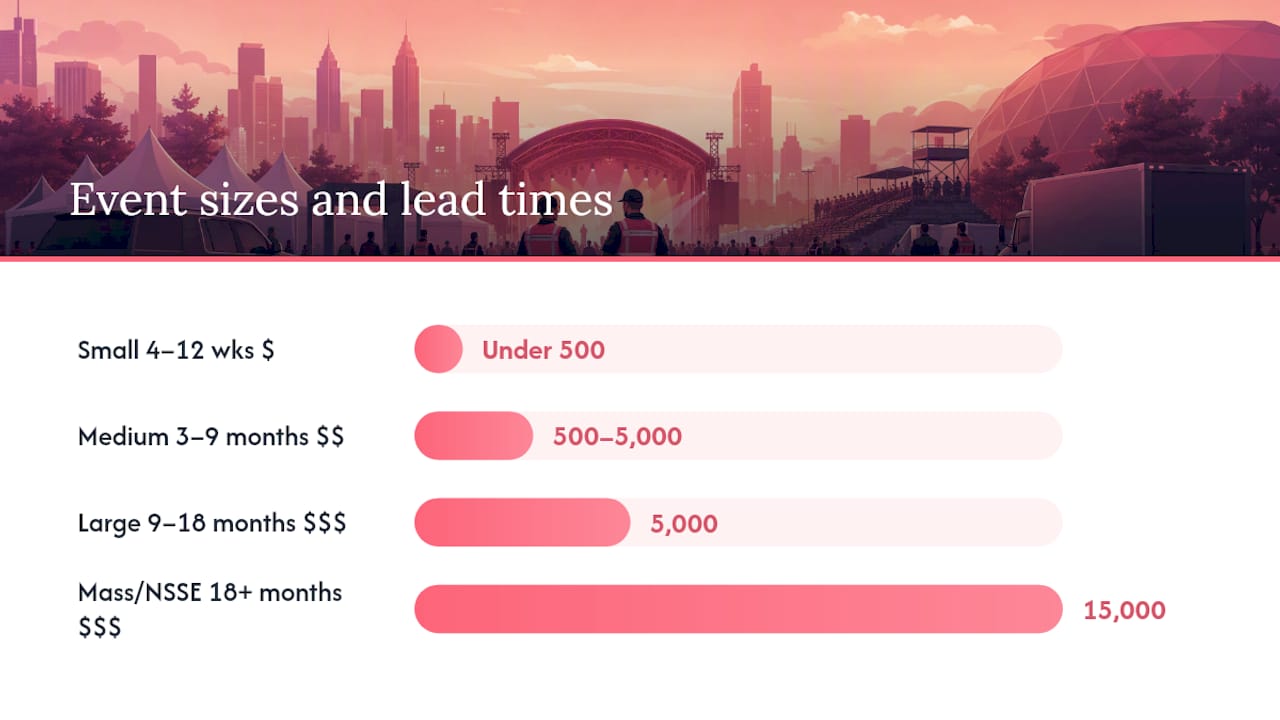
The BJA Planning Primer specifically advises beginning planning for large-scale events 12–18 months before the event date. For National Special Security Events (NSSEs), federal coordination requirements push that timeline even further.
Cost band examples by tier:
- $ (Low complexity): Uniformed security guards, basic credentialing, hand-held radios, portable fencing, first-aid station
- $$ (Moderate complexity): Walk-through metal detectors, CCTV with monitoring, vehicle access control, dedicated EMS unit, background-checked vendor staff
- $$$ (High complexity): Vehicle barriers (ASTM-rated), counter-UAS systems, command post with interoperable communications, armed security details, canine units, full perimeter fencing with controlled entry points
Planning timeline milestones (working backward from event day):
- 18+ months out: Initial threat assessment, venue selection, law enforcement notification for large events
- 12 months out: Core planning team formed, ICS roles assigned, permit applications started
- 6–9 months out: Vendor contracts executed, EAP drafted, communications plan written
- 3–6 months out: Credentialing system designed, staffing plan finalized, tabletop exercise scheduled
- 4–8 weeks out: Full-scale drill or functional exercise, EAP distributed to all stakeholders
- 1–2 weeks out: Final site walk, communications check, credential distribution
San Francisco’s outdoor event security guidelines note that events exceeding 500 attendees may be required to submit a formal security plan to local authorities. Check your jurisdiction’s specific threshold — many US cities have similar requirements.
Who belongs on your core planning team and command structure?
Security planning is not a solo task. The BJA Planning Primer stresses that active engagement with local law enforcement, fire, EMS, and vendors during planning reduces operational confusion on event day. Build your team before you build your plan.
Required stakeholders:
- Event organizer / lead planner (overall accountability)
- Venue operations manager (site access, utilities, layout)
- Security lead or contracted security supervisor
- Local law enforcement liaison (permits, tactical support, intelligence sharing)
- Fire marshal representative (occupancy limits, evacuation routes)
- EMS coordinator (medical response thresholds, AED placement, hospital routing)
- Transportation and parking authority contact
- Public works or facilities contact (barriers, lighting, sanitation)
- Key vendors (catering, production, AV) who will have site access
- Legal counsel or risk manager (permit sign-off, liability review)
ICS-style command structure for the planning team:
- Incident Commander: single point of authority on event day; typically the security lead or a designated law enforcement official for large events
- Operations Section: manages security staff, access control, and crowd management
- Logistics Section: handles equipment, communications gear, credentialing materials, and medical supplies
- Planning Section: maintains the EAP, risk register, and situational awareness
- Communications/Public Information Officer: manages PA announcements, media, and inter-agency radio channels
Brown University’s Event Security Planning Guidance offers a practical institutional example of how to formalize this request and coordination process, including submission forms that trigger the right internal and external contacts.
Stakeholder role checklist:
- [ ] Each role has a named individual and a backup
- [ ] All stakeholders have signed off on the EAP
- [ ] Law enforcement and EMS have received the final site map
- [ ] The Incident Commander has authority to activate protective actions without committee approval
Pro Tip: Formalize unified command in writing before the event. One of the most common failure modes is overlapping authority between private security and public agencies. A signed role-definition document eliminates ambiguity when seconds matter.
How do you run a site-specific risk assessment for your event?
A physical security risk assessment is the foundation every other planning decision rests on. Without it, you are guessing at controls rather than selecting them based on actual exposure. The ISO 31000 risk management framework — establish context, identify risks, analyze, evaluate, treat, and monitor — adapts well to event environments and gives your process a defensible structure.
Step-by-step risk assessment process
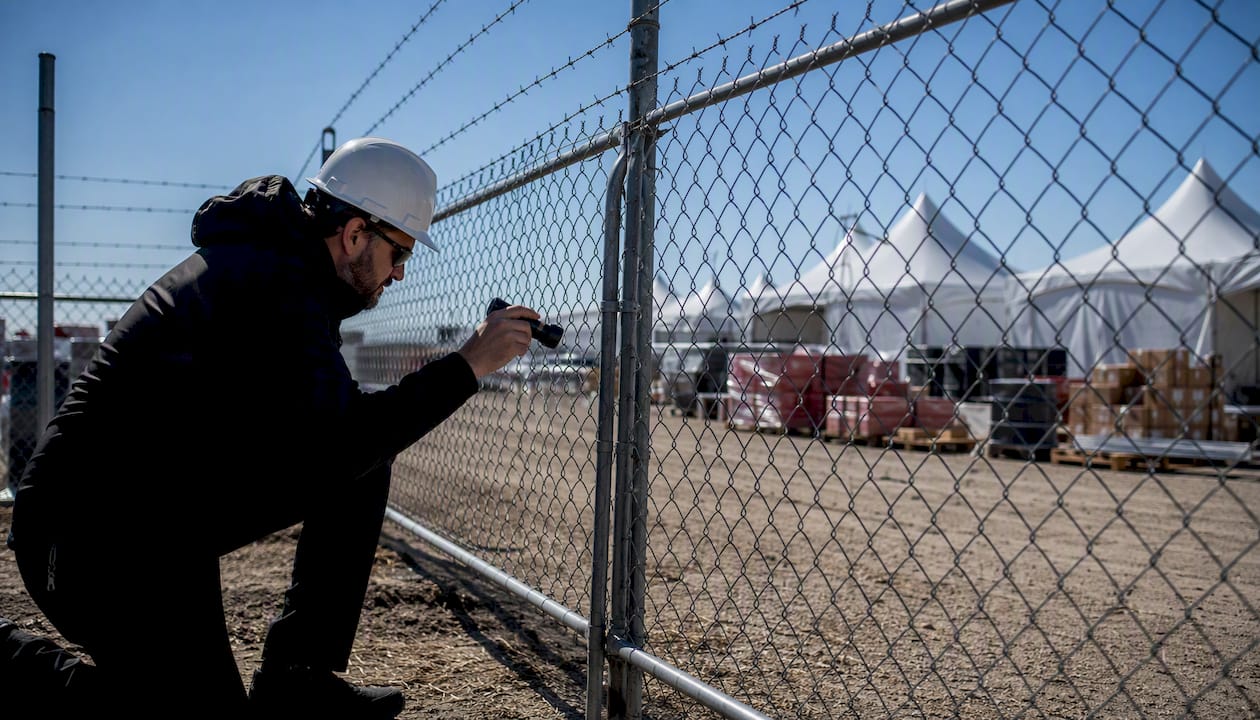
- Conduct a site walk-through with your security lead and venue manager. Document ingress and egress routes, lighting gaps, blind spots, vehicle access points, and proximity to sensitive infrastructure.
- Apply a CPTED checklist (Crime Prevention Through Environmental Design): assess natural surveillance (lines of sight), natural access control (defined entry points), territorial reinforcement (signage, fencing), and maintenance (lighting, landscaping that could conceal threats).
- Identify hazards through structured workshops with your planning team. Pull historical incident data from the venue, local law enforcement, and comparable events. Interview stakeholders about past near-misses.
- Build a risk register that records each identified hazard, its likelihood (1–5 scale), its potential consequence (1–5 scale), and the resulting risk score (likelihood × consequence).
- Prioritize controls based on risk score. High-scoring risks get mandatory controls; medium-scoring risks get monitored controls; low-scoring risks get documented acceptance.
- Record residual risk after controls are applied and confirm it is acceptable to the Incident Commander and legal counsel.
Risk register fields to capture
| Field | What to Record |
|---|---|
| Hazard description | Specific threat or failure scenario |
| Location on site | Zone, gate, or infrastructure point |
| Likelihood score (1–5) | Probability based on historical data |
| Consequence score (1–5) | Severity of impact to life, property, or operations |
| Risk score | Likelihood × Consequence |
| Assigned control | Specific measure to reduce likelihood or consequence |
| Residual risk | Remaining risk after control is applied |
| Owner | Named individual responsible for the control |
The CISA Venue Guide reinforces that no single template prevents all threats — site-specific physical security assessments are required to prioritize protections meaningfully. A generic checklist applied without a site walk produces a plan that looks complete on paper but misses the actual vulnerabilities at your venue.
What security layers should you build around your event?
The DNI/NCTC First Responders Special Events Working Aid recommends concentric rings of security as the organizing principle for event protection. Each ring adds a layer of detection, deterrence, and delay between a threat and your attendees.
Concentric ring structure and typical controls:
- Outer perimeter (public approach zone): Temporary fencing or crowd-control barriers, signage directing attendees to official entry points, vehicle exclusion zones, law enforcement or security patrols, CCTV coverage of approach routes
- Controlled entry zone: Walk-through or handheld metal detectors, bag inspection stations, ticket/credential verification, prohibited-items signage, queuing barriers to manage flow
- Sterile inner zone: Credentialed-access-only areas, roving security patrols, CCTV with active monitoring, medical station placement, radio-equipped security supervisors
- Critical infrastructure zone: Restricted access for authorized personnel only, locked or guarded utility access points, production and power equipment secured
Matching measures to cost bands and venue type:
- Outdoor festivals with large perimeters need vehicle barriers ($$$ for ASTM-rated systems) and extended CCTV coverage; indoor venues can rely more on controlled entry points and roving patrols ($)
- Lighting upgrades and CPTED fixes are often low-cost ($) but high-deterrence measures that planners underuse
- Metal detectors at entry add moderate cost ($$) and measurable deterrence; the tradeoff is slower ingress, which requires more queuing space and additional staff to maintain flow
Pro Tip: Design your security posture in modular tiers. Document what additional resources you would deploy if the threat level rises 24 hours before the event — extra patrols, additional bag-check lanes, or vehicle barriers at secondary access points. Having that plan written in advance means you can act on new intelligence without convening an emergency meeting.
How do you build a staffing plan, credential system, and crowd-flow strategy?
Staffing is where plans meet reality. Ratios, roles, and credentialing rules need to be written down and communicated to every vendor before the event, not negotiated on the day.
Staffing roles and ratio guidelines:
- Security supervisors: one per 5–10 security officers; responsible for a defined zone and direct radio contact with the Incident Commander
- Access controllers: stationed at every entry point; responsible for credential verification and prohibited-items screening
- Roving patrols: one per defined zone; responsible for crowd observation, suspicious activity reporting, and first contact with disturbances
- Medical/first-aid staff: coordinate with EMS; placement based on crowd density zones identified in the risk assessment
- Communications officer: manages radio channels, PA system access, and inter-agency contact
Credentialing checklist:
- Define access tiers (public, vendor, staff, media, VIP, operations) before printing any credentials
- Assign a unique credential design or color to each tier
- Require background checks for all staff with access to restricted zones; verify licenses for armed personnel
- Maintain a credential issuance log with name, role, and access tier
- Establish a credential revocation procedure and communicate it to supervisors
Third-party vendor contract requirements:
- Proof of state security guard licensing for all deployed personnel
- Certificate of insurance naming your organization as additionally insured
- Written confirmation of background check policy and vetting standards
- Chain-of-command documentation showing how vendor supervisors report to your Incident Commander
- Interoperable communications plan (radio channels, frequencies, or app-based alternatives)
Crowd-flow techniques:
- Use one-way routing for high-density ingress and egress to prevent counter-flow collisions
- Place queuing barriers 50–100 feet before entry points to distribute crowd pressure
- Post clear, high-visibility signage at decision points (entry gates, restrooms, exits)
- Stagger entry times for large events to prevent simultaneous peak load at gates
- Identify choke points during the site walk and assign dedicated staff to manage them
What belongs in your Event Emergency Action Plan?
Your EAP is the document that tells every stakeholder exactly what to do when something goes wrong. CISA’s Securing Public Gatherings guidance recommends developing incident response plans, training staff, and establishing pre-event collaboration with emergency authorities as core components of any public gathering security approach.
Required EAP sections:
- Activation criteria: specific thresholds that trigger each protective action (evacuation, lockdown, shelter-in-place)
- Roles and responsibilities: named individuals for each ICS function with backup contacts
- Evacuation routes and assembly points: mapped, signed, and communicated to all staff
- Lockdown procedures: criteria, announcement language, and staff actions by zone
- Medical response plan: EMS contact, hospital routing, AED locations, triage area
- Reunification point: designated location and process for attendees separated from their group
- Communications plan (PACE): Primary, Alternate, Contingency, Emergency channels
PACE communications planning:
- Primary: Event radio network (dedicated channels per zone)
- Alternate: Cell phones with a pre-shared contact list
- Contingency: Venue landlines or a designated runner system
- Emergency: Pre-arranged signal (air horn, PA tone) that triggers immediate protective action without verbal instruction
The DNI First Responders Working Aid specifically recommends interoperable communications and joint training with responders. If your security radios cannot communicate with local law enforcement frequencies, you have a gap that must be resolved before event day.
Sample PA script — evacuation:
Sample PA script — shelter-in-place:
EAP sign-off and distribution checklist:
- [ ] Incident Commander has signed the final EAP
- [ ] Copies distributed to law enforcement liaison, fire marshal, EMS coordinator, and all security supervisors
- [ ] On-site command post is equipped with printed EAP, site map, and contact list
- [ ] All staff have received role-specific EAP briefing
Pro Tip: Keep a laminated one-page EAP summary at every security post. Full documents get lost in a crisis; a single-page reference card with activation criteria, radio channels, and assembly points keeps staff on task.
For detailed emergency evacuation planning guidance, including reunification procedures and professional EAP templates, that resource covers the operational specifics in depth.
How do you train staff and test your plan before event day?
A written EAP that has never been tested is a hypothesis, not a plan. Experienced security consultants consistently advise running at least one full dress rehearsal for events with high attendance or VIPs, because tabletop exercises alone often fail to reveal logistical choke points or communications interoperability issues.
Training and exercise sequence
- Onboarding training (all staff): Cover the EAP, site map, radio procedures, prohibited items policy, and escalation protocols. Deliver this at least two weeks before the event.
- Role-specific training: Access controllers practice credential verification and prohibited-items screening; roving patrols practice suspicious-activity reporting and conflict de-escalation; supervisors practice ICS radio discipline and incident logging.
- Tabletop exercise (planning team): Walk through two or three realistic scenarios (medical emergency, suspicious package, crowd surge) with all ICS role-holders present. Identify decision gaps and update the EAP.
- Functional exercise (operations staff): Test communications and command-post procedures under simulated conditions without moving people through the venue.
- Full-scale drill (all staff, ideally with first responders): Run a complete scenario from detection through resolution. Time evacuation routes, test PA system audibility, and verify radio interoperability with law enforcement.
After-action review (AAR) template fields:
- Scenario tested and date
- Objectives met / not met
- Specific gaps identified (by zone, role, or procedure)
- Corrective action required (named owner and deadline)
- EAP sections requiring revision
- Confirmation that revisions were made and re-distributed
Exercise checklist:
- [ ] All ICS role-holders participated in the tabletop
- [ ] Communications tested on all PACE channels
- [ ] Evacuation timing recorded and compared against venue capacity
- [ ] Medical response activation tested with EMS coordinator
- [ ] AAR completed and corrective actions assigned within 48 hours of the exercise
What are the C-IED and suspicious item procedures for your event?
Counter-IED (C-IED) planning is not optional for events above a certain size or risk profile. CISA’s Outdoor Events Annex outlines C-IED tasks specifically for outdoor events, including risk information sharing, screening and detection options, pre-event sweeps, and coordination with canine or technical assets where appropriate.
C-IED planning tasks:
- Share threat information with local law enforcement and the FBI field office before the event
- Request a threat briefing from your law enforcement liaison covering current alert levels and any relevant intelligence
- Determine screening requirements based on threat level and venue type (handheld detection, walk-through portals, canine sweeps)
- Schedule pre-event venue sweeps and document cleared areas with timestamps
- Establish a suspicious item reporting chain and brief all staff on it
Pre-event sweep checklist:
- [ ] All public areas swept and cleared before gates open
- [ ] Unattended bags or items documented and resolved
- [ ] Vehicle access points inspected
- [ ] Utility rooms, restrooms, and concession areas checked
- [ ] Canine unit sweep completed (if requested and available)
- [ ] Sweep completion time and supervisor signature recorded
Suspicious item reporting flowchart:
- Staff member observes unattended or suspicious item
- Staff does not touch, move, or open the item
- Staff immediately radios supervisor with location and description
- Supervisor notifies Incident Commander
- Incident Commander contacts law enforcement liaison
- Protective action initiated per EAP (evacuation of affected zone, minimum 300-foot standoff)
- Law enforcement assumes control of the scene
Protective actions by alert level:
- Low/normal: Standard screening at entry, routine patrols, staff briefed on reporting procedures
- Elevated: Increased bag checks, additional patrols in high-density areas, canine sweep requested
- High: Enhanced screening at all entry points, vehicle exclusion zone extended, law enforcement presence increased, command post activated
Which templates should you download and how do you adapt them?
The government-issued templates below are the fastest path to a complete, defensible event security plan. Each one fills a specific section of your EAP and risk register.
Primary templates and what they contain:
- CISA Mass Gathering Security Planning Tool: generates a downloadable report based on your venue inputs; covers venue features, suggested planning considerations, and links to additional resources. Use it to populate your venue profile and initial risk register.
- CISA Security Planning Workbook (via Securing Public Gatherings): covers training requirements, pre-event collaboration steps, and incident response planning. Use it to build your training plan and EAP activation criteria.
- BJA Planning Primer Toolkit: 18 operational area checklists covering everything from access control to transportation. Use it to assign ownership to each operational area and verify nothing is missing from your plan.
- CISA Venue Guide Security Enhancements Table: maps specific security measures to intended outcomes, cost bands, and complexity levels. Use it to select and justify controls in your risk register.
- CISA Outdoor Events Annex: C-IED task checklists and sweep guidance. Use it to build your suspicious item procedures and pre-event sweep log.
How to use a template as a living document:
- Open the template and immediately populate the venue name, address, event date, and Incident Commander name
- Work through each section in order, assigning a named owner to every action item
- Flag incomplete fields in red and set a deadline for each; never leave a field blank without a resolution date
- Distribute the working document to all planning team members with edit access and a version-control log
- Freeze the final version at least 72 hours before the event and distribute printed copies to all command post personnel
Minimum fields an event security plan must contain before operations start:
- [ ] Venue name, address, and site map attached
- [ ] Event date, hours, and expected attendance
- [ ] Incident Commander name and backup
- [ ] All ICS roles named with contact numbers
- [ ] PACE communications plan complete
- [ ] Evacuation routes and assembly points mapped
- [ ] Medical response plan with EMS contact and hospital routing
- [ ] Risk register with controls assigned and owners named
- [ ] Credentialing tiers defined and credential design finalized
- [ ] EAP signed off by Incident Commander, law enforcement liaison, and fire marshal
When should you hire professional security and what should you ask them?
Some events genuinely require professional security firms. Knowing when to outsource and what to demand from a vendor protects both your attendees and your legal exposure.
Objective triggers to hire professionals:
- Expected attendance exceeds 500 (formal plan often required; see local jurisdiction thresholds)
- VIPs, elected officials, or executives will be present
- Event involves politically sensitive content or public controversy
- Venue is open-air with multiple uncontrolled access points
- Threat assessment produces high-scoring risks that exceed internal capacity
- Event involves alcohol service, late-night hours, or a history of incidents at the venue
- Transportation logistics require armed escort or executive protection
For political event security specifically, the threat profile changes significantly and requires a provider with demonstrated experience in protective intelligence and advance work.
Vendor selection checklist:
- [ ] State security guard license verified for all deployed personnel
- [ ] General liability and workers’ compensation insurance confirmed
- [ ] Background check policy documented and verifiable
- [ ] Supervisor-to-officer ratio specified in the contract
- [ ] Interoperable communications plan provided in writing
- [ ] References from comparable events available and checked
- [ ] Chain of command documented with named supervisors
Sample interview questions for security vendors:
- What is your process for conducting a pre-event site assessment?
- How do your supervisors communicate with the client’s Incident Commander during an incident?
- What background check standard do you apply to all deployed staff?
- Can you provide a sample EAP or operational plan from a comparable event?
- How do you scale staffing if the threat level changes 24 hours before the event?
Contractual red flags:
- No written vetting or background check policy
- Unclear or absent chain of command
- No interoperable communications plan
- Inability to provide proof of licensing for specific personnel
- Vague staffing commitments without named supervisors
Pro Tip: Ask every vendor candidate how they handled a specific incident at a past event. A vendor who can walk you through a real scenario, including what went wrong and how they corrected it, demonstrates operational maturity that a polished proposal cannot fake.
What most event security plans get wrong
The failure mode we see most often is not a missing checklist item. It is a planning team that convenes too late, assigns roles informally, and never tests the plan under realistic conditions. By the time the event arrives, the EAP exists as a document but not as a shared mental model among the people who need to execute it.
Scalability is the other underrated factor. A plan built for the expected attendance of 3,000 that does not account for 5,000 showing up will have insufficient staffing at entry points, overwhelmed medical resources, and a command structure that was not designed for the actual load. The solution is not to over-staff every event. It is to design modular tiers into the plan from the start, so adding resources is a decision that can be made and executed in hours, not days.
Site-specific tailoring prevents most avoidable problems. A template is a starting point, not a finished plan. The venue walk, the risk register, and the stakeholder conversations are what transform a generic document into something that actually works for your event, your venue, and your community.
Hubsecurityandinvestigativegroup’s event security services and next steps
When your risk assessment reveals exposures that exceed what an internal team can manage, Hubsecurityandinvestigativegroup delivers the personnel, planning depth, and operational experience to close those gaps. With over seventy-five years of combined law enforcement and loss prevention expertise, our team brings a practitioner’s perspective to every engagement, from a 200-person corporate function to a multi-day outdoor festival.
Our event security services cover the full planning cycle: site risk assessment, EAP development, staffing and credentialing design, crowd management, and on-site command support. For events requiring armed security or executive protection, we integrate those capabilities directly into the event security plan rather than treating them as separate engagements. Every client engagement begins with a scoping call and a site assessment, producing a written deliverable your team can use immediately. Contact Hubsecurityandinvestigativegroup to schedule your site assessment and get a plan built for your specific event.
Sources
These are the primary resources to open and download as you build your plan. Each one serves a specific function in the planning process.
Downloadable templates (active planning tools):
- Mass Gathering Security Planning Tool | CISA
- LSSE planning Primer | Bureau of Justice Assistance (BJA)
Guidance papers (read and apply, not fill-in templates):
Recommended
- Emergency Evacuation Planning: A Professional Guide
- Political Event Security: Why Stronger Protection Plans Are Essential to Prevent Shootings – Hub Security & Investigative Group
- Political Events Security & Protection Panning – Hub Security & Investigative Group
- Fireworks Security : Why Safety Should Never Be an Afterthought