
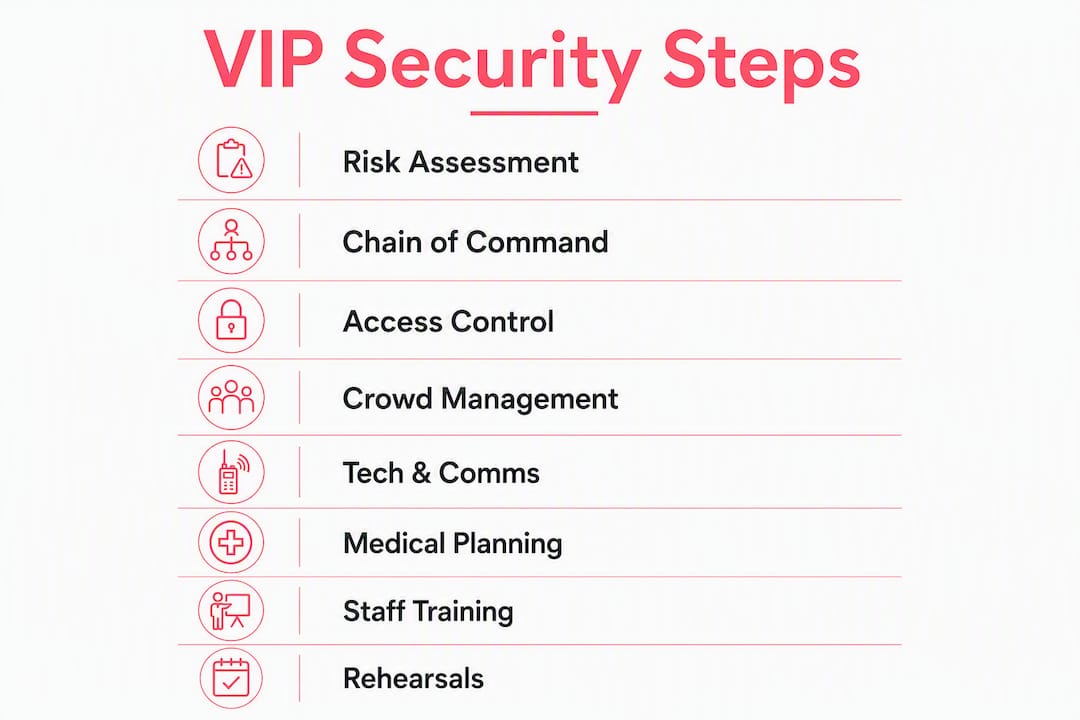
Effective VIP event security planning requires eight integrated elements working together: a clear mission and command structure, defined roles with handoff protocols, a VIP-focused threat assessment, tiered access control and credentialing, crowd and perimeter management, a technology and communications architecture, a medical and emergency response plan, and documented rehearsals with a post-event debrief. Miss any one of these, and the gaps compound under pressure.
Quick-reference checklist:
- Appoint a single incident commander before any other planning begins
- Complete a VIP-specific threat assessment and risk matrix
- Build tiered credentials and a secure ingress/egress plan
- Map perimeter zones, vehicle exclusion areas, and VIP sightlines
- Establish encrypted comms channels with redundancy and roll-call cadence
- Assign on-site medics, map evacuation routes, and confirm nearest hospital ETAs
- Run at least one tabletop and one full dress rehearsal with all key stakeholders
- Conduct a formal post-event debrief and document all incidents
Hub Investigative Group and coordination with local law enforcement and CISA resources are mandatory partners in any high-profile event security plan, not optional add-ons.
Table of Contents
- Who does what: defining security roles and chain of command
- How to build a VIP-focused event risk assessment
- How to design access control and screening for VIP events
- Managing crowds, perimeters, and VIP sightlines at high-profile events
- What technology and communications does a VIP security operation need?
- Medical planning and emergency response for VIP events
- What qualifications and training should your security staff have?
- When to start planning and what drives the budget
- A copy-ready VIP event security checklist and timeline template
- How Hub Investigative Group plans VIP events
- Key Takeaways
- A practitioner’s note on balancing security and guest experience
- Hubsecurityandinvestigativegroup: your vetted partner for high-profile event security
- Authoritative U.S. references for event security planners
Who does what: defining security roles and chain of command
Every high-profile event security operation needs a single incident commander. That person holds final authority on all security decisions, coordinates with venue management and law enforcement, and is the only one who can authorize a full evacuation or lockdown. Without that clarity, competing directives during a dynamic incident create dangerous delays.
Core roles and primary responsibilities:
- Incident Commander (Event Security Director): Overall authority, law-enforcement liaison, final escalation point
- Close-Protection Team Lead: Manages the VIP protective detail, controls proximity, and coordinates transport
- Venue Liaison: Owns the relationship with facility management, controls access to restricted areas, and manages venue staff briefings
- Credentialing and Logistics Coordinator: Manages the guest list, credential issuance, and ingress/egress flow
- Crowd Control Leads: Deployed at entry points, press areas, and audience zones; report directly to the incident commander
- Communications Officer: Maintains radio discipline, manages channel assignments, and runs roll-call checks
- On-Site Medics: Operate independently but coordinate with the incident commander on evacuation decisions
- Law-Enforcement Liaison: Maintains contact with local police, coordinates off-duty officer deployment, and manages any interagency communications
The chain of command runs from the incident commander down through the close-protection team lead and venue liaison in parallel, with the communications officer serving as the connective tissue across all roles. Shift handoffs require a formal briefing: the outgoing lead verbally confirms active threats, credential anomalies, and any open items before stepping down.
Pro Tip: For events with both a public-facing component (red carpet, press line) and a private VIP area, build a dual-layer command. Assign a separate sub-commander for each layer, both reporting to the incident commander. This prevents the public-side team from being pulled into VIP-side decisions and vice versa, which is where most communication breakdowns originate.
How to build a VIP-focused event risk assessment
A VIP threat assessment starts with the individual, not the venue. Before you evaluate the building, you need a clear picture of the VIP’s public profile, known adversaries, recent social-media exposure, travel patterns, and any prior security incidents. That profile shapes every decision that follows.
Information to collect for each VIP:
- Public profile and media exposure level (local, national, international)
- Known threats, restraining orders, or documented stalking history
- Social-media footprint and any recent doxxing or location-leakage incidents
- Schedule and travel route from origin to venue and back
- Venue vulnerabilities: approach roads, parking structures, loading docks, and sightlines from adjacent buildings
Common VIP-specific threats to assess:
- Targeted physical attack or assault by a known or unknown subject
- Hostile vehicle incursion near pedestrian arrival zones
- Intrusive media or paparazzi breaching restricted areas
- Stalker or obsessive fan attempting proximity access
- Insider threat from venue staff or contracted vendors
- Organized protest activity that could escalate or be used as a distraction
- Doxxing or real-time social-media leakage of VIP location
Once you have your threat list, apply a simple likelihood-versus-impact matrix. Plot each threat on a two-axis grid: how likely is it to occur, and how severe would the consequences be? High-likelihood, high-impact cells (a stalker with documented history at a public appearance, for example) require immediate, specific mitigations. Low-likelihood, low-impact cells can be monitored rather than resourced.
Statistic callout: The BJA/OJP Large-Scale Security Events Planning Primer identifies 19 core operational areas for event security, including dedicated tracks for Intelligence/Counter-terrorism, Interagency Communications, and Dignitary/VIP Protection. Aligning your plan to those areas and coordinating with CISA’s interagency protocols gives your assessment a defensible, field-tested structure.
CISA recommends starting every venue assessment with a formal vulnerability review and developing emergency action plans in coordination with local law enforcement. Their Protective Security Advisors can assist with that assessment at no cost to the event organizer.
How to design access control and screening for VIP events
Access control is where most security plans either hold or fall apart. The goal is a tiered system that keeps unauthorized people out of restricted areas without creating visible friction for credentialed guests.
- Define your credential tiers. At minimum: general admission, staff/vendor, press, VIP, and backstage/inner perimeter. Each tier gets a distinct credential color or design that security staff can verify at a glance.
- Build the guest list with verification fields. Name, photo ID type, credential tier, and a secondary contact for VIP guests. Use a structured check-in list that your security staff can work from efficiently under pressure.
- Establish VIP-only lanes. Separate the VIP arrival lane from general admission at least 50 feet before the first checkpoint. This prevents queue mixing and gives close-protection teams room to manage the approach.
- Screen at every tier transition. Bag screening and manual pat-downs at general admission; ID verification plus credential scan at the VIP perimeter; biometric or RFID confirmation at the inner sanctum if warranted by the risk profile.
- Map secure transport transitions. Designate a vehicle staging area away from public view, with a covered transfer point from vehicle to venue. Document the route from the staging area to the VIP holding room, and assign a close-protection agent to that corridor at all times.
- Plan egress with the same rigor as ingress. Identify the primary and secondary exit routes for each VIP, confirm vehicle staging for departure, and brief the close-protection team on the departure sequence before the event begins.
Pro Tip: The most effective discreet access control uses hospitality-trained staff at the first checkpoint rather than uniformed guards. A greeter who warmly redirects an uncredentialed guest creates far less scene than a guard who physically blocks them. Reserve uniformed presence for the inner perimeter, where its deterrent value is highest.
Managing crowds, perimeters, and VIP sightlines at high-profile events
Crowd management for VIP events is less about controlling people and more about controlling geometry. Where you place barriers, how you route press versus public, and where the VIP stands relative to sightlines from adjacent areas all determine how much exposure the VIP has at any given moment.
Core principles:
- Identify chokepoints during the site walk, not on event day. Every narrow corridor, stairwell, and single-door exit is a potential compression point under crowd surge.
- Establish a standoff distance for VIP areas. For outdoor events, a minimum buffer zone between the public perimeter and the VIP position reduces the risk of both physical approach and long-lens photography.
- Use CISA’s vehicle mitigation guidance: vehicle area patrols, enhanced lighting at approach roads, and physical barriers (jersey barriers, bollards, or vehicle-rated planters) near high-pedestrian zones. Restrict delivery vehicle access to a single, monitored entry point.
- Deploy crowd control leads at press lines with explicit instructions on camera positioning. Press should never have an unobstructed sightline to the VIP holding area.
- Use directional signage and steward deployment to route general admission away from VIP arrival corridors. The public should never share a path with the VIP.
Pro Tip: For high-risk VIP movements, build a deceptive routing plan: announce one arrival route internally, execute a different one. Use redundant vehicles so that even if the primary route is compromised, the VIP is already in a secondary vehicle on an alternate path. Document both routes and the decision criteria for switching in the operational plan.
What technology and communications does a VIP security operation need?
The right technology gives your team situational awareness without turning the event into a surveillance operation. The wrong setup, or no setup, leaves critical blind spots.
Recommended equipment:
- CCTV cameras positioned on approach roads, vehicle staging areas, and all perimeter entry points. Avoid placing cameras in VIP holding rooms; focus coverage on approaches and transitions.
- Portable credential scanners or RFID readers at tier-transition checkpoints, integrated with your visitor management system for real-time access logs
- Body-worn cameras for close-protection agents, with a clear retention and review policy documented before the event
- Vehicle barriers with sensor alerts at the primary vehicle exclusion perimeter
- RFID wristbands or smart credentials for inner-perimeter access, which create an automatic log of who entered and when
Communications protocol:
- Assign encrypted radio channels by function: command, close-protection, crowd control, and medical each get a dedicated channel
- Establish a naming convention for channels and brief all staff before the event
- Build in redundancy: primary encrypted radio, secondary cell-based group messaging, and a satellite or backup radio option for outdoor or remote venues
- Run a buddy-check and roll-call at the start of each shift and at every major transition point (VIP arrival, VIP movement, VIP departure)
OSINT and social-media monitoring should be active from the moment the event is announced. Pre-event leakage of a VIP’s schedule or location is one of the most common and preventable threat vectors. Assign a dedicated analyst or use a monitoring service to scan for event hashtags, venue tags, and VIP name mentions in the 72 hours before the event.
Privacy note: Minimize recording of VIP faces in any footage shared publicly or with venue staff. Retain access logs and incident-related footage for a minimum of 30 days post-event for potential incident review.
Medical planning and emergency response for VIP events
Medical planning is not a separate track from security planning. It is integrated into it. Your incident commander needs to know where the medics are, what they can treat, and how long it takes to get a VIP or attendee to the nearest trauma center.
Minimum on-site medical capabilities:
- At least one Advanced Life Support (ALS) provider or paramedic on site for events over 500 attendees; Basic Life Support (BLS) minimum for smaller gatherings
- STOP THE BLEED® kits staged at every security post and in the VIP holding area, with staff trained in their use
- A dedicated medic assigned to the VIP convoy, not shared with general attendee coverage
- A documented ETA to the nearest Level I or Level II trauma center, confirmed during the site walk
Evacuation and EMS coordination:
- Map primary and secondary evacuation routes for both the VIP and the general attendee population. These routes should never cross.
- Designate a vehicle staging area for VIP medevac that is accessible to EMS without crossing the public perimeter
- Coordinate with local EMS in advance: share the venue layout, confirm their access point, and integrate their entry path into your access-control plan so they are not delayed at a checkpoint during an emergency
- Assign a security escort to meet EMS at the perimeter and guide them to the incident location
Post-incident documentation checklist:
- Incident report completed within two hours of the event’s conclusion
- Witness statements collected and secured
- Medical records and chain of custody documented per HIPAA requirements
- All access logs and relevant footage preserved and stored securely
What qualifications and training should your security staff have?
Credentials matter, but they are a floor, not a ceiling. The minimum bar for any event security staff member in the United States is a valid state guard card (required in most states), current first aid and CPR certification, and documented conflict de-escalation training. For close-protection roles, add a recognized close-protection or executive protection course from a credentialed provider.
Recommended certifications and experience:
- State-issued security guard license (mandatory in most U.S. states)
- First Aid/CPR/AED certification, current within two years
- Close-protection coursework for any agent within 10 feet of the VIP
- STOP THE BLEED® training for all security staff
- Active-shooter emergency action plan training, aligned with CISA’s Active Shooter Emergency Action Plan Product Suite
Staffing ratios (general guidance, scaled by risk profile):
- General admission crowd control: 1 security officer per 100–150 attendees
- VIP perimeter: 1 officer per 25–30 guests in the restricted zone
- Close-protection detail: minimum 2 agents per VIP principal for public-facing events; 3 or more for elevated-risk profiles
- Medical: 1 ALS provider per 500 attendees, supplemented by BLS staff
Rehearsal requirements:
- Tabletop exercise with all key stakeholders (incident commander, close-protection lead, venue liaison, law-enforcement liaison, medics) at least 30 days before the event. Multi-agency tabletop exercises reveal both policy and operational gaps that single-agency rehearsals miss.
- Full dress rehearsal with all security staff at the venue, walking every route and transition point, at least 7 days before the event
- Communications check: all channels tested, all staff confirmed on correct channels, 24 hours before the event
Non-security venue staff (hosts, ushers, catering) should receive a 15-minute briefing covering: how to report suspicious behavior, their role in an evacuation, and who to contact if they observe a credentialing anomaly. They are your eyes in areas where security staff cannot be present without creating an overt presence.
When to start planning and what drives the budget
For large-scale VIP events, planning should begin 12–18 months in advance. For mid-size corporate or celebrity appearance events, six months is the practical minimum. Starting later compresses every milestone and forces reactive decisions.
| Milestone | Timing | Key Actions |
|---|---|---|
| Initial planning | 12–18 months out | Appoint incident commander, begin VIP threat assessment, identify venue |
| Interagency coordination | 6 months out | Engage local law enforcement, apply for permits, confirm EMS coordination |
| Operational plan draft | — | Finalize roles matrix, comms plan, access-control scheme, medical plan |
| Tabletop exercise | 30 days out | Test plan with all stakeholders, document gaps and revisions |
| Dress rehearsal | 7 days out | Full walk-through at venue, comms check, credential system test |
| Final briefings | 24 hours out | Brief all staff, confirm law-enforcement contacts, verify medical staging |
| Event day | Day of | Roll-call, comms check, VIP arrival confirmation, post-event debrief |
Primary budget drivers:
- Security staffing: hours, overtime, and supervisor premiums
- Close-protection detail: daily rates for licensed executive protection agents
- Credentialing technology: scanners, RFID wristbands, visitor management software
- Vehicle mitigation: barrier rental, vehicle staging logistics
- Medical staffing: ALS/BLS provider fees
- Law-enforcement overtime and permit fees (varies by jurisdiction)
- Event security insurance and liability coverage
For a detailed breakdown of executive protection cost factors, the variables that move the number most are the VIP’s risk profile, the number of public-facing transitions, and the duration of coverage.
Pro Tip: If you have to prioritize spend, put it in rehearsals, comms redundancy, and vetted transport first. These three areas prevent the most common failure modes: communication breakdown during a dynamic incident, a single-point-of-failure radio system, and an unvetted driver with access to the VIP’s route.
A copy-ready VIP event security checklist and timeline template
Use this checklist as the backbone of your operational plan. Assign an owner to every line item before distribution.
| Phase | Task | Owner |
|---|---|---|
| Pre-event | Complete VIP threat assessment and risk matrix | Security Director |
| Pre-event | Finalize credential tiers and issue credentials | Credentialing Coordinator |
| Pre-event | Confirm law-enforcement liaison and permits | Incident Commander |
| Pre-event | Map all ingress/egress routes and vehicle staging | Venue Liaison |
| Pre-event | Conduct tabletop exercise and document gaps | Incident Commander |
| Pre-event | Brief non-security venue staff | Venue Liaison |
| Event day | Roll-call and comms check (T-2 hours) | Communications Officer |
| Event day | Credential system test and checkpoint staffing (T-1 hour) | Credentialing Coordinator |
| Event day | VIP arrival confirmation and close-protection handoff | Close-Protection Lead |
| Event day | Continuous OSINT/social-media monitoring | Designated Analyst |
| Event day | VIP departure: vehicle staging, route confirmation, escort | Close-Protection Lead |
| Post-event | Venue sweep and credential collection | Venue Liaison |
| Post-event | Incident reports completed within 2 hours | All Team Leads |
| Post-event | Formal debrief with all stakeholders | Incident Commander |
Hour-by-hour event-day timeline (sample):
- T-3 hours: Security team arrives, venue walk-through, checkpoint setup
- T-2 hours: Roll-call, comms check, medical staging confirmed
- T-1 hour: Credential system live, VIP holding room secured, transport confirmed
- T-0 (VIP arrival): Close-protection team activates, all checkpoints at full staffing
- During event: Continuous monitoring, shift check-ins every 30 minutes
- VIP departure: Staged vehicle confirmed, route cleared, close-protection escort active
- T+30 minutes: Venue sweep, credential collection, initial incident log review
- T+2 hours: All incident reports submitted, debrief scheduled
Document storage and distribution: The operational plan should be distributed only to named stakeholders in password-protected format. Version-control every revision with a date stamp. Never share the full plan via unencrypted email or public file-sharing platforms.
How Hub Investigative Group plans VIP events
Hubsecurityandinvestigativegroup has been building event security plans since 2004, drawing on over seventy-five years of combined law enforcement and loss prevention experience across the team. That background shapes how we approach every engagement: not as a staffing exercise, but as an operational planning problem with a specific risk profile, a specific VIP, and a specific venue.
A representative engagement for a corporate leadership event with a high-profile keynote speaker illustrates the methodology. The core risks were intrusive media, an organized protest group with a documented history of venue disruption, and a VIP with a publicly known schedule. We structured the operational plan around three priorities: a deceptive arrival routing plan with redundant vehicles, a dual-layer command separating the public press area from the private VIP corridor, and a dedicated OSINT analyst monitoring event-related social-media activity from 72 hours before the event through departure.
The tabletop exercise, run 21 days before the event with the incident commander, venue liaison, local law-enforcement liaison, and the client’s communications team, surfaced a critical gap: the venue’s loading dock shared a wall with the press staging area, creating an unmonitored transition point. That finding was corrected in the operational plan before event day.
When evaluating any security provider for a high-profile event, ask these questions: Do they conduct a VIP-specific threat assessment, or do they apply a generic event template? Do they run tabletop exercises with your team before the event? Can they provide a dedicated incident commander with law-enforcement coordination experience? And do they have documented close-protection protocols for transport transitions?
For political events and high-exposure appearances, the planning complexity increases further, and the interagency coordination requirements become more demanding. Hubsecurityandinvestigativegroup’s team has the background to manage those relationships directly.
Key Takeaways
Effective VIP event security planning requires eight integrated elements, a single incident commander, and coordination with local law enforcement and CISA resources from the earliest planning stage.
| Point | Details |
|---|---|
| Start planning early | Large-scale events require significant lead time; mid-size VIP events should begin planning as early as possible to allow adequate preparation. |
| Appoint one incident commander | A single authority prevents competing directives during dynamic incidents and is the most critical structural decision. |
| Run multi-agency tabletop exercises | Tabletop exercises with all stakeholders, held at least 30 days out, surface operational gaps that no SOP review will catch. |
| Integrate medical into the security plan | Assign a dedicated medic to the VIP convoy, map evacuation routes separately from general attendee routes, and confirm hospital ETAs during the site walk. |
| Hubsecurityandinvestigativegroup | Established in 2004 with over seventy-five years of combined law enforcement experience, Hubsecurityandinvestigativegroup provides VIP-specific event security planning, close protection, and OSINT threat monitoring for high-profile events. |
A practitioner’s note on balancing security and guest experience
The tension between thorough protection and a frictionless guest experience is real, and most planners resolve it the wrong way. They either over-staff with uniformed guards who signal threat to every guest who walks in, or they under-staff to preserve atmosphere and leave genuine gaps in coverage. Neither is the right answer.
The most effective VIP security operations are ones where the guests never feel watched. That requires deliberate choices at every layer. Hospitality-trained staff at the outer perimeter. Credential checks that feel like a welcome, not a screening. Close-protection agents dressed to match the event’s dress code, not standing out in tactical gear. The security presence should be felt as confidence, not as tension.
Where visible security is necessary, it should be purposeful. A uniformed officer at the vehicle exclusion perimeter communicates deterrence to a potential hostile vehicle threat. That same officer standing inside the VIP cocktail reception communicates something very different to the guests. Context determines whether a visible security presence reassures or unsettles.
Media management is a specific skill that many security teams underestimate. Press at a red carpet event or celebrity appearance are not adversaries, but they will test every boundary you set if those boundaries are not clearly communicated and consistently enforced. Brief the press coordinator and the close-protection team together before the event. Agree on the camera positions, the no-go zones, and the protocol for a photographer who violates the boundary. A calm, pre-planned response to a media boundary violation is far less disruptive than an improvised one.
Pro Tip: Train your entire security team in one customer-service principle: every interaction with a guest, credentialed or not, should end with the guest feeling respected. A guest who feels respected does not complain to the client. A guest who feels dismissed does, and that complaint lands on the event planner’s desk, not the security team’s.
Hubsecurityandinvestigativegroup: your vetted partner for high-profile event security
Planning a VIP event and need a security partner who has already done the operational work described in this guide? Hubsecurityandinvestigativegroup brings over seventy-five years of combined law enforcement experience to every engagement, with a team that builds event-specific operational plans, not generic staffing templates.
Our event security services cover the full scope: threat assessment, roles and command structure, credentialing and access control, close-protection details, OSINT monitoring, and post-event debrief. For events requiring armed posts or armed close-protection, our armed security team is licensed and experienced in high-exposure environments.
To request a scoped proposal, have the following ready: event date and duration, VIP count and risk profiles, venue name and address, expected attendance, and any known threat indicators or prior incidents. Contact Hubsecurityandinvestigativegroup directly through hubsecurityandinvestigativegroup.com to schedule a planning consultation.
Authoritative U.S. references for event security planners
These are the primary sources we recommend for templates, toolkits, and policy guidance:
- Securing Public Gatherings | CISA: CISA’s central hub for mass gathering security, including the Mass Gathering Security Planning Tool, Security Planning Workbook, and tabletop exercise packages. Start here for official templates.
- Mass Gathering Security Planning Tool | CISA: A structured framework for event planners to begin or continue planning for mass gatherings, with checklist items and venue characteristics.
- Protecting Patrons at Public Gathering Locations | CISA: Covers vulnerability assessments, vehicle mitigation, STOP THE BLEED® recommendations, and active-shooter emergency action planning.
- Public Venue Security Screening Guide | CISA: Practical options for developing and implementing security screening at public venues, developed with the Commercial Facilities Sector Coordinating Council.
- Staying Secure at Large-Scale Events | CISA: Tips and resources for host cities and event organizers, updated for major 2026 gatherings.
- Managing Large-Scale Security Events: A Planning Primer | BJA/OJP: The most detailed U.S. government planning framework for law enforcement and event security coordinators, covering all 19 operational areas including VIP/dignitary protection and interagency communications.
- Event Security Services | Hubsecurityandinvestigativegroup: Hubsecurityandinvestigativegroup’s event security service page, covering staffing, operational planning, and scope-of-work options for high-profile events in the United States.
- OSINT Capabilities | Hubsecurityandinvestigativegroup: Overview of OSINT and social-media monitoring capabilities for pre-event threat detection and VIP location-leakage prevention.
Recommended
- Political Events Security & Protection Panning – Hub Security & Investigative Group
- Political Event Security: Why Stronger Protection Plans Are Essential to Prevent Shootings – Hub Security & Investigative Group
- Hotel Security Management: What Every Property Must Require
- Corporate Security Policy: A Complete Guide for Managers