
An access control policy is a written, enforced rule set stating who may enter which zones, when, and how, backed by badges, escorts, and logs to make every entry auditable. Write one that maps zones to roles and enforce it consistently. Anchor your approach to established frameworks like NIST and the CISA Venue Guide, and if you need a partner to implement and enforce it, that’s where a firm like Hubsecurityandinvestigativegroup can help.
TL;DR:
- Only grant access to zones based on clearly defined roles that follow the principle of least privilege, avoiding unnecessary broad permissions.
- Maintain an accurate, up-to-date inventory of physical keys, credentials, and combinations, with scheduled rotations tied to role changes or suspicions of compromise.
- Ensure visitor logs capture full details and enforce strict badge visibility and expiration protocols, issuing time-bound credentials for contractors and requiring escorts in sensitive areas.
- Revoke access immediately upon badge loss or termination, and document all incidents with CCTV evidence, witness statements, and proper follow-up procedures.
- Support audits with comprehensive logs, device inventories, and retention of visitor records at least 90 days, conducting regular reviews and policy updates aligned with established standards.
Table of Contents
- Why an Access Control Policy Matters for Your Property
- What Should Be in Your Access Control Policy?
- How Should Visitor Access and Badges Be Managed?
- What Happens When Access Fails: Incident Response
- What Do Auditors Expect From an Access Control Policy?
- How Do You Implement an Access Control Policy Step by Step?
- Where Access Control Policies Usually Break Down
- How Hub Investigative Group Implements and Enforces Your Policy
- Sources
Why an Access Control Policy Matters for Your Property
Your policy has to do three jobs at once: keep people safe, protect physical and intellectual assets, and produce a paper trail an auditor or investigator can actually use later. Scope comes first. Decide which sites, buildings, rooms, and events the policy governs before you write a single rule, because a policy with fuzzy boundaries gets ignored the first time it’s inconvenient.
Defense-in-depth is the operating principle behind almost every credible framework in this space. No single barrier, guard post, or card reader should be the only thing standing between a stranger and a sensitive area.
- Physical barriers (fencing, locked doors, mantraps) slow down casual intrusion
- Staffed checkpoints add judgment and de-escalation that hardware can’t
- Electronic access control systems (PACS) create the logs auditors need
CISA’s guidance for venues and events recommends tailoring these layers to your actual risk and budget rather than copying a generic template, and escalating to higher-assurance controls (biometrics, dual authentication) only where a risk assessment justifies the added cost.
What Should Be in Your Access Control Policy?
A policy that doesn’t survive contact with a real incident usually skipped one of these components. Build your document around them, and you’ll have something an auditor, a new security director, or a court can actually rely on.
- Ownership and approval authority. Name the specific person or role who grants and revokes access, and the workflow that requires their sign-off. Absent ownership is the single biggest failure mode security consultants encounter when reviewing a client’s existing access control policy.
- Access roles mapped to least privilege. Every credential holder gets access to exactly the zones their job requires, nothing more. A visiting vendor doesn’t need a badge that opens the server room just because it was easier to provision that way.
- Credential types by zone risk. Standard proximity cards work for general office space. Server rooms, cash-handling areas, and executive suites warrant mobile credentials with multifactor authentication or biometric verification.
- Key and combination management. Keep a current inventory of all physical keys, cards, and combination locks, assign custody, and maintain a schedule for rotation related to role changes or potential compromises.
- Zone classification. Label spaces Controlled, Limited, or Exclusion, following the model the Interagency Security Committee uses, so credential strength and escort requirements follow logically from where someone is trying to go.
- Logging and retention minimums. Capture entry and exit at every defined checkpoint, and don’t fall below the 90-day retention baseline PCI-covered environments follow, even if you aren’t processing payment data. It’s a reasonable floor for almost any facility.
Pairing your zone map with a formal physical security risk assessment tells you exactly where the stronger credentials actually need to go, instead of guessing.
Pro Tip: Automate revocation wherever you can. Tying badge deactivation directly to your HR offboarding trigger closes the gap between someone’s last day and the moment their access actually stops working.
How Should Visitor Access and Badges Be Managed?
Visitors are where policies most often break down, mainly because the rules exist on paper but nobody enforces them at the front desk. Every visitor log should capture full name, company affiliation, host employee, and exact entry and exit times, held for at least 90 days under the PCI-aligned baseline that applies broadly even outside payment environments.
Badge design matters more than most facility managers assume. Distinct visual cues, different colors, bold “VISITOR” text, or a clear expiration date, let guards and staff spot an unescorted or expired badge from across a lobby, and that visual differentiation is a documented, effective control against one of the most common failure points in high-traffic sites.
- Require escorts for visitors entering Limited or Exclusion zones
- Issue time-bound contractor credentials that expire automatically at shift end
- Train staff to challenge anyone without a visible badge, politely but consistently
- Install anti-tailgate hardware (mantraps, turnstiles) at your highest-risk entry points
A visitor management system built for this purpose beats a paper sign-in sheet on every one of those points, especially retention and searchability.
What Happens When Access Fails: Incident Response
Lost badges, tailgating, and unauthorized entry aren’t hypothetical. Your policy needs a documented, immediate response, not an improvised one.
- Contain it. Revoke the compromised credential immediately, secure the affected perimeter, and preserve any physical evidence at the scene.
- Investigate it. Pull CCTV footage tied to the badge logs for that entry point, and collect witness statements from anyone who saw the event.
- Remediate it. Reissue credentials, rotate any keys or combinations that may have been exposed, and schedule retraining for the staff involved.
- Document it. Keep a complete record of the incident and response for audit and potential legal follow-up.
Human error, not hardware failure, causes most of these incidents. Role-specific training that walks staff through exactly what tailgating looks like beats a generic security memo every time.
What Do Auditors Expect From an Access Control Policy?
An auditor doesn’t take your word that the policy works. They want artifacts: access logs from every entry point, a current device inventory with named custodians, visitor logs going back at least 90 days, and a change log documenting every key or combination rotation.
- Access logs tied to specific checkpoints, not a general building log
- Device inventory listing custodian and last-verified date for each credential
- Visitor logs meeting the retention baseline
- Key and combination rotation records with dates and reasons
NIST SP 800-53 PE-03 sets the bar most auditors reference: verify authorization before every physical entry, maintain logs at defined points, escort visitors under defined conditions, and rotate credentials on a set schedule. Quarterly log reviews and an annual full policy refresh keep you ahead of drift between what’s written and what’s actually happening at the door.
Pro Tip: Standardize your log-review report format before your first audit, not during it. A consistent template makes anomalies jump out instead of hiding in inconsistent spreadsheets.
How Do You Implement an Access Control Policy Step by Step?
Writing the policy is the easy part. Getting it operational is where most facility teams stall out. Work through these in order:
- Map every entry and exit point, including loading docks and emergency exits, plus every zone that holds sensitive assets or data.
- Define roles and least-privilege groups before you touch a single credential system, so access maps to job function from day one.
- Select credential types per zone and document the approval workflow for each, from standard badge to biometric-plus-MFA.
- Design your visitor flow, badge format, and log retention rules, aligned to the 90-day baseline.
- Inventory every physical access device, assign custodians, and set a rotation schedule for keys and combinations.
- Run a tabletop exercise simulating a lost or stolen credential. This proves your incident response holds up before a real one tests it.
- Publish the policy, train each role specifically, and put quarterly log reviews and annual refreshes on the calendar now, not later.
Event planners running a one-time or recurring event should treat checkpoints and staffing the same way, referencing a dedicated event security playbook for crowd flow and public access points that a standing office policy doesn’t need to address.
Where Access Control Policies Usually Break Down
The failures we see most often aren’t exotic. They’re mundane: nobody owns the policy, the badge list hasn’t been reconciled in eight months, and visitors sign a clipboard nobody reads twice. Fixing those three things solves more risk than any new piece of hardware.
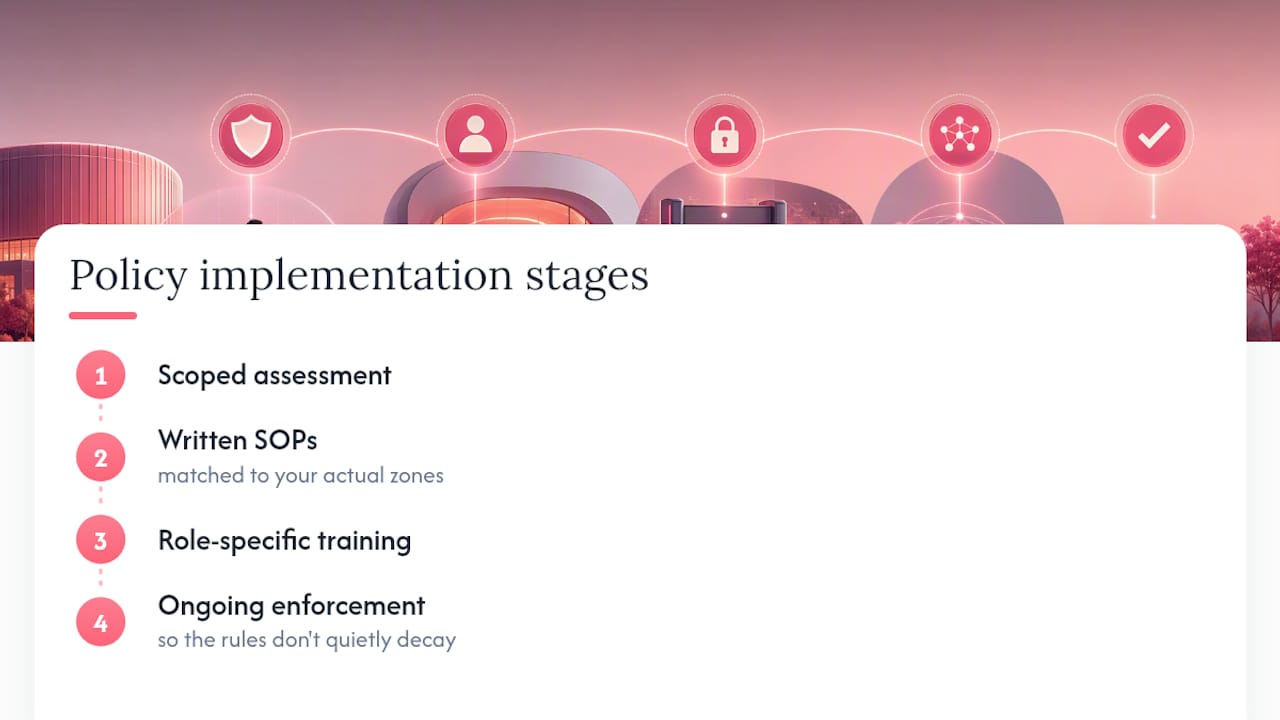
A policy implementation engagement typically starts with a scoped assessment, moves into written SOPs matched to your actual zones, adds role-specific training, and finishes with ongoing enforcement support so the rules don’t quietly decay again next quarter. Before hiring a security partner, ask them to name your policy owner, your revocation trigger, and your log retention period. If they can’t answer clearly, they haven’t actually looked at your facility yet.
— Derek
How Hub Investigative Group Implements and Enforces Your Policy
Hubsecurityandinvestigativegroup is the option for facility managers and event planners who need a policy that actually gets enforced at the door, not just drafted and filed away. Where a generic consultant hands you a document, Hub pairs the paperwork with the guards, badge protocols, and executive protection staff who make it real on-site, every shift.

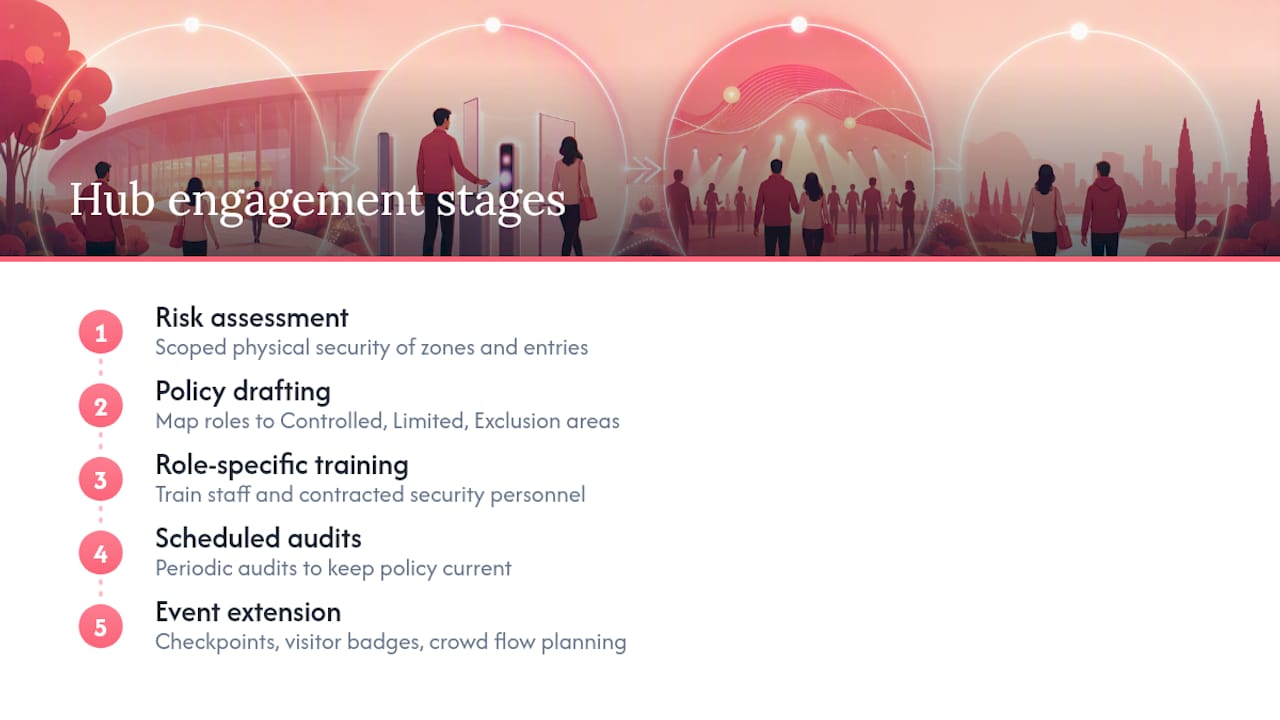
A typical engagement moves through four stages: a scoped physical security risk assessment of your zones and entry points, policy drafting that maps roles to Controlled, Limited, and Exclusion areas, role-specific training for your staff and any contracted security personnel, and scheduled audits to keep the policy current as your facility changes. For events, that same framework extends to dedicated checkpoints, visitor badge management, and crowd flow planning handled by Hub’s event security teams.
If you’re evaluating whether your current setup would survive an audit or an incident, start with a conversation about trusted security services built around your specific zones, staffing, and risk profile.
Sources
Consult the CISA venue guide for layered event controls, NIST SP 800-53 PE-03 for audit-ready logging standards, and PCI-aligned visitor log guidance for retention documentation auditors will request directly.
- CISA venue guide for security enhancements and mitigating dependency disruptions (2025)
- Wipfli assurance — guidance on visitor log retention for PCI compliance
- Coram