
An effective alarm response procedure must do six things without exception: verify the signal, prioritize risk, secure the scene, escalate through the right channels, document every action, and run a post-incident review. Standards like NFPA 72 and ANSI/SIA CP-01 define the equipment and monitoring behaviors that underpin those steps, while Enhanced Call Verification (ECV) is the industry-standard method monitoring centers use before requesting police dispatch on unverified signals.
Your baseline alarm response checklist:
- Receive and classify the signal (alarm type, zone, time of day)
- Attempt verification using ECV, audio, or video before dispatching
- Escalate immediately for life-safety alarms (panic, holdup, fire)
- Dispatch a trained responder and notify the keyholder
- Document every action with timestamps in CAD or your incident log
- Conduct a post-incident debrief and update procedures as needed
Every section below unpacks one of those steps with operational detail, templates, and policy context your team can use today.
Key Takeaways
Effective alarm response procedures require verified signals, clear role assignments, CP-01-compliant equipment, jurisdiction-specific dispatch rules, thorough documentation, and regular training to remain operationally sound.
| Point | Details |
|---|---|
| Verify before dispatching | Use ECV and audio/video verification on all non-life-safety alarms before requesting police response. |
| Life-safety alarms skip verification | Panic, holdup, fire, and CO alarms require immediate dispatch with no verification delay. |
| CP-01 equipment reduces false alarms | Abort windows, cross-zoning, and swinger shutdown lower nuisance activations and improve police trust. |
| Local policy determines escalation | Confirm permit requirements, fine schedules, and verified-response rules with your local communications center before finalizing any procedure. |
| Documentation is non-negotiable | Every action must be timestamped and logged; weak notes cannot defend a response decision or support a prosecution. |
| Hubsecurityandinvestigativegroup | Provides site-specific alarm response audits, procedure drafting, responder training, and live drills for commercial facilities. |
Table of Contents
- What alarm response procedures are and who they apply to
- How monitoring centers verify alarms before escalation
- A step-by-step alarm response flow for your organization
- Equipment and system controls that change how alarms are handled
- How local dispatch policies affect your alarm procedures
- Who does what during an alarm event
- How to log and report alarm incidents properly
- Training and quality assurance for alarm response teams
- Ready-to-use templates and checklists for alarm response
- Why safety must come before speed in alarm response
- How Hubsecurityandinvestigativegroup supports alarm response implementation
- Sources
What alarm response procedures are and who they apply to
Alarm response procedures are the documented, step-by-step instructions that govern how every party in the alarm chain acts from the moment a signal is received to the moment an incident is closed. They apply to four distinct audiences: central station operators who receive and verify signals, dispatchers who coordinate police or guard response, on-site responders (security officers, facility managers, or law enforcement) who physically respond, and keyholders who hold authority to cancel or confirm an alarm.
The procedures are not one-size-fits-all. Each alarm type carries a different risk profile and a different expectation for how fast verification must happen before escalation.
Alarm types and their urgency levels:
- Intrusion/burglary alarms: High false-alarm rate; verification-first protocols apply in most jurisdictions before police dispatch is requested.
- Panic/holdup alarms: Immediate escalation. Most police departments and agency directives treat these as life-safety events and dispatch without waiting for verification.
- Fire alarms: Governed by NFPA 72; typically require immediate fire department notification with no verification delay.
- Environmental alarms (CO, flood, temperature): Urgency depends on the specific hazard; CO alarms warrant immediate evacuation and dispatch.
- Supervisory alarms: Low urgency; indicate a system fault or tamper condition. Log and investigate, but rarely require police dispatch.
- Duress/silent alarms: Treat as life-safety; immediate, covert response is standard.
- Vehicle alarms: Lowest priority; verification and keyholder contact before any field response.
| Alarm Type | Typical Verification Expectation | Usual Initial Responder Action |
|---|---|---|
| Intrusion/burglary | ECV or video verification required | Conditional dispatch after verification |
| Panic/holdup | No verification delay | Immediate police dispatch, covert approach |
| Fire | No verification delay | Immediate fire department notification |
| Environmental (CO) | No verification delay | Immediate evacuation and dispatch |
| Supervisory/tamper | Log and investigate | Keyholder notification only |
| Duress/silent | No verification delay | Immediate covert police dispatch |
| Vehicle | Keyholder contact first | Field response only after confirmation |
How monitoring centers verify alarms before escalation
Verification is the most consequential step in the entire process. Done well, it separates genuine threats from nuisance activations and determines whether law enforcement responds with urgency or skepticism. Verified audio and video alarms provide the evidence most jurisdictions use to grant priority police response, and they materially reduce false dispatches and the fines that follow.
The standard monitoring-center verification sequence runs as follows:
- Signal receipt and classification. The central station receives the alarm signal, identifies the account, pulls the permit number, and classifies the alarm type. Life-safety signals (panic, fire, CO) skip to immediate dispatch.
- Initial premises call attempt. The operator calls the protected premises. Per TMA CS-V procedures, if an answering machine picks up, the operator leaves a brief message and proceeds to the next step.
- Enhanced Call Verification (ECV). If the premises call goes unanswered or unresolved, the operator calls a second contact from the account’s notification list before requesting police dispatch. ECV is the Security Industry Association’s recommended two-call minimum standard and is accepted by most police departments as a condition for response.
- Audio or video verification. Where two-way audio or live video is available, the operator uses it to confirm activity. A confirmed voice, a visible intruder, or an open door on camera all meet the threshold for a verified dispatch.
- Dispatch decision. If verification confirms a genuine event, the operator requests police response and notifies the keyholder. If the alarm is cancelled by an authorized user with the correct verbal password, the operator logs the cancellation and closes the event.
Best-practice call attempt guidance:
- Make at least two call attempts to separate contacts before requesting dispatch on a burglary signal.
- Always ask for the account’s verbal password or a pre-agreed identification code before accepting a cancellation.
- Log the time of each attempt, the number called, who answered, and what was said.
- If the caller cannot provide the correct password, treat the alarm as unresolved and proceed to dispatch.
AI-powered video analytics are increasingly integrated into this workflow, classifying motion events by object type (person, animal, vehicle) before the signal even reaches a human operator. That pre-filtering step reduces the volume of signals requiring manual verification and improves operator confidence when a genuine event does come through.
Industry data suggests that up to 98% of traditional alarm activations are false. Verified audio or video confirmation changes that equation entirely, giving law enforcement a concrete reason to prioritize the call.
A step-by-step alarm response flow for your organization
The operational answer is straightforward: run a consistent, documented flow from the moment a signal arrives through to final disposition. Every branch in that flow should be pre-decided, not improvised in the field.
Decision tree overview:
- Verified alarm (audio/video confirmation or authorized confirmation): Request immediate police dispatch. Notify keyholder. Dispatch trained responder. Do not enter until law enforcement clears the scene.
- Unverified alarm (no answer, no video, no audio): Complete ECV. If second contact also fails, request conditional dispatch per local policy. Notify keyholder.
- Panic/holdup alarm: Immediate police dispatch, no verification delay. Covert approach required. Do not announce arrival.
- Cancelled alarm (correct password provided): Log cancellation with timestamp and authorizing contact. No dispatch.
- Simultaneous alarms (multiple zones or multiple sites): Prioritize life-safety signals first. Assign a dedicated operator to each active account. Do not allow one operator to manage more than two simultaneous active events without supervisor support.
On-scene checklist for responders:
- Park at a distance that allows observation without announcing your presence.
- Approach on foot from a position that keeps you out of direct sight lines from windows and doors.
- Observe for signs of forced entry, open doors, broken glass, or fleeing individuals before approaching the structure.
- Do not enter a building alone when a confirmed or suspected intruder may be present. Wait for law enforcement.
- Establish a perimeter if safe to do so and maintain radio contact with the central station.
- Document your arrival time, observations, and any contact with law enforcement.
Per Oregon Police Department alarm policy, standard police tactics for holdup alarms include covert arrival, minimum two-officer response, and no announcement of presence. Your responders’ approach should mirror that posture to avoid compromising the police response.
Pro Tip: For multi-site operations, assign each site a risk tier (high, medium, low) in your monitoring platform. High-tier sites get dedicated operator attention during peak-risk hours; lower-tier sites can be handled in queue. This prevents a busy night from leaving a high-value location under-monitored.
Equipment and system controls that change how alarms are handled
Proper equipment configuration materially changes verification needs and police prioritization. A panel that meets ANSI/SIA CP-01 requirements gives monitoring centers and insurers confidence that nuisance activations have been engineered out at the source. Panels that lack these features generate more false signals, which erodes law enforcement trust over time.
Key equipment controls and what they do:
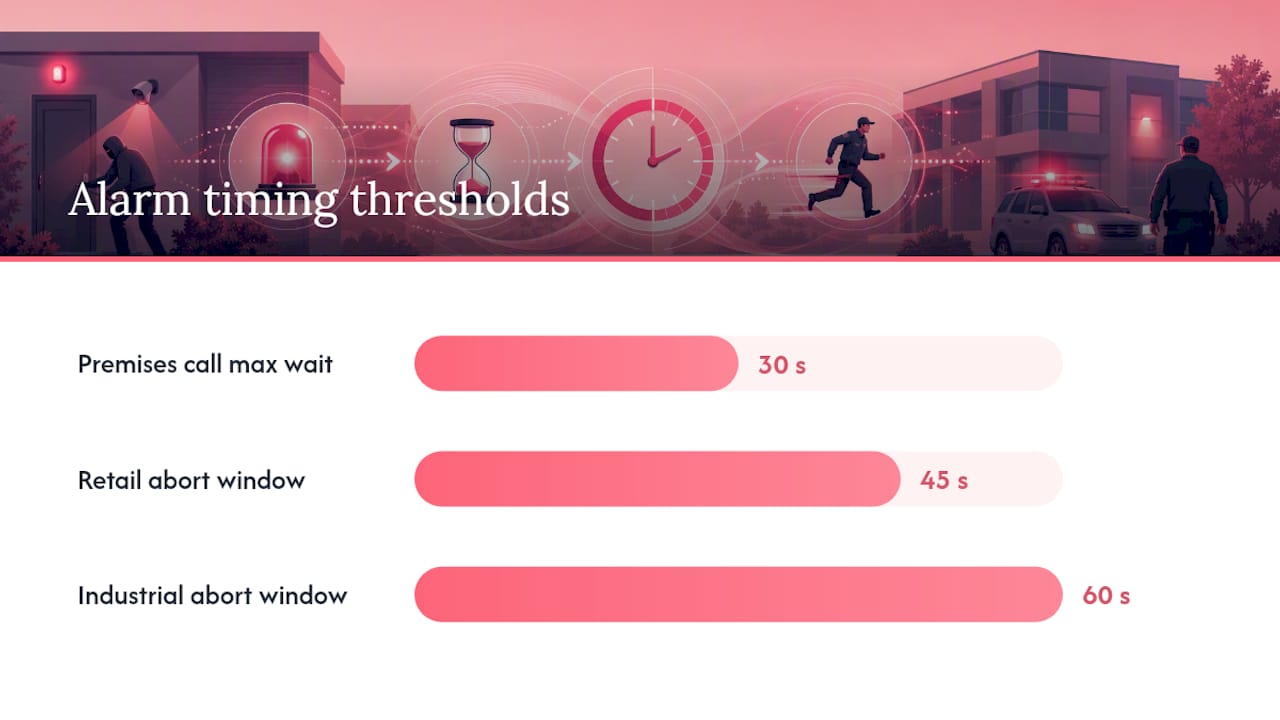
- Abort window: A programmable delay (typically 30–60 seconds) between when a sensor trips and when the panel transmits the signal to the central station. If the user disarms during that window, no signal is sent. CP-01 requires this feature to be programmable and enabled by default.
- Cancel window: A post-transmission window during which an authorized user can cancel a dispatched alarm by providing the correct password. The central station stops the police request if the cancel arrives in time.
- Cross-zoning: Requires two separate sensors in the same zone to trip before a signal is transmitted. A single motion detector triggering alone does not generate a dispatch-worthy signal. Effective for reducing pet-triggered and environmental false alarms.
- Swinger shutdown: Automatically suspends a zone that trips repeatedly within a defined period (e.g., three activations in 24 hours) without a confirmed cause. Prevents a malfunctioning sensor from flooding the central station with signals.
- Dual-technology sensors: Combine two detection methods (passive infrared + microwave, for example) in one device. Both technologies must trigger simultaneously before the sensor reports motion. Dramatically reduces single-cause false activations.
- CP-01 compliance: The full suite of ANSI/SIA CP-01 panel features. Monitoring centers and some municipalities treat CP-01-compliant installations as lower-risk accounts.
False alarm reduction works through three layered mechanisms: equipment controls, verification protocols, and response policy frameworks. CP-01 features like abort windows, swinger shutdown, and cross-zoning are the foundation of the equipment layer.
| Control Feature | What It Prevents | Recommended Configuration |
|---|---|---|
| Abort window | Accidental activations during entry/exit | 30–45 seconds for most commercial sites |
| Cancel window | Unnecessary dispatch after user error | Enable on all accounts; require verbal password |
| Cross-zoning | Single-sensor false trips | Use in open-plan areas and high-traffic zones |
| Swinger shutdown | Malfunctioning sensor floods | Set to suspend after 3 trips in 24 hours |
| Dual-technology sensors | Environmental and pet-triggered false alarms | Deploy in areas with HVAC drafts or animal access |
| CP-01-compliant panel | Systemic false alarm generation | Specify CP-01 compliance in all new installations |
Pro Tip: Abort windows should be longer for sites with complex entry sequences (multi-door access, elevator lobbies) and shorter for simple single-door entries. A 30-second window that works for a retail storefront may not be enough for a multi-floor office building. Review entry timing during your initial site assessment.
Access control hardware also plays a role. Panic bars and emergency egress hardware on perimeter doors affect how quickly an alarm is triggered and whether a legitimate exit generates a false signal. A panic bar installation that is properly integrated with the alarm panel can be zoned separately so emergency egress does not generate a burglary signal.
How local dispatch policies affect your alarm procedures
Local dispatch policy can nullify a standard procedure. A procedure written for a jurisdiction that dispatches on ECV will fail in a verified-response jurisdiction that refuses unverified calls entirely. Always confirm your local rules before finalizing any alarm response policy.
Questions to ask your local communications center:
- Does the jurisdiction require an alarm permit, and what are the renewal and fee requirements?
- Does the department accept ECV as sufficient for dispatch, or is audio/video verification required?
- Does the department offer priority response for verified video alarms?
- What is the fine schedule for false dispatches, and at what number of false calls do fines begin?
- Are panic/holdup alarms exempt from verification requirements?
- What documentation must accompany a dispatch request (permit number, account number, verification evidence)?
- Does the jurisdiction participate in a verified-response program through PPVAR or FARA?
The False Alarm Reduction Association (FARA) and the Partnership for Priority Verified Alarm Response (PPVAR) have both influenced municipal policy across the country. Many jurisdictions now operate tiered permit programs where fines begin on the third or fourth false dispatch within a rolling 12-month period.
Two scenarios illustrate how much local policy matters. In a verified-response jurisdiction, police will not respond to a burglary alarm without audio or video confirmation of an intrusion. Your procedure must route unverified signals to a private guard response rather than a police dispatch request. In contrast, most jurisdictions treat holdup and panic alarms as unconditional dispatch events regardless of verification status. Your procedure needs a separate branch for each scenario.
Pro Tip: When a jurisdiction adopts a new verified-response policy, notify all keyholders in writing within 30 days. Update your monitoring platform’s dispatch notes for every affected account so operators do not request police response on signals that will be refused. A single operator working from outdated account notes can generate a fine and damage your relationship with the department.
Who does what during an alarm event
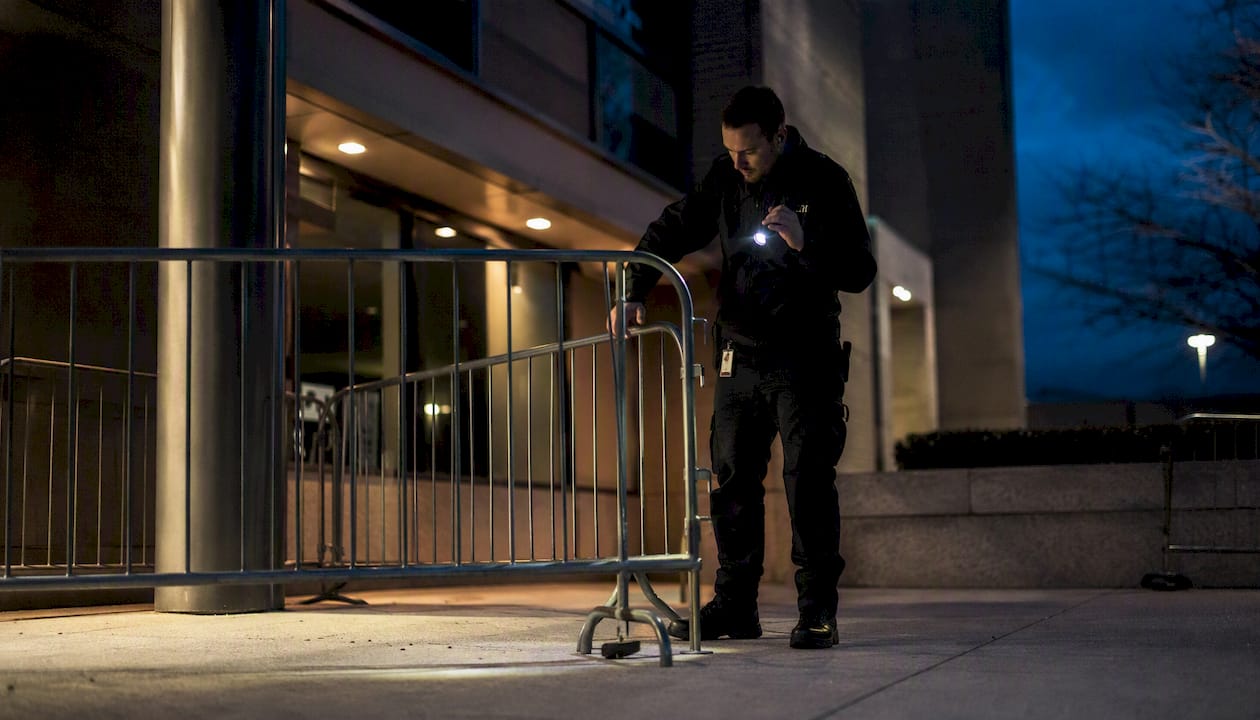
Assign clear, testable responsibilities and decision authority before an alarm occurs. A team that has to negotiate roles during an active event will lose critical minutes. The roles matrix below defines primary duties, timing expectations, and escalation authority for each position.
| Role | Primary Duties During Alarm | Timing Expectation | Escalation Authority |
|---|---|---|---|
| Central station operator | Receive signal, classify, attempt verification, request dispatch | Initial call within 60 seconds of signal receipt | Escalate to supervisor if verification is inconclusive |
| Dispatcher | Coordinate police or guard response, relay verification evidence | Dispatch request within 90 seconds of operator decision | None; executes operator’s decision |
| First responder/security officer | Approach scene, observe, establish perimeter, support law enforcement | On-scene within response time SLA | Can request additional units; cannot authorize entry alone |
| Supervisor/central station manager | Handle simultaneous events, resolve ambiguous verification, authorize non-standard actions | Available within 2 minutes of escalation request | Full escalation authority including cancellation override |
| Keyholder | Confirm or cancel alarm, provide access, cooperate with law enforcement | Must be reachable within 30 minutes of notification | Can cancel alarm with correct verbal password |
Sample call script for monitoring staff contacting a keyholder:
If the password is correct:
If the password is incorrect or the caller cannot provide it:
Communication timing rules:
- Wait no more than 30 seconds between call attempts to the same number before moving to the next contact.
- If all keyholder contacts are unreachable, proceed to dispatch and log every attempt with timestamp and outcome.
- When a responder and a keyholder give conflicting instructions simultaneously, the responder defers to the central station supervisor for a final decision.
Understanding how professional security guards operate on commercial properties gives facility managers a clearer picture of what to expect from a trained responder during an alarm event.
How to log and report alarm incidents properly
Accurate, timestamped logs are required to defend response choices, support prosecutions, and manage fines. A log that says “alarm received, police notified” is nearly useless in a post-incident review or a court proceeding. Every action needs a timestamp, a named actor, and a specific outcome.
Sample CAD/incident entry template:
| Field | Example Entry |
|---|---|
| Time received | 2026-03-14 02:17:43 |
| Account/permit number | Permit #SPD-2024-04412 |
| Alarm type | Burglary, interior motion, Zone 3 |
| Initial call attempt 1 | 02:18:05 — premises line, no answer |
| Initial call attempt 2 (ECV) | 02:18:42 — keyholder cell, no answer |
| Verification method | Video: operator viewed live feed, no visible intrusion |
| Dispatch decision | Conditional dispatch requested at 02:19:15 |
| Responder arrival | 02:31:00 — Officer J. Reyes, no signs of forced entry |
| Disposition | Unfounded; possible sensor malfunction in Zone 3 |
| Follow-up action | Technician service call scheduled for 2026-03-15 |
Per Sacramento Police Department Communications Directive CD 531.08, all alarm calls must be recorded in CAD using the permit number when available, and enhanced or full alarm statuses trigger different handling rules including specific call attempt requirements and disposition codes.
Evidence preservation checklist:
- Upload bodycam footage within 2 hours of incident closure.
- Pull and save CCTV clips covering 15 minutes before and after the alarm activation.
- Document chain of custody for any physical evidence (forced entry tools, broken glass, discarded items).
- Retain all alarm logs and video for a minimum of 90 days, or longer if a police report was filed.
- Note the name and badge number of every law enforcement officer who responded.
Strong vs. weak incident notes:
Weak: “Alarm went off. Called keyholder. No one home. Police called.”
Strong: “Signal received 02:17:43. Premises call at 02:18:05, no answer. ECV call to keyholder at 02:18:42, no answer. Live video reviewed at 02:19:00, no visible intrusion. Conditional dispatch requested at 02:19:15. Officer J. Reyes arrived 02:31:00, confirmed no forced entry. Zone 3 flagged for sensor inspection.”
Training and quality assurance for alarm response teams
Continuous training and QA are the difference between a plan on paper and an operational program. A procedure that has never been drilled will fail under pressure, and a procedure that is never reviewed will drift out of alignment with current policy and equipment.
Drill scenarios to practice regularly:
- False alarm handling: operator receives signal, completes ECV, alarm is cancelled with correct password.
- Verified video response: operator identifies intruder on live feed, requests priority dispatch, notifies keyholder.
- Panic alarm: operator receives holdup signal, dispatches immediately, coordinates covert police approach.
- Building entry with suspects present: responder arrives on scene, observes signs of active intrusion, establishes perimeter, waits for law enforcement.
- Multi-site simultaneous activation: two accounts activate within 90 seconds; supervisor assigns operators and prioritizes life-safety site.
| KPI | Description | Target Range |
|---|---|---|
| False dispatch rate | Percentage of dispatches that result in unfounded dispositions | Below 10% |
| Verification success rate | Percentage of alarms verified before dispatch decision | Above 70% |
| Average time-to-verify | Mean time from signal receipt to verification decision | Under 90 seconds |
| Keyholder contact rate | Percentage of events where keyholder was reached | Above 85% |
| Post-incident debrief completion | Percentage of events with a completed debrief within 48 hours | 100% |
A layered approach to false alarm reduction requires that training address all three layers: equipment familiarity, verification protocol execution, and response policy awareness. An operator who does not know the local jurisdiction’s verified-response rules will make the wrong dispatch decision regardless of how well the panel is configured.
Recommended training cadence:
- Full scenario drill: quarterly for all central station operators and field responders.
- Policy update briefing: within 14 days of any change to local dispatch rules or permit requirements.
- Post-incident debrief: within 48 hours of any event that resulted in a dispatch, a fine, or a use-of-force situation.
- Annual procedure review: full audit of all written procedures against current NFPA 72, CP-01, and local policy.
Pro Tip: Track your false dispatch rate by site, not just by operator. A single poorly configured panel or a keyholder who repeatedly forgets to disarm will skew your numbers and mask the real problem. Site-level data tells you where to invest in equipment upgrades or user training.
Ready-to-use templates and checklists for alarm response
Documented procedures are not optional. As exida’s industry commentary notes, an alarm response procedure must be organized, tested, and integrated with both monitoring and responder workflows to be effective. The templates below give you a starting point you can adapt for retail, office, or industrial sites.
8-step baseline alarm response procedure:
- Receive and classify the alarm signal (type, zone, time, account status).
- Check for life-safety designation; if yes, dispatch immediately without verification delay.
- Attempt premises call (30-second wait maximum before moving to step 4).
- Complete ECV: call second contact from notification list.
- Attempt audio or video verification if equipment is available.
- Make dispatch decision based on verification outcome and local policy.
- Notify keyholder of alarm status and response action taken.
- Log all actions with timestamps; schedule post-incident debrief.
Verification call script snippet:
On-scene checklist for responders:
- Park at least 50 feet from the main entrance; avoid blocking the driveway.
- Approach on foot; use available cover and avoid silhouetting yourself in doorways.
- Scan for signs of forced entry before touching any door or window.
- Do not enter if there is any indication that a suspect may still be inside.
- Establish a visual perimeter and maintain radio contact with the central station.
- Document arrival time, observations, and all contact with law enforcement.
- Preserve any physical evidence; do not move or disturb items at the scene.
For sites with complex access control or emergency egress hardware, coordinate with your access control and locksmith services vendor to confirm that door hardware is properly zoned and will not generate false signals during legitimate emergency exits.
Customization guidance by site type:
- Retail: Enable cross-zoning on sales floor sensors; set abort windows to 45 seconds to account for staff entry sequences. Train all keyholders on verbal password protocol.
- Office: Use dual-technology sensors in open-plan areas; configure swinger shutdown on any zone with HVAC proximity. Assign a dedicated after-hours keyholder for each floor.
- Industrial: Extend abort windows to 60 seconds for large-footprint entry sequences; use video verification as the primary verification method given the high cost of false dispatches in industrial zones.
Pro Tip: De-escalation starts before you arrive on scene. If you reach a keyholder who is agitated or confused, slow the conversation down. Confirm their identity, give them one clear instruction at a time, and avoid using alarm-system jargon they may not understand. A calm keyholder provides better information and makes the entire response faster.
Why safety must come before speed in alarm response
The instinct to move fast during an alarm event is understandable, but it is also the instinct most likely to get someone hurt. Speed without verification is not efficiency; it is exposure.
Consider a scenario we encounter repeatedly in the field: a responder arrives at a commercial site, sees a door ajar, and enters alone to “check it out” before police arrive. In the best case, it was a keyholder who forgot to reset the alarm. In a worse case, the responder walks into an active burglary. The procedure exists precisely to prevent that second outcome, and the procedure only works if the responder follows it even when the scene looks routine.
The same logic applies to monitoring operators who feel pressure to close an event quickly. An operator who accepts a cancellation without verifying the caller’s password because the caller “sounds like the owner” has just created a vulnerability. Criminals study these habits. The verbal password requirement is not bureaucratic friction; it is the one control that stands between a legitimate cancellation and an adversary who wants the alarm turned off.
Verification-first is not a slow approach. A well-drilled team using ECV and live video can make a defensible dispatch decision in under 90 seconds. That is faster than most police response times and far more defensible than a reckless entry. The integration of physical guard response with alarm systems is where this philosophy pays off most clearly: a trained guard who holds the perimeter and feeds real-time observations to the central station is more valuable than one who enters alone and compromises the scene.
How Hubsecurityandinvestigativegroup supports alarm response implementation
Most security firms will sell you a monitoring contract. Hubsecurityandinvestigativegroup does something different: we audit your existing alarm response procedures against current NFPA 72 and CP-01 standards, identify the gaps, and build a site-specific program your team can actually execute.

Our process runs in four stages. First, a site audit that maps your current alarm zones, panel configuration, verification capabilities, and local dispatch policy. Second, a written procedure tailored to your site type, keyholder structure, and jurisdiction. Third, hands-on training for your central station operators, field responders, and keyholders. Fourth, a live drill that tests the procedure under realistic conditions and produces a debrief report with specific improvement actions.
For facilities that need ongoing support, our building security services include mobile patrol, verified monitoring coordination, and regular procedure reviews as local policies change. Contact Hubsecurityandinvestigativegroup today to schedule your alarm response audit and get a procedure your team will actually follow.
Sources
The standards and directives below are the primary references for any alarm response policy. Each one addresses a specific layer of the procedure.
- SACRAMENTO POLICE DEPARTMENT COMMUNICATIONS DIRECTIVE (Alarm Answering Service)
- CS‑V-01 (Central Station Verification) Procedures | TMA
- Verified alarms: how to reduce false alarms and speed response | Securitas Technology (2026)
To check your local policy, contact your city or county communications center directly and ask for the current alarm ordinance and any verified-response program documentation. Update your written procedures within 30 days of any policy change.
Recommended
- Hotel Security Management: What Every Property Must Require
- 24-Hour Security Guard Coverage vs. Alarm Systems: Which One Protects Your Property Better? – Hub Security & Investigative Group
- 24-Hour Security Guard Coverage vs. Alarm Systems: Which One Protects Your Property Better? – Hub Security & Investigative Group
- “Security for Medical Facilities: Essential Strategies to Protect Patients and Staff” – Hub Security & Investigative Group