
For senior hires, run a role-proportionate executive background check that goes beyond standard pre-employment screening. That means expanded criminal and civil records searches, credential and employment verification, and media or sanctions screening, layered on top of the core FCRA/EEOC steps every employer must follow. Skip the compliance steps and you expose your organization to legal risk regardless of how thorough the report looks.
TL;DR:
- The scope of an executive background check should include expanded criminal, civil, regulatory, media, and international searches based on the role’s risk profile.
- Employers must strictly follow FCRA and EEOC rules, including providing a standalone disclosure, obtaining signed authorization, and conducting individualized risk assessments.
- Screening should be tailored to the specific authority and responsibilities of the role, with deeper checks for financial or public-facing positions.
- The timing of verification is crucial; deeper investigations should be initiated early and run in parallel to avoid delays or missing critical issues.
- Most companies wrongly treat executive screening as a generic checklist, ignoring role-specific risks and the need for follow-up verification beyond database reports.
Table of Contents
- Core Components Of An Executive Background Check
- FCRA And EEOC Rules Every Employer Must Follow
- Matching Screening Scope To The Role’s Authority
- How Long It Takes And What It Costs
- Reading The Results: What’s A Dealbreaker And What Isn’t
- When A Standard Check Isn’t Enough
- The Scoping Mistake Most Employers Make
- Get A Scoped Executive Screening Package From Hub Investigative Group
- Sources
Core Components Of An Executive Background Check
A standard pre-employment check verifies identity, confirms a clean criminal record, and calls a couple of references. An executive package asks harder questions, because the cost of getting a C-suite hire wrong runs into the millions, not just a bad quarter.
Executive packages typically layer these searches on top of the basics:
- Identity and Social Security number trace to confirm the candidate’s history and catch aliases or address inconsistencies.
- Expanded criminal searches across every jurisdiction the candidate has lived or worked, not just their current county.
- Civil litigation history, including breach of contract, wrongful termination, and shareholder disputes tied to previous executive roles.
- Regulatory actions, sanctions, and debarments through agencies relevant to the candidate’s industry, plus professional license verification for roles that require one.
- Extended employment and education verification, confirming actual titles, dates, and degrees rather than accepting a resume at face value.
- Corporate affiliations and board memberships, which can reveal conflicts of interest a standard check never surfaces.
- Media and adverse-news review, scanning for reputational issues, lawsuits, or controversies that never made it into a court record.
Candidates with international backgrounds or recent overseas roles often need cross-border verification added to the package, and some employers add a pre-employment credit check for roles with direct financial control. Each of these searches maps to a specific risk category. Skipping one because it seems redundant is how a fraud conviction from a prior role slips through unnoticed.
FCRA And EEOC Rules Every Employer Must Follow
Executive seniority does not exempt an employer from federal screening law. The FCRA requires a standalone written disclosure and a signed authorization before any third-party background report gets pulled, whether the candidate is applying for a warehouse job or a CEO seat.
- Provide a standalone disclosure. It cannot be buried inside a job application or an employment contract.
- Get signed authorization before the background screening company runs the report.
- Send pre-adverse notice if findings might disqualify the candidate, along with a copy of the report and a summary of rights.
- Wait a reasonable period, then send the final adverse-action notice if the decision stands.
- Apply individualized assessment to any criminal record. The EEOC’s job-relatedness and business-necessity standard requires evaluating context rather than issuing an automatic disqualification.
- Check state and local restrictions, since ban-the-box laws and credit-check limitations vary widely and can override a national policy.
Bring HR and legal into the process early to review documentation practices. A background check for executives that skips any of these steps creates legal exposure that outweighs whatever the report uncovers.
Matching Screening Scope To The Role’s Authority
Not every executive needs the same package. A CFO with wire authority needs a different depth of financial and litigation screening than a Chief Marketing Officer with no signing power.
- Map authority to scope. Financial control, regulatory accountability, and public representation each raise the stakes and should widen the search.
- CFO and finance leadership: prioritize civil litigation, regulatory sanctions, credit history where legally permitted, and verification of any professional certifications like CPA status.
- CEO and public-facing roles: weight media and reputation review heavily, since a controversy that never reached a courtroom can still damage the company.
- Non-financial C-suite roles: keep criminal, civil, and employment verification intact, but scale back credit and licensing checks that don’t apply.
- Board and investor-facing positions: add conflict-of-interest checks, ownership disclosures, and scrutiny of any intermediaries who introduced the candidate.
Document the sign-off. HR, legal, and the hiring manager should agree in writing on what searches were run and why, before the offer goes out. That record protects the company if a decision is ever challenged.
How Long It Takes And What It Costs
Standard identity and criminal checks usually clear in a few business days. Civil litigation searches, media reviews, and any international components typically take longer to complete, depending on the number of jurisdictions involved.
- Search depth drives cost. A basic criminal and identity check costs far less than a package with international coverage and licensed investigator hours.
- International and licensed-investigator work costs more because it requires manual record retrieval rather than automated database pulls.
- Start the process early, ideally alongside a conditional offer, so a dispute or a slow jurisdiction doesn’t stall the start date.
- Run searches in parallel where possible instead of waiting for each component to finish sequentially.
- Decide upfront whether a standard FCRA-compliant consumer reporting agency covers the role, or whether the position warrants a bespoke investigator for deeper corroboration.
Reading The Results: What’s A Dealbreaker And What Isn’t
Not every flag is disqualifying, and treating them all the same way is a mistake that costs good candidates and lets bad ones slide through on a technicality.
- Identify genuine red flags: resume fabrication, financial misconduct tied to fiduciary duty, fraud convictions, active regulatory sanctions, or undisclosed board seats that create conflicts.
- Apply a materiality test. Tie every finding back to the specific duties and access the role carries. A decade-old civil dispute unrelated to the job function carries different weight than a recent fraud judgment.
- Verify before acting. Confirm the finding is accurate and current, since public records databases do get things wrong.
- Give the candidate a chance to respond. This step is both fair and often legally required before adverse action.
- Document the analysis and loop in legal counsel before finalizing any decision based on the findings.
Adverse-news mentions deserve more scrutiny than proven convictions. Public records and media searches surface controversies but aren’t exhaustive, so look for corroboration across multiple sources rather than treating a single article as fact.
Pro Tip: Weight a pattern of similar complaints across different employers far more heavily than a single isolated incident. One lawsuit is often noise. Three lawsuits with the same underlying complaint is a signal.
When A Standard Check Isn’t Enough
Standard background screening companies excel at pulling records fast and cheap. They struggle when the job requires interviews, source corroboration, or mapping relationships between a candidate and the people or entities they’ve worked with. That gap is where specialist investigative work earns its keep.
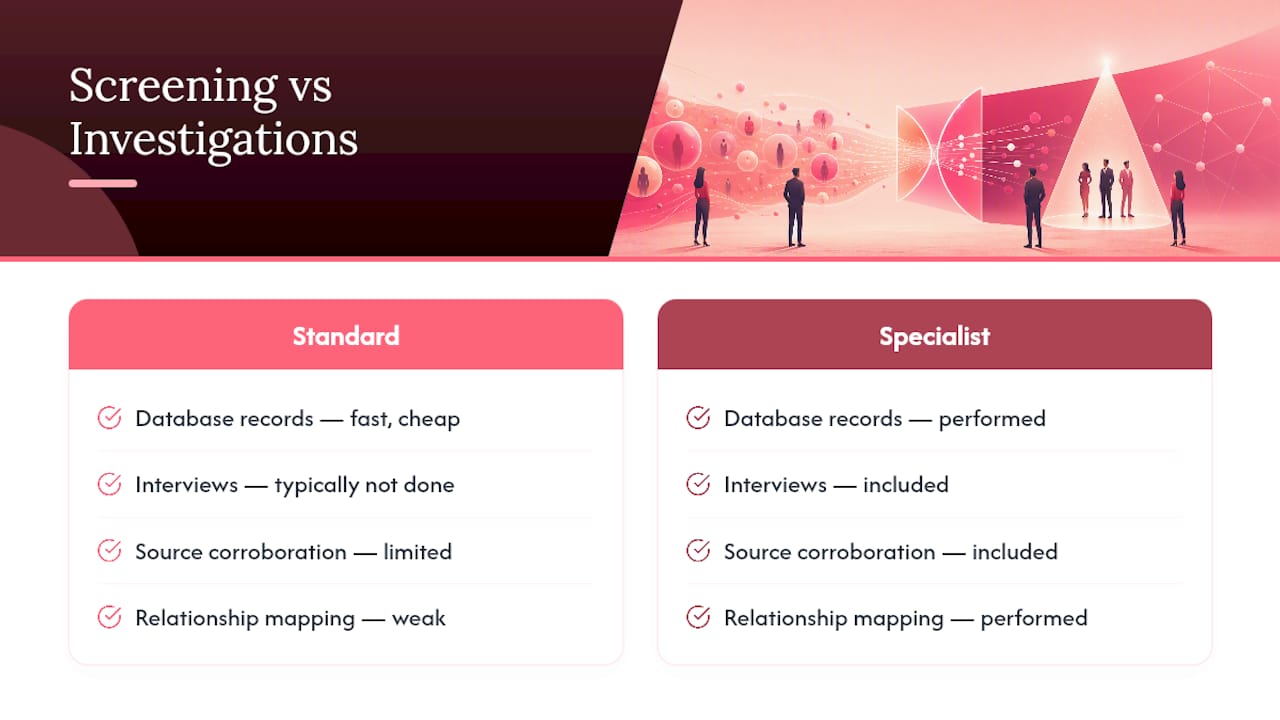
A security and investigative group has operated in this space with extensive combined law enforcement and loss prevention experience. Beyond standard verification, that background supports work like executive protection assessments and tailored investigations that go past a database pull, including aggregating civil litigation across jurisdictions, researching sanctions and debarment histories, and running global searches with corroborated narratives rather than raw hits. One caveat matters regardless of who runs the check: if the output functions as a consumer report used for an employment decision, FCRA disclosure and authorization rules still apply in full.
The Scoping Mistake Most Employers Make
Most companies treat executive screening as a bigger version of the same checklist they run for every other hire. That’s backwards. The right question focuses on what risks this specific role exposes the company to rather than what’s generically included in the executive package.
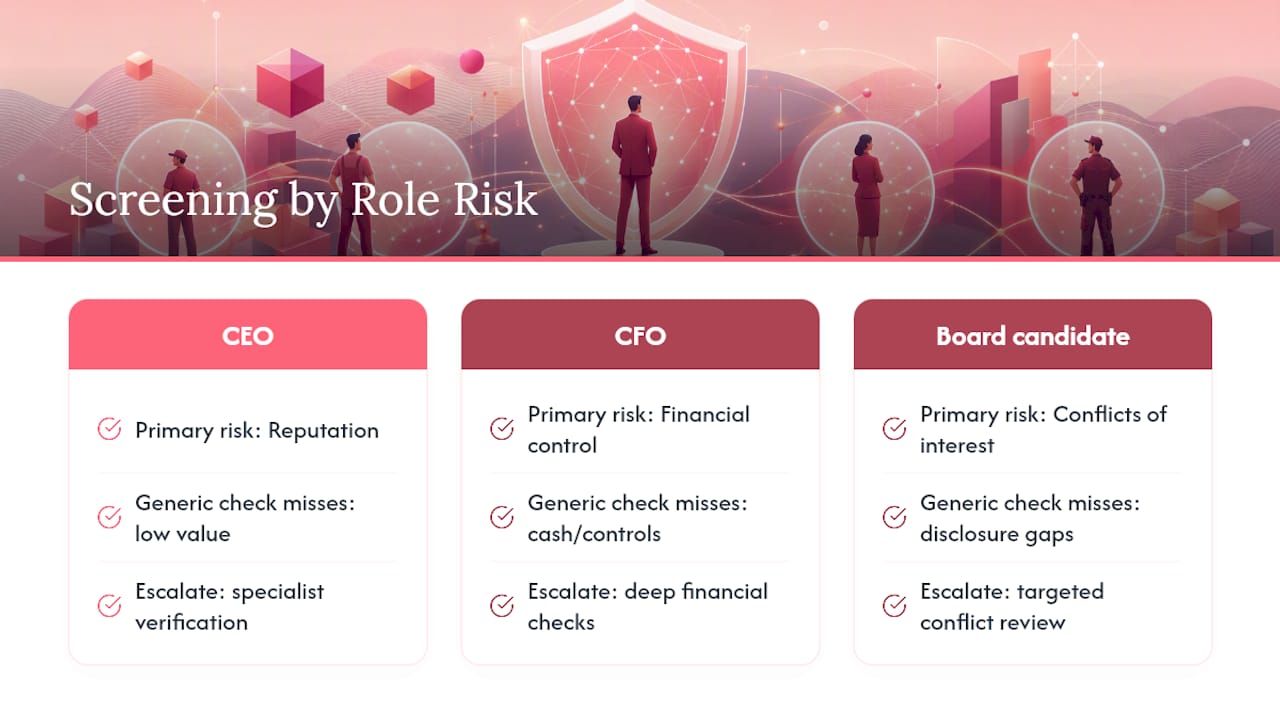
A CEO’s biggest risk is reputational. A CFO’s biggest risk is financial control. A board candidate’s biggest risk is undisclosed conflicts of interest. Run the same generic package on all three and you’ll over-invest in searches that don’t matter for one role while missing the search that would have caught a real problem in another.
The bigger gap in conventional advice is timing. Most guidance treats screening as a single event before the offer letter. In practice, the candidates worth worrying about most are the ones whose history requires actual verification work, not a database query, and that only happens when someone knows to ask the follow-up question a standard report can’t ask itself. That’s the point where a company should stop treating this as a compliance checkbox and start treating it as a judgment call about which hires warrant a specialist’s time.
— Derek
Get A Scoped Executive Screening Package From Hub Investigative Group
This firm offers an alternative to generic background check vendors for companies hiring senior leadership in and around Boston. Instead of running every executive through the same template, our team scopes the search to the role’s actual authority and adds the corroboration work a standard database pull can’t provide, from civil litigation aggregation to relationship mapping around board conflicts.

That approach draws on the same investigative foundation behind our confidential private investigation services, built on decades of combined law enforcement and loss prevention experience. If a hire also carries personal safety considerations, our executive protection team can assess that risk alongside the screening itself. For the compliance side, resources like this FCRA guidance for HR teams are worth reviewing before you start.
Ready to scope a package for your next senior hire? Visit our security services page to request a consultation and get a screening plan matched to the role, not a one-size-fits-all template.
Sources
- Background Checks: What Employers Need to Know | U.S. Equal Employment Opportunity Commission
- Executive Background Check: A Guide for Employers 2026 – iprospectcheck
- Executive Background Checks | Reveal Background