
The fastest path to a working crisis plan follows six steps: assemble a Crisis Management Team, assess risks, run a business impact analysis, draft response playbooks, test and train, then maintain the plan on a set schedule. You can start today. Within 24 to 72 hours, name your initial Crisis Management Team members and put a first risk assessment workshop on the calendar.
You don’t need a 200-page binder to start. You need a working draft your team has actually read, tested once, and can execute under pressure. FEMA’s CPG 101 provides the all-hazards framework this guide builds from, PD CEN/TS 17091 shapes how we frame strategic decision-making, and a downloadable one-page checklist template is available further down this guide to help you move from reading to action.
Key Takeaways
Business crisis response planning works when six sequential steps, team assembly, risk assessment, business impact analysis, playbook development, testing, and maintenance, are documented, rehearsed, and reviewed on a fixed schedule.
| Point | Details |
|---|---|
| Follow the six-step sequence | Assemble the CMT, assess risk, run a BIA, draft playbooks, test, then maintain the plan on a fixed calendar. |
| Fewer than half of businesses are prepared | Only 49% of U.S. businesses have a formal documented crisis communication plan, per HubSpot. |
| Document everything during activation | Keep a timestamped decision log to support post-crisis review and future training. |
| Test on a real cadence | Run monthly drills, quarterly tabletops, and one full-scale exercise annually, closing every gap with an AAR. |
| Get facilitated support if needed | Hubsecurityandinvestigativegroup runs risk assessments, CMT workshops, and live exercises for businesses that want hands-on guidance. |
Where to Verify This Guidance
- FEMA CPG 101: the all-hazards planning framework this guide is built from
- PD CEN/TS 17091: strategic crisis management capability guidance
- ISO 22361: structural elements for a crisis management plan
Use these as alignment checkpoints, and download a plan template from Hubsecurityandinvestigativegroup to start filling in your own.
Table of Contents
- Why Business Crisis Response Planning Matters
- What Should a Crisis Response Plan Include?
- How Do You Build a Crisis Response Plan Step by Step?
- Who Has Authority When a Crisis Hits?
- How Often Should You Test Your Crisis Plan?
- How Does Crisis Response Connect to Business Continuity?
- What Tools and Templates Speed Up Implementation?
- Sources
Why Business Crisis Response Planning Matters
A documented plan changes how fast your leadership team moves when something goes wrong. Companies with a rehearsed response can make containment decisions in minutes instead of hours, and that speed usually determines how much revenue, trust, and market position survives the event.
The gap between having a plan and having a good one is wider than most owners assume. HubSpot’s research found that fewer than half of U.S. businesses, 49%, have a formal, documented crisis communication plan in place. That means the majority of companies are drafting statements and assigning blame in real time, during the exact moment clarity matters most.
Planning ahead protects three things directly: cash flow (you know which functions to keep running and which to pause), customer relationships (you communicate before rumors fill the gap), and recovery time (you’re executing a rehearsed sequence, not inventing one). Businesses that treat crisis response planning as a management discipline recover faster and lose less along the way.
What Should a Crisis Response Plan Include?
A crisis response plan is only as useful as its weakest section. Before you build one from scratch, audit whether an existing plan (or your mental model of one) actually covers the following:
- Activation protocols that define exactly what triggers plan activation and who can declare it
- Crisis Management Team roster with backups, so a single unavailable executive doesn’t stall the whole response
- Escalation matrix showing who authorizes what, at what severity level
- Response playbooks for your highest-priority scenarios (data breach, workplace violence, extreme weather, product failure)
- Crisis communications templates, including pre-drafted language for media, social channels, employees, and customers
- Business impact analysis outputs that rank which functions must be restored first
- Recovery sequence and continuity triggers connecting response to business continuity planning
- Documentation and record-keeping processes for decisions made during the event
Alongside those sections, your plan needs specific artifacts you can hand someone under pressure: an updated contact list, a decision log template, pre-approved public statements, a one-page BIA summary, and a testing calendar for the year ahead.
A strong crisis management plan isn’t a narrative document, it’s an operations manual. The ACCA’s crisis management guidance.pdf) is clear that activation protocols, defined roles, communications templates, and a documented recovery sequence are non-negotiable components, and that the plan should be reviewed and tested on a set cadence, not left on a shelf.
If your current plan is missing more than one of these sections, don’t try to rebuild it all in one sitting. Pull a one-page template, fill in what you know, and flag the gaps for your next planning session.
How Do You Build a Crisis Response Plan Step by Step?
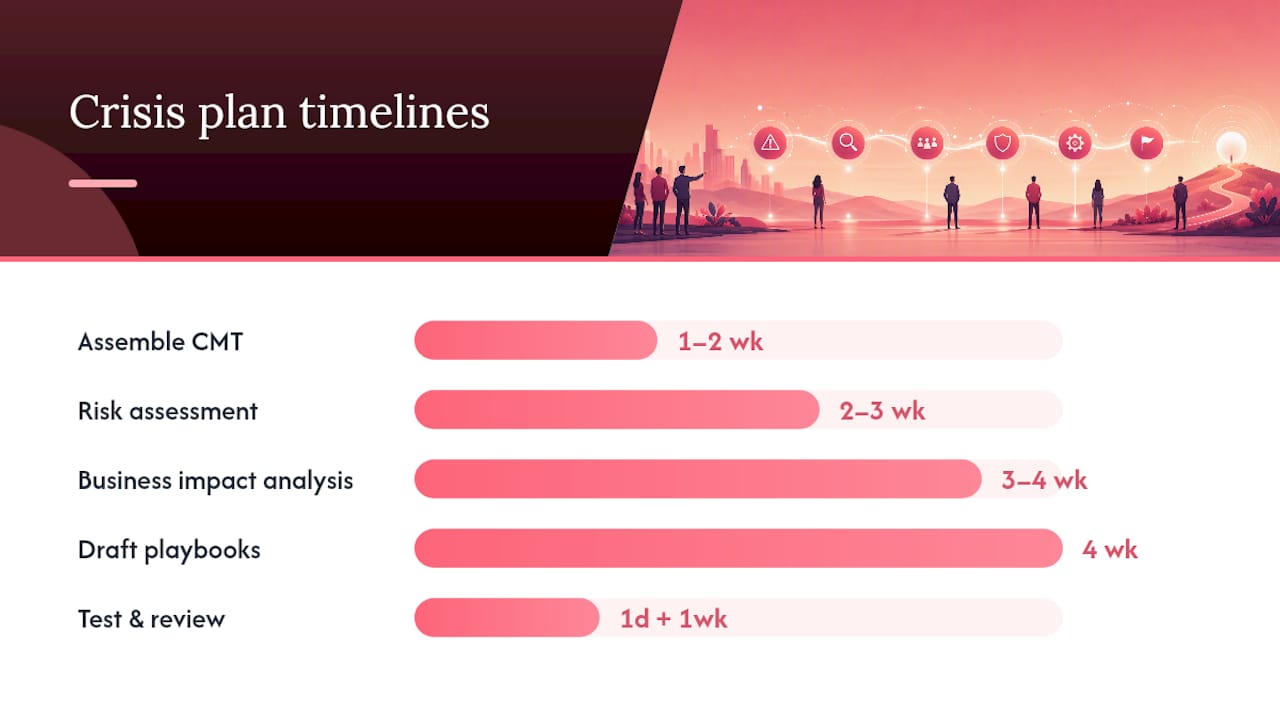
Building the plan is a sequence, not a single meeting. Here’s how the six steps break down in practice, including who typically owns each one and what a small business can do when time and budget are tight.
1. Assemble the Crisis Management Team
Purpose: give your response a clear chain of command before you need one.
Owner: CEO or senior operations leader.
Deliverables: a named CMT roster with title, contact information, and a backup for every role.
Timeline: one to two weeks.
Small businesses without a dedicated security or risk function can assign these roles as secondary duties. The point isn’t headcount, it’s clarity about who does what.
2. Conduct a risk assessment and horizon scan
Purpose: identify what could actually hurt your business, ranked by how likely it is and how badly it would hurt.
Owner: operations lead, ideally with input from finance, IT, and facilities.
Deliverables: a likelihood by impact matrix covering your top eight to twelve risks.
Timeline: two to three weeks, including stakeholder interviews.
A physical security risk assessment is a practical starting point for businesses with a physical location, and a workplace threat assessment covers internal risk factors many owners overlook.

3. Run a business impact analysis
Purpose: figure out which functions matter most and how long you can survive without each one.
Owner: finance lead, working with department heads.
Deliverables: a ranked list of critical functions with maximum tolerable downtime for each.
Timeline: three to four weeks for a mid-sized business; smaller teams can compress this into a single working session.
The BDC’s guidance for small and medium enterprises recommends identifying core activities, assessing cash flow impact, and flagging critical suppliers as the minimum viable version of this step.
4. Draft response procedures and activation protocols
Purpose: turn the risk assessment and BIA into actual playbooks people can follow.
Owner: CMT lead, with input from legal and communications.
Deliverables: scenario-specific playbooks (data breach, active threat, severe weather, supply disruption) plus one activation protocol that applies across all of them.
Timeline: four weeks.
An emergency evacuation planning guide is useful reference material for the physical-safety playbooks specifically.
5. Test, drill, and refine with after-action reviews
Purpose: find the gaps in your plan before a real incident does.
Owner: CMT lead facilitates; full team participates.
Deliverables: a completed tabletop exercise and a documented after-action review.
Timeline: one day for the exercise itself, one week to document and act on findings.

6. Finalize a maintenance schedule and training program
Purpose: keep the plan current as staff, vendors, and risks change.
Owner: CMT lead, calendared as a recurring responsibility.
Deliverables: an annual review date, a training schedule for new hires and existing staff, and a version-control process for updates.
Timeline: ongoing, reviewed quarterly at minimum.
Common blockers worth naming directly:
- Lack of dedicated time gets solved by treating planning as a project with deadlines, not an open-ended task
- Siloed information gets solved by requiring department heads to submit their piece of the BIA in writing
- Unclear authority gets solved by putting the escalation matrix in writing before, not during, a crisis
Pro Tip: Build your first draft in a single afternoon using whatever information you already have. A rough plan you can revise beats a perfect plan you never finish.
Who Has Authority When a Crisis Hits?
Every plan needs clear answers to three questions: who decides, who executes, and what triggers activation. Your Crisis Management Team should include a CMT lead (final decision authority), an incident manager (coordinates the operational response), a communications lead (owns all external and internal messaging), an operations lead (keeps the business running), a legal or compliance point person, and an HR lead for personnel matters. Every role needs a named backup, since crises rarely wait for your first choice to be reachable.
Activation triggers should be specific enough that anyone on the team can recognize one without calling for permission: a data breach affecting customer records, a workplace injury requiring emergency services, a supplier failure lasting more than 48 hours. Define these thresholds in advance, then use a simple decision matrix or pre-scripted agenda during activation itself.
Sense-making under pressure is often harder than lack of information. Structured decision aids don’t replace judgment, they remove the cognitive noise that makes good judgment harder to access when it counts.
How Often Should You Test Your Crisis Plan?
A plan that’s never been tested is a hypothesis, not a capability. ASIS Security Management recommends testing against specific objectives rather than treating a drill as a checklist to complete. A reasonable cadence for most businesses:
- Quick internal drills monthly, focused on one procedure at a time (evacuation, notification chain)
- Tabletop exercises quarterly, walking the CMT through a written scenario without physical action
- A full-scale exercise annually, involving real coordination across departments and, where relevant, outside responders
Each exercise should end with an after-action review covering what worked, what didn’t, who was slow to respond, and what needs to change in the written plan. Feed every AAR finding back into the plan itself and into your next training cycle, or the exercise was just theater.
How Does Crisis Response Connect to Business Continuity?
Crisis response and business continuity planning aren’t the same document, but they hand off to each other. Response covers the first hours and days: containing the situation, communicating, protecting people. Continuity picks up from there: restoring operations in a defined sequence.
A workable recovery timeline moves in three phases: stabilize the immediate situation, restore your highest-priority functions identified in the BIA, then work toward full recovery. Costs vary by scenario, but plan for temporary staffing, potential facility repairs, and communications overtime as recurring line items. Engaging suppliers and community partners early speeds this phase considerably, since recovery rarely happens in isolation.
Keep a decision log and a financial impact snapshot throughout. Whoever owns recovery, typically the operations lead, needs both documents to justify decisions later and to speed up any insurance claims.
What Tools and Templates Speed Up Implementation?
You don’t need enterprise software to execute a solid crisis plan, but a few templates make the difference between a plan people use and one that sits in a drawer:
- A one-page incident action plan for the first hour of any activation
- Pre-written communications scripts for employees, customers, and media
- A contact roster with backups, reviewed quarterly
- An escalation checklist matching your decision matrix
- A BIA worksheet ranking functions by downtime tolerance
Align your templates with recognized guidance rather than reinventing structure: FEMA’s CPG 101, PD CEN/TS 17091, and ISO 22361 all provide free or low-cost frameworks. For incident tracking and mass notification, evaluate tool categories like Everbridge for alerting at scale or Asana for task and deliverable tracking across your CMT, and compare platform options such as those covered in this safety management software overview before committing to any single system.
Making a Written Plan Into a Practiced Capability
Paper plans fail when nobody outside the executive suite knows what to do first. Training a handful of “resilience champions,” frontline staff outside the formal security function, gives you eyes and hands on the ground before your full CMT even convenes. Culture and clear authority matter more here than the document itself; a plan nobody trusts to use under pressure is just a file.
Pro Tip: Keep a running decision log during any activation, timestamped and specific. It protects your team during post-crisis review and becomes training material for the next drill.
How I Approach Crisis Planning With Business Clients
Most owners don’t need a longer plan, they need a prioritized one. Speed, clear authority, and a paper trail for post-crisis accountability matter more than polish. Every plan we help build gets tested before it’s called finished.
What a Supported Crisis Planning Engagement Looks Like
If building all six steps alone feels like more than your team has bandwidth for right now, that’s a common starting point, not a failure. Hubsecurityandinvestigativegroup works alongside business owners on the parts that take specialized judgment: facilitated risk assessments, Crisis Management Team workshops, plan drafting, and live exercises that actually stress-test your response before a real incident does.

Where this differs from doing everything entirely in-house is speed and objectivity. Our team brings over seventy-five years of combined law enforcement and loss-prevention background to the risk assessment itself, so you’re not guessing at threats you haven’t seen before. That matters most for businesses with a physical footprint, like commercial properties, event venues, or executive teams who need protection plans that hold up under real pressure, not just on paper.
Explore our comprehensive building security services in Boston to see how a facilitated risk assessment and crisis planning engagement works, or reach out directly to schedule a consultation and get your Crisis Management Team workshop on the calendar.