
Cannabis Dispensary Security is an important for all State Dispensary.
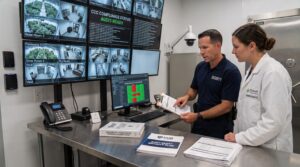
For Massachusetts cannabis operators, obtaining and keeping a license comes down to one core reality: regulatory compliance is not negotiable. Whether operating an adult-use dispensary in Greater Boston, an expansive indoor cultivation canopy in Central Massachusetts, or a processing and extraction lab in the Pioneer Valley, scrutiny from the Cannabis Control Commission (CCC) is rigorous, detailed, and ongoing.
Many license applicants and facility operators make the mistake of viewing security as a hardware checklist. They install high-definition commercial cameras, wire perimeter alarms, order commercial vaults, and assume the box is checked. However, during an initial licensing inspection, an unannounced audit, or an annual renewal, state investigators are not simply testing whether a motion sensor triggers. They are determining whether your documented security operating procedures hold up against everyday human operations.
Under 935 CMR 500.000 (adult-use) and 935 CMR 501.000 (medical-use), security requirements mandate clear, verifiable operational controls. Understanding how hardware connects with on-the-ground physical staffing is the difference between an operational license and a costly notice of deficiency.
Unpacking the CCC Mandates: 935 CMR 500.110 & 501.110
The regulatory framework governing cannabis security operations is established in 935 CMR 500.110 for adult-use establishments and 935 CMR 501.110 for medical facilities. These sections outline stringent technical and procedural expectations:
-
Continuous Surveillance and 90-Day Video Retention: Video cameras must provide continuous, unobstructed coverage of all operational areas. This includes all points of entry and exit, point-of-sale (POS)
 counters, processing stations, cultivation canopies, drying rooms, and vault areas. Recorded footage must be archived for a minimum of 90 calendar days, maintained with accurate date-and-time stamps, and produced immediately upon request by CCC investigators or local law enforcement.
 -
Strict Perimeter and Duress Alarms: Every exterior entrance, egress door, and window requires an active intrusion detection system. The facility must feature silently triggered duress and panic alarms hardwired or linked directly to local public safety dispatchers. Crucially, the system must detect and transmit system failures or operational malfunctions to administrators within five minutes of an outage.
-
Limited Access Areas (LAAs): Every square foot of a facility where cannabis is stored, weighed, packaged, or handled is classified as a Limited Access Area. Entry into LAAs is legally restricted strictly to badged, registered agents, escorted vendors, and authorized state officials.
-
Commercial Storage and Vault Security: Outside of operational hours, all finished cannabis inventory, cash assets, and high-value extracts must be locked within commercial-grade safes, reinforced vaults, or secure steel cages engineered to resist forced entry.
-
Public Visibility Standards: No plant canopy, drying harvest, or finished cannabis merchandise may be visible from outside the exterior premises without the aid of optical equipment, aircraft, or binoculars.
Clarifying the “Two-Person Staffing Rule” Myth
A persistent rumor across Massachusetts cannabis trade forums claims that the state flatly mandates “at least two security guards or employees” on-site at all times during cultivation, processing, or vault storage. A careful reading of 935 CMR reveals that the text prioritizes the exact opposite intent: minimizing foot traffic.
The regulations demand that access to secure areas be limited solely to the minimum personnel necessary to complete the task. Submitting a security plan that defaults to unverified forum advice rather than statutory text can derail an application. Compliance relies on precise risk management, not inflated assumptions.
Bridging the Gap: Why Hardware Alone Fails Audits
Cameras record events; they do not intervene. Perimeter alarms sound after a glass pane breaks; they do not vet the person attempting to walk through the front door. The real operational vulnerabilities in any Massachusetts cannabis facility occur during transition periods: shift changes, waste disposal runs, vault intake, product staging, and busy retail hours.
Professional security staffing provides the proactive operational bridge that technology cannot supply.
+--------------------------+-----------------------------------+------------------------------------+
| Regulatory Requirement   | What Technology Does              | What On-Site Personnel Enforces   |
+--------------------------+-----------------------------------+------------------------------------+
| Age Verification & Entry | ID scanners read barcode data     | Identifies fraudulent/tampered IDs |
| Limited Access Areas     | RFID keycards unlock latch pins   | Stops tailgating & logs escorts    |
| Package & Vault Intake   | Overhead cameras record delivery  | Secures loading dock perimeter     |
| Incident Documentation   | System logs alarm timestamps      | Writes CCC-compliant event reports |
+--------------------------+-----------------------------------+------------------------------------+
1. Preventing Perimeter Infiltration and Tailgating
A card-swipe door only prevents unauthorized access if the door closes behind the authorized user. In practice, delivery contractors, waste haulers, maintenance crews, and visiting inspectors move through facilities daily. Uniformed security guards manage visitor sign-in logs, distribute visitor badges, conduct physical escorts within Limited Access Areas, and systematically prevent tailgating into cultivation bays and vault rooms.
2. Rigorous Retail ID Validation
For adult-use dispensaries, serving an underage consumer or an individual presenting an expired or counterfeit ID carries severe penalties, including license suspension or hefty administrative fines. Stationing an officer at the dispensary retail vestibule ensures that customer credentials are checked before individuals enter the sales floor. Trained security personnel identify altered out-of-state IDs, spot fraudulent military or passport credentials, and manage lobby congestion during peak sales periods.
3. Secure Transport and Loading Dock Operations
Intake from wholesale distributors and transfers of trim or concentrate to extraction labs represent critical moments of risk. Stationed security personnel maintain 360-degree situational awareness across open loading bays, audit driver credentials against pre-manifest documentation, and safeguard inventory during product transfers into the secure vault.
4. Audit-Defensible Incident Reporting
When an equipment failure, visitor dispute, missing inventory tag, or perimeter trip occurs, the CCC expects immediate documentation. A licensed security officer trained in regulatory protocols generates a formal, detailed incident report. This documentation creates a verifiable chain of custody and a defensible timeline for property managers, corporate leadership, and state inspectors.
Operational Checklist: Who Needs Dedicated Staffing?
A comprehensive security operating procedure should align with specific facility footprints:
-
Adult-Use Retail Dispensaries: Need visible front-of-house presence to manage consumer check-in, handle parking lot surveillance, deter retail theft, and protect cash drawers during POS closing cycles.
-
Cultivation & Canopy Facilities: Require controlled gate access, exterior boundary patrols, loading dock escorts, and interior checks to prevent internal inventory shrinkage and unauthorized canopy access.

-
Extraction & Product Manufacturing Sites: Demand strict LAA enforcement, chemical and hazardous material barrier oversight, third-party vendor tracking, and after-hours checks to safeguard volatile extraction machinery and high-potency concentrates.
-
Multi-Site Cannabis Operators (MSOs): Require standard operating security procedures across municipal boundaries, ensuring that facilities in Boston, Worcester, or Springfield run on the same compliance playbooks.
Built on Real Investigative and Compliance Experience
Drafting an effective CCC security plan requires an understanding of how law enforcement and compliance auditors examine a site. Hub Security and Investigative Group is a Massachusetts-licensed private detective firm. The senior leadership team brings more than 75 years of combined law enforcement, private investigations, and loss prevention experience to commercial security management.
Hub delivers:
-
State-licensed, uniformed security officers trained specifically on Massachusetts cannabis protocols.
-
Staffing levels built to defend the exact plan submitted with your CCC operational licensing packet.
-
Proactive risk assessments for entry lobbies, delivery docks, vaults, and cultivation footprints.
-
24/7 central dispatch coverage to address sudden incidents, transport handoffs, or unexpected facility alarms.
Protect your operating license, your team, and your commercial investment with security staffing engineered for state compliance.
Hub Security and Investigative Group
24/7 Dispatch: (617) 857-1200
Web: Contact our cannabis compliance division to schedule a facility risk assessment or request a CCC-ready staffing proposal.
Would you like to turn this guide into a formatted PDF checklist for facility compliance managers, or adapt it into shorter sub-articles targeting dispensary managers versus cultivation directors?
Other Services Hub Offers
Unarmed Security Guard in Massachusetts
Armed Security Guard in Massachusetts
Armed Transport Protection in Massachusetts
Follow Us
https://www.instagram.com/hubsecinvestigative/
https://www.facebook.com/HubSecurityAndInvestigativeGroup/