
Before you approve a run-of-show or send the guest list to badge printing, five things need a checkmark: a completed risk assessment, locked-down access control and credentialing, a staffing plan with named posts, a tested communications and Emergency Action Plan, and confirmed medical coverage. Everything else in this article builds out those five items into a working plan, grounded in frameworks from CISA and FEMA that public safety agencies already use.
TL;DR:
- Conduct a risk assessment that prioritizes the top threats and assigns mitigation ownership, forming the foundation of your event safety plan.
- Walk the venue thoroughly before signing any agreement, checking access points, sightlines, exit routes, and potential unmanned aircraft risks.
- Lock down credentialing with multiple badge tiers, anti-counterfeit features, and reconcile the final guest list 48 hours before the event.
- Assign separate, escorted delivery windows for vendors and establish a clear incident command structure with designated roles to ensure quick decision-making.
- Prepare emergency triggers, laminated decision cards, and conduct tabletop drills to streamline response during severe weather, active threats, or infrastructure failures.
Table of Contents
- Building Your Corporate Event Security Checklist Before Doors Open
- Running the Show: On-Site Security Operations Checklist
- What Triggers an Evacuation, Postponement, or Lockdown?
- Closing the Loop: Post-Event Review and Documentation
- Putting Hub’s Playbooks to Work on Your Event
- Protecting Attendee Data at Your Corporate Event
- Securing Transportation, Parking, and Arrival Points
- Legal and Liability Considerations Before You Sign Anything
- Get a Security Plan Built Around Your Event, Not a Generic Template
- Why Early Security Involvement Changes the Outcome
- Sources
- FAQ
Building Your Corporate Event Security Checklist Before Doors Open
Most event security failures trace back to a decision made weeks earlier, not a mistake made on the day. A vendor got waved through a side door without a check-in log. A venue’s second stairwell was never walked. A guest list wasn’t reconciled against badge printing until an hour before doors opened. A proper corporate event security checklist catches these gaps while there’s still time to fix them, and it starts with a document most planners skip: a written risk assessment.
Start With a Risk Matrix, Not a Gut Check
Run a simple risk matrix that plots likelihood against impact for every plausible hazard at your event. Weather, protest activity, a disgruntled former employee on the guest list, a fire alarm during a keynote. MPI’s safety and security best-practices guide recommends exactly this kind of all-hazards approach, sorting risks into three working categories: monitor, mitigate, or accept with conditions. That framing keeps your planning team from either ignoring real threats or drowning in hypotheticals nobody can act on, according to MPI’s guide to safety and security.
Write the top three to five risks down, along with who owns the mitigation and by what date. This document becomes the backbone of your event risk assessment and the first thing a public safety liaison or insurance underwriter will ask to see.
Walk the Venue Before You Sign the Contract
A venue walkthrough belongs on your calendar before the deposit clears, not after. Walk every access point, not just the main entrance, and check:
- Perimeter fencing, gates, and any unsecured service doors
- Sightlines from staffed posts to entrances, exits, and stages
- Loading dock location relative to your credentialing checkpoint
- HVAC intake locations and rooftop access points
- Power distribution and backup generator placement
- Emergency exit routes and whether they’re clear of furniture, cabling, or décor
- Cellular and radio signal strength in below-grade or metal-heavy rooms
CISA’s Venue Guide for Security Enhancements catalogs these measures by cost and complexity, which is useful when you’re negotiating what the venue will fix versus what you’ll need to cover with your own security team. The guide also flags an emerging item most corporate planners haven’t thought about: unmanned aircraft. For a high-visibility executive event, that can mean requesting UAS detection support or, in rare cases, a Temporary Flight Restriction.
Small changes to a floor plan made during this walkthrough, moving a registration table six feet, adding a second badge checker at a bottleneck door, tend to prevent bigger problems than any amount of day-of improvisation.
Lock Down Credentialing Before You Print a Single Badge
Your guest list is a security document, not a marketing spreadsheet. Build at least three credential tiers: general attendee, VIP or executive, and vendor/contractor, each with a distinct badge color or feature that’s hard to replicate with a home printer. Anti-counterfeit touches like holographic foil, sequential numbering, or a unique lanyard color for staff are cheap insurance against someone photocopying a badge and walking in.
- Reconcile the final guest list against registration data 48 hours before the event, not the morning of
- Set up a dedicated VIP or executive lane with its own screener, separate from general admission queuing
- Require every contractor and vendor badge to tie back to a signed access agreement
- Flag any names that require additional screening or coordination with your executive protection detail
Pro Tip: Print a handful of blank, pre-approved “day-of” badges under lock and key. Last-minute additions happen at every corporate event, and a controlled process for issuing them beats scrambling to hand-write a name tag at the front desk.
Gate Every Vendor and Delivery
Loading docks are where most uncredentialed access happens, because everyone assumes the caterer’s truck is legitimate. Assign scheduled delivery windows, a single designated service entrance, and an escort requirement for anyone moving beyond that entrance. Log every vendor check-in with a name, company, time, and destination. Staggered load-in windows and escorted deliveries are consistently among the simplest measures that cut down on incidents, since they remove the unsupervised gaps where problems tend to start.
Draw the Org Chart Before You Need It
An organizational chart and command matrix, aligned to the Incident Command System used by FEMA and most public safety agencies, tells everyone on-site who has authority to make a call. FEMA’s IS-15.B course covers exactly this: forming a planning team, running a hazard analysis, and integrating your event’s command structure with local fire, police, and EMS. Naming your incident commander, your public safety liaison, and your medical lead on paper before the event removes the guesswork when something actually goes wrong, according to FEMA’s IS-15.B course overview.
Don’t Forget the Data Side of Registration
Your registration platform and sponsor lead-capture tools are part of your security perimeter now, not just your marketing stack. Confirm your registration vendor encrypts attendee data in transit and at rest, limits who on your team can export the full guest list, and has a documented breach notification process. If sponsors are scanning badges for lead retrieval, get their data-handling terms in writing before the event, not after a complaint arrives. For deeper operational templates covering credentialing and command structure together, Hub Investigative Group’s event security planning playbook walks through how these pieces fit into one working document.
Running the Show: On-Site Security Operations Checklist
The pre-event work sets the conditions. What happens in the two hours before doors open, and every hour after, determines whether the plan actually holds.
Brief the Team Like You Mean It
No post should open without a briefing. Run radio checks on every channel, confirm post orders are printed and understood, distribute keys and credentials, and set muster points for shift handoffs. This is also the moment to walk through the day’s VIP schedule, known risks from your assessment, and any last-minute guest list changes. A rushed five-minute huddle is not a briefing; budget at least 20 to 30 minutes for a mid-sized corporate event.
Manage Entry Without Creating a Bottleneck
Decide your bag-check policy and metal-detection approach based on your risk assessment, not on what looked impressive at a competitor’s event. A general session for 200 employees rarely needs walkthrough magnetometers; a product launch with press and executives on stage might. Whatever you choose, staff it heavily enough that a queue doesn’t become its own security problem.
- Post clear signage at every entrance stating what’s prohibited and what screening to expect
- Staff express lanes for pre-screened VIPs and staff separately from general admission
- Position a supervisor at the busiest entrance, not just screeners
- Have a documented policy for handling a refused item or a flagged guest
Manage the Crowd, Don’t Just Watch It
Barrier placement and queuing design do more to prevent a crush or bottleneck than any number of staff standing around afterward. MPI’s guidance points to staffing ratios as a practical planning tool, and a widely used rule of thumb among event security professionals is roughly one trained crowd manager per 250 attendees in dense areas, adjusted upward for higher-risk zones like stages or bars.
By the numbers: A staffing ratio near one crowd manager per 250 attendees is a common industry benchmark for monitoring flow at entrances, stages, and other pinch points, per MPI’s safety and security best practices guide.
Watch capacity in real time, not just at the door. A ballroom that read comfortably at 6:00 PM can feel dangerously packed by 8:00 PM once a keynote lets out into a reception space.
Keep Eyes and Radios Running
CCTV coverage should extend to every entrance, loading dock, and cash-handling point, with a designated person actually watching the feed, not just recording it for later. Patrol frequency depends on venue size, but a good baseline is a full perimeter and interior walk every 30 to 45 minutes, logged with time and observations.
Communications run on a PACE plan, primary, alternate, contingency, emergency, so if radios fail, everyone already knows to switch to cell phones, then a runner system, then a pre-agreed fallback. Your operations center should have a direct line to venue management and, for larger events, a pre-established point of contact at local dispatch.
Medical Coverage Isn’t Optional
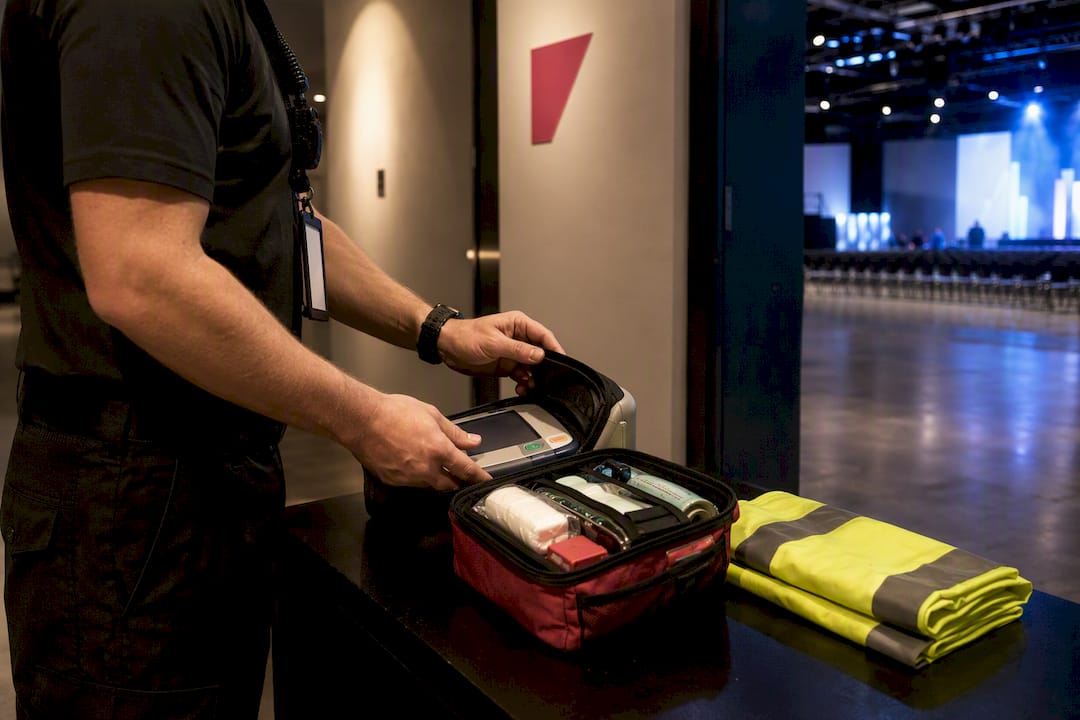
Position at least one medical responder or AED for every large event, placed where staff can reach it in under a minute from any point in the venue. Know your routing to the nearest emergency room before you need it, and log every medical incident with time, treatment given, and handoff details if EMS transports the guest. For events layered with executive protection needs, Hub’s VIP event security planning playbook covers how medical response coordinates with a principal’s detail without disrupting the broader crowd plan.
What Triggers an Evacuation, Postponement, or Lockdown?
Decision paralysis costs more time in an emergency than almost anything else. Define your triggers in advance, in writing, so nobody’s debating thresholds while a situation is unfolding.
- Severe weather: Set a specific threshold, wind speed, lightning within a set radius, a tornado warning, that automatically triggers shelter-in-place or postponement, no judgment call required in the moment.
- Confirmed active threat: Any credible, confirmed threat moves immediately to lockdown or evacuation, decided by your incident commander in direct coordination with law enforcement.
- Critical infrastructure failure: A total power outage, structural concern, or fire alarm activation triggers your evacuation checklist, not a wait-and-see approach.
- Medical mass-casualty event: Multiple simultaneous injuries or a suspected public health incident triggers EMS notification and, depending on scale, a broader evacuation.
Evacuation and shelter-in-place are different plans, not two versions of the same one. Evacuation means clear routes, staffed exits, and a designated assembly point away from the building. Shelter-in-place means identifying defensible interior rooms, away from windows and exterior walls, and a plan to account for everyone once the room is sealed. Your team needs to know, per hazard type, which one applies.
Activating incident command means your named commander takes charge, your public safety liaison opens a direct line to responding agencies, and every posted staff member reverts to their pre-briefed emergency role. FEMA’s guidance is direct on this point: pre-defining these authorities and roles, then practicing them, is what prevents freelancing during a real event, according to FEMA’s special events contingency planning primer.
Draft your attendee notification, media statement, and sponsor communication templates before the event, not during it. Run at least one tabletop exercise ahead of any event over a few hundred attendees, and a full walk-through drill for anything with executive-level exposure.
Pro Tip: Keep your evacuation and shelter-in-place decision criteria on a single laminated card at every command post. In a real incident, nobody has time to scroll through a 40-page plan.
Closing the Loop: Post-Event Review and Documentation
The event isn’t finished when the last guest leaves. What you document in the following 48 hours protects your organization legally and makes next year’s event safer.
Every incident, no matter how minor, needs a log entry with the time, location, reporting staff member, actions taken, outcome, and any evidence collected with a clear chain of custody. That last part matters more than planners expect: a poorly documented chain of custody on collected evidence can undermine an insurance claim or a legal case months later.
- Schedule an after-action review within a week, with every post leader present
- Build a timeline of what happened, what worked, and what didn’t
- Assign each corrective action a named owner and a deadline
- Notify your insurance carrier promptly on anything involving injury, property damage, or a security incident
- Retain incident logs, credentialing records, and vendor agreements per your organization’s records policy
| Post-event action | Why it matters |
|---|---|
| Incident log with chain of custody | Protects the organization in insurance and legal review |
| After-action review within a week | Captures details before memory fades |
| Corrective actions with named owners | Turns lessons into real changes, not just notes |
| Updated post orders and vendor contracts | Prevents the same gap from recurring next event |
Every corrective action from your after-action review should flow directly into an updated set of post orders, a revised staffing matrix, or a renegotiated vendor contract. A checklist that never changes after an incident isn’t a living plan, it’s paperwork.
Putting Hub’s Playbooks to Work on Your Event
You don’t need to build every document from scratch. Hub Investigative Group’s event security planning playbook and VIP event security planning guide give you templates for the pieces most planners struggle to draft under deadline:
- An Emergency Action Plan excerpt you can adapt to your venue and guest count
- A security team briefing outline covering post orders, radio checks, and muster points
- A command matrix structured around ICS/NIMS roles
- Post orders you can hand directly to contracted guards or venue staff
Feed the outputs from CISA’s Mass Gathering Security Planning Tool into these templates rather than starting blank. Scale everything to your event’s actual size, a 50-person board dinner doesn’t need the same command structure as a 3,000-person product launch, and run at least one tabletop exercise before doors open, no matter how small the event feels.
Protecting Attendee Data at Your Corporate Event
Attendee information deserves the same planning attention as physical access. Registration platforms, badge-scanning apps, and sponsor lead-retrieval tools all collect personal data, sometimes including dietary restrictions, travel details, or employer information that could be misused if exposed.
Limit who on your team can export the full attendee list, and require multi-factor authentication on your registration platform’s admin account. If sponsors are scanning badges to capture leads, confirm their data-handling agreement in writing, specifically what they collect, how long they retain it, and whether it’s shared with third parties.
For events involving executives or public figures, treat the guest list itself as sensitive. A leaked VIP attendee roster is a security exposure, not just a privacy inconvenience, since it can tip off anyone planning to approach a high-profile guest. Store printed guest lists and badge-printing stations behind the same access controls you’d apply to a cash box, not left on an unattended table.
Build a short data retention policy before the event: how long you’ll keep registration data, who can access it afterward, and when it gets deleted. Most corporate compliance teams already have a template for this. Loop them in early rather than treating data protection as an afterthought bolted onto the security plan.
Securing Transportation, Parking, and Arrival Points
Arrival and departure are two of the highest-exposure windows at any corporate event, and they’re often the least planned. A packed parking lot with no traffic control creates the same crowding risk as a packed lobby, just outdoors and harder to supervise.
Assign staff to direct vehicle flow at every entrance to a venue’s parking area, especially for events with valet service or executive vehicles arriving separately from general guest traffic. If your event includes VIPs or executives, build a separate arrival lane and drop-off point away from general parking, coordinated with your credentialing checkpoint so protective staff can move a principal directly inside without crossing the general guest flow.
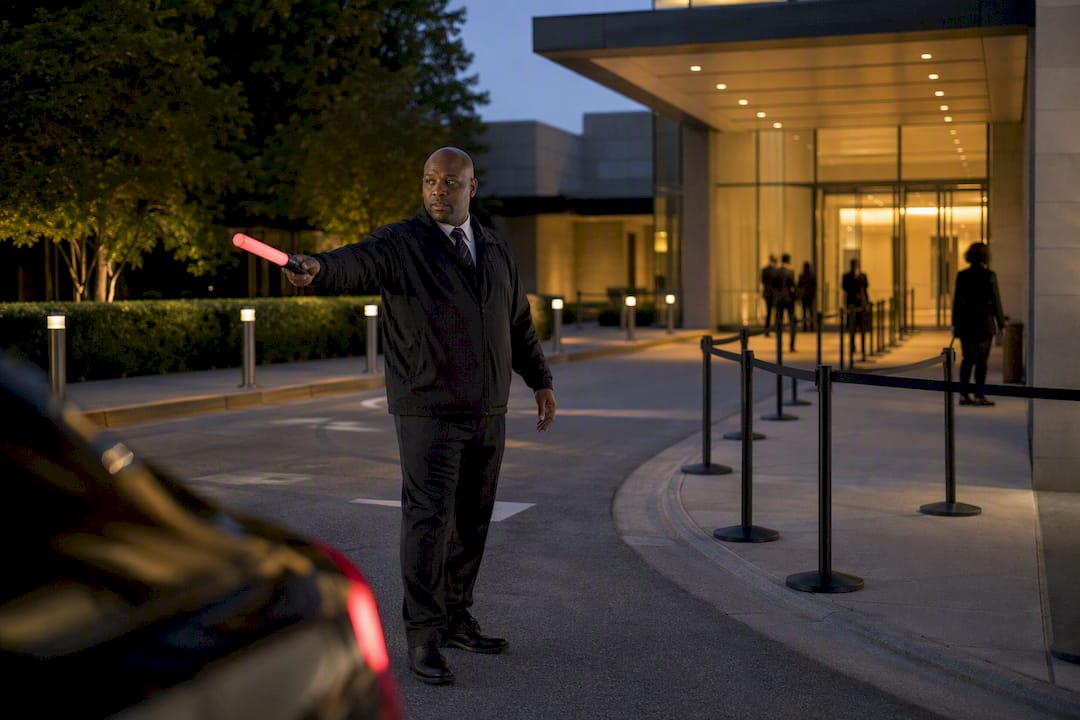
Light the parking area adequately for evening events, and station a visible security presence near vehicle entry points, not just inside the building. For events using rideshare or shuttle drop-off, designate a specific zone away from the main pedestrian entrance to avoid vehicles and foot traffic colliding at the door.
Coordinate with local law enforcement on street closures or traffic control if your event affects public roads, particularly for events with high-profile attendees where a motorcade or coordinated arrival is planned. Hub’s guide to safeguarding valuables during transport covers related principles for moving high-value items securely, which applies directly to any event involving cash handling, awards, or expensive equipment arriving by vehicle.
Legal and Liability Considerations Before You Sign Anything
Permits, insurance, and liability exposure sit underneath every item on this checklist, and skipping them creates risk no amount of good staffing can offset. Confirm what permits your venue or local jurisdiction requires for your event size, alcohol service, or any temporary structures like stages or tents, well before your event date.
Review your event insurance policy for what it actually covers, general liability, liquor liability if alcohol is served, and cancellation coverage for weather or venue-related disruptions. If you’re using contracted security guards, confirm they carry their own liability coverage and that their licensing is current in your state. Background-checked, properly vetted contract staff reduce your organization’s liability exposure significantly compared with unscreened temporary hires, a point worth confirming directly with any security vendor’s screening practices before signing a contract.
Workplace conduct exposure deserves attention too, particularly for events involving alcohol, late hours, or mixed staff and guest environments. Building basic harassment prevention awareness into your security team’s briefing closes a liability gap many corporate planners overlook until after an incident occurs.
Get a Security Plan Built Around Your Event, Not a Generic Template
A checklist gets you organized. A trained team gets you through the day. If your corporate event involves executives, high-profile guests, or a guest count that makes a spreadsheet feel inadequate, Staffing plans, credentialing systems, and command structures can be tailored to the actual venue and risk profile, rather than using a one-size-fits-all template pulled off the internet.
Our team has spent over two decades handling event security for corporate clients across Massachusetts, from product launches to board-level gatherings requiring executive protection coordination alongside the general security posture. If your event calls for licensed, trained personnel who understand both physical security and the liability side of the job, engage security professionals before you finalize your floor plan, not after.
Why Early Security Involvement Changes the Outcome
The best security decision most planners make happens weeks before the event, not the day of. Bringing security into the planning conversation before the venue layout and run sheet are locked lets small adjustments, a moved registration table, an added entrance, prevent problems that no amount of staffing can fix once the floor plan is set in concrete.
— Derek
Sources
- FEMA: IS-15.B Special Events Contingency Planning
- MPI: Guide to safety and security (best practices)
FAQ
What Are the 5 C’s of Event Security?
There’s no single universally agreed list, but planners commonly organize event security around communication, control, coordination, contingency planning, and command, mirroring the ICS structure FEMA teaches for special events.
How Do I Plan a Corporate Event Security Checklist Step by Step?
Start with a risk assessment, then move through venue inspection, credentialing setup, staffing and command structure, communications testing, and a written Emergency Action Plan, in that order, before finalizing any run-of-show details.
What Are the 5 D’s of Physical Security?
The commonly cited framework is deter, detect, deny, delay, and defend, layered controls that slow or stop an intruder rather than relying on any single barrier.
What Are the 5 P’s of Event Planning?
A widely used version covers purpose, people, product, promotion, and place, though some planners substitute “process” for one of these depending on the event type.
How Many Security Staff Do I Need for a Corporate Event?
Staffing depends on venue layout and risk level, but a common industry benchmark cited by MPI is roughly one trained crowd manager per 250 attendees in higher-density areas, adjusted upward for higher-risk zones.