
The safest large events run on three things working together: a written crowd management plan built before the gates open, one named person with authority to stop ingress the moment density hits a documented threshold, and real-time monitoring that feeds that decision. Get those three pillars right and you prevent most crowd incidents before they start. The sections below break down how to build each one, from occupant-load math to the show-stop chain of command.
TL;DR:
- Crowd management plans must include detailed occupant load calculations and a clear chain of command with designated authority to stop ingress at density thresholds.
- Venue design should prioritize one-way flows, separated entry and exit routes, and even distribute egress width across multiple exits to prevent dangerous density buildup.
- Staffing ratios should be paired with a single named show-stop authority and a structured communication hierarchy to effectively manage density and respond quickly to issues.
- Monitoring tools like CCTV, manual headcounts, and spotter reports must set specific density triggers with defined actions and responsible personnel to prevent surges.
- Pre-event messaging, clear signage, and leader agents reduce confusion and pressure points, while evacuation and invacuation procedures must be planned and rehearsed based on expected crowd density.
Table of Contents
- Building the Crowd Management Plan and Risk Assessment
- Designing Ingress, Circulation, and Egress to Prevent Density Problems
- How Do You Staff and Govern Crowd Operations During the Event?
- Real-Time Monitoring: Metrics, Tools, and Trigger Points
- Communications and Signage That Change Crowd Behavior Before It Starts
- Emergency Procedures, Evacuation Planning, and the Life Safety Evaluation
- Training, Drills, and the Post-Event Review
- How Hub Investigative Group Applies These Crowd Management Strategies
- The Checklist Every Planner Should Print for Event Day
- How Hub Can Help With Your Event’s Crowd Management Plan
- Sources
- FAQ
Building the Crowd Management Plan and Risk Assessment
Every crowd management plan starts with an honest profile of who is actually coming. That means accounting for age range, whether alcohol will be served, mobility needs, and how the schedule clusters arrivals. A 10 PM headliner set draws a different surge pattern than a family matinee, and your plan should say so in writing, not assume it.
The math behind the plan matters as much as the narrative. Design occupant load sets the ceiling for how many people a space can hold, but egress-limited capacity is often the real constraint. NFPA-aligned codes generally require a formal written crowd management plan for assemblies over 1,000 people, along with occupant-load calculations that inform egress planning and, in many cases, a full Life Safety Evaluation. Total egress width, not the number of doors, usually determines how fast a venue can empty safely.
A complete crowd management plan needs these components at minimum:
- Roles and chain of command, naming who holds show-stop authority and who backs them up.
- A monitoring and trigger table tying density readings to specific actions and deadlines.
- Evacuation and invacuation contingencies for weather, medical mass-casualty events, and security threats.
- Communications protocols covering staff radios, public address scripts, and digital alerts.
- Staffing assignments by zone, shift, and specialty (medical, security, guest services).
Commission a Life Safety Evaluation whenever expected density will challenge normal egress. That evaluation should come from someone the Authority Having Jurisdiction accepts, typically a licensed fire protection engineer or a credentialed life-safety professional. Building this early gives you the runway to fix design flaws before opening day rather than discovering them mid-event. Hub Investigative Group’s event security planning resources walk through how to structure this documentation for local approval.
Designing Ingress, Circulation, and Egress to Prevent Density Problems
Most crowd crises trace back to a design decision made months earlier, not a failure on event day. One-way flows, separated entry and exit routes, and the elimination of dead-ends do more to prevent dangerous density than any amount of shouting through a bullhorn later. Counter-flow, where entering and exiting crowds cross paths, is one of the most common and most avoidable design errors in event layouts.
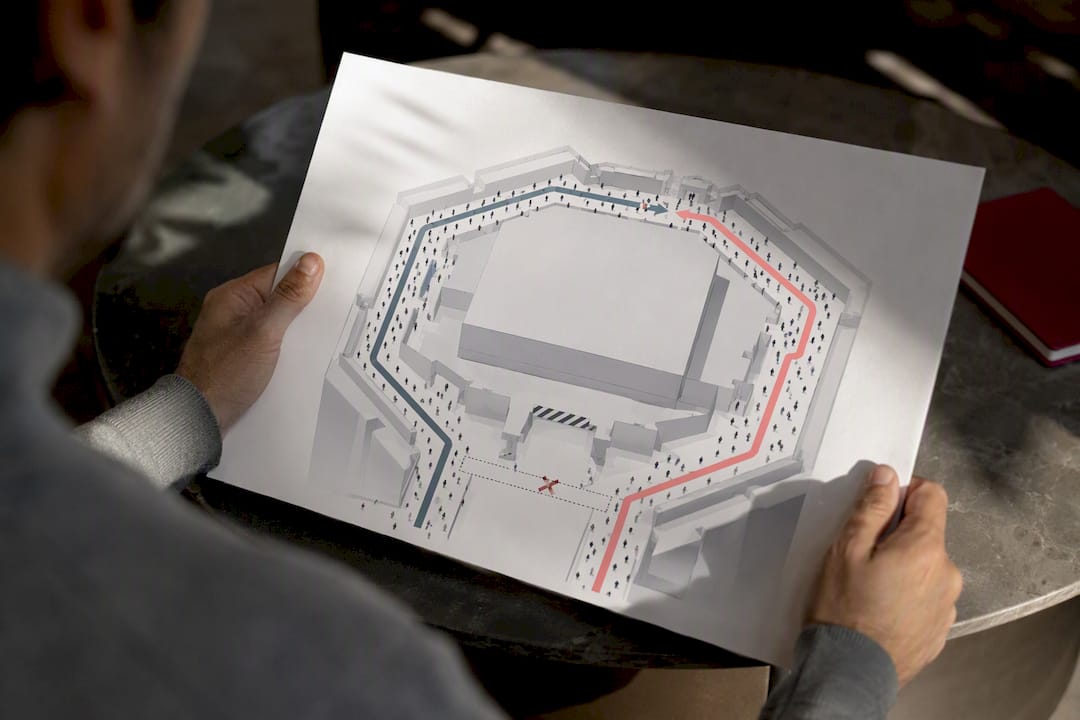
Egress width outperforms exit count as a safety metric. Research on emergency exit layouts shows that total egress width and how load distributes across exits matter more than simply having more doors. A single oversized exit that absorbs most of the crowd will clog and cause herding, while several modest exits spread evenly across a perimeter move people faster and calmer.
Practical measures that flatten peak density include:
- Zoning the venue into sectors with independent capacity limits.
- Timed or staggered admission windows instead of a single gate rush.
- Reserved seating or ticketed sections that reduce first-come scrambling.
- Load-rated crush rails at any pinch point where forward pressure could build, particularly near stages or barricaded pits.
Pro Tip: Walk your own site plan as if you were a guest arriving late and in a hurry. If you find yourself backtracking or guessing which way to go, so will thousands of others.
How Do You Staff and Govern Crowd Operations During the Event?
Staffing ratios only work when paired with a clear governance structure. Operational guidance from fire prevention authorities recommends roughly one trained crowd manager per 250 occupants once an assembly exceeds 1,000 people, and that ratio scales up for higher-risk crowds involving alcohol, standing pits, or known rivalries. Ratios alone do not prevent incidents, though. Field guidance on managing crowds safely points out that controls fail most often when the people watching density have no actual power to act on what they see.
That is why a single named show-stop authority matters more than headcount. Structure your on-site operation like this:
- Name one person, by title and by name, with pre-authorized power to halt ingress or pause an event.
- Assign spotters to fixed zones who report density readings up a defined chain, not into a general radio channel.
- Post sector stewards responsible for crowd behavior and minor conflict de-escalation within their zone.
- Staff a dedicated communications officer who relays trigger events to command and to the public address system.
- Assign a medical liaison who tracks casualty reports and coordinates directly with EMS on scene.
- Build an escalation ladder so a spotter’s warning reaches the show-stop authority in under a minute, not through three layers of approval.
Real-Time Monitoring: Metrics, Tools, and Trigger Points
Density is the number that should drive every intervention decision, and it needs a hard number attached to it before the gates open, not a gut feeling in the moment.
A commonly cited danger threshold is a crowd density at which individual movement becomes involuntary and crowd surges can occur, generally recognized at around four to five people per square meter. Below that, people can choose their own path. Above it, the crowd moves as a single mass and individuals lose the ability to stop or change direction on their own.
Reaching that number requires more than one tool. A layered monitoring toolkit typically includes:
- CCTV with density analytics covering chokepoints and gathering zones.
- Manual headcounts at gates and sector boundaries, cross-checked against ticket scans.
- A spotter network reporting density and mood by radio at fixed intervals.
- Heatmap or wearable-sensor systems for larger festivals where camera coverage has gaps.
Write your triggers as a table, not a paragraph: metric, action, responsible person, and timeline. For example: “Zone 3 density hits 4 people/m² → sector steward deploys dynamic signage rerouting arrivals to Zone 2 → show-stop authority notified → action within 90 seconds.” Dynamic signage, leader agents positioned in the crowd, and temporary rerouting are the three fastest levers for rebalancing flow once a trigger fires.
Communications and Signage That Change Crowd Behavior Before It Starts
Confusion, not malice, causes most crowd surges. A guest who does not know where to go stops walking, and a stopped guest in a moving crowd creates a pressure point. Pre-event messaging that sets clear arrival windows, transport guidance, and queuing expectations removes that confusion before anyone reaches the gate. Ticketing platforms that stagger arrival times through promotional windows can spread demand well before the event, an approach covered in detail by event promotion resources aimed at controlling attendance patterns.
On-site, short public address scripts work better than long announcements. “Move to your left toward Gate C” beats a three-sentence explanation every time, because a moving crowd needs a direction, not a rationale.
- Use LED boards and staff hand signals for dynamic rerouting when conditions change mid-event.
- Position leader agents, staff who visibly walk toward the correct exit, since simulation research shows informed-leader strategies reduce herding compared to unguided crowd-following behavior.
- Post multilingual signage and pair every visual sign with an audio equivalent for guests with visual impairments.
Emergency Procedures, Evacuation Planning, and the Life Safety Evaluation
Evacuation planning and invacuation planning solve different problems. Evacuation moves people out of a venue during fire, structural, or security threats. Invacuation moves people into secured indoor spaces during severe weather or an active threat outside. Your plan needs written procedures and staff training for both, because defaulting to “everyone run for the exits” is the wrong answer for a tornado warning.
A Life Safety Evaluation is the right tool whenever expected crowd density will challenge normal egress capacity. It documents egress capacity, travel distances to each exit, and identifies chokepoints before they become emergencies. Simulation research backs up what field practitioners have long suspected: leader-agent strategies and dynamic route information reduce herding at single exits far more effectively than static signage alone during an actual evacuation.
Key elements to lock down in advance:
- Medical staffing levels matched to expected attendance and known risk factors (heat, alcohol, mosh pits).
- A direct coordination line with EMS and local incident command, established before doors open.
- Rally points and reunification areas communicated during pre-event messaging, not improvised on the day.
A guide to emergency evacuation planning covers the drill structures that make these procedures actually usable under pressure.
Training, Drills, and the Post-Event Review
A crowd management plan that never gets tested is a document, not a system. Three exercise types cover most of what you need:
- Tabletop exercises walk staff through trigger scenarios verbally, testing whether the escalation ladder actually makes sense on paper.
- Live drills test whether spotters can relay a density reading to the show-stop authority within your target response time, usually under two minutes.
- Shadowing pairs new staff with experienced crowd managers during a lower-risk event before they run a high-risk one solo.
After the event, collect CCTV clips from trigger moments, heatmap exports, and incident logs while memories are still fresh. Convert every near-miss into a specific plan revision, not a vague note to “watch that area more closely” next time.
Pro Tip: File your after-action report within 48 hours. Details about exactly where a bottleneck formed fade fast, and that specificity is what AHJs and insurers actually want to see.
How Hub Investigative Group Applies These Crowd Management Strategies
Hub Investigative Group has built its event security work around the same operational discipline outlined above: a named crowd manager on every assignment, documented monitoring intervals, and a clear show-stop chain of command agreed with the client before doors open. Massachusetts venues have relied on trained crowd managers to catch density problems that generic security staffing misses, a pattern covered in Hub’s look at nightlife safety and crowd managers. For high-profile events with VIP flows or dignitary appearances, Hub’s VIP event security framework applies leader-agent positioning and dedicated egress lanes to keep principal movement separate from general crowd density.
The Checklist Every Planner Should Print for Event Day
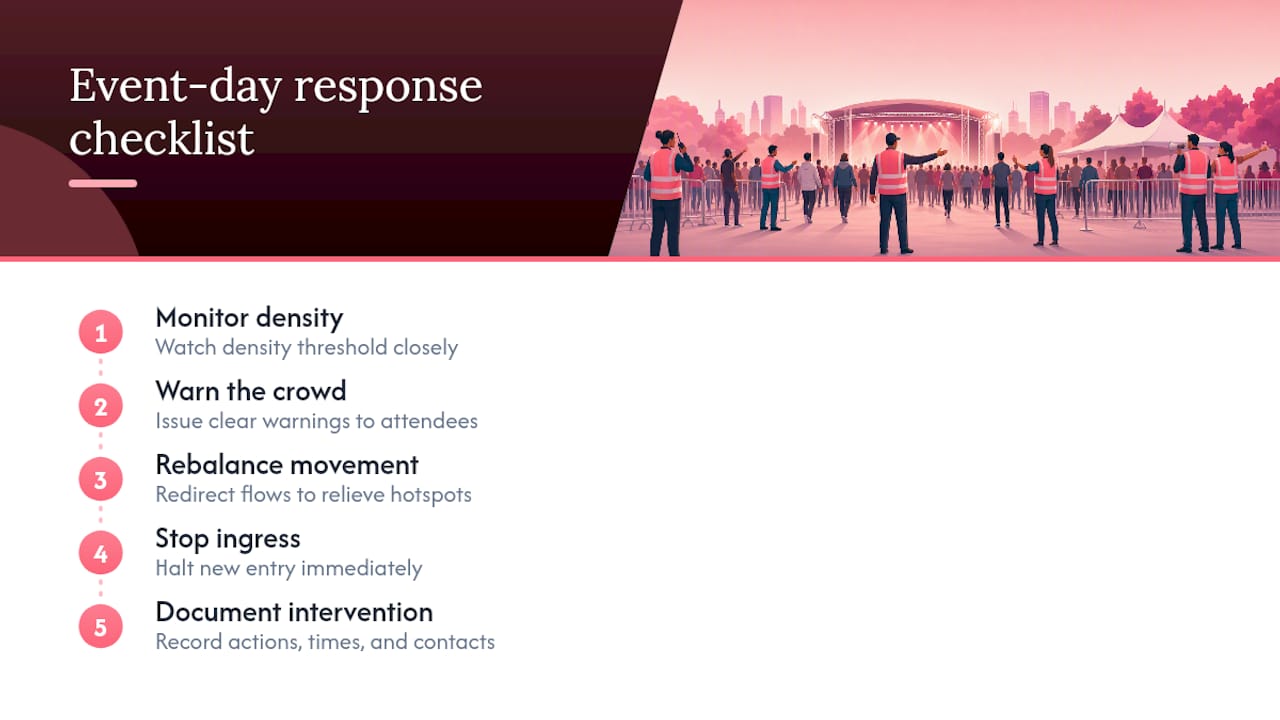
Post this near your command post: know your show-stop authority by name, watch your density threshold, know exactly who to call for EMS before you need them. If the threshold is met, the sequence is always the same. Monitor, warn, rebalance, stop ingress, document. Skipping a step to save time is how a manageable situation becomes an incident report.
How Hub Can Help With Your Event’s Crowd Management Plan
Some security firms provide crowd management plan services beyond generic staffing, building written plans, staffing with trained crowd managers at recommended ratios, and assigning a single accountable person in the show-stop role before the event opens its gates.

Coordination with venue staff, local fire marshals, and EMS helps align the Life Safety Evaluation with realistic egress numbers. This coordination can also extend to staffing, sector stewarding, and post-event documentation. For assemblies that could challenge normal egress capacity, consider requesting a security risk assessment and a monitoring and trigger table built around the specific venue before finalizing ticket sales.
Sources
- Crowd Managers – Number Required for Events and Training Requirements (UT Austin Fire Prevention)
- NFPA 101 applications and guidance (NFPA Journal)
- The Life Safety Evaluation: What It Is, What It Requires, and How to Use It – Entertaining Safety
FAQ
What Are the Main Tactics Used for Crowd Control?
The three most-used tactics are physical barriers and zoning to control flow, trained staff positioned to intervene early, and clear signage or public address messaging that directs movement before density builds. Reactive tactics like containment lines are used only after these proactive measures fail.
What Is the Key to Effective Crowd Management?
The key is combining a written, tested crowd management plan with one named show-stop authority who has pre-authorized power to close ingress the moment a documented density threshold is reached. Ratios and barriers matter, but they only work when someone has the standing authority to act on what monitoring shows.
How Can You Manage Crowds at a Large Event?
Manage crowds by assessing risk and calculating egress-limited capacity before the event, designing one-way flows with separated entry and exit routes, staffing at recommended ratios such as one trained crowd manager per 250 occupants, and monitoring density in real time against written triggers.
What Are the Basics of Crowd Management for Beginners?
The basics are a written plan built from a real risk assessment, physical design that prevents dead-ends and counter-flow, adequate trained staffing, and a monitoring system tied to specific action triggers. Every basic component should be documented before the event, not improvised during it.
Does Hub Investigative Group Offer Crowd Management Services?
Hub Investigative Group provides event security planning, trained crowd manager staffing, and coordination support for Life Safety Evaluations for events in the Massachusetts area. Services include on-site security staffing, risk assessments, and planning support built around named show-stop authority and real-time monitoring.