
When you suspect an employee of theft, your first move is not a confrontation. Secure the evidence, limit who knows about the inquiry, and call your attorney before you take any step that cannot be undone. That sequence, in that order, is what separates a legally defensible employee theft investigation from one that ends in a wrongful-termination lawsuit or a dismissed criminal case.
Occupational fraud remains one of the most persistent threats to U.S. businesses, and the Association of Certified Fraud Examiners (ACFE) documents in its 2024 Report to the Nations that organizations lose a significant share of revenue to internal fraud each year. The damage is not just financial. A mishandled workplace theft inquiry can expose you to defamation claims, privacy violations, and labor law liability that cost more than the original theft. This guide gives you a practical, step-by-step playbook built around U.S. law, with the legal risk controls built in at every stage.
Key Takeaways
A defensible employee theft investigation requires securing evidence before confronting anyone, maintaining a neutral team, involving counsel early, and documenting every step in a chain-of-custody log that survives adversarial review.
| Point | Details |
|---|---|
| Secure evidence first | Preserve CCTV, digital logs, and physical documents before any confrontation or disclosure. |
| Involve counsel early | Attorney involvement from the start protects privilege and prevents irreversible legal mistakes. |
| Keep the team neutral | The person who discovered the theft should not lead the investigation; use a neutral third party for high-stakes cases. |
| Document everything in real time | Contemporaneous notes, signed witness statements, and a chain-of-custody log are your defense in any proceeding. |
| Hubsecurityandinvestigativegroup | Provides forensic collection, surveillance, and neutral witness interviews for complex or high-risk theft cases. |
Table of Contents
- What to do first when you suspect employee theft
- Your employee theft investigation checklist for the first 72 hours
- Who should run the investigation and how to build a neutral team
- How to preserve evidence and maintain a defensible chain of custody
- How should you conduct interviews during a workplace theft inquiry?
- Building the investigative record and drafting a final report
- U.S. legal and compliance issues you need to know before you act
- When should you hire forensic accountants, private investigators, or law enforcement?
- What are your options after the investigation concludes?
- Controls and culture fixes that reduce future employee theft
- Practical templates and tools for your investigation
- Handling employee rights and communication during the investigation
- How to protect morale and prevent retaliation after an investigation
- What most investigations get wrong: a field perspective
- Hubsecurityandinvestigativegroup: your partner for complex theft investigations
- Sources
What to do first when you suspect employee theft
Your three highest-priority actions in the first hour are: suspend the suspected employee’s access to relevant systems, preserve all CCTV footage and digital logs before they are overwritten, and restrict knowledge of the inquiry to a small, need-to-know group. Do not alert the suspect, do not confront anyone, and do not delete or move any files.
Before you take any irreversible step, including suspension or termination, contact employment counsel. CaseIQ’s HR guidance is direct on this point: start with evidence, not confrontation. A call to your attorney at the outset costs far less than defending an employment claim later.
Your employee theft investigation checklist for the first 72 hours
A structured timeline keeps evidence intact and preserves your options for discipline, civil recovery, insurance claims, or criminal referral. Work through these steps in order.
- Hour 1: Restrict access. Suspend the employee’s login credentials, key-card access, and any financial system permissions. Do this quietly, framing it as a routine IT action if possible.
- Hour 1–2: Preserve digital evidence. Have IT create forensic images of relevant devices and back up email archives, transaction logs, and access records to a secure, write-protected location. Do not allow anyone to open or alter original files.
- Hour 2–4: Secure physical evidence. Lock physical documents, cash drawers, inventory records, and any items that may be relevant. Photograph everything in place before moving it.
- Hour 4–8: Notify counsel. Brief your attorney on what you know. If the case may involve criminal referral or civil recovery, early attorney involvement is the single most effective way to preserve evidence correctly and protect attorney–client privilege.
- Day 1–2: Assemble the investigation team. Identify who will lead the inquiry and who will serve in supporting roles. Keep the group small.
- Day 2–3: Begin evidence review. Review CCTV footage, transaction records, and access logs before interviewing anyone. Build a preliminary timeline of events.
- Day 3: Triage and plan interviews. Rank witnesses by proximity to the incident and schedule interviews, starting with those furthest from the suspected employee.
Expect police investigations to take weeks to months, and forensic accounting results to take anywhere from a few days to several weeks depending on data volume. Plan your internal timeline accordingly.
Pro Tip: The person who first discovered the suspected theft should not lead the internal investigation. Their involvement creates a perceived conflict of interest that opposing counsel will exploit at trial. Assign a neutral party from the start.
Who should run the investigation and how to build a neutral team
The composition of your investigation team determines whether your findings hold up in court, before a labor board, or in an insurance claim. A single investigator with a personal connection to the accused, or to the person who reported the theft, is a liability.
Fisher Phillips advises that investigations must be impartial and that using multiple investigators reduces bias risk. The practical implication: build a small team with clearly separated roles, and bring in a neutral third party whenever internal relationships create even the appearance of partiality.
| Role | Primary Responsibility | Conflict of Interest Red Flags |
|---|---|---|
| Lead investigator (HR or outside neutral) | Directs interviews, maintains evidence log, drafts final report | Reported the theft; personal relationship with accused; direct supervisor of accused |
| Legal counsel | Advises on privilege, search limits, and discipline options | Represents the accused in any capacity |
| IT/forensics | Preserves digital evidence, creates forensic images | Has system admin access that overlaps with the suspected activity |
| Operations/finance | Provides transaction context and access to financial records | Approves the accused’s expense reports or transactions |
| Outside investigator (when needed) | Conducts surveillance, witness interviews, or forensic collection | Any prior relationship with the accused or reporting party |
When the suspected theft involves a senior employee, a large dollar amount, or potential criminal exposure, bring in a neutral third-party investigator from the start. Internal teams investigating their own colleagues rarely produce findings that survive adversarial scrutiny.
How to preserve evidence and maintain a defensible chain of custody
Evidence integrity is the foundation of every outcome you want, whether that is a termination that survives appeal, a successful insurance claim, or a criminal prosecution. FindLaw’s guidance on employee embezzlement is clear: prompt preservation of records is non-negotiable, and engaging outside examiners through counsel helps protect privilege.

Preserve in this priority order: CCTV footage (often overwritten on 30-day cycles), transaction logs, system access logs, email and messaging archives, and then physical documents. For digital evidence, the goal is a forensic image, a bit-for-bit copy made before anyone opens or modifies the original.
Every piece of evidence needs a chain-of-custody log: who collected it, when, where it is stored, and who has accessed it since. A gap in that log is an opening for a defense attorney.
Pro Tip: Volatile digital evidence, including RAM contents, active session data, and browser history, disappears the moment a device is powered off. If a device is still running when you secure it, have a qualified forensic examiner image it live before shutting it down. Never let an untrained employee “just copy the files.”
Hubsecurityandinvestigativegroup’s employee device monitoring services are designed specifically for this step, using trained examiners who follow documented chain-of-custody procedures from the moment they take custody of a device.
How should you conduct interviews during a workplace theft inquiry?
Interview order matters as much as the questions you ask. Start with witnesses who are furthest removed from the suspected employee, work toward those with closer knowledge, and interview the accused last. This sequence lets you build a factual baseline before the subject has any opportunity to shape the narrative.
Pause all interviews immediately if your attorney advises it, particularly if a criminal referral is likely. Statements made during an internal inquiry can complicate a parallel criminal investigation.
Witness interview questions (fact-finding, non-leading):
- “Can you describe what you observed on [date and time]?”
- “Who else was present when that happened?”
- “Did you notice anything unusual about [process, system, or location] in the weeks before?”
- “Has anyone else mentioned concerns to you about this?”
- “Is there anything else you think we should know?”
Subject interview questions:
- “Can you walk me through your responsibilities related to [the relevant process]?”
- “Were you working on [date]? Can you describe what you did that day?”
- “Can you explain this transaction/discrepancy?” (show the document)
- “Is there anyone who can confirm what you’ve told us?”
- “Is there anything you want to add or clarify?”
Fisher Phillips is direct about why the subject interview matters: juries scrutinize whether the accused was allowed to tell their side. Skipping it, or conducting it so narrowly that the employee had no real opportunity to respond, creates trial exposure even when the evidence of theft is strong.
Document every interview with contemporaneous notes taken during or immediately after the session. Ask each witness to review and sign a written summary of their statement. Recording is permissible in many states but requires consent in two-party consent states; confirm the rule in your jurisdiction with counsel before you record.
Pro Tip: Never conduct an interview alone. Always have a second person present, typically an HR representative, who takes notes independently. Two sets of contemporaneous notes are far more credible than one, and a corroborating witness protects the interviewer if the subject later claims the questions were coercive.
Building the investigative record and drafting a final report
A complete investigative file does two things: it supports whatever action you take against the employee, and it protects you if that action is challenged. Every document, note, and piece of evidence belongs in a single, organized file maintained by the lead investigator.
Recommended final report outline:
- Executive summary — findings in plain language, recommended action
- Background — how the inquiry began, who reported it, and when
- Investigation team — names, roles, and any conflict-of-interest disclosures
- Evidence index — itemized list of every piece of evidence with collection date, custodian, and storage location
- Interview summaries — one paragraph per interview, with date, attendees, and key statements
- Timeline of events — chronological reconstruction of the suspected theft
- Analysis — how the evidence supports or contradicts the allegation
- Recommended actions — discipline, termination, civil referral, criminal referral, or no action
Store the complete file in a location accessible only to the lead investigator and counsel. If the investigation was conducted under attorney direction, the file may qualify for attorney–client privilege protection, which limits what opposing parties can demand in discovery.
Pro Tip: Redact third-party personal information (Social Security numbers, unrelated financial data, bystander names) before sharing the report with anyone outside the core team. Limit distribution to those with a genuine need to know. Every additional copy is a potential leak and a potential privacy claim.
U.S. legal and compliance issues you need to know before you act
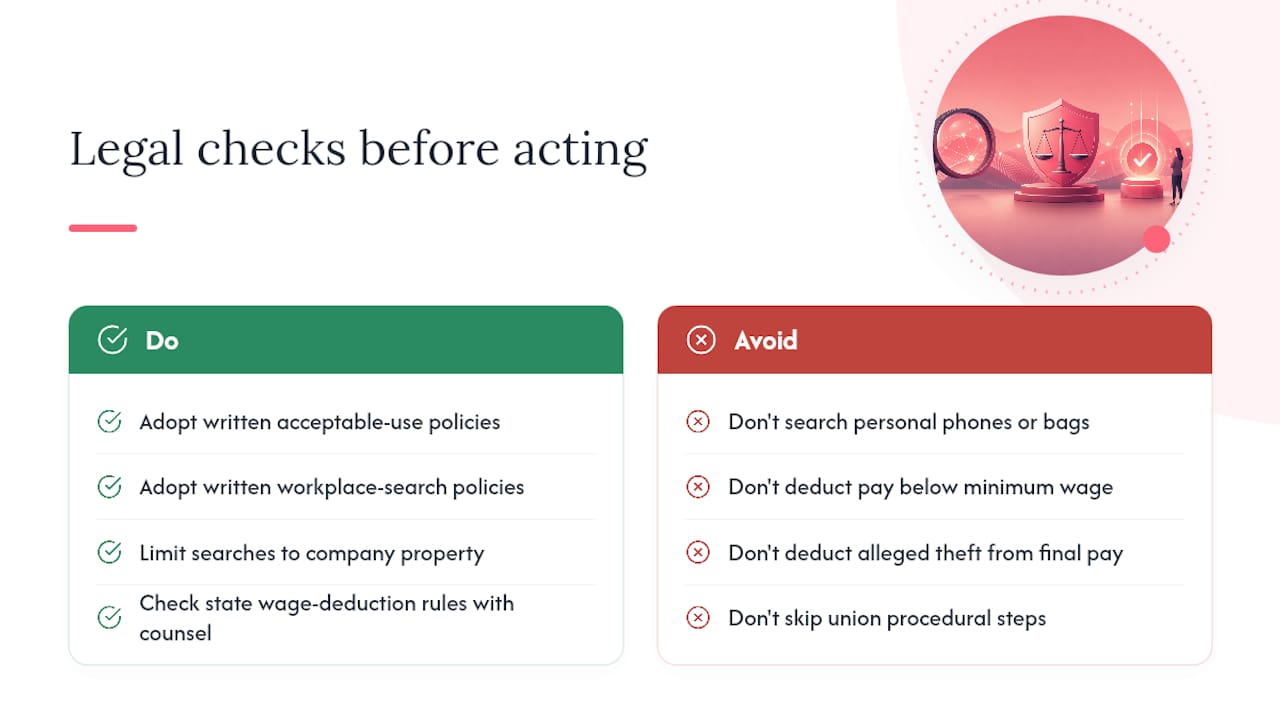
Employee theft investigations in the United States operate inside a web of federal and state laws that can trip up even experienced HR teams. The most common mistakes involve searches, wage deductions, and union procedures.
Searches and privacy: You generally have the right to search company-owned devices, vehicles, and workspaces, provided your written policies put employees on notice that company property is subject to search. Searching an employee’s personal vehicle, personal phone, or personal bag without consent is a different matter entirely and can expose you to Fourth Amendment-adjacent state privacy claims and tort liability. Your written acceptable-use and workplace-search policies are your first line of defense here.
Wage deductions: Federal law under the Fair Labor Standards Act (FLSA) prohibits deductions that bring a non-exempt employee’s pay below minimum wage. Many states impose stricter limits. Some states prohibit deducting alleged theft losses from a final paycheck without a court judgment or signed written authorization. Confirm your state’s rule with counsel before withholding any pay.
State wage-deduction laws vary significantly. In states like California and New York, deducting alleged theft losses from wages without a court order or explicit written consent is prohibited regardless of what your employee handbook says. Violating these rules can turn a theft victim into a defendant.
Union contracts and state labor laws: If the accused employee is covered by a collective bargaining agreement, the contract likely requires specific procedural steps before discipline or termination, including the right to union representation during investigative interviews (Weingarten rights). Skipping those steps can result in reinstatement even when the evidence of theft is clear.
Dickinson Wright recommends involving employment counsel before any disciplinary action in unionized environments, and before conducting searches or wage deductions in states with strong employee-privacy statutes.
The NRF’s National Retail Security Survey identifies employee theft as a leading driver of retail shrink, and retail employers face an additional layer of compliance complexity because loss-prevention practices are subject to state-specific civil demand and detention laws. Know your state’s rules before you detain or question an employee on the sales floor.
When should you hire forensic accountants, private investigators, or law enforcement?
Not every theft case needs outside specialists, but the cases that do tend to be the ones where the stakes are highest and the internal team is least equipped to handle them.
Forensic accountants are the right call when the suspected theft involves manipulated financial records, falsified invoices, payroll fraud, or any scheme that requires reconstructing transactions over time. They produce reports formatted for litigation and can testify as expert witnesses. Engage them through counsel to preserve privilege.
Private investigators add value when you need surveillance, witness interviews outside the workplace, background research, or evidence collection that your internal team cannot conduct without creating bias. A licensed investigator follows documented chain-of-custody procedures and can testify about their findings. For cases where the investigation itself poses a safety risk, such as a confrontational employee or a situation involving organized internal theft, Hub’s private investigation services bring both investigative expertise and security capability to the same engagement.
Law enforcement is appropriate when the dollar amount crosses the felony threshold in your state, when the theft involves fraud against a government program, or when you have clear evidence and want criminal prosecution. Prepare a clean, organized evidence package before you contact police. LegalClarity warns that a sloppy internal investigation can derail a criminal case, so have your evidence indexed and your chain-of-custody log complete before you walk into a police station.
Vendor vetting checklist for outside specialists:
- Verify licensure (private investigators must be licensed in the state where they operate)
- Ask for sample deliverables: what does their final report look like?
- Confirm their chain-of-custody procedures in writing
- Ask whether they have testified as a witness and in what types of cases
- Clarify whether their engagement will be through counsel (for privilege) or direct
Cost drivers for outside specialists include data volume, travel requirements, whether the case is civil or criminal in focus, and the need for expert testimony. Insurance policies covering employee dishonesty, sometimes called fidelity bonds or crime policies, may reimburse investigation costs as part of a covered loss. Review your policy before you engage specialists.
Pro Tip: Hire forensic accountants and data-recovery experts through your attorney, not directly through your company. When counsel retains the specialist, the work product is more likely to be protected by attorney–client privilege and shielded from discovery in civil litigation.
What are your options after the investigation concludes?
The investigation produces findings. Those findings drive a decision. The decision must match the evidence, not the emotion of the moment.
- No action: The evidence does not support the allegation. Document the finding, close the file, and restore any suspended access. Communicate the outcome to the accused in writing.
- Coaching or written warning: The evidence shows a policy violation but not clear theft. Use your standard progressive discipline process, document it thoroughly, and update the employee’s file.
- Termination: The evidence supports termination for cause. Before acting, confirm with counsel that the termination is defensible given the evidence, the employee’s tenure, and any applicable contract or union agreement. Provide a written termination letter that states the reason without admitting facts you cannot prove.
- Civil recovery: You can sue to recover stolen funds. The evidentiary standard is a preponderance of the evidence, lower than the criminal standard. Civil suits are appropriate when the dollar amount justifies the cost of litigation and when criminal prosecution is unlikely or too slow.
- Criminal referral: Contact law enforcement with your organized evidence package. Cooperate with prosecutors, but understand that you lose control of the timeline once you do. A criminal conviction can support a subsequent civil judgment.
- Insurance claim: File a claim under your fidelity bond or crime policy promptly. Most policies have strict notice requirements. Provide your complete evidence file and the final investigative report as proof of loss.
Wrongful termination, defamation, and invasion of privacy are the three most common claims that follow a mishandled investigation. Keep findings factual, limit who you tell and what you say, and never characterize the employee as guilty in any communication before a final determination.
Controls and culture fixes that reduce future employee theft
Prevention is cheaper than investigation. The ACFE’s 2024 Report to the Nations consistently shows that organizations with stronger anti-fraud controls detect fraud faster and recover more. The practical controls that matter most are not complicated.
Structural controls:
- Segregation of duties: no single employee should be able to both authorize and process a transaction
- Surprise audits of cash drawers, inventory, and expense reports
- Dual-approval requirements for transactions above a defined threshold
- Role-based access controls that limit system permissions to what each employee actually needs
- CCTV coverage of cash-handling areas, stockrooms, and server rooms, with a documented retention policy
Reporting programs: Anonymous reporting hotlines are among the most cost-effective detection tools available. The ASU POP Center’s workplace dishonesty research supports this: coworkers often detect dishonest behavior earlier than audits do, and a structured reporting program gives them a safe channel to act on what they see.
The tone at the top is not a cliché. When leadership visibly enforces controls and takes theft seriously, employees internalize that the organization is watching and that violations have consequences. When leadership looks the other way, the message travels just as fast.
The most durable prevention approach follows a three-part cycle: diagnose the specific vulnerabilities in your current environment, prescribe targeted controls for those vulnerabilities, and test whether the controls are working. Retail operations, for example, can use the NRF’s loss-prevention framework as a benchmark for shrink rates and detection methods, then measure their own results against that baseline. For a broader look at how physical security integrates with internal controls, Hub’s office security guidance covers the building-level layer of a layered security approach.
Pro Tip: Review your access controls every time an employee changes roles or leaves the company. Terminated employees with active credentials are one of the most common vectors for post-employment theft and data exfiltration.
Practical templates and tools for your investigation
A well-run investigation does not rely on memory. It relies on forms. The templates below give you a starting framework you can adapt to your specific situation.
Toolkit contents:
- Investigative checklist: A sequenced list of every action from initial evidence preservation through final report, with a checkbox and a date field for each step. Use it to confirm nothing was skipped and to demonstrate procedural compliance if the case is challenged.
- Witness interview script: A structured question guide for witness interviews, with space for contemporaneous notes and a signature block for the witness to confirm the summary is accurate.
- Subject interview script: A parallel guide for the accused employee’s interview, designed to give the subject a genuine opportunity to respond, which Fisher Phillips identifies as critical to trial credibility.
- Chain-of-custody form: A log with fields for evidence description, collection date and time, collector name, storage location, and every subsequent access event.
- Evidence index template: A master list of all evidence in the file, cross-referenced to the relevant section of the final report.
When counsel is directing the investigation, these templates should be generated or reviewed by the attorney’s office so that the completed forms are more likely to fall within the scope of attorney–client privilege. In a case where the evidence file is later subpoenaed, the difference between privileged and non-privileged documents can determine the outcome of litigation.
Mini case example (anonymized): A mid-size distributor suspected a warehouse supervisor of diverting inventory. The HR team used a sequenced investigative checklist to preserve CCTV footage before the 30-day overwrite cycle, image the supervisor’s company laptop through a licensed examiner, and interview three coworkers before scheduling the subject interview. The chain-of-custody form documented every person who accessed the footage. When the case went to arbitration, the employer’s procedural record was clean enough that the arbitrator upheld termination without ordering reinstatement.
Pro Tip: Date and initial every page of every completed template at the time you fill it out. A form completed after the fact, even if accurate, looks fabricated to a jury or arbitrator. Real-time documentation is your credibility.
Handling employee rights and communication during the investigation
An employee under investigation retains legal rights, and how you handle communication during the inquiry affects both your legal exposure and the integrity of your findings.
Right to representation: In unionized workplaces, employees have Weingarten rights, meaning they can request union representation during any investigative interview they reasonably believe may lead to discipline. Denying that request is an unfair labor practice. In non-union settings, there is no federal right to have an attorney or coworker present during an internal interview, but some states provide broader protections. Confirm the rule in your jurisdiction.
Communication discipline: Tell the employee only what they need to know at each stage. At the start of an interview, explain that you are conducting a workplace inquiry, that their participation is expected, and that retaliation against anyone involved is prohibited. Do not reveal the names of witnesses, the full scope of the evidence, or the identity of the person who reported the concern.
Confidentiality: Instruct everyone involved in the investigation, including witnesses, to keep the matter confidential. This is not a gag order; employees retain the right to discuss wages and working conditions under the National Labor Relations Act (NLRA). But you can lawfully instruct participants not to discuss the specific details of the investigation with coworkers while it is ongoing, provided you can articulate a legitimate business reason for that instruction.
Written communication to the accused during the investigation should be factual, neutral, and reviewed by counsel before it is sent. A poorly worded suspension letter or email can be read as a pre-judgment of guilt, which creates defamation exposure.
How to protect morale and prevent retaliation after an investigation
An investigation, even a well-run one, creates anxiety in the workplace. People notice when a colleague’s access is suspended, when HR is conducting private meetings, or when a coworker is suddenly absent. Managing that anxiety is not a soft concern; it directly affects whether witnesses cooperate and whether your best employees stay.
During the investigation:
- Limit disclosure to those with a genuine need to know. Every additional person who learns about the inquiry is a potential source of rumors.
- Respond to direct questions from uninvolved employees with a neutral, consistent statement: “We are addressing an internal matter and cannot share details.”
- Document any report of retaliation immediately and treat it as a separate, urgent matter. Retaliation against a witness or reporting party is an independent legal violation under federal and many state laws.
After the investigation:
- If the accused is cleared, communicate that clearly and promptly to restore their standing. A cleared employee who returns to a workplace full of whispered suspicion has a hostile work environment claim in the making.
- If the accused is terminated, do not announce the reason to the broader team. A simple “they are no longer with the company” is sufficient. Anything more specific risks defamation liability.
- Hold a brief team meeting to acknowledge that the matter has been resolved and to reaffirm the organization’s commitment to a fair and respectful workplace. Do not reference the investigation by name.
Retaliation claims are among the fastest-growing categories of employment litigation. A written anti-retaliation policy, distributed before any investigation begins, is your first line of defense. Reinforce it verbally at the start of every witness interview.
What most investigations get wrong: a field perspective
Most employee theft investigations fail not because the evidence was insufficient, but because the process was compromised before the first interview was scheduled. We have seen it consistently: a manager discovers a discrepancy, confronts the employee on the spot, and the employee immediately deletes files, contacts coworkers, or fabricates a cover story. By the time a structured inquiry begins, the best evidence is gone.
The second most common failure is the conflict-of-interest problem. A business owner who personally caught the employee stealing wants to lead the investigation. That instinct is understandable, but it is almost always the wrong call. The owner’s emotional investment in the outcome colors every interview, every evidence decision, and every judgment call. Opposing counsel will use that investment to argue bias, and they will often be right.
Three lessons that apply to nearly every case we encounter:
- Document before you act. The impulse to confront is natural. Resist it. Every hour you spend building a documented evidence base before the first interview is an hour that protects you in every subsequent proceeding.
- Neutrality is not optional. A biased investigation is worse than no investigation. It gives the accused a procedural defense that can override even strong substantive evidence.
- Privilege is fragile. Attorney–client privilege over investigative materials evaporates the moment you share those materials outside the protected circle. Treat the investigation file like a legal document from day one.
The templates in the EEAT toolkit above are designed to address all three failure points. They force documentation in real time, they build a neutral procedural record, and they are structured to be maintained under counsel’s direction when privilege matters.
Hubsecurityandinvestigativegroup: your partner for complex theft investigations
When an employee theft case involves significant dollar amounts, a senior employee, potential criminal exposure, or a situation where your internal team has a conflict of interest, the right move is to bring in professionals who do this every day.

Hubsecurityandinvestigativegroup brings over seventy-five years of combined law enforcement and loss-prevention experience to every engagement. Our investigative team handles forensic evidence collection, surveillance operations, witness interviews, and chain-of-custody documentation, delivering a final report that is built to withstand legal scrutiny. When an investigation reveals a safety risk, such as a confrontational employee or an organized internal theft ring, our executive protection and security capabilities are available as part of the same engagement. We work alongside your legal counsel to preserve privilege and protect your organization at every stage. To discuss your situation and learn how we can support your investigation, contact our team through our private investigation services page or visit Hubsecurityandinvestigativegroup to get started.
Sources
These sources are grouped by the type of guidance they provide.
Legal and compliance:
- Report to the Nations 2024 — ACFE
- A step-by-step guide to terminating employees for theft (Part One) — Fisher Phillips
- Dickinson Wright
- Investigating employee embezzlement — FindLaw
Fraud detection and forensic accounting:
Retail loss prevention:
HR process and practical templates:
This article is general information, not a substitute for advice from a qualified lawyer. Consult a qualified legal professional about your own circumstances before acting on anything here.
Recommended
- Why Office Security Matters More Than Ever – Hub Security & Investigative Group
- Protecting Your Business Employee Theft : Why Hub Security And Investigative Group is Your Best Defense – Hub Security & Investigative Group
- Identifying Deception: A Comprehensive Report on Cheating Indicators and Professional Investigation Solutions – Hub Security & Investigative Group
- Betrayal of Financial Infidelity: 5 Reasons You Should Hire Hub Security And Investigative Group – Hub Security & Investigative Group