
A working event bag policy has to be written down, tied to a real threat assessment, and enforced the same way at every entry lane. Guidance from CISA and firms like Hub Investigative Group frame the goal in three parts: deter prohibited items before they reach the door, keep screening consistent from the first bag to the last, and move guests through without turning entry into a bottleneck.
TL;DR:
- A written bag policy must clearly define prohibited items, exemptions, and enforcement procedures aligned with threat levels to prevent gate disputes and bottlenecks.
- Signage, item lists, and staffing ratios need to be established before the event to ensure consistent enforcement and smooth guest flow.
- Screening methods should match the threat level, with X-ray machines at high-risk events and visual checks sufficient for low-capacity, low-threat settings.
- Regular training, pre-event briefings, and simulated tests like Red Team exercises are essential for effective enforcement and continuous policy improvement.
- Contracted security providers typically offer better consistency for frequent or high-capacity events than in-house teams, especially when policies are thoroughly stress-tested beforehand.
Table of Contents
- What Belongs in an Event Bag Policy Checklist?
- How Do You Write the Prohibited Items and Exceptions Sections?
- Which Screening Methods and Equipment Fit Your Event?
- What Staffing and Training Does Consistent Enforcement Require?
- How Should Signage and Entry Flow Be Designed?
- How Do You Test and Improve the Policy Over Time?
- What Templates Can You Copy Today?
- What a Security Partner Actually Builds
- How Hub Investigative Group Builds and Runs Your Bag Policy
- Sources
- FAQ
What Belongs in an Event Bag Policy Checklist?
Before your team opens a single lane, four things need to be locked down. Skip any one of these and you’ll spend opening hours improvising, which is exactly when mistakes happen.
- Put it in writing. Define the policy’s scope (which entrances, which events, which staff) and distribute it to screeners and ticket buyers alike, not just the security team.
- Publish the item list early. Prohibited and allowed items, bag-size limits, and any staff or vendor exceptions should appear on the ticketing page well before doors open.
- Set staffing ratios before you set lane counts. Decide how many screeners per lane and per expected guest volume, then build your entry plan around that number.
- Plan for storage and signage. Amnesty boxes, temporary bag check, and clear directional signage all need to exist before the first guest arrives, not after a line forms.
Hub Investigative Group’s event security planning playbook walks through how these four pieces connect to broader threat-informed planning, which matters more than any single checklist item on its own.
How Do You Write the Prohibited Items and Exceptions Sections?
The policy language matters as much as the item list itself. Vague wording creates arguments at the gate; specific wording prevents them.
Start by separating three categories, because each one carries a different response:
- Prohibited items (weapons replicas, glass containers, outside food at concession-only venues) get turned away or returned to a vehicle.
- Illegal items (actual weapons, narcotics) require supervisor notification and law-enforcement coordination, following the disposition and documentation steps in CISA’s bag search procedures guide.
- Suspicious items (unattended packages, unusual wiring) trigger an immediate radio call and a defined standoff distance, never a hands-on inspection by the screener who found it.
Medical and infant exceptions deserve their own clause. A guest carrying insulin, a diabetic supply kit, or diaper-bag contents shouldn’t face the same scrutiny as an unlabeled duffel. Most venues handle this with a quiet secondary check rather than a documentation requirement, since demanding paperwork at the gate slows everyone down and rarely improves security. A patron screening best-practices guide recommends building these exceptions into staff training rather than leaving screeners to decide case by case.
On clear-bag versus no-bag rules: a clear-bag policy fits high-throughput venues where visual screening needs to move fast, while a no-bag policy fits smaller footprints where storage or a coat check is realistic. Neither is universally “safer.” It’s a throughput decision as much as a security one.
Copyable language that actually works:
- Ticketing page notice: “All bags are subject to search. Bags larger than [X] inches will not be permitted; clear bags and small clutches are exempt.”
- On-site sign copy: “Bag policy in effect. Prohibited items will be confiscated or you will be asked to return them to your vehicle. Amnesty box available at Gate [X].”
- Staff-facing clause: “Medical devices, infant supplies, and service-animal equipment are exempt from size limits and receive secondary visual review only.”
Which Screening Methods and Equipment Fit Your Event?
Screening depth should scale to the threat level, not to habit. A community fundraiser and a stadium concert don’t need the same equipment, and buying more tech than your risk profile requires wastes budget better spent on trained staff.
- Visual search only works for low-risk, low-capacity events where the biggest concern is oversized bags or alcohol.
- Handheld or walk-through detectors make sense once attendance climbs into the thousands or the venue has hosted incidents before.
- X-ray screening belongs at high-capacity or elevated-threat events, per the layered model CISA outlines in its Public Venue Security Screening Guide, which pairs quick perimeter checks with more intensive screening at critical points.
When secondary screening is needed, the flow should always run the same way: notify the supervisor, move the guest to a separate area away from the main line, keep the interaction low-key, and document what was found and what happened next.
Every screener should carry a radio, gloves, a flashlight, and evidence bags for anything that needs to be logged. If a device looks suspicious, the rule is distance first, radio second, hands never.
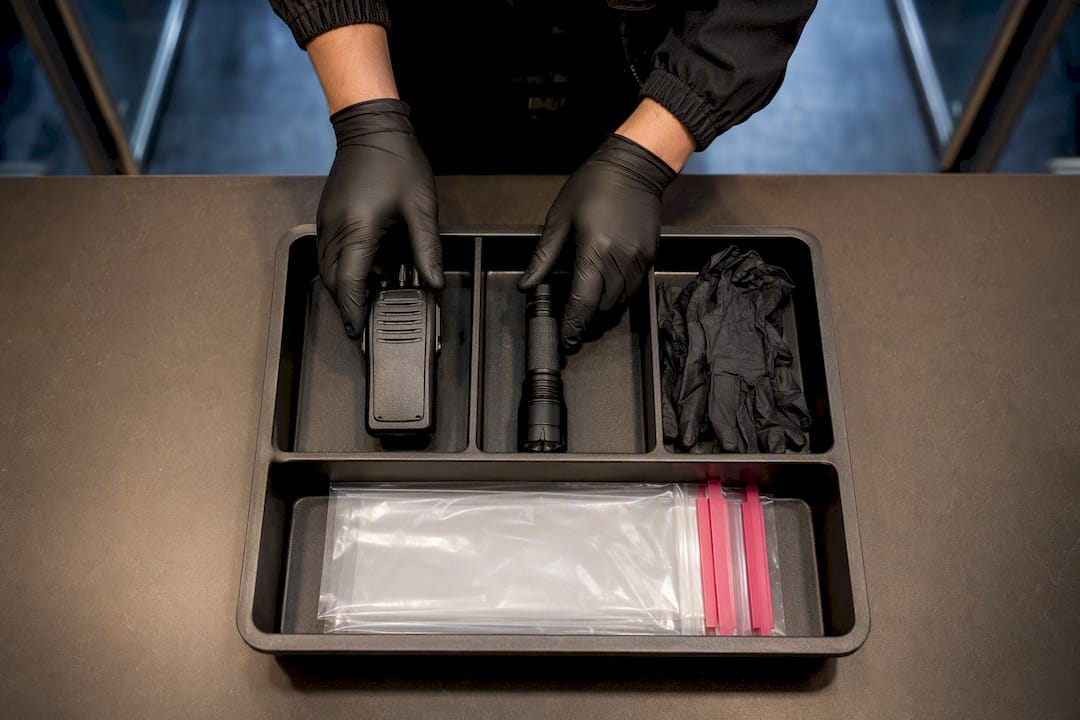
Pro Tip: Match your detector choice to your throughput target, not your budget ceiling. A venue that buys walk-through metal detectors but staffs one lane for 3,000 guests will create the exact bottleneck the equipment was supposed to prevent.
What Staffing and Training Does Consistent Enforcement Require?
Equipment doesn’t enforce a policy. People do, and inconsistent screeners create the appearance of profiling even when none is intended.
A defensible staffing model includes four roles: screeners at the line, supervisors who handle escalations, flow managers who watch queue length and adjust lanes in real time, and a law-enforcement liaison who’s briefed before doors open. Staffing ratios should scale with expected guest volume rather than a flat headcount picked in advance.
Training needs to cover more than “how to search a bag.” Screeners need to know:
- How to operate whatever detection equipment is in use.
- How to identify prohibited versus illegal versus suspicious items.
- The exact escalation phrase and chain of command.
- How to stay courteous under pressure, since a rushed or curt screener is what generates complaints, not the policy itself.
- What documentation to complete after any incident, including time, checkpoint, and item description.
Run a pre-event briefing every single time, even for repeat staff at a familiar venue. Add spot checks mid-shift to catch drift before it becomes a pattern.
Pro Tip: A written policy tells you what should happen. A Red Team test, where someone attempts to carry a prohibited item through your line, tells you what actually happens. Run one before every high-capacity event.
How Should Signage and Entry Flow Be Designed?
Screening breaks down at the design level long before any bag reaches a table. Good entry flow starts outside the building, not at it.
Pre-event communication should go out through the ticketing page, a follow-up email, and a social post the week before, each repeating the same bag-size limit and prohibited-items language so no version contradicts another. CISA notes that signage and clear entry marking rank among the lowest-cost, highest-impact security measures a venue can deploy, which makes skipping them one of the more avoidable mistakes organizers make.
Signage itself needs a placement plan: bag-size templates at the perimeter, prohibited-item boards at the screening tables, and queuing directions well before the line forms. The Arrowhead Sign Company placement checklist covers visibility distances and lead times worth building into your production schedule.
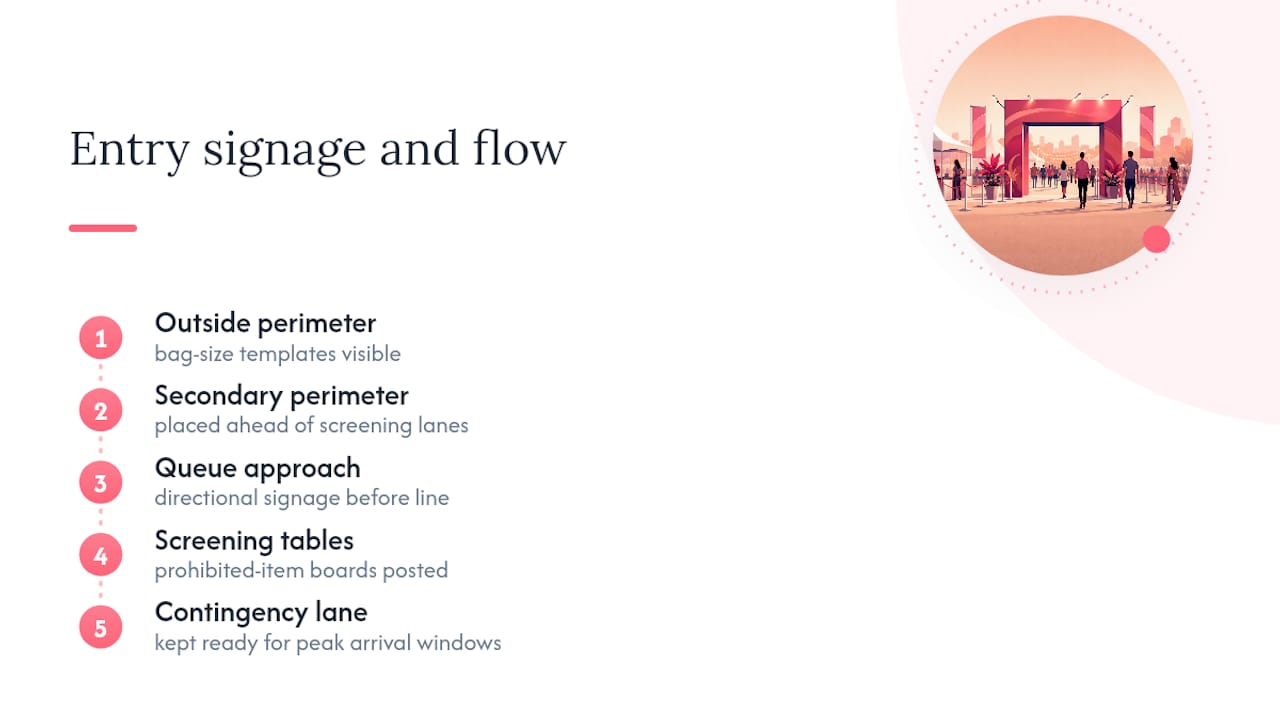
Design your entry points with a secondary perimeter ahead of the main screening lanes, and keep one contingency lane ready for peak arrival windows. Staff demeanor closes the loop: a calm, consistent tone at every lane does more to reduce complaints than any sign wording can.
How Do You Test and Improve the Policy Over Time?
A policy that’s never been tested is a guess dressed up as a procedure. Testing turns assumptions into evidence.
- Run Red Team exercises that simulate realistic concealment attempts, then debrief screeners immediately and correct gaps in training before the next event, not after the next incident.
- Track KPIs each event: average time per screening lane, number of prohibited items intercepted, complaint rate, and average secondary-screening duration.
- File an after-action report covering what worked, what didn’t, and what changes ship before the next event, reviewed on a set cadence rather than only after something goes wrong.
What Templates Can You Copy Today?
You don’t need to write this from scratch. Adapt the following and adjust for your venue’s size and risk level.
- Ticketing notice: “Bags subject to search. Maximum size [X]. Clear bags recommended.”
- On-site sign: “Bag policy in effect at all entrances. Prohibited items may be surrendered at the amnesty box near Gate [X].”
- Staff briefing bullets: role assignments by name, the escalation phrase (“Supervisor to Lane [X]”), and the documentation form location.
- Day-of checklist: signage posted, radios charged and distributed, evidence bags stocked, amnesty box and temporary storage area set up before doors.
What a Security Partner Actually Builds
A security and investigations firm with extensive law enforcement and loss-prevention experience builds bag policies the same way they build any protective plan: tailored staffing, live training, tested procedures, and a playbook the client keeps after the event ends.
A venue running one event a year rarely needs a full-time security department. A venue running dozens does. That distinction usually decides whether in-house screening or a contracted partner makes more sense.
— Derek
How Hub Investigative Group Builds and Runs Your Bag Policy
Most venues either write a bag policy once and never test it, or skip the written policy entirely and rely on whoever’s working the gate that day. Hub Investigative Group closes that gap directly: we design the policy, train the screeners who enforce it, staff the lanes, and run the tests that prove it holds up under real conditions.

That means you’re not hiring a vendor to hand you a document. You’re contracting a team that sets staffing ratios based on your actual guest volume, briefs your screeners before doors open, and coordinates directly with local law enforcement when an item crosses from prohibited into illegal. If your event has never had its bag policy stress-tested, that’s the first conversation worth having. Request a security assessment with Hub Investigative Group and find out where your current plan would actually hold up, and where it wouldn’t.
Sources
Two CISA documents anchor most of the operational guidance here: the Public Venue Security Screening Guide covers layered screening models, and the Public Venue bag search procedures guide covers search steps, staff training, and disposition. Hub Investigative Group’s access control and event security playbooks translate that guidance into practice, and the Arrowhead signage placement checklist covers the physical posting side.
FAQ
What Is an Event Bag Policy?
It’s a written, organizer-facing set of rules covering prohibited and allowed items, bag-size limits, screening procedures, and staffing that a venue or security firm enforces at entry points.
What Items Are Typically Prohibited at Events?
Weapons and weapon replicas, glass containers, outside food or drink at concession-only venues, and any item flagged by local threat assessments are standard exclusions, with medical and infant items usually exempted.
When Should a Venue Use X-Ray Screening Instead of Visual Checks?
X-ray screening fits high-capacity or elevated-threat events, following the layered model CISA describes, where perimeter visual checks handle low-risk traffic and more intensive screening covers critical entry points.
Should Venues Handle Bag Screening In-House or Hire a Security Firm?
Occasional single-event venues often manage with trained in-house staff, but venues running frequent or high-capacity events typically get more consistent enforcement from a contracted partner like Hub Investigative Group that trains, staffs, and tests the policy year-round.
How Often Should a Bag Policy Be Tested?
Run a Red Team test or drill before any high-capacity event and after any significant change to staffing, venue layout, or threat level, then file an after-action report to close the loop.