
To run a compliant event in Boston, you must file the Outdoor Public Event application or a One-Time Entertainment License, secure police captain sign-off, and submit a detailed site plan. If your event draws 1,500 or more attendees, you also need a Special Events Emergency Action Plan filed with the Office of Emergency Management, along with the usual companions: BFD, PWD, ISD, and EMS permits, depending on what you are building and serving.
TL;DR:
- Events with 1,500 or more attendees must submit a formal Emergency Action Plan to the Office of Emergency Management, including evacuation routes and medical protocols.
- Multiple permits may stack for a single event, with some requiring bonds or separate approvals, especially for street closures, tents over 400 square feet, or food and alcohol service.
- A detailed, close-to-scale site plan is crucial and must clearly show structures, ingress and egress points, crowd flow, and emergency lanes, with hydrant clearances prioritized.
- Security and operations plans should outline staff roles, deployment maps, credentialing, communication protocols, and incident response, with larger events demanding licensed security guards.
- Permit review timelines vary from 10 to over 30 business days, with delays often caused by dependencies like police signoff and property approval, making early planning essential.
Table of Contents
- What Permits Do You Need for a Boston Event?
- What Should a Boston Event Site Plan Include?
- What Belongs in Your Security and Operations Plan?
- When Do You Need a Special Events Emergency Action Plan?
- How Long Does Boston Event Permitting Take?
- What Happens at Outdoor Public Events Committee Review?
- Hub’s Practical Checklist and Staffing Calculator
- What Massachusetts Law Says About Event Security
- Do You Need Insurance for a Boston Event?
- What Crowd Control Measures Does Boston Expect?
- How Do You Coordinate With Emergency Services During an Event?
- What Happens If You Don’t Comply?
- A Local Perspective on Boston Event Security
- How Hub Investigative Group Supports Boston Event Organizers
- Sources
- FAQ
What Permits Do You Need for a Boston Event?
Boston’s permitting system runs through the Mayor’s Office of Consumer Affairs and Licensing (MOCAL), and which application you file depends on what your event actually looks like on the ground. An Outdoor Public Event application covers gatherings on city property, streets, parks, or plazas, while a One-Time Entertainment License applies when you’re hosting live music, DJs, or performances, indoors or out, even at a private venue. Many events need both.
From there, the permit list branches based on your event’s physical footprint:
- PWD Street Occupancy Permit — required for any structure, stage, or closure on a public street, and it typically requires a surety bond.
- BFD tent permit — triggered once a canopy or tent reaches 400 square feet or larger.
- BFD generator and open-burning permits — needed for portable power, fire pits, or cooking flames.
- ISD temporary food permit — required if you’re selling or serving food, even from a single vendor cart.
- EMS permits — needed when you’re arranging on-site medical coverage, which becomes mandatory at higher attendance tiers.
- Amusement device and electrical permits — cover rides, inflatables, and temporary electrical hookups for lighting or sound.
- Place of assembly permit — required for any indoor gathering over 49 people.
Common event permits, including BFD tent and generator permits and PWD street occupancy bonds, often stack on top of each other for a single event. A block party with a stage, a food truck, and string lights could realistically need four or five separate sign-offs before MOCAL will issue anything. Budget for permit fees on each one individually. They are not bundled into a single flat charge.
What Should a Boston Event Site Plan Include?
Boston’s Outdoor Public Events Committee will not move your application forward without a legible, close-to-scale site plan. That single document carries more weight than almost anything else in your submission packet.
Your site plan needs to show:
- The footprint of every tent, stage, booth, and barrier, with actual dimensions, not estimates.
- Ingress and egress points for both attendees and emergency vehicles.
- Crowd flow patterns, especially around entrances, restrooms, and any pinch points.
- A production schedule showing setup, event hours, and teardown.
- A 20-foot unobstructed emergency lane on any public street, plus a 10-foot clearance around every fire hydrant.
Mobile events, like parades, walks, or processions, need turn-by-turn route maps in addition to the static site plan. According to Boston’s guidance on hosting an outdoor public event, applications without a complete site plan simply will not be approved.
Pro Tip: Draw your hydrant clearances and emergency lane first, before you place a single booth or tent. Reviewers reject far more plans for missing clearances than for any other single error.
What Belongs in Your Security and Operations Plan?
City reviewers want to see that you’ve thought past “we’ll hire some guards.” A real security and operations plan spells out roles, headcounts, and what happens when something goes wrong, not just where the barricades sit.
Your plan should document:
- Specific positions and headcount: entry screeners, roving patrol, stage-front security, and exit monitors.
- A deployment map showing exactly where each position stands relative to your site plan.
- Credentialing procedures for staff, vendors, and anyone with backstage or restricted access.
- A radio or communications plan connecting security leads, event management, and on-site medical staff.
- An incident-reporting protocol, including who documents what and how it reaches police or EMS.
Boston’s licensing rules also touch on the people staffing your event, not just the plan on paper. Directives from the Mayor’s Licensing Division cover security staff screening and training for nightlife and live-entertainment venues, requiring licensees to document background-check methods and training records rather than simply asserting their staff is qualified.
Staffing scales with risk, not just headcount. Alcohol service, late-night hours, or high-capacity indoor spaces typically push organizers toward licensed, professional security guards rather than volunteer ushers. And once your projected attendance crosses 1,500 people, the city requires a formal Emergency Action Plan, which effectively forces a more structured staffing model regardless of what you’d originally planned.
When Do You Need a Special Events Emergency Action Plan?
Cross 1,500 expected attendees, and Boston requires a Special Events Emergency Action Plan submitted to the Office of Emergency Management. That threshold is not a suggestion. It’s the line where the city stops treating your event as a permitted gathering and starts treating it as a coordinated emergency-response scenario.
A complete EAP typically covers:
- Defined emergency roles: who calls 911, who activates evacuation, who serves as the on-site incident commander.
- Evacuation routes and designated assembly points, mapped against your existing site plan.
- Medical response protocols, including where EMS stages and how patients move to that location.
- A communications plan linking event staff, police, fire, and EMS on a shared channel or process.
- Mutual aid arrangements if your event draws resources from outside your immediate district.
Send your site map as a single email to [email protected] rather than submitting separate versions to different departments. OEM works from that map for its EAP review, and mismatched versions between your MOCAL application and your OEM submission are a common, avoidable source of delay. If your projected attendance sits near, but under, 1,500, request EMS coverage anyway. Waiting until a crowd surprises you on event day is the wrong time to discover you needed medical staff on-site.
How Long Does Boston Event Permitting Take?
Boston tiers its review timelines by event complexity, and the police captain’s sign-off is usually the slowest link in the chain.
- Tier 1 events (small, low-complexity) typically need about 10 business days for review.
- Tier 2 events (moderate footprint, street elements, or amplified sound) run closer to 20 business days.
- Tier 3 events (large-scale, multi-permit, high-attendance) can take 30 business days or more.
Add internal buffer days on top of every tier. Police sign-off is a practical bottleneck, and district captains are reviewing your application alongside their regular patrol duties, not as a dedicated task. Contact your district station directly, rather than waiting for MOCAL to route the request, and expect at least two weeks for a One-Time Entertainment License signoff specifically.
Sequence matters. Secure written approval from the property or street owner first, since Boston will not process an application without proof of that approval. Get police signoff second. Upload everything to MOCAL last, once you have both in hand. Permit dependency chains, like needing a surety bond before PWD will approve street occupancy, cause the most frustrating delays, especially during the busy spring and fall event seasons when every department is backlogged.
What Happens at Outdoor Public Events Committee Review?
The Outdoor Public Events Committee wants a complete picture in one sitting, not a series of partial updates. Come prepared with your production schedule, full site plan, security and operations plan, and a list of every permit you’ve already applied for, or already secured.
- Committee members may schedule a virtual pre-arranged meeting to walk through your materials before issuing anything.
- Expect the committee to hand back a permit checklist specific to your event after that review, listing exactly which department permits you still need.
- Reach out to neighborhood liaisons ahead of the meeting, especially for events affecting residential streets, since community pushback after approval can stall an otherwise clean permit.
Treat this meeting as a checkpoint, not a formality. Committees that see a disorganized presentation tend to schedule follow-up reviews, and follow-up cycles are exactly what push a Tier 2 event’s timeline into Tier 3 territory.
Hub’s Practical Checklist and Staffing Calculator
Most organizers don’t need another PDF explaining the theory. They need to know exactly what to file and roughly how many people to hire.
Mandatory city filings:
- Site map (submitted identically to MOCAL and, if applicable, to [email protected])
- Outdoor Public Event application or One-Time Entertainment License
- Special Events Emergency Action Plan (required at 1,500+ attendees)
- Relevant department permits: PWD, BFD, ISD, EMS
Best-practice operational items (not city-mandated, but strongly advisable): a written credentialing system, a staging area for security briefings before doors open, and a dedicated communications line separate from general event staff chatter.
For staffing, a conservative rule many Boston practitioners use: scale entry and flow-control positions to your expected crowd density, and increase roving coverage substantially once alcohol service, nighttime hours, or a stage draws a concentrated crowd. Exact ratios vary by venue and program, but under-staffing entry points is the single most common mistake first-time organizers make.
Pro Tip: Assign one staff member solely to incident documentation. In the middle of a crowded event, nobody else will remember to write down what actually happened.
If your event is large, involves VIPs, or includes complex street closures, Hub Investigative Group’s event security services can help build a staffing plan that satisfies both city reviewers and your actual operational needs.
What Massachusetts Law Says About Event Security
Boston’s municipal permitting sits on top of Massachusetts state law, and organizers sometimes overlook the state-level obligations underneath the city checklist. Massachusetts General Laws govern private security guard licensing, meaning any armed security personnel at your event must hold a valid state license, and unarmed guards working for a licensed agency typically fall under that agency’s own compliance obligations rather than a separate individual license.
State law also shapes liquor service at events. If your event serves alcohol, you need a one-day liquor license through the Boston Licensing Board, and that license often triggers additional security staffing expectations, since alcohol service is one of the factors that pushes municipal authorities toward requiring licensed, professional guards rather than volunteer staff.
Massachusetts premises liability law also matters here, separate from any permit. Event organizers and venue owners carry a legal duty of care to attendees, and inadequate security in the face of foreseeable risk (a known history of altercations at similar events, for example) can expose organizers to liability regardless of whether the city approved your permit. Compliance with Boston’s checklist does not automatically satisfy your legal duty of care under state law. Those are related but distinct standards, and organizers running large or higher-risk events should treat them as separate boxes to check, not one and the same.
Do You Need Insurance for a Boston Event?
Boston’s permit applications generally require proof of general liability insurance before the city will finalize your approval, and the specific coverage minimum often depends on your venue, whether the event uses city property, and its attendance tier. Many City of Boston venues and park permits ask for $1 million in general liability coverage naming the City of Boston as an additional insured, though your exact requirement should be confirmed with MOCAL for your specific event, since some venues and event types carry different minimums.
If your event involves alcohol service, expect your insurer or the Boston Licensing Board to require liquor liability coverage on top of your general policy, since standard general liability often excludes alcohol-related incidents entirely. Events with amusement rides, pyrotechnics, or elevated structures may need additional riders as well.
Beyond the city’s minimum, think about what actually protects your organization. A single slip-and-fall claim or a security-related incident can exceed a bare-minimum policy fast, particularly at events with several thousand attendees. Organizers running higher-risk events, concerts with mosh pits, festivals with alcohol, or anything drawing a crowd near the 1,500-attendee EAP threshold, often carry coverage well above the city’s stated floor specifically because that threshold correlates with real claims history. Talk to your insurance broker about your specific attendance and programming before assuming the city’s minimum is adequate for your actual exposure.
What Crowd Control Measures Does Boston Expect?
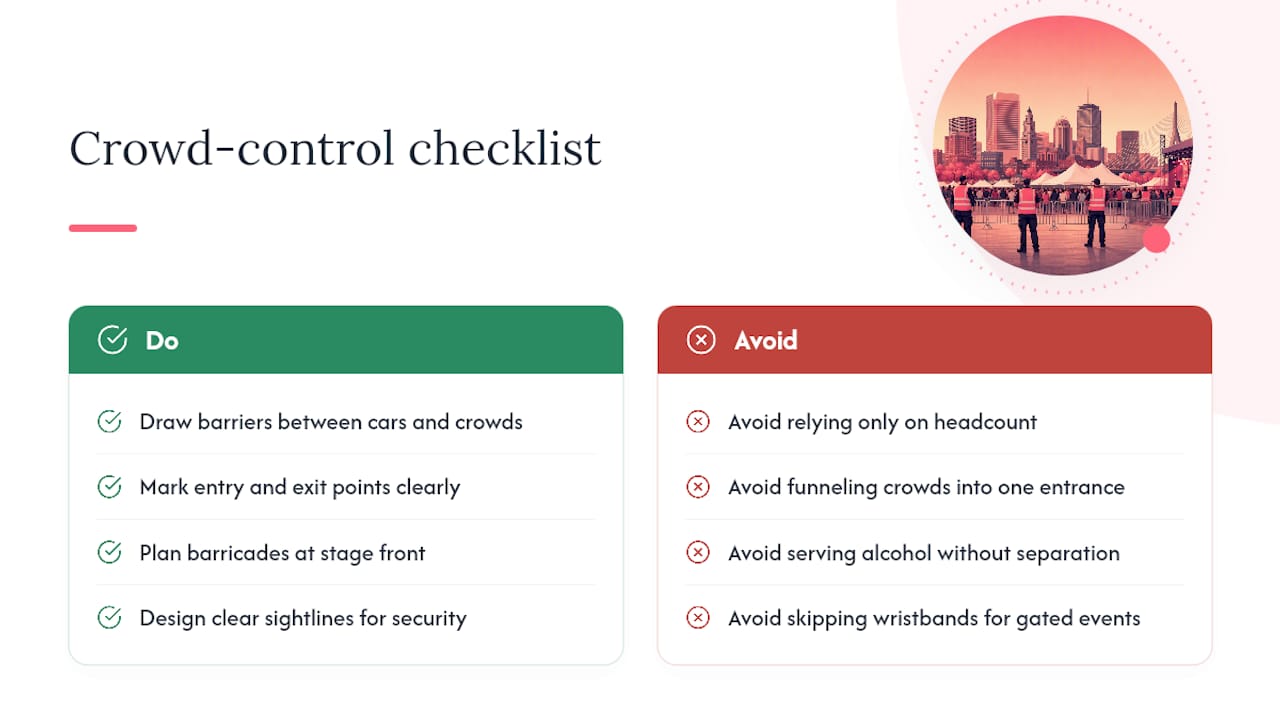
Boston doesn’t hand organizers a single rigid crowd-control rulebook, but its review process makes certain measures effectively mandatory through the site plan and security plan requirements. Barriers separating vehicle traffic from pedestrian areas, clearly marked entry and exit points, and defined queuing lanes all show up as expectations woven into the site-plan approval process rather than a standalone crowd-control permit.
For any event with a stage or a concentrated draw point, expect reviewers to look for a barricade plan that prevents crowd crush near the front, along with clear sightlines for security staff positioned at capacity-sensitive zones. Density management matters more than raw headcount. A plaza that comfortably holds 2,000 people spread out becomes dangerous fast if that same crowd funnels into a single 40-foot-wide entrance.
Boston authorities also expect organizers to plan for crowd behavior around alcohol service and after dark, both of which the city treats as escalation triggers requiring more staff and often physical separation between drinking areas and general event space. Wristband or credential systems for re-entry, while not universally required, are recommended for any multi-day or gated event, since they reduce disputes at entry points and give security staff a fast visual check without slowing the line.
The common thread across Boston’s expectations is that crowd control isn’t an afterthought bolted onto security staffing. It’s baked into how you draw your site plan, place your barriers, and position your entry and exit points from the very first draft.
How Do You Coordinate With Emergency Services During an Event?
Every Boston event above the EAP threshold needs a defined communications plan connecting event staff to police, fire, and EMS, and even smaller events benefit from establishing this before doors open rather than improvising it mid-event. That plan typically names a single point of contact empowered to communicate directly with responding agencies, rather than routing emergency communication through multiple staff layers.
A dedicated radio channel or app-based communication system, separate from whatever channel your general event staff uses for logistics, keeps emergency traffic from getting buried under routine chatter about supply runs and vendor questions. Larger events often designate one person specifically to monitor this channel and nothing else during peak hours.
Boston’s Office of Emergency Management also expects organizers of large events to establish contact before the event date, not just during an active emergency. Submitting your site map to [email protected] as part of your EAP filing opens that communication line early, and OEM’s staff will often flag concerns about your plan before you’re standing in a crowd trying to solve them in real time.
For mid-size events below the EAP threshold, a simple written protocol works: designate who calls 911, who meets responding units at the nearest access point, and who directs those units through the crowd to the incident location. That last step matters more than organizers expect. A responding ambulance that can’t find its patient inside a packed venue costs precious minutes.
What Happens If You Don’t Comply?
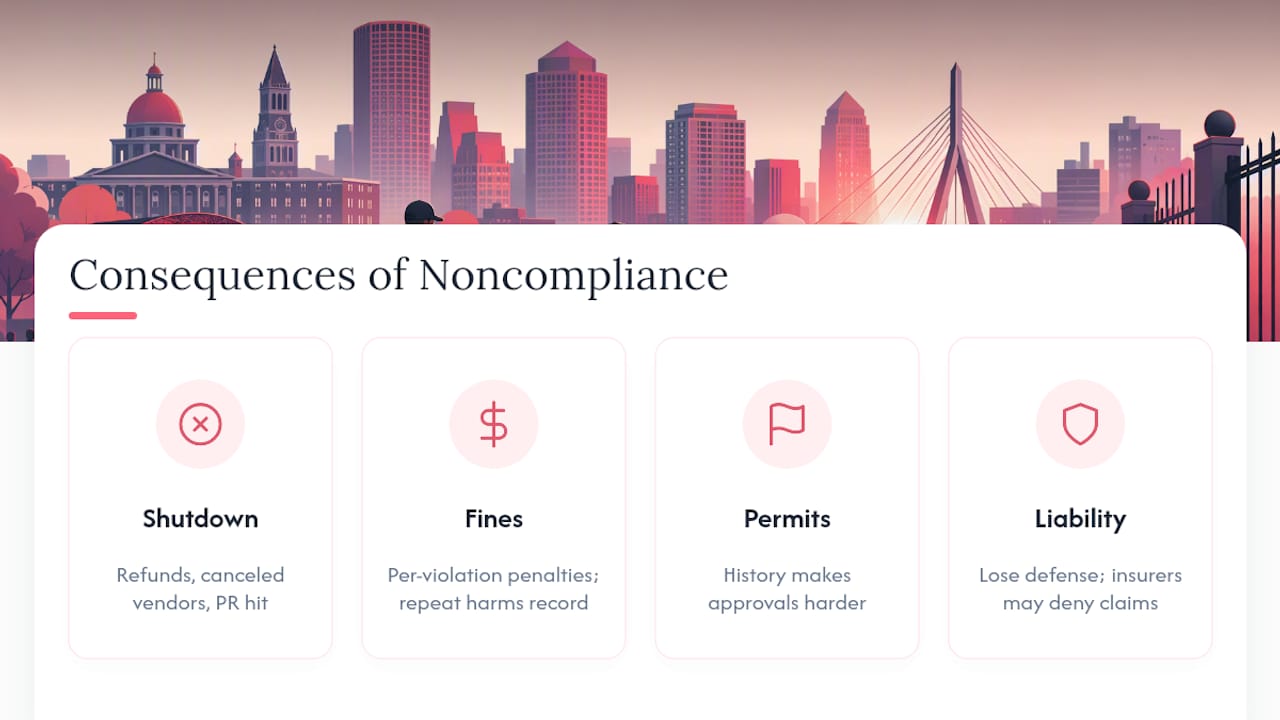
Running an unpermitted event, or ignoring the security and staffing expectations tied to your permit, carries real consequences beyond a stern warning. Boston can issue stop-work orders that shut an event down mid-operation, which means refunded tickets, canceled vendor contracts, and a public relations problem on top of the immediate financial loss.
Fines for operating without required permits or entertainment licenses accumulate per violation, and repeat or serious violations can affect your ability to secure future permits, since MOCAL and the Licensing Division track applicant history. An organizer with a pattern of non-compliant events becomes a harder sell on every subsequent application, regardless of how well that specific event is planned.
The liability exposure runs deeper than fines. If an incident occurs at an unpermitted event, or at a permitted event where your actual security staffing didn’t match what you submitted to the city, you lose the protection that comes with demonstrated regulatory compliance. Massachusetts premises liability claims become significantly harder to defend when the organizer skipped required permits or misrepresented their security plan to reviewers. Insurance carriers can also deny claims tied to events operating outside their approved permit scope, leaving organizers personally exposed for damages that a compliant, properly insured event would have covered.
Boston Police and Inspectional Services Department staff also have authority to conduct on-site checks during your event, and finding your actual crowd size, security staffing, or structures don’t match your approved application can trigger immediate enforcement action, not just a post-event citation.
A Local Perspective on Boston Event Security
Boston’s permit process rewards organizers who treat security planning as infrastructure, not an afterthought bolted onto a fun run or a street festival two weeks before the date. The recurring failure Hub Investigative Group sees isn’t malice or negligence. It’s organizers assuming their event is too small to need the rigor that Boston’s checklist actually demands. For complex events, VIP attendance, or anything approaching that 1,500-attendee threshold, reach out early. Getting the plan right before you file saves far more time than fixing it after a rejection.
— Derek
How Hub Investigative Group Supports Boston Event Organizers
Filing the paperwork is only half the job. The harder part is building a security plan that actually holds up when a few thousand people show up, and that’s where a dedicated Boston security partner earns its keep instead of a generic national chain spread thin across every city it serves.

Hub Investigative Group works directly with Boston event organizers on the pieces that MOCAL and OEM reviewers actually scrutinize: staffing plans, deployment maps, and background-checked personnel documented the way the city’s licensing rules expect. Our team builds event security services around your specific site plan, not a generic template, and we can help translate a rejected or incomplete submission into one that clears committee review on the next pass. For events crossing the 1,500-attendee EAP threshold, involving VIPs, or navigating multi-permit street closures, we also support emergency response planning so your EAP addresses medical response and mutual aid coordination the way OEM expects to see it on paper.
If you’re staffing an upcoming event and want licensed, trained security professionals rather than last-minute volunteers, visit Hub Investigative Group’s services page to request a quote and talk through your specific site plan before your next filing deadline.
Sources
- One Time Entertainment License application and instructions (fillable PDF) | Boston.gov
- Boston
- Rules and Regulations of the Mayor’s Licensing Division (security staff requirements) | City of Boston
FAQ
How Much Security Do You Need for an Event?
Staffing depends on attendance, alcohol service, and venue layout, but entry, roving, and stage-front positions are the baseline for any crowd-drawing event. Events crossing 1,500 expected attendees require a formal Emergency Action Plan, which typically pushes staffing toward a more structured, professionally licensed model.
Do You Need Security for an Event in Boston?
Most permitted events in Boston need some form of documented security or operations plan, even if formal guards aren’t required for smaller gatherings. Once alcohol service, nighttime hours, or higher attendance enter the picture, licensed security staff become the practical expectation rather than an optional add-on.
How Do You Get a Special Events Permit in Boston?
You apply through MOCAL’s Outdoor Public Event application or One-Time Entertainment License, uploading a complete site plan and securing district police captain sign-off before submission. Larger events also need a Special Events Emergency Action Plan filed with the Office of Emergency Management.
How Do You Plan Security for an Event?
Start with a site plan showing entry, exit, and crowd flow, then build a staffing map assigning specific roles and headcounts to each zone. Add a communications protocol linking your team to police, fire, and EMS, and for complex events, Hub Investigative Group’s event security team can help build that plan around your specific venue and attendance.