
Start with a baseline ratio, adjust it for risk, then add fixed posts and supervisors on top. Most events land between one guard per 25 attendees for high-risk crowds and one per 250 for low-risk, seated gatherings. That baseline is a starting point, never a final number, until you’ve checked venue layout, alcohol service, and permit requirements against it.
TL;DR:
- Staff-to-attendee ratios vary from 1:25 for high-risk events to 1:250 for low-risk, seated gatherings, depending on crowd behavior and event specifics.
- Factors like crowd density, venue layout, alcohol service, event type, duration, and local context can significantly increase staffing needs beyond base ratios.
- A systematic staffing calculation involves applying a risk-based ratio to peak attendance, plus fixed posts and supervision, then comparing with venue and permit requirements.
- Unarmed guards cost around $25 to $40 per hour nationally in 2026, with higher rates for armed guards and added expenses for equipment, travel, and supervisors.
- Formal security plans, involving venue maps, ratio calculations, and staff roles, are recommended for events over 300 attendees, with alcohol or multiple sites.
Table of Contents
- What Is the Right Event Security Staffing Ratio?
- What Factors Push Your Security Ratio Higher or Lower?
- How Do You Calculate Event Security Staffing?
- How Should You Structure Posts and Supervision?
- What Does Event Security Staffing Cost?
- How Hub Investigative Group Builds a Staffing Plan
- Get a Written Staffing Plan From Hub Investigative Group
- Sources
- FAQ
What Is the Right Event Security Staffing Ratio?
The baseline range planners use most often runs from 1:25 to 1:250, and where your event falls inside that band depends almost entirely on crowd behavior, not just headcount. A seated corporate conference and a standing-room concert with the same attendance can require wildly different staffing.
Here’s how the ranges break down by event character:
- Low-risk, seated events (conferences, award dinners, ticketed lectures): 1 guard per 150 to 250 attendees
- Medium-risk, mixed-activity events (trade shows, community festivals, weddings with 200+ guests): 1 guard per 75 to 150 attendees
- High-risk, high-energy events (concerts, nightlife, alcohol-heavy festivals, events with a history of incidents): 1 guard per 25 to 50 attendees
Industry planning guidance commonly cites a working baseline of one guard per 50 to 100 attendees for general-purpose events, tightening toward 1:25 when alcohol, standing crowds, or late hours enter the picture.
Two quick examples include choosing from Orlando performance venues for school groups that illustrate footprint and access-point considerations for mapping posts.
- A 500-person corporate holiday party, seated dinner, cash bar closes at 10 p.m.: baseline 1:150 gives you 4 guards, plus 1 fixed door post.
- A 2,000-person outdoor music festival with open bar and mosh-pit energy: baseline 1:30 gives you 67 guards, before you add gate screening and backstage posts.
What Factors Push Your Security Ratio Higher or Lower?
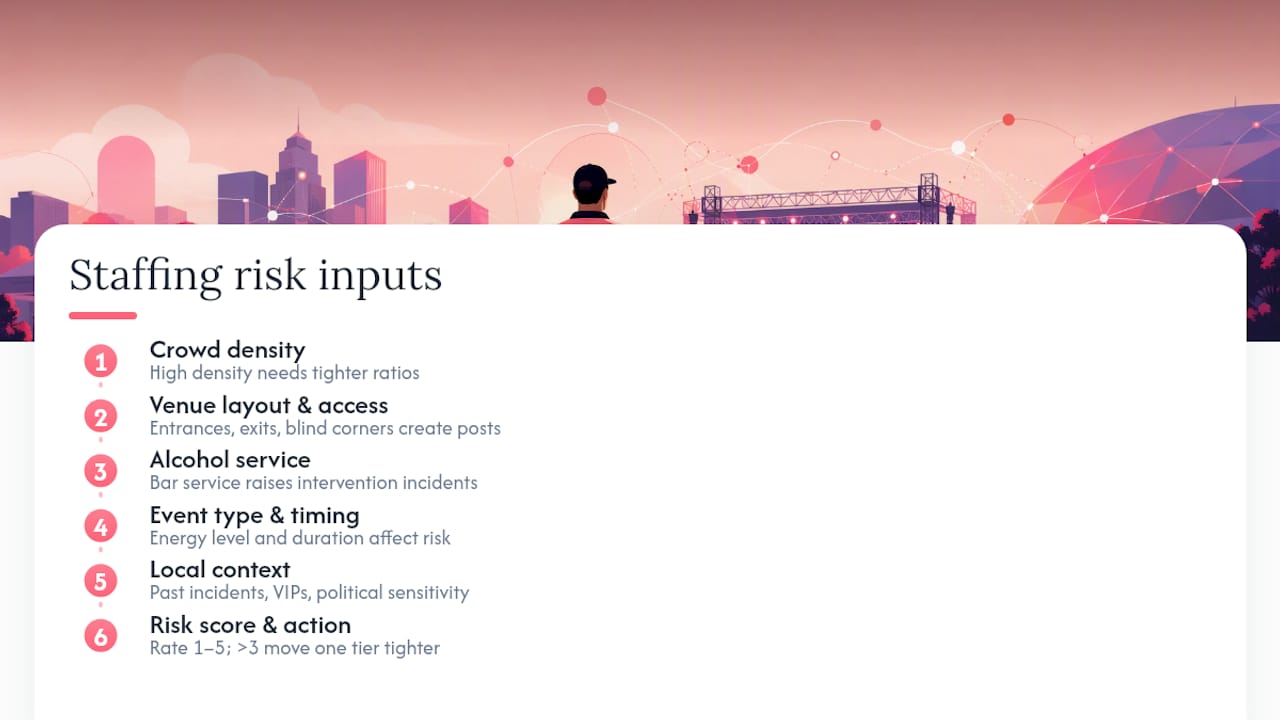
Six variables move the needle more than raw attendance ever will.
Density matters more than headcount. A thousand people spread across a convention hall behave differently than a thousand packed against a stage barrier. Standing, high-density crowds need tighter ratios even at identical attendance.
Venue layout and access points determine how many guards you need before you even touch the ratio. Every entrance, emergency exit, and blind corner is a potential post, not a percentage.
Alcohol changes everything. Bar service correlates with a measurable jump in incidents requiring intervention, and most insurers and venues will require tighter staffing and dedicated bar-area coverage once alcohol is on the floor.
Event type and energy level matter qualitatively. A silent auction and a boxing match with the same ticket count are not the same staffing problem.
Timing and duration drive fatigue. Shifts beyond 8 hours need built-in relief rotations, or your last two hours are covered by exhausted staff.
Local context compounds everything else. Prior incidents at the venue, high-profile attendees, or political sensitivity around the event should push you toward the tighter end of your range regardless of what the math says.
Pro Tip: Build a simple 1 to 5 risk score across these six factors before you finalize numbers. A score above 3 usually means you should move at least one tier tighter on your baseline ratio.
How Do You Calculate Event Security Staffing?
Follow this sequence every time, and write it down. Venues, insurers, and permit offices increasingly want to see the method, not just a final headcount.
- Pick your baseline ratio based on event type and risk tier (1:25 to 1:250).
- Apply the ratio to peak attendance, not average attendance. A festival with 3,000 total ticket holders but 1,800 on-site at peak hour staffs to 1,800.
- List fixed posts separately and add them on top of the ratio number, one guard per door lane, VIP area, cash room, and backstage access point.
- Add supervisors and relief staff using span-of-control guidance covered below.
- Reconcile against venue, insurer, and local permit minimums, which sometimes exceed your calculated number.
Worked example one: a 1,200-person conference, baseline 1:200 = 6 guards, plus 2 fixed door posts and 1 loading-dock post = 9 total.
Worked example two: an 800-person nightclub-style launch party with full bar, baseline 1:40 = 20 guards, plus 2 entry posts, 1 VIP room, 1 cash post = 24 total, before supervisors.
Event-planning templates recommend running both the ratio calculation and a separate post map, then using whichever number is higher as your working requirement.
How Should You Structure Posts and Supervision?
Fixed posts cover the positions your ratio math will never catch on its own: entry lanes, vendor gates, VIP rooms, cash-handling areas, backstage, and parking lots. Map every post directly onto a venue floor plan. An uncovered corner on that map is a staffing gap, not a rounding error.
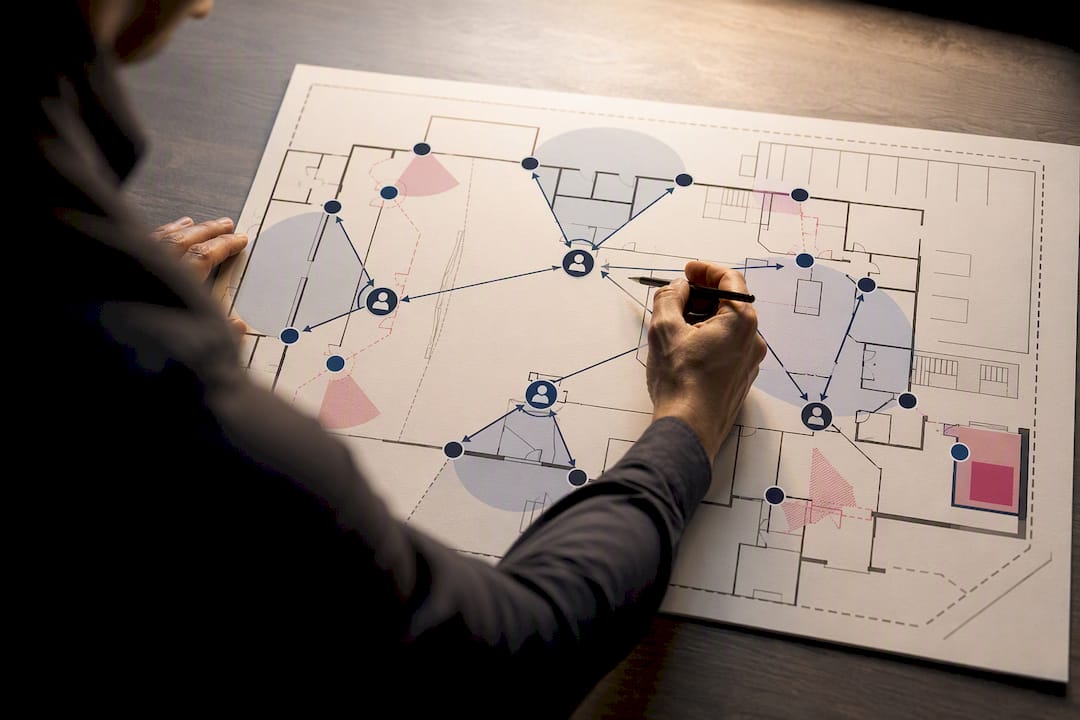
For supervision, a common approach is to assign roughly one supervisor per several officers, with a tighter ratio for high-risk or multi-site deployments where radio coordination and rapid response matter more. The Event Safety Alliance draws a clear line between licensed security personnel and trained crowd managers, and NFPA guidance ties crowd-manager minimums to occupant load, sometimes one per 250 occupants depending on code.
Pro Tip: Assign every post a radio channel and a named supervisor before doors open. A post map with no assigned supervisor is the fastest way to discover a coverage gap mid-event.
Build in shift overlap of at least 15 minutes at relief points so no post ever sits empty during a handoff.
What Does Event Security Staffing Cost?
Unarmed guard rates for 2026 planning purposes run roughly $25 to $40 per hour nationally, with higher-cost metro areas pushing past that range. Armed guards and off-duty police details cost more, often carrying a premium of several dollars per hour above unarmed rates.
Budget for these standard billing practices:
- Four-hour minimum bookings, even for shorter events
- Travel charges for guards deployed outside a provider’s normal coverage area
- Equipment add-ons (radios, metal detection, barricades)
- Supervisor premiums layered on top of base hourly rates
When you present a staffing plan to finance or a client, pair the guard count with the cost breakdown so the number isn’t just a headcount, it’s a line item with a rationale attached.
How Hub Investigative Group Builds a Staffing Plan
A formal, systematic approach to event staffing involves a risk assessment first, then a venue map, followed by the ratio calculation, and finally adding supervision and post lists. This process benefits from extensive combined law enforcement and loss prevention experience, and ensures clients receive a staffing count with clear reasoning behind it.
We’d recommend a formal, written security plan once attendance passes roughly 300 people, alcohol is served, VIPs are present, or an event spans multiple sites or entrances. Below that threshold, the math in this guide will usually get you close enough to defend to a venue or insurer.
— Derek
Get a Written Staffing Plan From Hub Investigative Group
A professional security firm can provide a written staffing plan based on a risk assessment, including a venue map, documented ratio calculation, supervisor structure, and fixed-post list covering key areas such as doors, VIP areas, and cash rooms, rather than a generic headcount without documented rationale.

That combined law enforcement and loss prevention background across our team means the plan you receive holds up under scrutiny from permit offices and insurers, not just in the room the night of the event. Whether you need general event coverage or dedicated VIP protection for a headline guest, we build the staffing lines separately so nothing gets lost between licensed security and crowd management.
If your event is approaching 300 attendees, involves alcohol, or has any complexity beyond a straightforward seated gathering, request a written staffing plan from our event security services team before you finalize your budget.
Sources
- Standards & Guidance (Event Safety Alliance)
- Event security plan template with staffing ratios (Eventstaff)
FAQ
How many security guards do you need per 100 people?
For a low-risk seated event, roughly 1 guard covers every 100 to 150 attendees; for a high-energy event with alcohol, plan closer to 2 to 4 guards per 100 attendees.
What is the ideal ratio of crowd managers to attendees?
NFPA guidance ties crowd-manager minimums to occupant load, sometimes one trained crowd manager per 250 occupants, and this role should be staffed separately from licensed security officers.
How much does event security cost per hour in 2026?
Unarmed guards typically run $25 to $40 per hour depending on metro area, with armed guards and off-duty police details priced higher and most bookings carrying a four-hour minimum.
What is the difference between ratio coverage and fixed posts?
Ratio coverage is the general guard count generated by applying a baseline ratio to your peak attendance, while fixed posts are specific positions, like door lanes, VIP rooms, and cash areas, staffed regardless of overall headcount; event templates recommend calculating both and using the higher number.
When should I hire a professional security firm instead of calculating staffing myself?
Once attendance passes roughly 300 people, alcohol is served, VIPs are present, or the event spans multiple entrances or sites, a formal risk assessment from a firm like Hub Investigative Group produces a more defensible plan than a self-calculated ratio.