
A professional executive protection advance checklist is a living operational audit that closes venue, route, medical, comms, and team gaps before the principal ever arrives. It must span nine domains and end in one written product: a mission-ready advance report with annotated floor plans, a minute-by-minute timeline, and a comms annex. Complete it fresh for every movement, and drive the routes at the actual hour the principal will travel, not a convenient one.
TL;DR:
- Driving routes at the actual mission hour is essential to accurately identify chokepoints and traffic patterns that differ from daytime or non-peak times.
- Venue surveys must cover three concentric rings and be verified multiple times, including confirming private elevator use and staff access in writing.
- Medical evacuation planning requires knowing the trauma center’s level designation, operational status, and arrival ETA based on the principal’s exact location.
- Communications equipment must be tested on-site before the mission, including radio coverage, encryption fallback, and secure data transfer procedures.
- The final advance report should include a detailed timeline, floor plans, personnel rosters, and verification of trauma center status, not just a checklist completion.
Table of Contents
- What Goes Into Mission Overview and Threat Assessment?
- How Do You Run a Venue Survey Checklist?
- What Should a Route and Motorcade Checklist Cover?
- How Do You Assess Accommodation and Lodging Security?
- What Communications Systems Need Verification?
- What Belongs in Medical and Emergency Readiness Planning?
- How Do You Structure Team Coordination and Briefings?
- Which Event-Specific Checks Change the Standard Advance?
- What Goes Into the Post-Mission Debrief and Written Advance?
- How Hub Investigative Group Applies This in the Field
- What Experienced Agents Get Wrong About Advance Work
- Ready to Put a Professional Advance Team to Work?
- Sources
What Goes Into Mission Overview and Threat Assessment?
Every advance starts with the principal, not the venue. You need medical conditions that could affect evacuation decisions, sensitive exposures (litigation, activism ties, prior threats), and schedule highlights that change your posture hour to hour.
Local threat indicators shape resourcing: crime trends near the venue, protest forecasts, and any known hostile actors tied to the principal or the event. This intelligence gets briefed, not filed. At minimum, loop in your risk analyst, the local law enforcement liaison, and any diplomatic points of contact before you finalize staffing.
- Principal profile: medical flags, exposure history, daily schedule
- Threat picture: crime data, protest activity, hostile-actor history
- Briefing chain: risk analyst, local PD, diplomatic or corporate security POCs
- Posture decision: low, medium, or high, each dictating team size and equipment load
A low-posture domestic corporate visit might run two agents and no armored vehicle. A high-posture international trip changes both numbers fast.
How Do You Run a Venue Survey Checklist?
Site surveys work in three rings, and skipping any one of them is how agents miss the detail that gets someone hurt. Outer ring covers approach geometry, parking control, and whether a neighboring rooftop or parking structure gives a hostile actor unobstructed line of sight. Middle ring covers lobby flow, screening points, elevator and stairwell control, and blind spots created by columns, kiosks, or construction.
Inner ring is where the principal actually sits or stands: seat placement, nearest cover, and both primary and secondary evacuation paths.
- Walk the outer perimeter and map every vehicle approach and departure option
- Trace lobby and hallway flow, noting screening chokepoints and elevator bank control
- Confirm the principal’s exact seat or stage position and identify the nearest hard cover
- Document primary and secondary evacuation routes from that exact position
- Photograph and annotate a floor plan; confirm CCTV access and verify staff credentials against a roster
Industry practice holds that agents should visit every itinerary site multiple times, once for the initial protective security advance survey and again to set cordons and execute security tasks on the day.
Pro Tip: Get the venue point of contact’s confirmation of private elevator use, staff holding areas, or reserved parking in writing. Verbal assurances evaporate the moment a different manager is on shift the day of the event.
What Should a Route and Motorcade Checklist Cover?
Timing is the variable most advances get wrong. A route driven at 10 a.m. on a Tuesday tells you almost nothing about how it performs during the principal’s actual 5 p.m. departure, when school pickup traffic and a shift change at the loading dock both hit at once.
- Drive and time the primary, alternate, and evacuation routes at the mission hour, not a convenient one
- Flag choke points and note how much their timing varies between the survey and the live run
- Document fuel and vehicle recovery options along each route
- Set vehicle positioning: lead, principal, and follow, with defined spacing and engine-running standard operating procedures
- Confirm any coordination needed with local traffic control or a police escort
Agents who identify chokepoints on paper but never drive them at the correct hour are the ones who end up explaining a late arrival after the fact.
How Do You Assess Accommodation and Lodging Security?
Overnight stays and transient lodging both demand a distinct set of checks separate from the venue survey. Get the hotel’s floor plan and mark every exit before you look at anything else.
- Verify stairwell and elevator access control, and confirm who besides staff can reach the principal’s floor
- Establish room-clearing procedures and designate a specific safe room within the suite
- Set up a hotel liaison contact and get clear NDA expectations in writing for any staff with room access
- Check parking surveillance, perimeter sightlines, and in-room communications coverage before confirming the booking
A residence-specific security assessment applies the same logic when the principal is staying at a private home rather than a hotel.
What Communications Systems Need Verification?
Comms failures rarely happen because the equipment is broken. They happen because nobody tested it at the actual venue before the mission started.
- Assign callsigns and radio channels, then physically test coverage at every location on the day’s itinerary, including elevators and underground parking
- Set an encrypted fallback, whether a secure messaging app or a satellite phone, and confirm battery levels and spares
- Confirm the command post location and shared document access for real-time updates
- Verify secure upload procedures for photos and evidence collected during the survey
- Test any digital advance platform or mission template before day one, since digital tools that lose data between the advance and day-of teams create exactly the gaps advance work exists to prevent
What Belongs in Medical and Emergency Readiness Planning?
Medical planning is where the checklist stops being paperwork and starts being the difference between a bad day and a fatal one. Identify the nearest trauma centers before anything else, and confirm both their trauma level designation and their current operational status.
- Confirm the nearest Level I or Level II trauma center, its ETA at the mission hour, and a direct line to the emergency department
- Verify on-team medical capability and confirm the kit meets MARCH protocol standards
- Map the extraction path from the principal’s exact position to the vehicle, and from the vehicle to the trauma center
- Document EMS liaison contacts, family notification steps, and secure access to the principal’s medical file
Field doctrine sets a working target of sub-ten-minute transport to definitive trauma care for survivable penetrating injuries. Route planning and medical staging should work backward from that number, not treat it as an afterthought.
How Do You Structure Team Coordination and Briefings?
A checklist means nothing if the team executing it never read the same document. Locking in roles before the mission starts is what turns a written advance into an executable plan.
- Confirm the detail leader, agent in charge, medical lead, comms lead, and driver assignments in writing
- Set a briefing cadence and require every deployed team member to read and sign the written advance
- Document a contact tree with clear substitution procedures for last-minute personnel changes
- Establish need-to-know boundaries for sensitive information before the team disperses to their posts
An event security coordination framework gives you a starting structure to adapt for mixed teams working a single detail.
Which Event-Specific Checks Change the Standard Advance?
Not every mission fits the standard template. Press events demand extra credentialing checks, crowd-control planning, and sightline management around cameras and press risers. Multi-site days need staged staffing and secure holding areas between stops, with staggered arrivals to avoid predictable patterns.
- Media events: verify credentialing lists, crowd barriers, and press sightlines
- Multi-site days: confirm secure holding, staging order, and staggered staffing
- Air transfer: distinguish secure transfer lanes for commercial flights from general aviation handling
- High-risk travel: assess kidnap-and-ransom exposure and know the threshold for escalating to specialized measures
What Goes Into the Post-Mission Debrief and Written Advance?
The written advance is the actual deliverable, not the checklist itself. A complete product needs an executive summary, annotated floor plans, a minute-accurate timeline, a personnel roster, a comms annex, and a medical annex covering trauma-center verification.
- Verify every checklist item is complete before uploading to secure archive storage
- Collect deviations from the plan, corrective actions taken, and principal feedback
- Apply access controls and a retention schedule to sensitive mission documents
How Hub Investigative Group Applies This in the Field
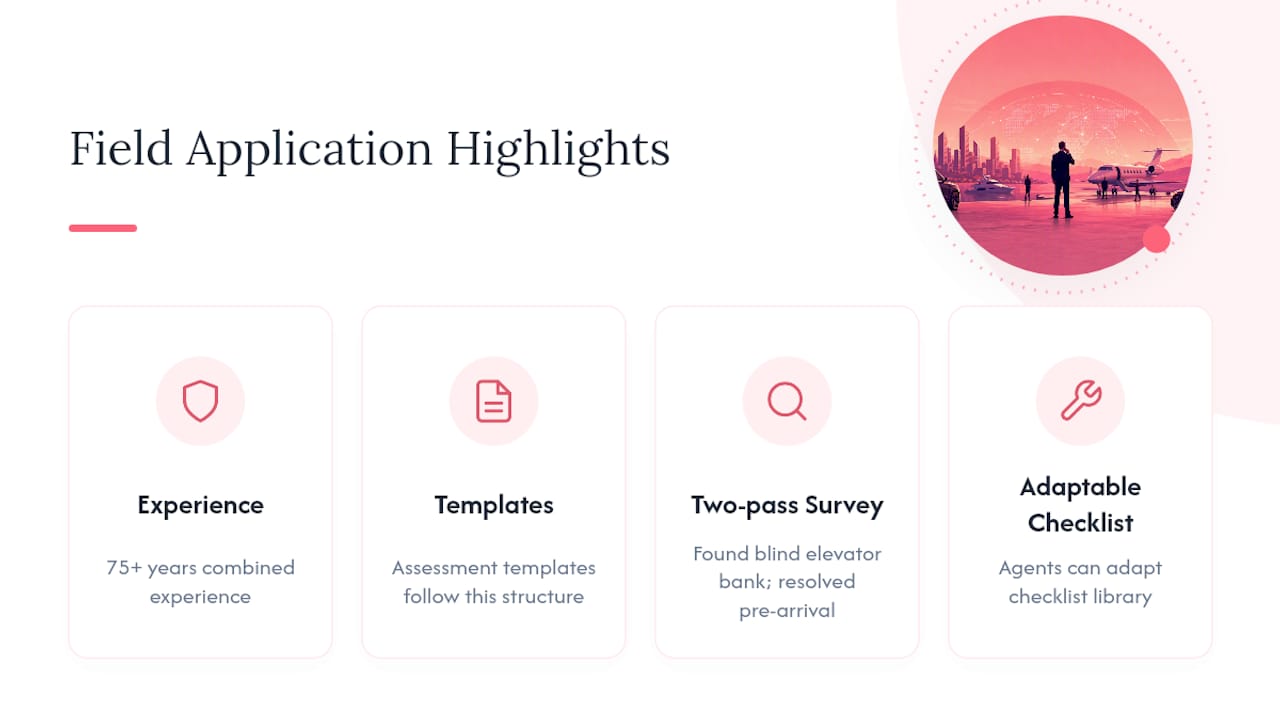
Hub Investigative Group has built security assessment templates around this exact structure, drawing on more than seventy-five years of combined law enforcement and loss prevention experience across our team. On a recent corporate travel detail, applying a two-pass venue survey, as detailed in CSO Online’s doctrine above, surfaced a blind elevator bank the client’s own facilities team had never flagged, which was resolved before the principal’s arrival. Agents can adapt our checklist library directly for their own advance packages.
What Experienced Agents Get Wrong About Advance Work
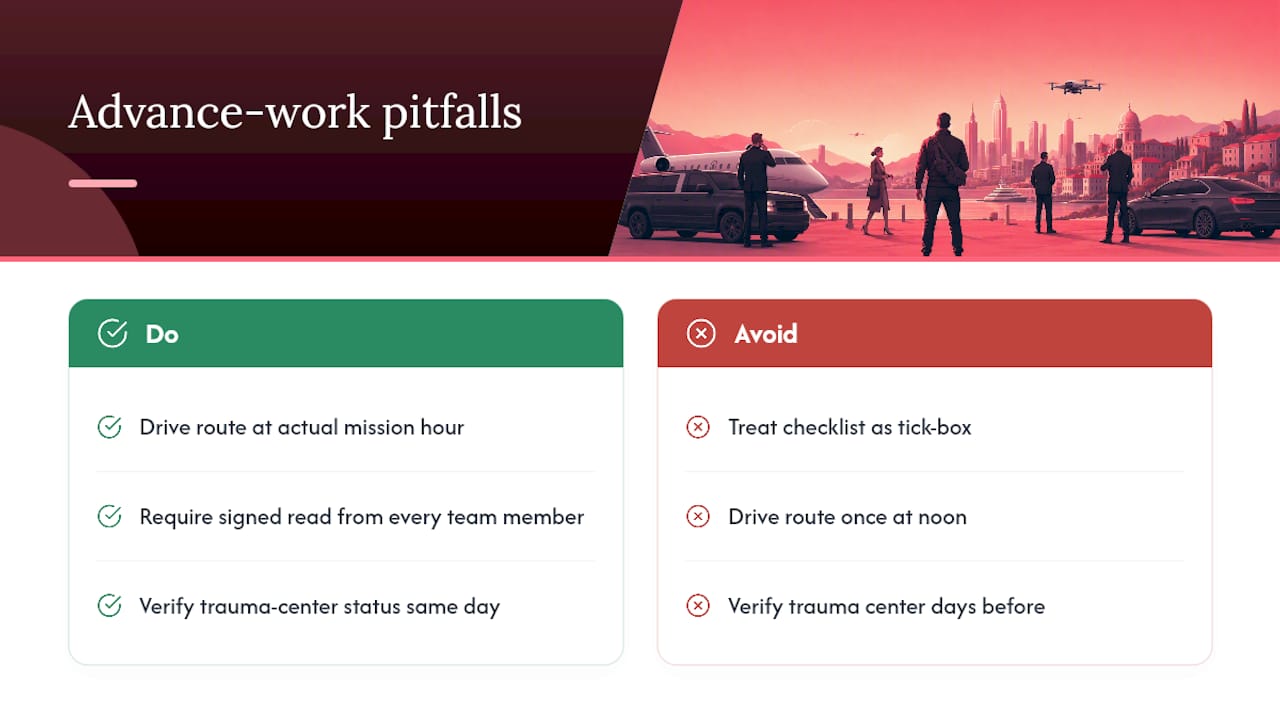
The most common failure isn’t a missing line item. It’s treating the checklist as a box-checking exercise instead of a live audit, then driving the route once at noon and calling the timing “close enough” for a 6 p.m. departure. Three fixes change outcomes fast: drive every route at the actual mission hour, require a signed read of the written advance from every team member, and verify trauma center status the same day, not the week before.
Pro Tip: If you only fix one habit this year, fix route timing. It’s the single most common gap between advances that work and ones that fail quietly.
— Derek
Ready to Put a Professional Advance Team to Work?
Hub Investigative Group builds advance packages the way this checklist describes them, not as a theoretical framework but as a written product your team can execute from directly. Where a generic security vendor hands over a template and calls it done, our advance teams conduct the two-pass venue survey, drive the routes at mission time, and verify trauma center status before delivering the report.

Every engagement produces the deliverables covered above: an annotated floor plan, a minute-accurate timeline, a comms annex, and trained personnel who have read and signed the advance before deployment. If you’re planning a protective detail and need an advance team that treats the checklist as a live operational tool rather than paperwork, request a consult through our executive protection services in Boston page to scope your next mission.
Sources
- Advance Work Checklist: Ensuring comprehensive EP planning (AdvanceWork)
- Excerpt: Conducting a protective security advance (CSO Online) — David L. Johnson
- SCS Advanced field manual — executive & travel protection (GACS)